
Understanding the Pythagorean Theorem: Why a² + b² = c²
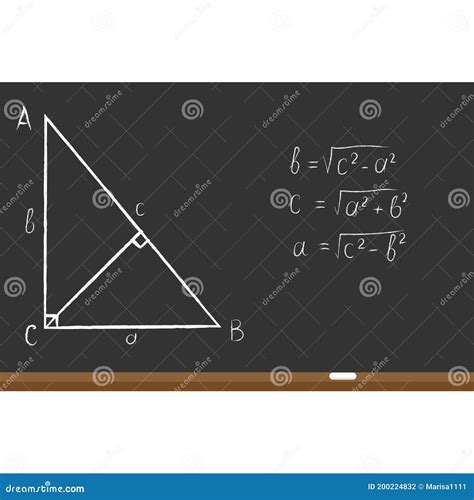
Introduction to the Pythagorean Theorem
The Pythagorean theorem is one of the most fundamental principles in geometry, establishing a clear relationship between the sides of a right-angled triangle. Expressed algebraically as a² + b² = c², where
- a and b represent the lengths of the two legs of the triangle, which form the right angle, and
- c denotes the length of the hypotenuse, the side opposite the right angle and the triangle's longest side.
This theorem not only serves as a cornerstone in the study of geometry but also has profound applications across various fields such as engineering, physics, architecture, and even art. Understanding why this relationship holds true involves exploring both geometric and algebraic proofs, which collectively demonstrate the theorem's universality and robustness.
Geometric Proofs of the Pythagorean Theorem
Visualizing the Relationship
One of the most intuitive ways to comprehend the Pythagorean theorem is through geometric visualization. Consider a right-angled triangle with legs of lengths
- a
- b
- c (the hypotenuse)
If we construct squares on each of these three sides, the areas of these squares will relate directly to the lengths of the sides. Specifically, the area of the square on the hypotenuse (c²) is exactly equal to the sum of the areas of the squares on the other two sides (a² + b²).
Dissecting the Square
Imagine creating four identical copies of the right-angled triangle and arranging them meticulously within a larger square whose side is equal to the sum of the legs (a + b). The arrangement will leave a smaller square at the center, whose side length is the difference between the legs (b - a). Calculating the total area of the large square in two different ways leads us to the Pythagorean relationship:
- Calculating Directly: The area of the large square is (a + b)².
- Calculating by Components: The combined area of the four triangles is 4*(½*a*b) = 2ab, and the area of the smaller central square is (b - a)².
Setting these two expressions equal to each other:
(a + b)² = 2ab + (b - a)²
Expanding and simplifying this equation reveals:
a² + 2ab + b² = 2ab + b² + a² - 2ab
Which ultimately simplifies to:
a² + b² = c²
Area-Based Proof
Another geometric proof involves directly comparing the areas of squares constructed on the sides of the right triangle. By constructing squares on sides
- a
- b
- c
, one can rearrange the smaller squares (a² and b²) through various geometric transformations to exactly cover the larger square (c²). This visual evidence compellingly demonstrates that the sum of the areas of the squares on the legs equals the area of the square on the hypotenuse.
Algebraic Proofs of the Pythagorean Theorem
Coordinate Geometry Approach
Using coordinate geometry provides an algebraic pathway to proving the Pythagorean theorem. Consider placing the right-angled triangle in a coordinate plane with the right angle at the origin (0,0). Let the legs of the triangle lie along the x-axis and y-axis with lengths
- a
- b
, and the hypotenuse spanning from (0,0) to (a,b). The distance between these two points, calculated using the distance formula, is:
c = √[(a - 0)² + (b - 0)²] = √(a² + b²)
Squaring both sides yields:
c² = a² + b²
This succinctly demonstrates the Pythagorean relationship through the lens of algebra and coordinate geometry.
Using Similar Triangles
Another algebraic approach involves the concept of similar triangles. By drawing an altitude from the right angle to the hypotenuse, the original triangle is divided into two smaller, similar right-angled triangles. Leveraging the properties of similar triangles allows us to establish proportions that culminate in the Pythagorean theorem.
Let’s denote the segments of the hypotenuse as
- c₁
- c₂
The similarity of the resulting triangles leads to the equations:
a² = c₁ * c
b² = c₂ * c
Adding these equations gives:
a² + b² = c₁c + c₂c
Since c₁ + c₂ = c (the entire hypotenuse), it follows that:
a² + b² = c(c₁ + c₂) = c²
This algebraic demonstration through similar triangles reinforces the validity of the Pythagorean theorem.
Proof by Algebraic Manipulation
Employing pure algebraic manipulation provides another route to the theorem. Consider the formula of the area of the right-angled triangle and explore relationships between the sides:
The area of the triangle is:
Area = (½)ab
The area of the square on the hypotenuse is:
A = c²
Through various algebraic steps and transformations, it's possible to show that the relationship a² + b² = c² must hold for the areas to correspond correctly. This approach, while abstract, solidifies the theorem's algebraic foundation.
Historical Context and Significance
Named after the ancient Greek mathematician Pythagoras, who is credited with its first known proof, the Pythagorean theorem has a rich history that predates Greek civilization. Evidence suggests that ancient Babylonian and Indian mathematicians were aware of the theorem long before Pythagoras formalized it. This universal recognition across diverse cultures underscores the theorem's fundamental importance in mathematics.
Applications in Modern Times
The Pythagorean theorem is not merely an academic concept but a practical tool used extensively in various disciplines:
-
Engineering and Construction: Ensuring structures are level and properly aligned often relies on right-angled measurements informed by the theorem.
-
Physics: Calculations involving vectors, forces, and motion frequently utilize the theorem to resolve components and determine magnitudes.
-
Computer Science: Algorithms for graphics, navigation, and spatial calculations incorporate the theorem for calculating distances and optimizing paths.
-
Everyday Problem Solving: From determining the shortest path between two points to designing layouts, the theorem offers practical solutions.
Educational Importance
In education, the Pythagorean theorem serves as a gateway to more advanced mathematical concepts such as trigonometry, calculus, and linear algebra. Mastery of this theorem is essential for developing spatial reasoning and problem-solving skills, forming a critical foundation for students pursuing STEM fields.
Pythagorean Triples and Their Significance
Pythagorean triples are sets of three positive integers (a, b, c) that satisfy the equation a² + b² = c². These triples exemplify the Pythagorean theorem in its most elegant form, where the sides of the right-angled triangle are whole numbers. Common examples include:
- (3, 4, 5)
- (5, 12, 13)
- (7, 24, 25)
- (8, 15, 17)
- (9, 40, 41)
These triples not only provide concrete examples of the theorem but also have applications in areas requiring whole number measurements, such as in tiling patterns, architectural designs, and digital graphics where pixel-based dimensions are prevalent.
Generating Pythagorean Triples
Pythagorean triples can be generated using various formulas. One such method utilizes two positive integers, m and n, where m > n:
- a = m² - n²
- b = 2mn
- c = m² + n²
By selecting different values for m and n, an infinite number of triples can be generated, demonstrating the theorem's extensive applicability and versatility.
Implications in Higher Dimensions
While the Pythagorean theorem is traditionally associated with two-dimensional space, its principles extend into higher dimensions. In three-dimensional space, the distance between two points can be determined using an extension of the theorem:
d = √(a² + b² + c²)
This formula calculates the straight-line distance (d) between two points in three-dimensional space, incorporating the same foundational idea that the sum of the squares of the dimensions equates to the square of the distance.
Vector Calculations
In vector mathematics, the Pythagorean theorem plays a critical role in determining the magnitude of vectors. Given a vector in a plane with components (a, b), its magnitude (|v|) is calculated as:
|v| = √(a² + b²)
This concept is fundamental in physics and engineering, where vectors represent quantities such as force, velocity, and acceleration.
Proofs Across Cultures and Eras
The universality of the Pythagorean theorem is evidenced by its independent discovery and proof across various cultures and historical periods. Ancient civilizations such as the Babylonians, Egyptians, Indians, and Chinese recognized and utilized the theorem long before Pythagoras himself. Each culture contributed uniquely to the understanding and application of the theorem, enriching its legacy in the annals of mathematics.
Euclidean Proofs
Euclid, the ancient Greek mathematician, provided one of the most renowned proofs of the Pythagorean theorem in his seminal work, "Elements." His proof employs a series of propositions and logical deductions to establish the theorem's validity without relying on algebraic expressions, showcasing the theorem's intrinsic geometric truth.
Bhaskara's Proof
Bhaskara, an Indian mathematician, offered an innovative proof involving a clever use of geometric rearrangements. His method visualizes how altering the positions of triangles within a square can demonstrate the equality of the areas, providing an accessible and intuitive understanding of the theorem.
Chinese Proofs
Chinese mathematicians also developed unique proofs of the Pythagorean theorem, often involving intricate geometric constructions and algebraic reasoning. These proofs not only affirm the theorem's validity but also highlight the diverse mathematical traditions that recognize and utilize this fundamental principle.
Practical Examples and Applications
To solidify the understanding of the Pythagorean theorem, it's beneficial to consider practical examples where this relationship is applied:
Determining Distance
Suppose you need to determine the straight-line distance between two points in a coordinate plane. If the horizontal distance is 3 units and the vertical distance is 4 units, the distance between the points is:
c = √(3² + 4²) = √(9 + 16) = √25 = 5 units
This calculation confirms that a distance of 5 units accurately represents the straight-line separation, exemplifying the theorem's practical utility.
Construction and Engineering
In construction, ensuring that structures are perfectly perpendicular is crucial for stability and aesthetics. By measuring 3 units along one side, 4 units along the adjacent side, and adjusting until the diagonal measures 5 units, builders can create precise right angles, applying the Pythagorean theorem to achieve accuracy.
Navigation and Mapping
Navigation systems often use the Pythagorean theorem to calculate the shortest path between two points, especially when dealing with grid-based maps. By determining the horizontal and vertical distances, the system can compute the direct distance, optimizing travel routes and enhancing efficiency.
Extending Beyond the Plane
The principles underpinning the Pythagorean theorem extend into various branches of mathematics and science, illustrating its foundational significance. Concepts such as the distance formula, norm of vectors, and even aspects of non-Euclidean geometry build upon the theorem's core ideas, demonstrating its enduring relevance.
Distance Formula in Higher Dimensions
In three-dimensional space, the distance between two points (x₁, y₁, z₁) and (x₂, y₂, z₂) is given by:
d = √[(x₂ - x₁)² + (y₂ - y₁)² + (z₂ - z₁)²]
This formula is a natural extension of the Pythagorean theorem into three dimensions, showcasing its adaptability and foundational role in spatial calculations.
Euclidean and Non-Euclidean Geometry
While the Pythagorean theorem holds true in Euclidean geometry, it serves as a contrasting foundation when exploring non-Euclidean geometries, such as spherical and hyperbolic geometry. Understanding its applications and limitations in different geometric contexts enhances the comprehensive study of mathematical spaces.
Conclusion
The equation a² + b² = c², known as the Pythagorean theorem, is a timeless and universal truth that elegantly bridges geometry and algebra. Its numerous proofs, both geometric and algebraic, attest to its validity and foundational significance in mathematics. Beyond theoretical importance, the theorem's practical applications permeate various disciplines, underscoring its enduring relevance. From ancient civilizations to modern technological advancements, the Pythagorean theorem remains an indispensable tool in the mathematician's arsenal, exemplifying the profound interconnectedness of mathematical principles and their real-world applications.
Last updated December 31, 2024