
Understanding the Pythagorean Theorem
A Comprehensive Exploration of the Classic Right Triangle Relationship
Highlights
- Fundamental Concept: The theorem explains the intrinsic relationship among the three sides of a right-angled triangle, expressed as a² + b² = c².
- Historical Significance: Though linked to Pythagoras, the theorem has roots that extend to ancient civilizations, evidencing its millennia-old development in diverse cultures.
- Practical Applications: Beyond pure mathematics, its uses span from architecture to navigation, making it a versatile tool for solving real-world problems.
Introduction to the Pythagorean Theorem
The Pythagorean Theorem is one of the cornerstones of Euclidean geometry. It establishes a special relationship among the sides of a right triangle. In any triangle with one right angle, the square of the length of the hypotenuse (the side opposite the right angle) is exactly equal to the sum of the squares of the other two sides. This concise relationship is succinctly expressed in the formula:
a² + b² = c²
Here, 'a' and 'b' represent the lengths of the legs (the two sides that form the right angle), and 'c' symbolizes the hypotenuse, which is always the longest side in a right triangle. This relationship not only simplifies many geometric calculations, but also provides a foundation for advanced mathematical concepts.
Historical Background and Evolution
Ancient Roots and Global Contributions
Despite its association with the Greek mathematician Pythagoras, historical evidence suggests that the principles behind the theorem were understood by civilizations long before his time. Artifacts such as Babylonian tablets dating back to between 1900 and 1600 BCE reveal that practitioners in ancient Mesopotamia utilized a form of the theorem. Similarly, early mathematicians in ancient China and India made significant contributions using the same fundamental ideas in their own mathematical practices.
Mesopotamian Influence
The Babylonians used complex clay tablets to document mathematical relationships, with some records demonstrating knowledge akin to what we attribute to the Pythagorean Theorem. Their practical applications were seen in land measurement, construction, and astronomical calculations. These historical data points underscore a global and interconnected growth of mathematical knowledge.
Greek Formalization
Pythagoras, who lived around the 6th century BCE, is traditionally credited with the formal proof of the theorem. The extent to which Pythagoras was solely responsible for the discovery is a subject of historical debate; however, his approach in categorizing mathematical wisdom certainly cemented the theorem’s place in Western education. Pythagoras' school of thought emphasized not only discovery but also the aesthetic symmetry in numerical relationships, which resonated through subsequent generations of mathematicians.
Mathematical Formulation and Proofs
The Core Equation
The theorem is concisely expressed through the well-known equation:
a² + b² = c²
This equation implies that if you square the lengths of the two legs (a and b) and then sum them, you get the square of the hypotenuse (c). This algebraic relationship is critical in establishing the proportionality and balance within any right-angled triangle.
Proofs and Derivations
There are numerous proofs of the theorem, ranging from geometric constructions to algebraic demonstrations. One of the classical geometric proofs involves creating squares on each of the triangle's sides and showing that the square on the hypotenuse has an area equivalent to the sum of the other two squares. Another elegant approach involves rearranging multiple copies of the triangle within a square to observe congruent patterns that validate the theorem.
Additionally, proofs utilizing similar triangles provide an analytical method to derive the formula. These approaches are celebrated not only for their mathematical rigor but for the creative ways in which they showcase the unity of geometry and algebra.
Illustrative Examples and Practical Applications
Example of a Classic Right Triangle
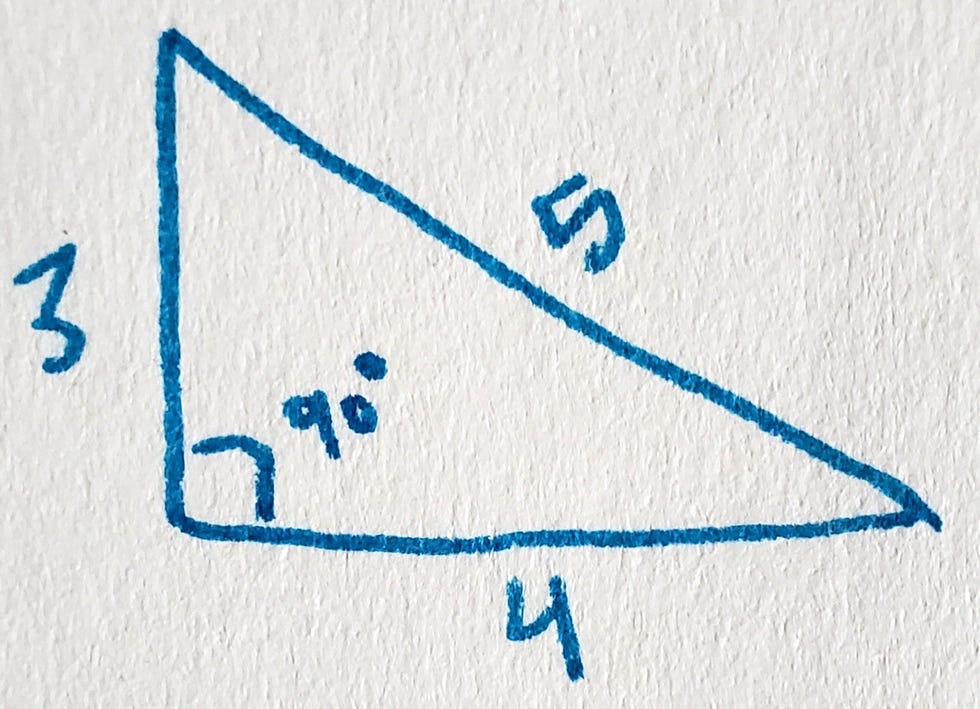
A common and oft-illustrated example is the right triangle with side lengths of 3, 4, and 5. Here’s the breakdown:
- Let a = 3 and b = 4.
- According to the theorem, the hypotenuse c should be: √(3² + 4²) = √(9 + 16) = √25 = 5.
This triple (3, 4, 5) is one of several so-called "Pythagorean triples": sets of three integers that satisfy the theorem, which can be extended further to families of solutions.
Practical Applications in Various Fields
The utility of the Pythagorean Theorem extends far beyond theoretical mathematics. Its implications can be observed in a variety of disciplines:
Geometry and Trigonometry
In mathematics education, the theorem serves as a bridge between pure geometric intuition and algebraic manipulation. Problems involving the determination of unknown side lengths, the derivation of the distance formula in the Cartesian plane, and the foundation of trigonometric functions all rely on this fundamental relationship.
Architecture and Construction
Architects use the theorem to ensure the structural integrity of constructions and to design elements that involve right angles. Surveyors, using simple yet effective measurement techniques, have historically applied the theorem to ascertain exact boundaries and design proportional spaces in buildings and public works.
Navigation and Physics
The theorem is also critical in navigation, particularly in aviation and maritime contexts, where determining the shortest path or distance between two points on a grid is imperative. In physics, it assists in resolving vector components and in analyzing forces acting perpendicular to one another.
Detailed Analysis Through a Step-by-Step Guide
Step 1: Identifying the Triangle Elements
When presented with a right-angled triangle, begin by identifying the two legs (a and b) and the hypotenuse (c). The legs form the right angle, and the hypotenuse is the side opposite this angle.
Step 2: Applying the Formula
Once you have established the correct labels for each side, apply the Pythagorean theorem:
a² + b² = c²
This equation will allow you to solve for the missing side if you have the lengths of the other two sides.
Step 3: Calculating Unknown Sides
Depending on which side is unknown, rearrange the equation accordingly:
- To find c (the hypotenuse): c = √(a² + b²)
- To find a (one of the legs): a = √(c² - b²)
- To find b (the other leg): b = √(c² - a²)
This straightforward approach makes the theorem not only easy to understand but also extremely powerful when applied in practical situations.
Step 4: Verification of Right Triangles
An important application of the theorem is in verifying whether a triangle is right-angled. By measuring the sides, one can check if the relationship a² + b² = c² holds, confirming the presence of a right angle.
Visualizing the Pythagorean Theorem
Diagrammatic Representation
The concept of the theorem is often best appreciated through visual diagrams. Consider a right-angled triangle:
| Side | Description | Mathematical Representation |
|---|---|---|
| Leg a | One of the two sides forming the right angle | a |
| Leg b | The other side forming the right angle | b |
| Hypotenuse c | The side opposite the right angle, and the longest side | c |
Below is a simple diagram that explains how the squares are arranged on each side:
<svg width="200" height="200" xmlns="http://www.w3.org/2000/svg">
  <!-- Right angle triangle illustration -->
  <line x1="20" y1="180" x2="20" y2="20" stroke="black" stroke-width="2"/>
  <line x1="20" y1="180" x2="180" y2="180" stroke="black" stroke-width="2"/>
  <line x1="20" y1="20" x2="180" y2="180" stroke="black" stroke-width="2"/>
  <text x="10" y="100" fill="black">a</text>
  <text x="100" y="190" fill="black">b</text>
  <text x="100" y="100" fill="black">c</text>
  <!-- Right angle marker -->
  <line x1="20" y1="20" x2="40" y2="20" stroke="black" stroke-width="2"/>
  <line x1="20" y1="20" x2="20" y2="40" stroke="black" stroke-width="2"/>
</svg>
This SVG code creates a basic illustration of a right triangle and marks the sides. Visual aids like this help solidify the conceptual understanding of how the areas of the squares built on each side relate to one another.
Advanced Topics and Extensions
Generalizations of the Theorem
Beyond simple right triangles, the ideas underpinning the Pythagorean Theorem have led to generalizations in higher dimensions. For instance, the distance formula in Cartesian space, given by:
Distance Formula in Two Dimensions: d = √[(x₂ - x₁)² + (y₂ - y₁)²]
is derived directly from applying the theorem in a coordinate system. This same principle extends to three dimensions, where the distance between two points in 3D space is derived by considering the sum of squares along each axis.
Relating to Euclidean Norms
In linear algebra and vector analysis, the concept translates into the Euclidean norm of a vector, often represented as:
||v|| = √(v₁² + v₂² + … + vₙ²)
This abstraction maintains the core principle of the Pythagorean Theorem while extending it to n-dimensional space, showcasing its fundamental importance in the broader realm of mathematics.
Applications in Modern Technology
In today's digital era, the theorem’s principles are embedded in numerous technological applications. Whether it is algorithms for computer graphics rendering, robotics and machine learning models that involve spatial calculations, or geospatial mapping software that helps in determining distances on Earth's surface, the Pythagorean Theorem plays a pivotal role.
These applications are further bolstered by the theorem's guaranteed accuracy and reliability, which have helped it remain an essential tool in both theoretical and applied mathematics.
Interdisciplinary Implications
Influence in Science and Engineering
The Pythagorean Theorem is not confined to abstract mathematics; its applications permeate several scientific disciplines. For example, in physics, when analyzing forces acting at right angles, the theorem provides an indispensable method for calculating the resultant magnitude. It facilitates the decomposition of vectors into their horizontal and vertical components, critical in fields ranging from mechanical engineering to electromagnetism.
Engineering and Structural Analysis
Engineers frequently use the theorem when designing load-bearing structures, ensuring that calculations involving diagonals, components of forces, and other critical parameters maintain proper proportionality and balance. In construction, it aids in confirming the squareness of corners and in creating precise, measured layouts.
Navigation and Astronomy
Navigation systems, particularly those used in aviation and maritime fields, employ the theorem to compute shortest path distances and to calibrate navigational instruments. Similarly, astronomical calculations that involve distances between celestial bodies can use these geometric principles to model spatial relationships in the universe.
Teaching and Learning the Theorem
Educational Strategies and Methods
Given its historical importance and broad application, the Pythagorean Theorem is a staple in educational curricula around the world. Effective teaching methods involve dynamic visualizations, interactive simulations, and step-by-step problem-solving activities. For students, understanding the theorem encourages logical reasoning, provides exposure to geometric proofs, and enriches their mathematical intuition.
Interactive Learning Tools
Digital tools and interactive software offer simulations where students can manipulate the sides of a right triangle and observe real-time changes in computed values. These educational platforms underline the theorem’s accuracy while making learning engaging and memorable.
Real-World Projects and Applications
Projects that integrate architecture, engineering, and even art allow students to explore how the theorem affects design, symmetry, and spatial understanding. Practical assignments like building models or using computer-aided design (CAD) software provide tangible examples of the theorem’s relevance and practicality.
Common Misunderstandings and Clarifications
Clarifying the Scope of the Theorem
One frequent misunderstanding is assuming that the theorem can be applied to every type of triangle. It is imperative to recognize that the theorem only holds true for right-angled triangles. In non-right triangles, relationships between the sides are governed by other principles such as the Law of Cosines.
Distinguishing Between Right and Non-Right Triangles
Non-right triangles do not satisfy the condition a² + b² = c², and trying to apply the theorem indiscriminately may lead to incorrect conclusions. Hence, verification of the triangle's nature is essential before proceeding with calculations.
Misinterpretation of the Formula
Another common error is mislabeling the sides. It is crucial to ensure that the hypotenuse is correctly identified as the side opposite the right angle, because using any other side as the hypotenuse will distort the calculations.
Innovative Problems and Extended Exercises
Real-World Problem Solving
Enthusiasts and students alike can challenge themselves with advanced problems that extend beyond basic computations. Consider a scenario in which an engineer must determine the diagonal brace required to support a rectangular frame. By using the Pythagorean Theorem, the engineer is able to quickly ascertain the length needed, ensuring both structural integrity and cost efficiency.
Challenging Pythagorean Triples
While the 3-4-5 triangle is one of the simplest and most intuitive examples, there exist many more Pythagorean triples (such as 5-12-13, 7-24-25, and beyond). Exercises involving these triples not only reinforce the theorem but also provide a window into number theory and its rich tapestry of patterns.
Advanced learners are encouraged to explore the method of generating Pythagorean triples using Euclid's formula, where any two positive integers m and n (with m > n) yield:
a = m² - n², b = 2mn, c = m² + n²
This formula demonstrates the theorem's connection to deeper areas of mathematics, linking geometry and algebra in intriguing and powerful ways.
Conclusion and Final Thoughts
In summary, the Pythagorean Theorem remains one of the most enduring and versatile principles in mathematics. Its simple yet profound relationship between the sides of a right-angled triangle has not only facilitated countless real-world applications—from engineering and architecture to navigation and modern technological innovations—but has also inspired generations of mathematicians to explore further.
Through historical evolution, varied proofs, and interactive learning methods, the theorem has transformed from an ancient practical tool to a cornerstone of modern analytical thought. Whether solving elementary geometry problems or delving into multifaceted applications in higher-dimensional spaces, the Pythagorean Theorem provides an enduring bridge between classical wisdom and contemporary innovation. Its influence continues to be felt across multiple disciplines, ensuring that its relevance endures in both educational settings and scientific advancements.
References
- Pythagorean Theorem - Explanation & Examples - The Story of Mathematics
- Pythagorean theorem - Wikipedia
- Pythagoras Theorem - Formula, Proof, Examples, Applications - BYJU'S
- What is the Pythagorean Theorem? - DreamBox Learning
- Pythagorean theorem | Definition & History - Britannica
Recommended
Last updated February 21, 2025