
Unlock Your Data Analyst Potential: Mastering Python for Technical Interviews
Your guide to beginner, intermediate, and advanced Python questions specifically for data analyst roles.
Preparing for a technical interview as a data analyst requires a strong command of Python, a cornerstone language in the field. Interviews often assess your ability to apply Python for data manipulation, cleaning, analysis, and sometimes visualization. Questions range from fundamental concepts for entry-level positions to complex problem-solving scenarios for experienced roles. This guide breaks down typical Python questions by difficulty level to help you structure your preparation effectively.
Key Preparation Highlights
- Focus on Core Libraries: Proficiency in Pandas for data manipulation and NumPy for numerical operations is crucial across all levels.
- Understand Data Structures: Be clear on the differences and use cases for Python's built-in data structures (lists, tuples, dictionaries) and Pandas/NumPy structures (Series, DataFrame, arrays).
- Practice Problem-Solving: Interviewers value your thought process. Practice coding exercises involving data cleaning, transformation, aggregation, and basic analysis tasks.
Python Skill Progression for Data Analysts
Visualizing Skill Importance by Interview Level
As you prepare for interviews at different experience levels (Beginner, Intermediate, Advanced), the emphasis on specific Python skills shifts. While core Python knowledge is always fundamental, the expectation regarding library proficiency, algorithmic thinking, and optimization increases significantly for more senior roles. The following chart illustrates the relative importance of key skill areas across these levels.
This chart highlights that while foundational skills remain important, advanced roles demand deeper expertise in specialized areas like performance optimization, complex library usage (advanced Pandas/NumPy), visualization for storytelling, and applying algorithms to data problems.
Beginner Level Python Questions
Establishing the Fundamentals
These questions target foundational Python knowledge, essential for entry-level data analyst roles or internships. They assess understanding of basic syntax, core data types, and simple programming constructs.
Core Concepts & Syntax
- What is Python? Why is it preferred for data analysis? Explain its high-level nature, readability, and the rich ecosystem of libraries (Pandas, NumPy, Matplotlib, Scikit-learn).
- Explain basic data types in Python (int, float, string, boolean). Provide examples of each.
- What's the difference between local and global variables? Discuss scope and lifetime.
- How do you write comments in Python? (# for single-line, """docstrings""" for multi-line/documentation).
- What is the purpose of the
__init__()method in Python classes? Explain its role as a constructor for object initialization.
Data Structures
- Explain the difference between a list and a tuple. When would you use each? Focus on mutability (list) vs. immutability (tuple). Lists are good for collections that might change; tuples for fixed sequences (like coordinates or RGB values).
- What are Python dictionaries? How do you access values? Explain key-value pairs and access using
my_dict['key']ormy_dict.get('key'). - How do you concatenate two lists? (Using the
+operator or theextend()method).
Control Flow & Functions
- Explain
if-elsestatements in Python. Provide a simple example. - What is a
forloop? How would you iterate through a list? Example:for item in my_list: print(item). - What is a
whileloop? Explain condition-based looping. - How do you define a simple function in Python? Use the
defkeyword.
Basic Library Usage
- How do you install a Python library (e.g., Pandas)? Using pip:
pip install pandas. - How do you import a library?
import pandasorimport pandas as pd. - How do you read a simple CSV file using Python (perhaps with the
csvmodule or basic Pandas)? Demonstratepd.read_csv('filename.csv').
Intermediate Level Python Questions
Applying Python for Data Manipulation
Intermediate questions focus on practical application, particularly using Pandas and NumPy for common data analysis tasks like cleaning, transforming, and aggregating data. These are typical for roles requiring 1-3 years of experience.
Pandas Proficiency
- Explain the difference between a Pandas Series and a DataFrame. Series = 1D labeled array (column), DataFrame = 2D labeled table (like spreadsheet).
- How do you select specific rows and columns from a Pandas DataFrame? Using
.loc[](label-based) and.iloc[](integer-position based), and boolean indexingdf[df['column'] > value]. - How do you handle missing data (NaN values) in a DataFrame? Detect with
isnull().sum(), remove withdropna(), fill withfillna()(using mean, median, mode, or a specific value). - How do you filter a DataFrame based on conditions? Example:
df[df['Sales'] > 1000]. - Explain how to group data and perform aggregations (e.g., sum, mean, count) using
groupby(). Example:df.groupby('Category')['Sales'].mean(). - How do you merge or join two DataFrames? Explain different join types (inner, outer, left, right). Use
pd.merge(df1, df2, on='key_column', how='inner'). - How do you handle duplicate rows in a DataFrame? Use
df.duplicated()to find anddf.drop_duplicates()to remove. - Explain the difference between
apply(),map(), andapplymap()in Pandas.apply()works on rows/columns,map()works element-wise on a Series,applymap()works element-wise on a DataFrame. - How do you convert a column's data type (e.g., string to datetime or numeric)? Use
pd.to_datetime()orastype().
NumPy and Efficient Coding
- What are the advantages of NumPy arrays over standard Python lists for numerical operations? Homogeneous data types, vectorized operations (faster execution), less memory usage.
- What are list comprehensions? Provide an example relevant to data transformation. Concise way to create lists. Example:
[x*2 for x in prices if x > 0]. Often mentioned for junior roles too. - What are lambda functions? Provide an example of using a lambda function with Pandas (e.g., in
apply). Anonymous functions. Example:df['column'].apply(lambda x: x * 1.1). - Write a Python function to calculate the mean and median of a list of numbers (potentially using NumPy).
Basic Data Cleaning & Analysis
- How might you identify outliers in a dataset using Python? (e.g., using standard deviations, IQR).
- Write Python code to generate basic descriptive statistics for a DataFrame column. Use
df['column'].describe().
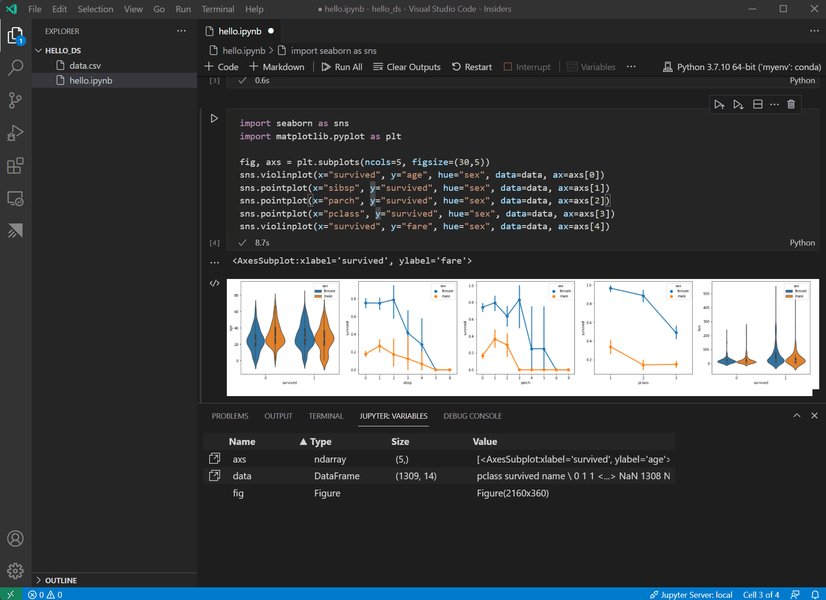
Example of running Python data analysis code in a Jupyter environment within VS Code.
Advanced Level Python Questions
Tackling Complex Problems and Optimization
Advanced questions are geared towards experienced data analysts (3+ years) and delve into optimization, algorithmic thinking, sophisticated library features, automation, and deeper statistical concepts integrated with Python.
Performance and Optimization
- How would you optimize Python code for handling very large datasets that don't fit into memory? Discuss chunking with Pandas (`read_csv(chunksize=...)`), using Dask or Spark, efficient data types (`astype`), and vectorized operations over loops.
- Explain memory management in Python (briefly). Mention garbage collection, reference counting.
- How can you identify performance bottlenecks in your Python data processing script? Profiling tools (`cProfile`), timing specific code sections (`timeit` or `%timeit` in Jupyter).
- Explain the difference between shallow copy and deep copy. When might this be relevant in data analysis (e.g., modifying DataFrames)? Shallow copy shares references to nested objects, deep copy creates fully independent copies. Crucial when modifying copies of DataFrames/lists to avoid unintended side effects.
Advanced Libraries and Techniques
- How do you perform data visualization using Matplotlib or Seaborn? Create a simple plot (e.g., histogram, scatter plot). `import matplotlib.pyplot as plt; plt.hist(df['column']); plt.show()`.
- Explain decorators in Python. How might they be useful in a data analysis workflow? Wrapping functions to add functionality like logging execution time, caching results, or validating inputs without modifying the original function code.
- How do you handle date and time data effectively in Pandas for time-series analysis? Converting to datetime objects (`pd.to_datetime`), setting index (`set_index`), resampling (`resample`), calculating rolling windows (`rolling`).
- How can Python be used for basic statistical analysis or hypothesis testing? Using libraries like SciPy (`scipy.stats`) for t-tests, ANOVA, chi-squared tests.
- Discuss how you could automate a data cleaning pipeline using Python. Writing reusable functions, potentially creating a class structure, using scripting for sequential steps.
Algorithms and Problem Solving
- Write a Python function to detect multicollinearity in a dataset (e.g., using VIF from `statsmodels`).
- Implement a simple algorithm relevant to data analysis (e.g., calculate TF-IDF for text data, implement K-Means clustering from scratch, or find N most correlated features).
- Find all bigrams (pairs of adjacent words) in a given sentence. (Requires string splitting and iteration).
- Write a function to find the number of ways to make change for a given amount using specific coin denominations (a dynamic programming concept often used to test algorithmic thinking).
Best Practices
- Discuss the importance of Type Hinting, Logging, and Unit Testing in Python projects. How do these apply to data analysis code?
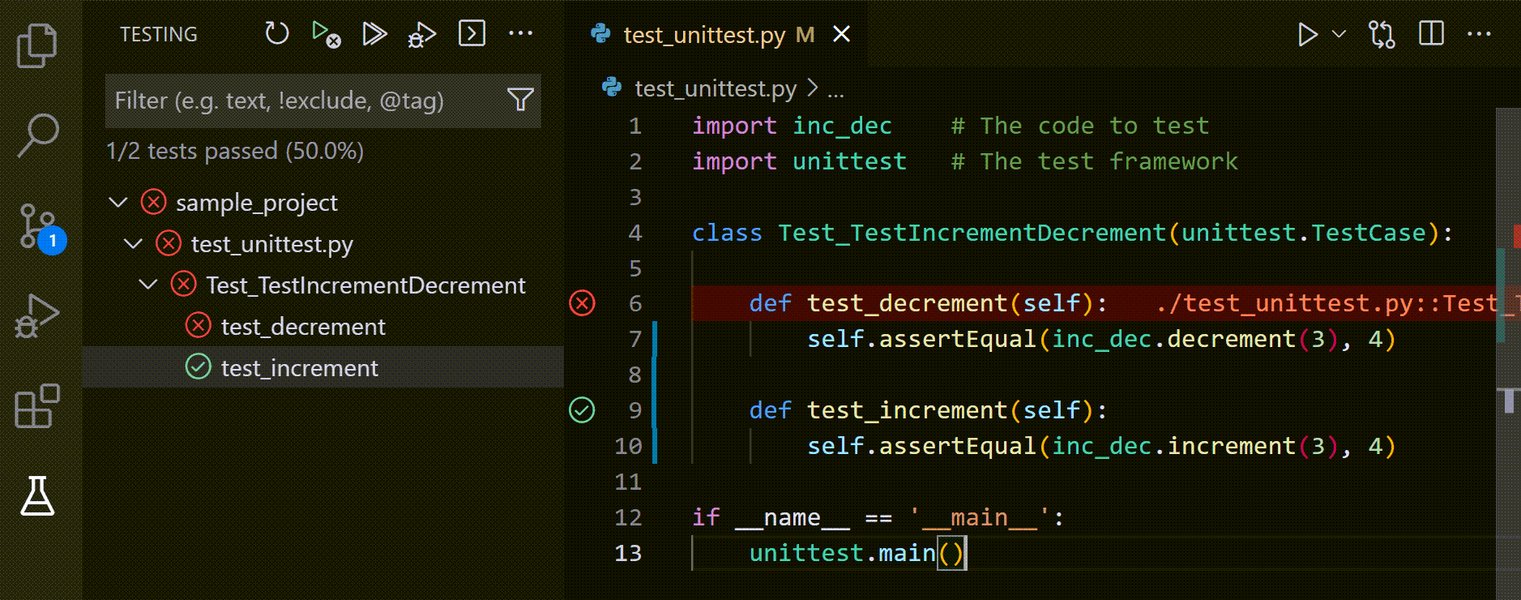
Example of viewing Python unit test results, highlighting best practices in software development applicable to data analysis scripts.
Core Python Concepts for Data Analysis: A Mindmap
Connecting the Dots
This mindmap provides a visual overview of the key areas of Python relevant to data analysis interviews, connecting fundamental concepts, essential libraries, common tasks, and the progression through different interview levels.
(int, str, bool)"] id1b["Data Structures
(List, Tuple, Dict, Set)"] id1c["Control Flow
(if/else, for/while)"] id1d["Functions & Lambdas"] id1e["File I/O"] id1f["OOP Basics (Classes, __init__)"] id1g["List Comprehensions"] id2["Key Libraries"] id2a["Pandas"] id2a1["DataFrame / Series"] id2a2["Reading Data (CSV, Excel)"] id2a3["Selection (.loc, .iloc)"] id2a4["Filtering / Sorting"] id2a5["Handling Missing Data"] id2a6["Grouping & Aggregation"] id2a7["Merging / Joining"] id2a8["Time Series"] id2b["NumPy"] id2b1["Arrays (ndarrays)"] id2b2["Vectorized Operations"] id2b3["Mathematical Functions"] id2b4["Random Number Generation"] id2c["Visualization"] id2c1["Matplotlib (Basic Plots)"] id2c2["Seaborn (Statistical Plots)"] id2d["Scikit-learn (Basics)"] id2d1["Preprocessing"] id2d2["Model Training (Simple)"] id2e["SciPy (Stats)"] id2e1["Hypothesis Testing"] id2e2["Statistical Functions"] id3["Common Tasks"] id3a["Data Cleaning"] id3b["Data Manipulation"] id3c["Exploratory Data Analysis (EDA)"] id3d["Data Aggregation"] id3e["Feature Engineering (Basic)"] id3f["Data Visualization"] id3g["Automation"] id4["Interview Levels"] id4a["Beginner"] id4a1["Focus: Core Syntax, Basic Pandas"] id4b["Intermediate"] id4a1["Focus: Pandas Proficiency, Data Cleaning, NumPy"] id4c["Advanced"] id4a1["Focus: Optimization, Algorithms, Advanced Libraries, Problem Solving"]
Comparing Key Python Concepts
Distinguishing Important Features
Understanding the nuances between similar concepts or functions is often tested in interviews. This table summarizes some key distinctions relevant to data analysis in Python.
| Concept Pair | Feature 1 | Feature 2 | Key Distinction & Use Case |
|---|---|---|---|
| List | Mutable (can be changed) | Ordered sequence | Use lists when you need a collection of items that might need modification (add, remove, change elements). Defined with `[]`. |
| Tuple | Immutable (cannot be changed) | Ordered sequence | Use tuples for fixed collections of items, ensuring data integrity. Often used as dictionary keys or for returning multiple values from functions. Defined with `()`. |
| Pandas `apply()` | Operates on rows or columns | Passes Series/DataFrame chunks | Flexible function application across rows (axis=1) or columns (axis=0). Good for complex row-wise or column-wise operations. |
| Pandas `map()` | Operates element-wise on a Series | Accepts dict or function | Used for substituting each value in a Series with another value, based on a dictionary mapping or a function. Only works on Series. |
| Pandas `applymap()` | Operates element-wise on a DataFrame | Applies function to every single element | Used for applying a function to every individual element in the entire DataFrame. Only works on DataFrames. |
| Shallow Copy (`copy()` method or slicing) | Creates new top-level object | Nested objects are referenced (shared) | Faster, less memory. Use when nested object changes don't matter or shouldn't affect the original. Changes to nested objects in the copy WILL affect the original. |
| Deep Copy (`copy.deepcopy()`) | Creates new top-level object | Nested objects are recursively copied (independent) | Slower, more memory. Use when you need a fully independent copy of an object, including all nested structures. Changes to the copy WILL NOT affect the original. |
Video Resource: Preparing for Python Interviews
Insights and Common Pitfalls
Watching experienced developers discuss interview preparation can provide valuable context and tips. This video covers common mistakes and strategies when preparing for Python technical interviews, which can be adapted for data analyst roles focusing on Python skills.
The video discusses differentiating between knowledge questions (like definitions) and technical coding challenges, emphasizing the need for hands-on practice. It also touches upon common areas interviewers probe, aligning well with the need to demonstrate practical Python application for data analysis tasks.
Frequently Asked Questions (FAQ)
Clearing Common Doubts
How much Pandas knowledge is typically expected?
Do I need to know Python visualization libraries like Matplotlib or Seaborn?
Should I focus only on Python, or are other skills like SQL important?
What's the best way to practice for the coding part of the interview?
Recommended Further Exploration
Deepen Your Understanding
- How can I optimize my Pandas code when working with very large datasets?
- What are common SQL interview questions that complement Python skills for data analysts?
- What are some best practices for creating effective data visualizations with Matplotlib and Seaborn?
- Can you show some real-world examples of complex data cleaning tasks solved using Python and Pandas?
References
Sources Used for This Analysis
Last updated May 4, 2025