
Unraveling Python's Core: The Essential Difference Between Variables and Objects
Dive deep into how Python manages data, understanding that variables are names and objects are the actual data entities.
Key Insights at a Glance
- Objects are the Core Data: In Python, every piece of data you encounter—be it numbers, text, lists, functions, or custom data structures—is an object. These objects reside in your computer's memory and inherently possess a type, a specific value, and a unique identity.
- Variables are Names or Labels: Contrary to some programming languages where variables are like containers holding data, Python variables are more akin to symbolic names, labels, or pointers. They don't store the data themselves but rather refer to the objects that hold the data.
- Dynamic Referencing and Shared Objects: A single object in memory can be referenced by multiple variables simultaneously. Furthermore, a variable is dynamic; it can be reassigned throughout your program's execution to point to entirely different objects, even objects of different types.
Demystifying Objects in Python
What Exactly is an Object?
In the realm of Python, an object is the fundamental building block for data. Think of an object as a concrete entity that exists in your computer's memory. Whenever you create a piece of data, like the number 42, the string "hello", or a list [1, 2, 3], Python internally creates an object to represent that data. This "everything is an object" philosophy is central to Python's design, extending to functions, classes, and modules as well.
Objects are instances of classes (which can be built-in, like int or str, or user-defined). A class acts as a blueprint, defining the structure and behavior of its objects.
Core Characteristics of Objects
Every object in Python possesses three key attributes:
- Identity: Each object has a unique identifier that distinguishes it from all other objects currently in memory. This identity is typically the object's memory address and can be retrieved using the built-in
id()function. For example,id(42)will give you the unique ID of the integer object representing 42. This ID remains constant for the lifetime of the object. - Type: The type of an object determines what kind of data it represents and what operations can be performed on it. For example, an object of type
intcan be used in arithmetic operations, while an object of typestrhas methods for text manipulation. The type can be found using thetype()function (e.g.,type("hello")returns<class 'str'>). An object's type is fixed once it's created. - Value: This is the actual data content stored within the object. For simple objects like integers or strings, the value is straightforward (e.g.,
42,"hello"). For more complex objects like lists or custom class instances, the value might be a collection of other objects or a set of attributes. Some objects are mutable (their value can change after creation, like lists), while others are immutable (their value cannot change, like integers and strings).
Understanding Variables in Python
The Role of a Variable
A variable in Python is not a box that holds data. Instead, it's a name or a label that you, the programmer, assign to an object. When you write an assignment statement like message = "Hello, Python!", you are not putting the string "Hello, Python!" *inside* the variable message. Rather, you are doing two things:
- Python creates a string object in memory with the value "Hello, Python!".
- The name
messageis then bound to (or made to refer to) this string object.
Think of variables as sticky notes that you can attach to different objects. The variable itself doesn't contain the object's data; it simply points to where the object is located in memory.
Key Attributes of Variables
- They are References: Variables hold references (memory addresses) to objects. This is why Python is often described as having a "pointer" model for variables, though these are managed automatically and are not like C/C++ pointers.
- No Intrinsic Type: A variable itself does not have a type. The type is a property of the object it references. A variable like
my_datacan point to an integer object at one moment (my_data = 10) and a string object later (my_data = "text"). Python is dynamically typed, meaning type checking happens at runtime. - Exist in Namespaces: Variables exist within specific contexts called namespaces. A namespace is a mapping from names (variables) to objects. Different namespaces (e.g., global, local to a function) can have variables with the same name pointing to different objects without conflict.
The Crucial Distinction: Variable vs. Object at a Glance
To crystallize the differences, consider the following table which summarizes the core distinctions between variables and objects in Python:
| Feature | Variable | Object |
|---|---|---|
| Nature | A name, label, or symbolic reference. | The actual data entity residing in memory. |
| Stores | A memory address (reference) of an object. | The actual value or data content. |
| Type | Does not have an intrinsic type; derives it from the referenced object. | Has a specific, fixed type (e.g., int, str, list, custom class). |
| Identity | Does not have its own unique ID; uses the ID of the object it points to. | Has a unique identity (memory address), accessible via id(). |
| Creation | Created (or bound) through an assignment statement (e.g., name = value). |
Created when a value is defined, an expression is evaluated, or a class instance is instantiated. |
| Mutability Aspect | Can be reassigned to point to different objects (even of different types). | Its value can be mutable (e.g., lists, dictionaries) or immutable (e.g., integers, strings, tuples). Mutability is a property of the object. |
| Analogy | A label on a box, a pointer, a name tag. | The content inside the box, the "thing" itself. |
| Existence | Exists within a specific scope (namespace) and for a defined lifetime. | Exists in memory as long as it's referenced by at least one variable or data structure (otherwise, it may be garbage collected). |
Visualizing the Connection: How Variables Point to Objects
Understanding the relationship between variables and objects is key. The following mindmap illustrates this conceptual model, showing how variables act as intermediaries to access the actual data stored in objects.
The Pointer Analogy
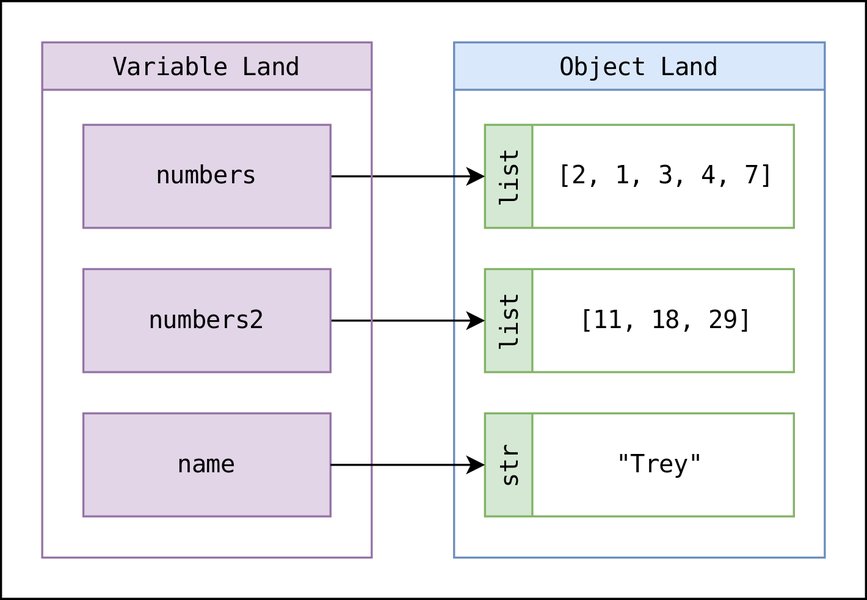
A common and helpful analogy is to think of "variable land" and "object land." Variables reside in "variable land" (conceptually, a namespace) and are like signposts. Each signpost (variable) has a name and points to a specific location in "object land" (memory), where the actual object resides. When your Python code uses a variable, Python follows the "pointer" from the variable to the object to perform operations or retrieve its value.
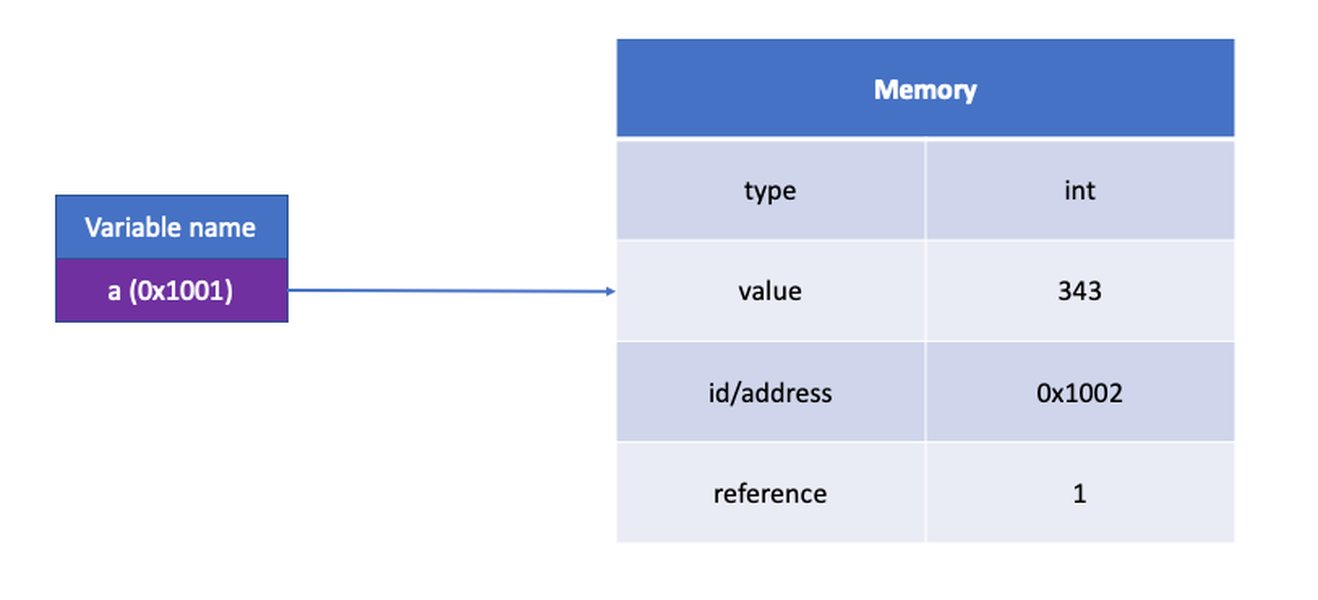
Visual representation of a Python variable (my_var) acting as a reference or pointer to an object stored in memory.
Unpacking the Differences: A Comparative View
The radar chart below offers a visual comparison of variables and objects across several key characteristics. This helps to quickly grasp their distinct roles and properties within Python's ecosystem. An "Object" is the actual data entity, while a "Variable" is a name that refers to it.
This chart visually emphasizes that objects are the entities that directly hold data, possess intrinsic types, and unique identities. Variables, conversely, excel in their ability to be reassigned and primarily function as names within namespaces, referencing these objects.
Data Storage and Types
Objects are where the data physically resides. The type of an object (e.g., int, str, list) dictates how that data is interpreted and what operations are valid. A variable, on the other hand, doesn't store data or have a type itself; it merely "borrows" the type of the object it currently points to for type-checking purposes.
Identity and Lifespan
Every object has a unique id(), which is constant throughout its existence. Objects live in memory as long as they are reachable (i.e., at least one variable or data structure refers to them). When an object is no longer referenced, Python's garbage collector may reclaim its memory. Variables exist within a certain scope (e.g., global, local to a function) and are destroyed when they go out of scope, which might lead to an object being garbage collected if that was its last reference.
Mutability and Reassignment
Mutability is a characteristic of objects. Mutable objects (like lists or dictionaries) can have their content changed after creation. Immutable objects (like integers, strings, or tuples) cannot. For example, if my_list = [1, 2], then my_list.append(3) changes the object my_list refers to, so it becomes [1, 2, 3].
Variables, however, can always be reassigned. If you have x = 10 (x points to the integer object 10), and then you execute x = "hello", the variable x now points to a completely new string object "hello". The original integer object 10 is unaffected (and might be garbage collected if x was its only reference).
Practical Implications and Code Examples
Understanding this distinction is crucial for writing correct and efficient Python code, especially when dealing with mutable data structures and function calls.
Basic Assignment and Object Creation
# Python code
x = 100
# Interpretation:
# 1. An integer object with the value 100 is created in memory.
# 2. The variable 'x' is created (if it doesn't exist in the current scope)
#    and is made to reference/point to this integer object 100.

print(type(x))  # Output: <class 'int'> (the type of the object x points to)
print(id(x))    # Output: A unique ID of the integer object 100
Multiple Variables, One Object
When you assign one variable to another, both variables end up pointing to the exact same object.
# Python code
original_list = [1, 2, 3]
alias_list = original_list  # 'alias_list' now points to the SAME list object as 'original_list'

print(f"Original list ID: {id(original_list)}")
print(f"Alias list ID:    {id(alias_list)}") # Will be the same ID

# Modifying the object via one variable affects the other
alias_list.append(4)

print(f"Original list after modification: {original_list}") # Output: [1, 2, 3, 4]
print(f"Alias list after modification:    {alias_list}")    # Output: [1, 2, 3, 4]
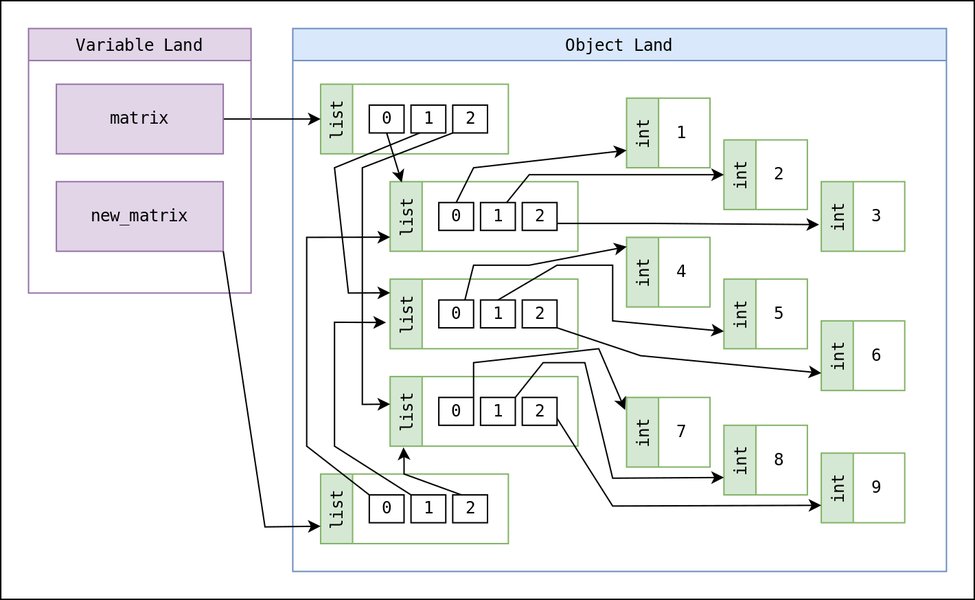
Illustration of two variables, list1 and list2 (analogous to original_list and alias_list), referencing the identical list object in memory. Changes via one are visible via the other.
Variable Reassignment
Reassigning a variable makes it point to a new object, leaving the original object (and any other variables pointing to it) untouched.
# Python code
a = 50  # 'a' points to the integer object 50
b = a   # 'b' also points to the integer object 50

print(f"ID of object 'a' points to: {id(a)}")
print(f"ID of object 'b' points to: {id(b)}") # Same as id(a)

# Reassign 'a' to a new object
a = 75  # 'a' now points to a NEW integer object 75.
        # The original integer object 50 still exists, and 'b' still points to it.

print(f"After reassigning 'a':")
print(f"Value of 'a': {a}")  # Output: 75
print(f"Value of 'b': {b}")  # Output: 50 (still points to the original object)
print(f"ID of object 'a' now points to: {id(a)}") # Different from original id(a)
print(f"ID of object 'b' still points to: {id(b)}") # Same as original id(b)
This diagram shows a variable x first pointing to an object with value 10, and then being reassigned to point to a new object with value 20, demonstrating variable reassignment.
Impact on Mutable vs. Immutable Objects
The behavior becomes particularly important with mutable objects passed to functions.
# Python code
def modify_list_and_string(my_list, my_string):
    my_list.append(100)      # Modifies the original list object (lists are mutable)
    my_string = my_string + " world" # Creates a NEW string object and rebinds 'my_string' locally
    print(f"Inside function: List is {my_list}, String is {my_string}")
    return my_string # return new string

# Immutable example (string)
immutable_val = "hello"
print(f"Before function (string): {immutable_val}, ID: {id(immutable_val)}")
new_string_val = modify_list_and_string([], immutable_val) # Pass empty list for this example
print(f"After function (string): {immutable_val}, ID: {id(immutable_val)}") # Unchanged
print(f"Returned string from function: {new_string_val}, ID: {id(new_string_val)}") # New object

# Mutable example (list)
mutable_val = [10, 20]
print(f"Before function (list): {mutable_val}, ID: {id(mutable_val)}")
modify_list_and_string(mutable_val, "") # Pass empty string for this example
print(f"After function (list): {mutable_val}, ID: {id(mutable_val)}") # Changed
In the case of my_list (mutable), modifications inside the function affect the original object because the function receives a reference to that same object. For my_string (immutable), the operation my_string + " world" creates a new string object, and the local variable my_string within the function is rebound to this new object. The original string object outside the function remains unchanged.
Diving Deeper with a Visual Explanation
To further solidify your understanding, the following video offers an alternative model and explanation of Python variables and objects, emphasizing the object-oriented nature of the language. It visually breaks down how variables act as references to objects in memory, which can be very helpful for grasping these abstract concepts.
This video discusses how Python's variable model differs from some other languages, illustrating that variables are more like labels pointing to objects rather than containers holding values. This perspective is crucial for understanding Python's memory management, how data is passed to functions (pass-by-object-reference), and the implications of mutability.
Frequently Asked Questions (FAQ)
Are variables themselves objects in Python?
No, variables are not objects in Python. Variables are names or identifiers that exist in a namespace and act as references (or pointers) to objects. The objects are the actual data entities in memory. While "everything is an object" refers to data types like integers, strings, lists, functions, and classes, variables are the mechanism to access these objects by name.
What does "everything is an object in Python" truly mean?
This core Python philosophy means that all data, and even the structures and operations that work on data, are represented as objects. This includes:
- Primitive data types: Integers (
int), floating-point numbers (float), strings (str), booleans (bool). - Data structures: Lists (
list), tuples (tuple), dictionaries (dict), sets (set). - Functions and methods: They are first-class objects, meaning they can be assigned to variables, passed as arguments, and returned from other functions.
- Classes and class instances: The blueprints (classes) and the entities created from them (instances) are objects.
- Modules and even types themselves.
Each of these has a type, an identity, and a value, fitting the definition of an object.
How does the variable/object distinction affect function arguments?
Python uses a mechanism often called "pass-by-object-reference" (or "pass-by-assignment"). When you pass a variable to a function, a copy of the reference (the "pointer" to the object) is passed to the function's parameter. This means:
- Both the variable outside the function and the parameter inside the function initially point to the same object.
- If the object is mutable (e.g., a list), modifications made to the object via the function parameter will be visible outside the function because it's the same object being changed.
- If the object is immutable (e.g., a number or string), any operation that seems to "change" it inside the function actually creates a new object. The function parameter is then rebound to this new object, leaving the original object (and the variable outside the function) unaffected.
- If you reassign the parameter itself inside the function (e.g.,
param = new_object), this only changes what the local parameter points to; it does not affect the original variable outside the function.
What is the purpose of the id() function in Python?
The built-in id() function returns the "identity" of an object. This identity is an integer which is guaranteed to be unique and constant for this object during its lifetime. You can think of it as the object's memory address, although the exact representation can be implementation-dependent (e.g., in CPython, it is the memory address).
id() is useful for:
- Checking if two variables refer to the exact same object (e.g.,
id(a) == id(b)is equivalent toa is b). - Understanding how Python manages memory and object creation, especially with immutable types where Python might reuse existing objects (e.g., small integers or short strings).
- Debugging issues related to object identity versus equality (
isvs.==).
Recommended Further Exploration
To deepen your understanding of Python's data model, consider exploring these related topics:
- How does Python's garbage collection work with objects and references?
- What are the differences between mutable and immutable objects in Python and their practical implications?
- Can you explain namespaces and scope in Python in relation to variables and object accessibility?
- How do shallow and deep copies of objects work in Python, and when should each be used?
References
Last updated May 9, 2025