

- Quadratic equations in two variables are the algebraic foundation for all conic sections.
- The discriminant ($B^2 - 4AC$) of the general quadratic equation \(Ax^2 + Bxy + Cy^2 + Dx + Ey + F = 0\) is key to classifying conic sections.
- Each conic section (circle, ellipse, hyperbola, parabola) has a unique standard form that reveals its key geometric properties and simplifies graphing.
Conic sections are fundamental geometric shapes that arise from the intersection of a plane with a double-napped cone. These elegant curves—the circle, ellipse, parabola, and hyperbola—are not merely abstract mathematical constructs; they are ubiquitous in nature, engineering, and various scientific disciplines. From the orbits of planets to the design of satellite dishes and architectural arches, understanding conic sections is crucial. Algebraically, these shapes are described by quadratic equations in two variables. The precise form of these equations dictates the type and orientation of the conic section, providing a powerful link between algebra and geometry.
Deciphering the foundational algebraic expression that governs all conic forms.
Every conic section can be represented by a general quadratic equation in two variables:
\[ Ax^2 + Bxy + Cy^2 + Dx + Ey + F = 0 \]The coefficients \(A, B, C, D, E,\) and \(F\) determine the specific type of conic section. A critical component in classifying these shapes is the discriminant, \(B^2 - 4AC\). This value dictates whether the equation describes a parabola, ellipse (including a circle), or hyperbola.
Understanding the Discriminant's Role
- If \(B^2 - 4AC = 0\), the equation represents a Parabola.
- If \(B^2 - 4AC < 0\), the equation represents an Ellipse (or a Circle, which is a special case of an ellipse).
- If \(B^2 - 4AC > 0\), the equation represents a Hyperbola.
In many introductory contexts, the \(Bxy\) term is often omitted, simplifying the equations and ensuring the conic's axes are aligned with the coordinate axes. When \(B=0\), the classification rules become even simpler based solely on the signs and magnitudes of \(A\) and \(C\).
A detailed look at each conic section, its standard equation, and characteristic graph.
Each conic section possesses a distinct standard form that simplifies identification of its key features, such as center, radius, vertices, and axes. Mastering these forms is essential for accurate graphing and analysis.
Circles: The Quintessential Roundness
A circle is a special case of an ellipse where the distances from the center to all points on the curve are equal. It is defined by a quadratic equation where the \(x^2\) and \(y^2\) terms have the same positive coefficient.
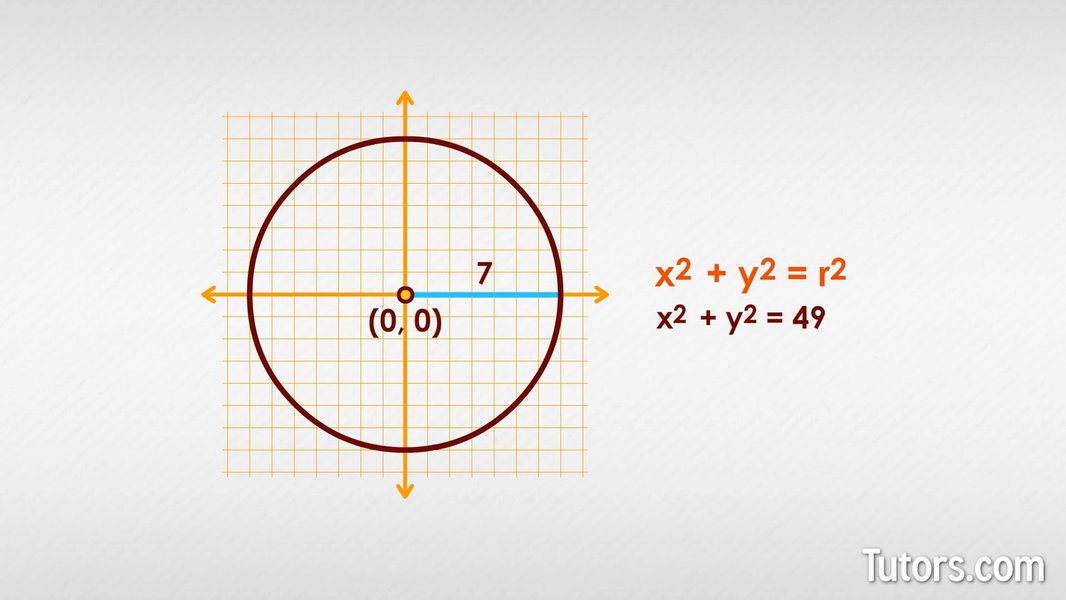
A circle centered at the origin, a fundamental conic section.
- Standard Form: \((x-h)^2 + (y-k)^2 = r^2\)
- Key Features: Centered at \((h,k)\) with radius \(r\).
- Example Equation: \((x-2)^2 + (y+3)^2 = 25\)
- Graph Description: A perfectly round shape centered at \((2, -3)\) with a radius of 5. Every point on the circle is 5 units away from the center.
Ellipses: The Stretched Circles
An ellipse is a closed, oval-shaped curve. It differs from a circle in that the coefficients of the \(x^2\) and \(y^2\) terms are positive but unequal, leading to an elongated shape.
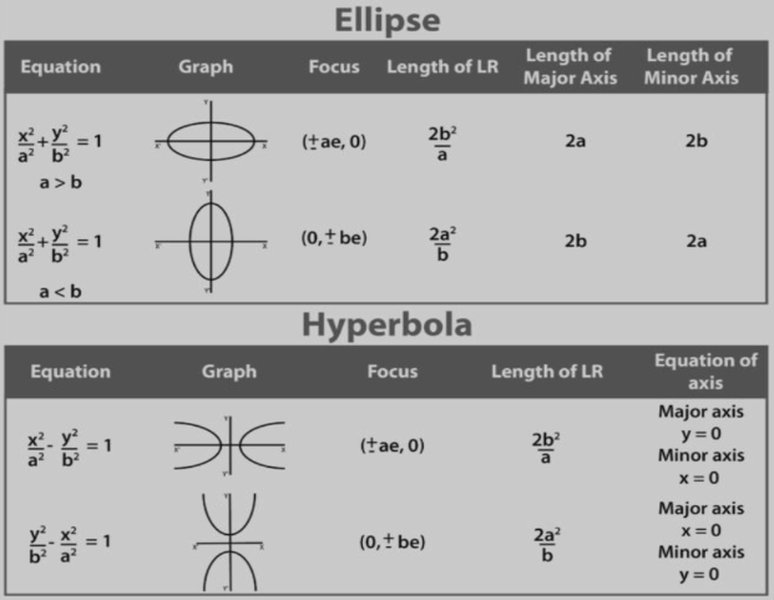
Visualizing the distinct, closed curve of an ellipse compared to a hyperbola.
- Standard Form: \(\frac{(x-h)^2}{a^2} + \frac{(y-k)^2}{b^2} = 1\)
- Key Features: Centered at \((h,k)\). \(a\) and \(b\) represent the lengths of the semi-major and semi-minor axes, determining the ellipse's stretch.
- Example Equation: \(\frac{x^2}{16} + \frac{y^2}{7} = 1\)
- Graph Description: An oval shape centered at the origin, wider along the x-axis with a semi-major axis of 4 and a semi-minor axis of approximately 2.65.
Hyperbolas: The Two-Branched Wonders
A hyperbola consists of two separate, symmetrical curves that extend infinitely. Its defining characteristic is that the \(x^2\) and \(y^2\) terms have opposite signs in the standard equation.
- Standard Form: \(\frac{(x-h)^2}{a^2} - \frac{(y-k)^2}{b^2} = 1\) (for horizontal transverse axis) or \(\frac{(y-k)^2}{b^2} - \frac{(x-h)^2}{a^2} = 1\) (for vertical transverse axis).
- Key Features: Centered at \((h,k)\). It has two branches that approach asymptotes, but never touch them.
- Example Equation: \(\frac{(x-2)^2}{4} - \frac{(y-3)^2}{5} = 1\)
- Graph Description: Two symmetric branches opening left and right, centered at \((2,3)\). The curves move away from the center and approach diagonal lines called asymptotes.
Parabolas: The U-Shaped Curves
A parabola is a U-shaped curve defined by a quadratic equation where only one variable is squared, while the other is linear. This results in a single, open curve.
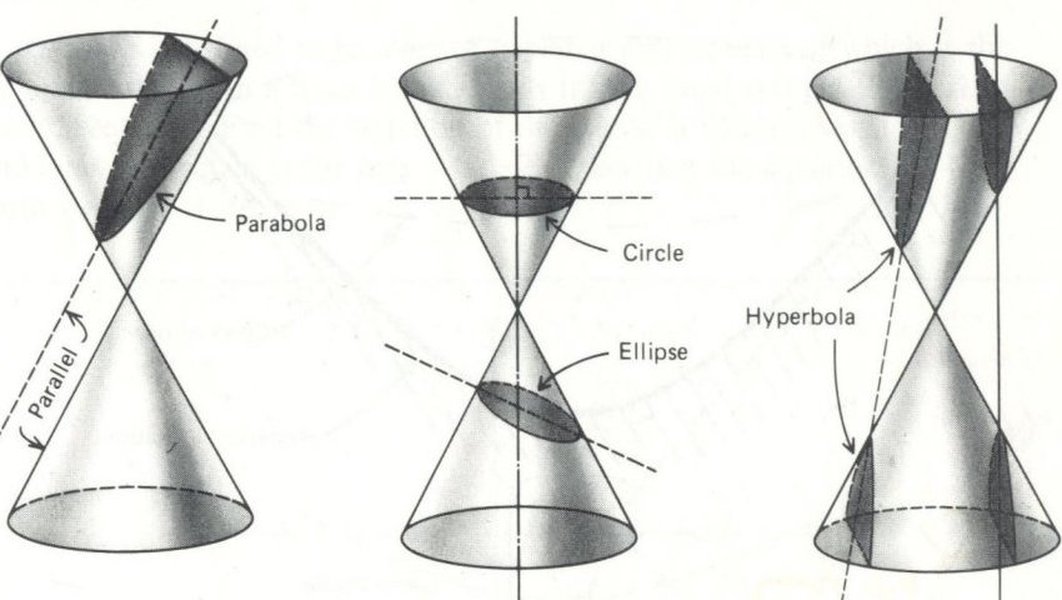
The formation of conic sections by intersecting a cone with a plane, illustrating a parabola.
- Standard Form: \(y = a(x-h)^2 + k\) (for vertical parabola) or \(x = a(y-k)^2 + h\) (for horizontal parabola).
- Key Features: Vertex at \((h,k)\). It has an axis of symmetry and opens either upward, downward, left, or right.
- Example Equation: \(y = (x - 1)^2 + 2\)
- Graph Description: A U-shaped curve opening upwards with its vertex at \((1,2)\). The curve extends infinitely in one direction.
An analytical breakdown of key characteristics across different conic sections.
To further illustrate the distinctions and similarities among the conic sections, the following table summarizes their standard forms, unique features, and example equations.
| Conic Section | Standard Equation | Description/Key Features | Example Equation |
|---|---|---|---|
| Circle | \((x-h)^2 + (y-k)^2 = r^2\) | Center at \((h,k)\), radius \(r\). Both \(x^2\) and \(y^2\) terms have the same positive coefficient. | \((x-2)^2 + (y+3)^2 = 25\) |
| Ellipse | \(\frac{(x-h)^2}{a^2} + \frac{(y-k)^2}{b^2} = 1\) | Center at \((h,k)\). Coefficients of \(x^2\) and \(y^2\) positive but different, producing an elongated circle shape. | \(\frac{x^2}{16} + \frac{y^2}{7} = 1\) |
| Hyperbola | \(\frac{(x-h)^2}{a^2} - \frac{(y-k)^2}{b^2} = 1\) or \(-\frac{(x-h)^2}{a^2} + \frac{(y-k)^2}{b^2} = 1\) | Center at \((h,k)\). The \(x^2\) and \(y^2\) terms have opposite signs. Consists of two separate curves called branches. | \(\frac{(x-2)^2}{4} - \frac{(y-3)^2}{5} = 1\) |
| Parabola | \(y = a(x-h)^2 + k\) or \(x = a(y-k)^2 + h\) | Quadratic in one variable only. Graph is a "U"-shaped curve. Vertex at \((h,k)\). | \(y = (x - 1)^2 + 2\) |
Unraveling the interconnectedness of conic sections through their defining characteristics.
This mindmap provides a visual overview of how conic sections are interrelated, stemming from their fundamental definition and diverging into distinct types based on their quadratic equations and geometric properties. It highlights the common origin of these shapes and their unique distinguishing features.
An essential resource for understanding how to manipulate and graph conic equations.
For a dynamic approach to understanding conic sections, the video "Algebra II - General Quadratic (Conic Sections)" offers a clear explanation of how the general quadratic equation \(Ax^2 + Bxy + Cy^2 + Dx + Ey + F = 0\) is used to represent and classify these shapes. This video is particularly relevant as it delves into the significance of coefficients and the discriminant in determining the conic type, which is a core concept in the study of quadratic equations and conic sections.
The video covers the underlying principles of the general quadratic equation as it applies to conic sections, reinforcing the theoretical knowledge with practical insights. It's a valuable visual aid for grasping how the various terms in the equation influence the resulting geometric shape, including considerations for rotation when the \(Bxy\) term is present. This deeper dive helps bridge the gap between abstract algebra and tangible geometric representations.
Frequently Asked Questions (FAQ)
What is a conic section?
How are quadratic equations related to conic sections?
What is the discriminant used for in conic sections?
What is the main difference between an ellipse and a hyperbola?
How can I easily graph a conic section?
Conclusion
The journey from a general quadratic equation in two variables to the distinct geometric forms of circles, ellipses, parabolas, and hyperbolas is a testament to the elegant interplay between algebra and geometry. Each conic section, defined by its unique algebraic structure and standard form, reveals specific properties that are critical for understanding its graphical representation and real-world applications. By understanding the role of the discriminant and the characteristic features embedded within each standard equation, one can not only classify these shapes but also accurately visualize and interpret their behavior. From the simplicity of a circle's equation to the complex asymptotes of a hyperbola, these conic sections offer a rich and varied landscape of mathematical exploration, with profound implications across science and engineering.
Recommended Further Reading
- What are the practical applications of conic sections in engineering?
- How are the standard equations of conic sections derived from their geometric definitions?
- How do you graph conic sections when the Bxy term is present in the general equation?
- What is the role of the focus and directrix in defining parabolas and other conic sections?