

Key Insights into Quadrupole-Ellipsoid Relationships
- Quadrupole Moments Quantify Deviation: A quadrupole moment is a precise mathematical description of how a charge or mass distribution deviates from perfect spherical symmetry, specifically highlighting elongated (prolate) or flattened (oblate) shapes.
- Ellipsoids as Embodiments of Asymmetry: Ellipsoidal shapes naturally represent these non-spherical distributions, with their principal axes directly reflecting the directions of elongation or flattening that a quadrupole moment describes.
- Physical Significance Across Scales: This relationship is crucial in diverse fields, from describing the shapes of atomic nuclei in nuclear physics to understanding gravitational waves from cosmological objects.
The concept of a quadrupole, often perceived as embodying "four directions," is intrinsically linked to the geometry of ellipsoidal shapes through its ability to quantify deviations from spherical symmetry. While the notion of "four directions" can be misleading if interpreted literally, it figuratively refers to the anisotropic distribution of charge or mass along different spatial axes. This fundamental relationship allows us to describe and understand the shapes of various physical systems, from the subatomic to the cosmic scale.
Deconstructing the conceptual framework of quadrupoles and their role in describing asymmetric distributions.
A quadrupole is not simply an object with four physical poles pointing in four distinct directions. Instead, it is a mathematical construct that characterizes the second-order distribution of charge, mass, or other physical properties. It represents a more complex asymmetry than a dipole, which describes a separation of two equal and opposite charges or poles.
In three dimensions, a quadrupole is most accurately described by a 3x3 symmetric tensor, known as the quadrupole moment tensor. This tensor captures how the distribution of a physical quantity extends differently along various axes. While this might seem abstract, its physical manifestation is often seen in shapes that are not perfectly spherical, such as ellipsoids.
From Dipoles to Quadrupoles: A Progression of Complexity
To understand a quadrupole, it's helpful to consider its simpler precursor: the dipole. A dipole can be imagined as two equal and opposite charges separated by a distance. A quadrupole, then, can be conceptualized as two such dipoles of equal but oppositely directed moments, arranged in a way that produces a more intricate field pattern. This arrangement results in a distribution that deviates significantly from a simple point charge (monopole) or a simple pair of charges (dipole).
The "four directions" can be metaphorically understood as representing the key axes along which this complex distribution is oriented, indicating areas of concentration and scarcity of the distributed quantity.
Exploring how ellipsoidal shapes serve as ideal models for understanding quadrupole moments.
An ellipsoid is a three-dimensional geometric shape that results from deforming a sphere through directional scalings or affine transformations. It is defined by three principal semi-axes (conventionally denoted as a, b, and c), which determine its overall geometry. Crucially, an ellipsoid can be elongated (prolate, like a cigar) or flattened (oblate, like a pancake), making it a perfect visual and mathematical representation of the asymmetries that a quadrupole moment quantifies.
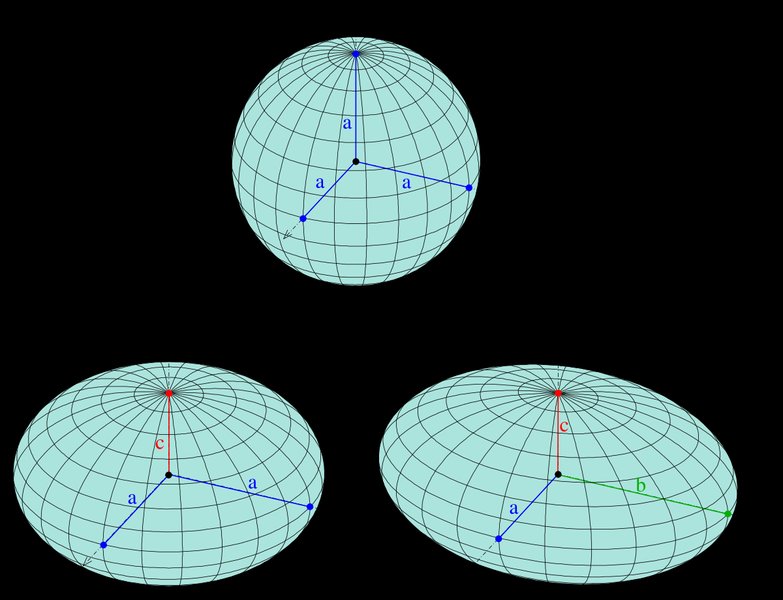
A visual representation of an ellipsoid, showcasing its three principal axes.
Mathematical Description of an Ellipsoid
The standard equation for an ellipsoid centered at the origin is given by:
\[ \frac{x^2}{a^2} + \frac{y^2}{b^2} + \frac{z^2}{c^2} = 1 \]Where \(a\), \(b\), and \(c\) are the lengths of the semi-axes along the x, y, and z directions, respectively. When \(a=b=c\), the ellipsoid reduces to a sphere. Any deviation from this equality signifies a non-spherical shape, which is precisely what a quadrupole moment measures.
Prolate vs. Oblate: The Sign of the Quadrupole Moment
The sign and magnitude of the quadrupole moment reveal the specific nature of the ellipsoidal deviation:
- Positive Quadrupole Moment (Prolate Spheroid): This indicates an elongation along one axis, with the other two axes being shorter and roughly equal. Imagine a rugby ball or a cigar.
- Negative Quadrupole Moment (Oblate Spheroid): This indicates a flattening along one axis, with the other two axes being longer and roughly equal. Think of a flattened disk or the Earth's shape (an oblate spheroid due to rotation).
How the quadrupole moment mathematically captures the nuanced shapes of ellipsoids.
The relationship between a quadrupole and an ellipsoidal shape is established through the quadrupole moment, which quantifies the extent to which a charge or mass distribution within an ellipsoid deviates from perfect spherical symmetry. If the charge or mass is homogeneously distributed within a perfectly spherical object, its quadrupole moment is zero. However, if the distribution is non-spherical, specifically ellipsoidal, a non-zero quadrupole moment arises.
The Quadrupole Tensor and Ellipsoid Axes Alignment
The components of the quadrupole tensor are directly influenced by the lengths of the ellipsoid's semi-axes. In the principal axis frame of the ellipsoid, the quadrupole tensor simplifies, with its diagonal elements reflecting the degree of elongation or flattening along each axis. This makes the quadrupole tensor an elegant descriptor of the ellipsoid's anisotropic geometry.
Consider a homogeneously charged ellipsoid. The calculation of its quadrupole moment tensor involves integrating the charge distribution over its volume, taking into account the distances from the center. This integral directly yields values that depend on the square of the semi-axes lengths, thus establishing a direct mathematical link.
Real-World Applications: From Nuclei to Galaxies
This fundamental relationship finds profound applications across various scientific disciplines:
- Nuclear Physics: Atomic nuclei often exhibit non-spherical shapes due to the distribution of protons and neutrons. The nuclear electric quadrupole moment is a key parameter that describes the effective shape of a nucleus's charge distribution. A non-zero quadrupole moment indicates that the nucleus is either prolate or oblate, providing crucial insights into nuclear structure and forces.
- Astrophysics and General Relativity: In the realm of celestial mechanics, the mass quadrupole moment is vital. When the mass quadrupole moment of a celestial body changes over time (e.g., due to its rotation or deformation), it can emit gravitational waves. The "ellipsoidal universe" model even suggests that large-scale cosmological structures might exhibit quadrupolar alignments, influencing phenomena like the cosmic microwave background.
- Molecular Physics: The quadrupole moments of molecules can influence their interactions and spectroscopic properties, providing information about their charge distribution and symmetry.
A conceptual mindmap illustrating the various facets of quadrupole moments and ellipsoidal shapes.
To consolidate the various relationships and concepts discussed, a mindmap provides a hierarchical overview.
This mindmap visually organizes the key concepts, from the definition of a quadrupole and an ellipsoid to their intricate relationship and diverse applications in physics. It emphasizes that the "four directions" are a conceptual simplification for a more complex tensor description, which finds its natural geometric counterpart in ellipsoidal forms.
Understanding why deviation from a perfect sphere necessitates a quadrupole description.
When a physical system possesses perfect spherical symmetry, its charge or mass distribution is uniform in all directions from its center. In such a case, the first non-zero moment beyond the monopole (total charge/mass) would be zero, meaning there's no dipole or quadrupole moment. However, most real-world objects and distributions are not perfectly spherical.
The quadrupole moment emerges precisely when this spherical symmetry is broken. It quantifies the degree and nature of this deviation. An ellipsoid, by its very definition (unless it's a perfect sphere), represents a breaking of spherical symmetry, making it the ideal geometric shape to model systems exhibiting a quadrupole moment.
Comparing Symmetry Levels
The following table summarizes the different levels of symmetry and their corresponding moments:
| Symmetry Level | Description | Dominant Moment | Associated Shape |
|---|---|---|---|
| Spherical | Uniform distribution in all directions | Monopole | Sphere |
| Axial | Asymmetry along one axis (e.g., charge separation) | Dipole | Two separated point charges |
| Quadrupolar | Elongation or flattening along axes | Quadrupole | Ellipsoid (prolate or oblate) |
This table highlights how the quadrupole moment is specifically associated with the more complex asymmetry characterized by ellipsoidal shapes, which go beyond simple axial separation.
Exploring the significance of quadrupolar shapes in understanding atomic nuclei.
One of the most prominent examples of the quadrupole-ellipsoid relationship is found in nuclear physics, particularly with the nuclear electric quadrupole moment. This moment provides critical information about the shape of an atomic nucleus.
Atomic nuclei are composed of protons and neutrons, which carry electric charge. While some nuclei are nearly spherical, many exhibit significant deviations, taking on prolate (elongated) or oblate (flattened) shapes. These deviations are directly measured through their electric quadrupole moment. A non-zero electric quadrupole moment indicates that the nucleus's charge distribution is not spherical.
This video provides an explanation of the nuclear electric quadrupole moment, specifically discussing spherical nuclei, prolate, and oblate shapes. It visually clarifies how the distribution of charge within a nucleus, when deviating from a perfect sphere, leads to a non-zero quadrupole moment, characteristic of prolate (elongated) or oblate (flattened) ellipsoidal forms. Understanding these nuclear shapes is crucial for studying nuclear structure and reactions.
The video above delves into the specifics of the nuclear electric quadrupole moment, explaining how the shape of the nucleus, whether prolate or oblate, is intrinsically linked to this fundamental physical property. It underscores that while the nucleus is a quantum system, its effective charge distribution can be modeled as an ellipsoid, and the quadrupole moment provides the quantitative measure of its deviation from sphericity.
FAQs
What does "four directions" mean in the context of a quadrupole?
How does an ellipsoid relate to a quadrupole?
Can a sphere have a quadrupole moment?
Where are quadrupole moments observed in nature?
Is the quadrupole moment a scalar or a tensor?
Conclusion: The Ubiquitous Dance of Asymmetry
The relationship between a quadrupole and an ellipsoidal shape is a cornerstone in understanding how charge and mass are distributed in asymmetric systems. Far from a simple "four directions," the quadrupole moment provides a sophisticated tensor description that quantifies deviations from spherical symmetry, perfectly embodied by the prolate or oblate forms of an ellipsoid. This profound connection is not merely an abstract mathematical concept but a crucial tool for dissecting the fundamental properties of matter at scales ranging from the subatomic nucleus to the vast expanse of the cosmos, enabling us to measure, predict, and understand the subtle dances of asymmetry that shape our universe.
Recommended Further Exploration
- How is the nuclear electric quadrupole moment measured?
- What is the role of quadrupole moments in gravitational wave detection?
- Explain multipole expansion and its significance in physics.
- How do planetary rotations lead to oblate spheroids?