
Unveiling the Distinction: Quantitative vs. Qualitative Data
Understanding the Core Differences Between Numerical and Descriptive Information
Key Highlights
- Quantitative data is numerical and measurable, focusing on "how many" or "how much."
- Qualitative data is descriptive and interpretive, exploring the "why" and "how" behind phenomena.
- Both types of data are crucial and often used together to gain a comprehensive understanding.
In the realm of data and research, two fundamental types of information are consistently referenced: quantitative and qualitative data. While both are essential for gaining insights and making informed decisions, they differ significantly in their nature, collection methods, and analysis techniques. Understanding this distinction is crucial for anyone working with data, whether in academic research, business analysis, or everyday problem-solving.
Quantitative Data: The Power of Numbers
What is Quantitative Data?
Quantitative data, as the name suggests, is all about quantity. It is numerical information that can be counted, measured, and expressed using numbers. This type of data is objective and provides concrete measurements of variables. It answers questions like "how many," "how much," or "how often."
Characteristics of Quantitative Data
- Numerical: It is always represented by numbers.
- Measurable: It can be measured using standard units.
- Countable: Individual units can be counted.
- Objective: It is based on factual measurements and is less subject to interpretation.
- Analyzed statistically: Statistical methods are used to analyze quantitative data to identify patterns, correlations, and test hypotheses.
Examples of Quantitative Data
Quantitative data is prevalent in many aspects of life and research. Some common examples include:
- The number of students in a classroom.
- The height or weight of individuals.
- Sales figures for a product.
- Website traffic statistics (e.g., number of visitors).
- Test scores.
- Credit card transactions.
- Macroeconomic indicators like GDP or inflation rates.
When you encounter data that can be easily plotted on a graph or used in mathematical calculations, you are likely dealing with quantitative data.
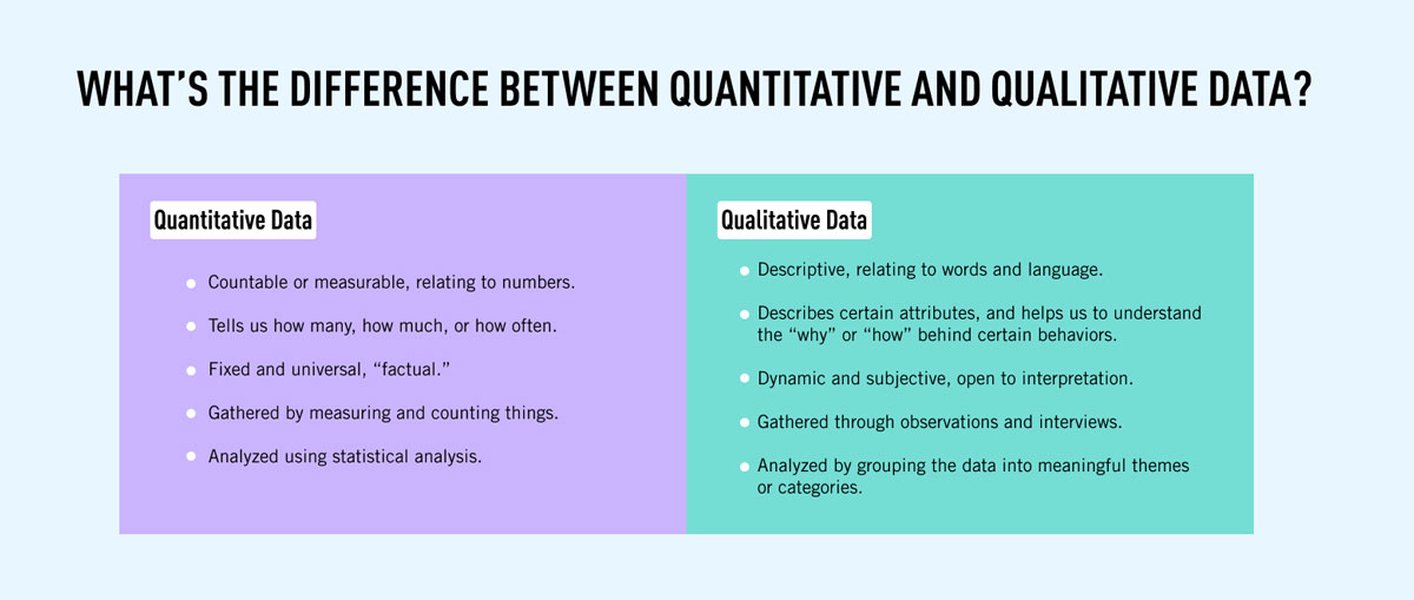
Visual representation of quantitative and qualitative data examples.
Qualitative Data: Exploring Meaning and Description
What is Qualitative Data?
Qualitative data, in contrast to quantitative data, is descriptive and focuses on qualities, characteristics, and meanings. It is non-numerical and expressed in words, images, or other non-measurable forms. Qualitative data seeks to understand the "why" and "how" behind phenomena, providing rich, detailed insights into subjective experiences, attitudes, and perceptions.
Characteristics of Qualitative Data
- Descriptive: It describes qualities or characteristics.
- Interpretation-based: Analysis often involves interpreting meanings and identifying themes.
- Subjective: It can be influenced by individual perspectives and experiences.
- Exploratory: It is often used to explore new ideas, generate hypotheses, or gain a deeper understanding of a topic.
- Analyzed through thematic analysis, discourse analysis, etc.: Various methods are used to analyze qualitative data, focusing on identifying patterns, themes, and narratives.
Examples of Qualitative Data
Qualitative data helps us understand the nuances and context surrounding quantitative data. Examples include:
- Interview transcripts that capture people's opinions and experiences.
- Observations of behavior in a natural setting.
- Open-ended responses in surveys that allow for detailed feedback.
- Case studies that provide in-depth descriptions of specific situations.
- Notes from focus groups discussing a particular topic.
- Product reviews describing user satisfaction or dissatisfaction.
When you are collecting information that provides context, opinions, or descriptions, you are likely working with qualitative data.
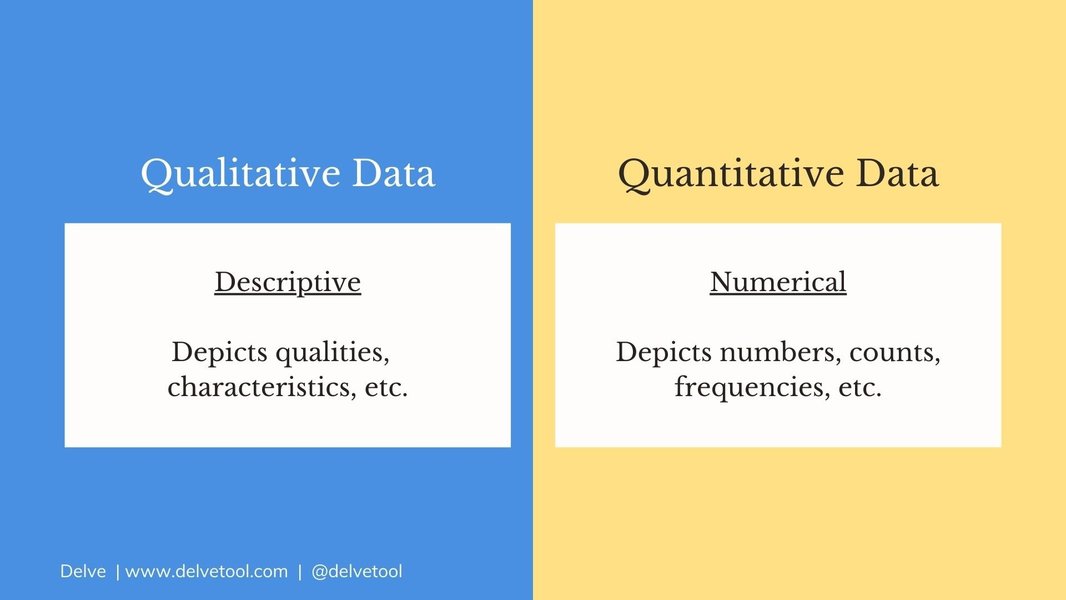
Comparing the forms and purposes of qualitative and quantitative data.
Key Differences Summarized
To further clarify the distinction between quantitative and qualitative data, here is a table summarizing their key differences:
| Feature | Quantitative Data | Qualitative Data |
|---|---|---|
| Nature | Numerical, measurable, countable | Descriptive, interpretive, language-based |
| Focus | Quantities, amounts, frequencies | Qualities, characteristics, meanings, experiences |
| Answers Questions Like | How many? How much? How often? | Why? How? What are the meanings? |
| Collection Methods | Surveys (closed-ended), experiments, observations (numeric), data logs | Interviews, focus groups, observations (descriptive), open-ended surveys, case studies |
| Analysis Methods | Statistical analysis (mean, median, correlation, regression, etc.) | Thematic analysis, content analysis, discourse analysis, interpretation of narratives |
| Purpose | Measure and test relationships, identify patterns, generalize findings | Explore ideas, understand experiences, gain in-depth insights, generate hypotheses |
The Synergy of Quantitative and Qualitative Data
Working Together for a Complete Picture
While quantitative and qualitative data are distinct, they are not mutually exclusive and are often used in conjunction to provide a more complete understanding of a research question or phenomenon. This approach, known as mixed methods research, leverages the strengths of both types of data.
For instance, quantitative data might reveal a trend, such as a decrease in customer satisfaction scores. Qualitative data, collected through interviews or open-ended survey questions, could then help uncover the reasons behind this trend, providing valuable context and actionable insights that numbers alone cannot provide.
Conversely, qualitative research can be used to explore a topic and develop hypotheses, which can then be tested and validated using quantitative methods. This iterative process of using both types of data allows researchers and analysts to gain a deeper and more nuanced understanding.
This video provides a clear explanation of the differences between quantitative and qualitative research approaches, which rely on these distinct types of data.
Applications in Various Fields
The application of quantitative and qualitative data is widespread across numerous fields:
Business and Marketing
Businesses use quantitative data like sales figures, website analytics, and customer demographics to track performance, identify trends, and measure the effectiveness of marketing campaigns. Qualitative data, such as customer feedback from surveys, reviews, and social media, helps businesses understand customer preferences, perceptions, and the reasons behind their behavior. This combination informs product development, marketing strategies, and customer service improvements.
Healthcare and Medicine
In healthcare, quantitative data includes clinical trial results, patient statistics, and measurements of vital signs. This data is crucial for evaluating the effectiveness of treatments, tracking disease prevalence, and monitoring patient health. Qualitative data from patient interviews and focus groups can provide insights into patient experiences, the impact of illness on quality of life, and barriers to accessing healthcare, leading to more patient-centered care.
Social Sciences and Psychology
Social scientists and psychologists use quantitative data from surveys and experiments to measure attitudes, behaviors, and cognitive processes across large populations. Qualitative data from interviews, observations, and case studies allows for in-depth exploration of individual experiences, cultural phenomena, and the complexities of human interaction. Both are vital for developing theories and understanding human behavior in its diverse forms.
Education
In education, quantitative data includes test scores, enrollment numbers, and graduation rates, used to assess student performance, evaluate programs, and inform policy. Qualitative data from classroom observations, teacher interviews, and student feedback can shed light on learning processes, the effectiveness of teaching methods, and the factors influencing student engagement and motivation, leading to more effective educational practices.
Challenges and Considerations
While both quantitative and qualitative data offer valuable insights, they also come with their own sets of challenges:
Challenges with Quantitative Data
- May lack context and fail to explain the "why" behind the numbers.
- Requires careful attention to sampling and research design to ensure generalizability.
- Can be subject to biases in measurement or data collection.
Challenges with Qualitative Data
-
Analysis can be time-consuming and subjective, requiring careful interpretation.
-
Findings may not be generalizable to larger populations due to smaller sample sizes.
-
Relies heavily on the researcher's skills in data collection and analysis.
Recognizing these challenges is important for choosing the appropriate data type and methods for a given research question and for interpreting findings accurately.
Frequently Asked Questions (FAQ)
Can qualitative data be converted to quantitative data?
Yes, in some cases, qualitative data can be quantified. For example, themes identified in interview transcripts can be counted to determine their frequency, or responses to open-ended questions can be categorized and counted. However, this process can sometimes lose the richness and depth of the original qualitative information.
Which type of data is better?
Neither quantitative nor qualitative data is inherently "better" than the other. The most appropriate type of data depends entirely on the research question, objectives, and the nature of the phenomenon being studied. Often, a combination of both provides the most comprehensive understanding.
Is qualitative data always subjective?
Qualitative data is often described as subjective because its interpretation can be influenced by the researcher's perspective. However, rigorous methods of data collection and analysis, such as using multiple coders or detailed documentation of the analysis process, can enhance the trustworthiness and credibility of qualitative findings.
When should I use quantitative research?
Quantitative research is best suited for questions that involve measuring variables, testing relationships, and generalizing findings to a larger population. It is useful when you want to confirm or test a hypothesis, identify patterns, and establish statistical relationships.
When should I use qualitative research?
Qualitative research is ideal for exploring complex issues, understanding experiences and perspectives, and gaining in-depth insights into a phenomenon. It is useful when you want to understand the "why" and "how," explore new topics, or develop a rich description of a particular context.
References
Last updated May 8, 2025