
Unlocking the Quantum Realm: A Paradigm Shift in Computation
Delving into the revolutionary principles and vast potential of quantum computing, a field poised to redefine technological boundaries.
Key Insights into Quantum Computing
- Qubits and Superposition: Unlike classical bits that are either 0 or 1, quantum bits (qubits) can exist in a superposition of both states simultaneously, allowing for parallel processing of information.
- Entanglement and Interference: Quantum computers leverage entanglement, where qubits are interconnected regardless of distance, and quantum interference, which amplifies correct solutions while suppressing incorrect ones, to achieve exponential computational power.
- Transformative Applications: While still in its nascent stages, quantum computing promises to revolutionize fields such as cryptography, materials science, drug discovery, financial modeling, and artificial intelligence by solving problems currently intractable for classical machines.
Quantum computing represents a groundbreaking frontier in information processing, fundamentally diverging from classical computing paradigms. It harnesses the peculiar and powerful laws of quantum mechanics to tackle complex problems that are beyond the capabilities of even the most powerful classical supercomputers. This multidisciplinary field intricately weaves together computer science, physics, and mathematics to exploit unique quantum phenomena such as superposition, quantum interference, and entanglement. While the concept was first proposed by physicist Richard Feynman in the 1980s, its practical realization is still evolving, with significant advancements being made in hardware and algorithms. Understanding quantum computing means grasping its core principles, recognizing its potential applications, and acknowledging the current challenges in its development.
The Core Mechanics: How Quantum Computing Operates
At the heart of quantum computing lies its ability to leverage quantum-mechanical effects to process information. This involves a set of fundamental principles that differentiate it from classical computation.
Qubits: The Quantum Foundation of Information
The basic unit of information in quantum computing is the quantum bit, or qubit. Unlike a classical bit, which must be in one of two definite states (0 or 1), a qubit can exist in a superposition—meaning it can be 0, 1, or a combination of both simultaneously. This inherent property allows a single qubit to hold more information than a classical bit, providing the foundation for quantum parallelism.
Physically, qubits can be implemented using various systems, each presenting unique advantages and challenges. These include individual atoms, ions, electrons, photons, or specially designed superconducting circuits. The challenge lies in maintaining these delicate quantum states, as they are highly susceptible to environmental noise.
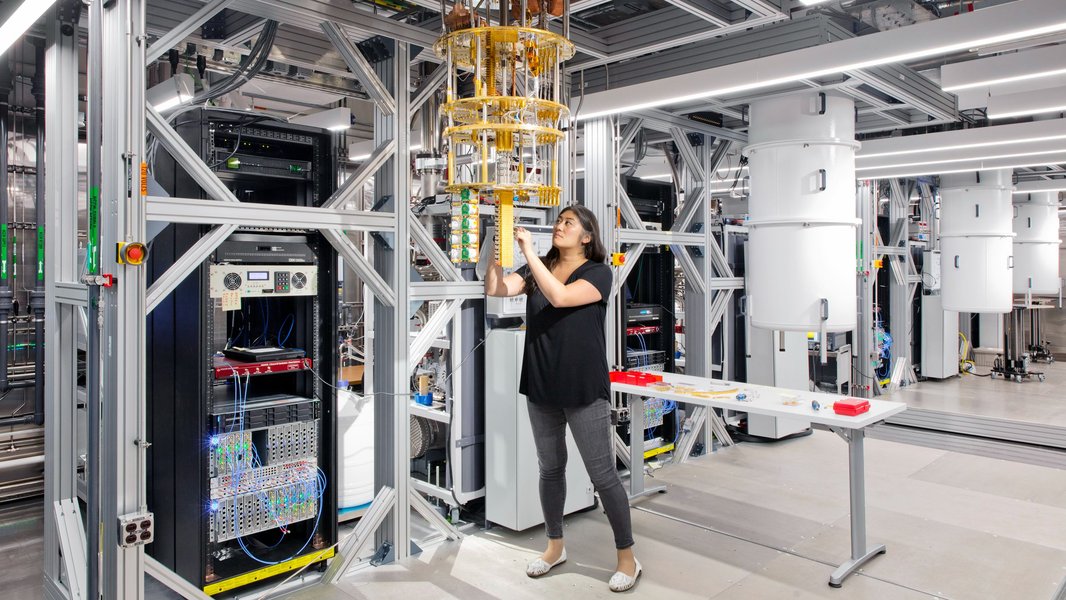
A sophisticated quantum computing laboratory environment showing a large cryostat for housing superconducting qubits.
Superposition: Simultaneously Exploring Possibilities
Superposition is a cornerstone of quantum computing. It allows qubits to exist in multiple states at once, enabling quantum computers to explore a vast number of possibilities simultaneously. This is often compared to a spinning coin that is both heads and tails until it lands. For example, two qubits can process four pieces of information, three qubits can process eight, and this exponential scaling continues, offering immense parallel processing capabilities for certain problems.
Entanglement: Interconnected Qubits for Correlated Computations
Entanglement is another profound quantum phenomenon where two or more qubits become linked in such a way that the state of one qubit instantly correlates with the state of others, regardless of the physical distance between them. This means that measuring one entangled qubit provides immediate information about the others, and the manipulation of one can influence others in the entangled system. Entanglement is crucial for generating interference between different computational states, which is fundamental to how quantum algorithms achieve their efficiency.
Quantum Interference: Amplifying the Right Answers
Quantum interference is the process by which quantum computers amplify the probability of correct answers and suppress the probability of incorrect ones. Through carefully designed quantum logic gates and circuits, the probabilities of different outcomes can be manipulated. This phenomenon is essential for quantum algorithms to converge on useful solutions with high probability, making them effective for solving problems that would be intractable for classical machines.
Quantum Logic Gates and Circuits: Building Quantum Algorithms
Just as classical computers use logic gates to manipulate bits, quantum computers use quantum logic gates to manipulate qubits. These gates perform operations that can create and control superposition and entanglement. Quantum algorithms are constructed by arranging these gates into specific sequences, forming quantum circuits that carry out complex computations. Unlike many classical logic gates, quantum logic gates are often reversible.
Measurement and Decoherence: The Challenges of Quantum Stability
A quantum computation concludes with a measurement, which collapses the qubits' superpositions into definite classical states (0 or 1). However, maintaining these delicate quantum states for a sufficient duration is a significant challenge. Qubits are highly susceptible to "quantum decoherence," where they lose their quantum properties due to interaction with their environment, introducing noise and errors into calculations. This necessitates operating quantum computers at extremely low temperatures (near absolute zero) and developing sophisticated error-correcting codes to achieve reliable computations.
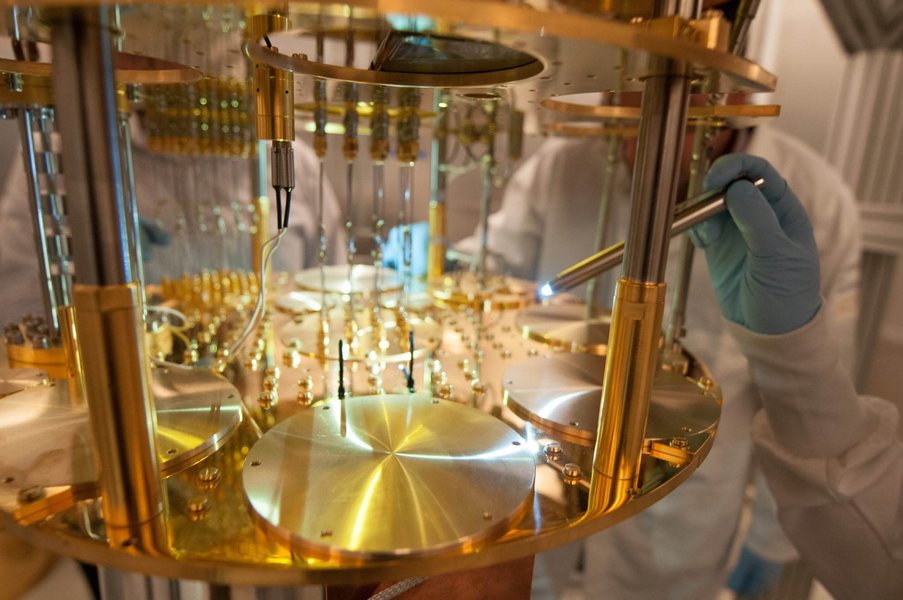
An ultra-low temperature dilution refrigerator, a common component in quantum computing labs for cooling qubits.
The Distinct Divide: Quantum vs. Classical Computing
The fundamental differences between quantum and classical computing dictate their respective strengths and applications. While classical computers excel at sequential processing and everyday tasks, quantum computers are uniquely suited for problems requiring massive parallel exploration of possibilities.
| Feature | Classical Computing | Quantum Computing |
|---|---|---|
| Basic Unit of Information | Bit (0 or 1) | Qubit (0, 1, or superposition of both) |
| Information Processing | Sequential, binary operations | Parallel processing via superposition and entanglement |
| Computational Power Scaling | Linear with number of bits | Potentially exponential with number of qubits |
| Problem Solving Approach | Evaluates one possibility at a time | Explores multiple possibilities simultaneously |
| Error Susceptibility | Less prone to environmental errors | Highly susceptible to decoherence; requires advanced error correction |
| Typical Applications | General-purpose tasks, databases, word processing, internet browsing | Optimization, simulation of quantum systems, cryptography, AI/ML |
Revolutionary Applications of Quantum Computing
While still in its experimental phase, quantum computing holds immense promise for transforming numerous industries and scientific disciplines. Its ability to solve problems currently intractable for classical machines opens doors to unprecedented advancements.
Materials Science and Drug Discovery: Simulating the Unseen
Quantum computers can simulate the behavior of molecules and materials at the atomic and subatomic levels with unparalleled accuracy. This capability is crucial for understanding chemical reactions, designing new materials with specific properties (e.g., superconductors, catalysts), and accelerating drug discovery by precisely modeling protein folding and molecular interactions. This could lead to breakthroughs in medicine, energy, and manufacturing.
Cryptography and Cybersecurity: A Double-Edged Sword
Quantum computing presents both a threat and an opportunity in the realm of cybersecurity. On one hand, algorithms like Shor's algorithm could potentially break widely used public-key encryption schemes (eRSA). On the other hand, quantum computers can also be used to develop new, quantum-resistant encryption methods, ensuring secure communication in a post-quantum world. Quantum Key Distribution (QKD), for instance, leverages entanglement to create inherently secure communication channels.
This video from "6 Quantum Computing: Applications of Quantum Computing" delves into how quantum computing will revolutionize cryptography, enabling new forms of secure communications like quantum key distribution. It highlights the dual nature of quantum computing in cybersecurity, both posing a threat to existing encryption and offering solutions for future secure communications.
Financial Modeling and Optimization: Precision in Complex Systems
The financial sector could benefit significantly from quantum computing's ability to solve complex optimization problems. This includes optimizing investment portfolios, assessing risk more accurately, pricing derivatives, and performing high-frequency trading with greater efficiency. Quantum algorithms can navigate vast solution spaces to find optimal strategies in rapidly changing market conditions, potentially leading to improved financial stability and profitability.
Artificial Intelligence and Machine Learning: Supercharging Algorithms
Quantum computing can enhance machine learning algorithms by speeding up training processes for large datasets and improving pattern recognition. Quantum machine learning could lead to more powerful AI, enabling breakthroughs in areas like image processing, natural language understanding, and predictive analytics. The ability to process vast amounts of data in superposition allows quantum systems to find correlations and patterns that might be missed by classical approaches.
Other Promising Areas
Beyond these primary applications, quantum computing is being explored in diverse fields such as:
- Logistics and Supply Chain Management: Optimizing routes, resource allocation, and inventory management for greater efficiency.
- Environmental Modeling: Developing more accurate climate models and discovering new materials for carbon capture and sustainable energy.
- Scientific Research: Aiding physicists in performing physical simulations, such as modeling inertial fusion implosions and exploring quantum field theories.
Current State and Future Outlook
The field of quantum computing is still largely experimental and in its nascent stages, yet it is advancing rapidly. Current quantum computers are often described as "noisy intermediate-scale quantum" (NISQ) devices, consisting of a few to a few hundred qubits. These devices are prone to errors and are not yet capable of outperforming classical computers in practical applications. The key goal for researchers is to achieve "quantum advantage," where a quantum system can perform operations that no classical computer can simulate in a reasonable timeframe.
This radar chart illustrates the perceived progress and future projections across key challenges in quantum computing development. It highlights areas like qubit stability and error correction as ongoing hurdles, while also showing strong progress in algorithmic development. The "Current State" reflects the experimental nature and limitations of today's devices, while the "Projected Future" indicates significant anticipated advancements in the coming decade across all dimensions, leading towards more commercially viable and robust quantum systems.
Major players like IBM, Google, IonQ, and Rigetti are actively investing in research and development, exploring various qubit technologies such as superconducting circuits and trapped ions. The focus is on increasing the number of stable, error-corrected qubits and developing robust quantum algorithms. Experts anticipate that quantum computers will not entirely replace classical computers but will rather work in conjunction with them, acting as powerful accelerators for specific, highly complex problems that classical machines cannot handle efficiently. The full transformative potential of quantum computing is expected to unfold over the next few decades.
The Quantum Computing Landscape
To better visualize the interconnectedness of concepts in quantum computing, consider the following mindmap:
(e.g., Superconducting, Ion Traps)"] C["Key Differences from Classical Computing"] C1["Bits vs. Qubits"] C2["Sequential vs. Parallel Processing"] C3["Error Handling Complexity"] C4["Computational Power Scale"] D["Applications"] D1["Cryptography
(Shor's Algorithm, QKD)"] D2["Materials Science & Chemistry
(Drug Discovery, New Materials)"] D3["Financial Modeling
(Optimization, Risk Assessment)"] D4["Artificial Intelligence & Machine Learning"] D5["Optimization Problems"] D6["Scientific Research"] E["Current State & Challenges"] E1["Experimental & Early Stage"] E2["Noisy Intermediate-Scale Quantum (NISQ)"] E3["Qubit Stability & Scalability"] E4["Error Correction"] E5["Achieving Quantum Advantage"]
This mindmap provides a structured overview of quantum computing, breaking down its fundamental principles, operational mechanisms, differentiators from classical computing, diverse applications, and current developmental challenges. It illustrates how various concepts interlink to form the complete picture of this revolutionary technology.
Frequently Asked Questions (FAQ)
What is a qubit?
How does superposition work in quantum computing?
What is quantum entanglement?
Can quantum computers replace classical computers?
What are the main challenges in building quantum computers?
Conclusion
Quantum computing stands as a testament to humanity's ongoing quest to push the boundaries of technology and understanding. By harnessing the counterintuitive yet immensely powerful laws of quantum mechanics—specifically superposition, entanglement, and interference—it offers a fundamentally new paradigm for information processing. While the field is still in its infancy, grappling with significant engineering and scientific hurdles such as qubit stability and error correction, the potential applications are transformative. From accelerating drug discovery and revolutionizing financial modeling to creating unhackable encryption and supercharging artificial intelligence, quantum computing promises to unlock solutions to problems previously deemed intractable. As research and development continue to advance, quantum computers are poised to complement classical systems, ushering in an era of unprecedented computational power and innovation across science, technology, and industry.
Recommended Further Exploration
- How do quantum algorithms work and what are their advantages?
- What are the latest advancements in quantum hardware development?
- Explore the ethical implications and security risks of quantum computing
- What career opportunities are emerging in the field of quantum computing?