
Quantum Entanglement
An In-depth Exploration of a Quantum Phenomenon
Key Takeaways
- Interconnected States: Entangled particles share a unified quantum state, making their properties directly linked regardless of distance.
- Non-Local Correlations: Measurement of one entangled particle instantaneously influences its partner, defying classical notions of locality.
- Crucial Applications: Quantum entanglement is foundational for advancements in quantum computing, cryptography, and teleportation.
Introduction
Quantum entanglement stands as one of the most intriguing and fundamental phenomena in the realm of quantum mechanics. It describes a unique connection between two or more particles, such that the quantum state of each particle cannot be fully described independently of the others. This interdependence persists even when the entangled particles are separated by vast distances, challenging our classical understanding of the physical world.
Understanding Quantum Entanglement
Definition and Basic Concepts
At its core, quantum entanglement occurs when particles become linked through their quantum states, creating a system where the state of one particle directly influences the state of another, no matter the separation between them. This phenomenon defies classical physics, where objects are thought to be influenced only by their immediate surroundings.
Historical Context and Theoretical Foundations
The concept of entanglement emerged from the early development of quantum mechanics in the 20th century. Pioneers like Albert Einstein, Boris Podolsky, and Nathan Rosen highlighted entanglement in the famous EPR paradox, questioning the completeness of quantum mechanics. Later, John Bell formulated Bell's Theorem, providing a way to test the predictions of quantum mechanics against local hidden variable theories, ultimately supporting the reality of entanglement through experimental evidence.
Key Characteristics of Quantum Entanglement
Shared Quantum State
Entangled particles are described by a single, unified wave function that encompasses all their possible states. For instance, in a pair of entangled electrons, if one electron is measured to have an "up" spin, the other must simultaneously be in a "down" spin state, regardless of the distance separating them. This shared quantum state ensures that the particles are intrinsically linked in their properties.
Non-Locality and Instantaneous Correlations
One of the most perplexing aspects of entanglement is its non-local nature. When a measurement is performed on one particle, the corresponding state of its entangled partner is instantly determined, seemingly defying the speed of light constraint. However, this instantaneous correlation does not permit faster-than-light communication, as the measurement outcomes are inherently random and cannot be controlled to transmit information.
Superposition and Measurement Effects
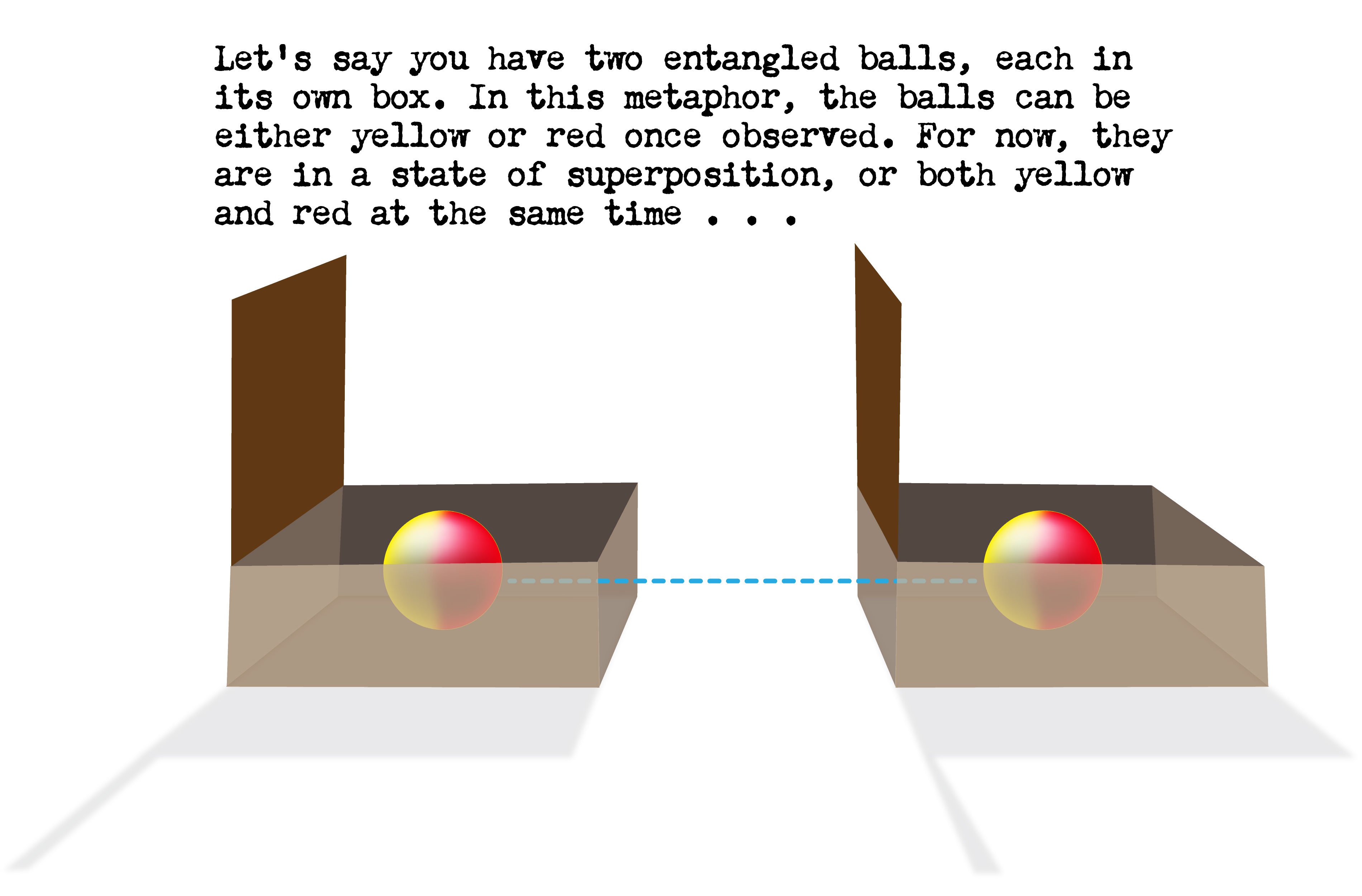
Entangled particles exist in a superposition of multiple states simultaneously. It is only upon measurement that the system collapses into a definite state. This collapse affects the entire entangled system instantaneously, ensuring that the properties of all particles in the entangled pair are consistent with each other post-measurement.
Implications and Applications
Quantum Computing
Quantum entanglement is a cornerstone of quantum computing. Entangled qubits can perform complex calculations at speeds unattainable by classical bits, enabling quantum computers to solve problems in cryptography, optimization, and simulation with unprecedented efficiency.
Quantum Cryptography
Entanglement facilitates highly secure communication channels through quantum cryptography. Techniques like Quantum Key Distribution (QKD) use entangled particles to create encryption keys that are theoretically immune to eavesdropping, as any attempt to intercept the key would disrupt the entanglement, alerting the communicating parties.
Quantum Teleportation
Quantum teleportation leverages entanglement to transmit quantum states from one location to another without moving the physical particles themselves. This process involves entangling particles at both the sending and receiving ends, allowing the state of a particle to be transferred instantaneously upon measurement.
Precision Metrology and Other Uses
Entanglement enhances precision in measurements beyond classical limits, benefiting fields like spectroscopy and gravitational wave detection. Additionally, ongoing research explores entanglement's potential in merging quantum mechanics with general relativity, aiming to achieve a unified theory of quantum gravity.
Experiments and Evidence
Bell’s Theorem and Inequalities
John Bell's formulation of Bell's Theorem provided a tangible means to test the predictions of quantum mechanics against local hidden variable theories. Experiments measuring Bell inequalities have consistently violated these inequalities, empirically supporting the existence of quantum entanglement and the non-local nature of quantum mechanics.
Notable Experiments Demonstrating Entanglement
Numerous experiments, such as those conducted by Alain Aspect in the 1980s, have been pivotal in demonstrating entanglement. These experiments involved entangled photons and measured their polarization states, providing clear evidence of instantaneously correlated behaviors that align with quantum mechanical predictions rather than classical interpretations.
Advanced Experimental Techniques
Modern advancements have enabled the manipulation and measurement of entangled states with greater precision. Techniques like quantum tomography allow for the detailed reconstruction of entangled states, facilitating further research and development in quantum technologies.
The Debate and Interpretations
Einstein’s View and Local Hidden Variable Theories
Albert Einstein skeptically referred to entanglement as "spooky action at a distance," advocating for local hidden variable theories that posited predetermined states for particles to preserve locality. However, experimental results have consistently nullified these theories, reinforcing the non-local nature of quantum entanglement.
Modern Interpretations in Quantum Mechanics
Contemporary quantum mechanics embraces entanglement as a fundamental aspect, with interpretations like the Copenhagen Interpretation and Many-Worlds Interpretation providing frameworks to understand the phenomenon. Ongoing research continues to explore the philosophical and practical implications of entanglement in understanding the fabric of reality.
Classical vs. Quantum Correlations
| Classical Correlations | Quantum Correlations |
|---|---|
| Articles have predefined states irrespective of measurement. | Particles exist in superposition; states are determined upon measurement. |
| Influences are limited by the speed of light. | Entangled particles exhibit instant correlations regardless of distance. |
| Information can be shared and transmitted using classical methods. | Cannot use entanglement to transmit information faster than light. |
| Described by classical probability distributions. | Described by quantum wave functions leading to non-classical probabilities. |
Mathematical Representation of Entanglement
Entangled states are often represented using the tensor product of individual particle states. For example, the entangled state of two qubits can be expressed as:
$$|\Psi\rangle = \frac{1}{\sqrt{2}} \left( |0\rangle_A |1\rangle_B + |1\rangle_A |0\rangle_B \right)$$
Here, particles A and B are in a superposition where if particle A is in state |0⟩, particle B is in state |1⟩ and vice versa, with equal probability amplitudes.
Conclusion
Quantum entanglement remains a cornerstone of quantum mechanics, offering profound insights into the fundamental nature of reality. Its non-local correlations challenge classical intuitions, opening pathways to revolutionary technologies in computing, communication, and beyond. As research progresses, entanglement continues to bridge theoretical physics with practical applications, promising a future where the quirks of quantum mechanics are harnessed to transform our technological landscape.
References
Last updated January 28, 2025