
Unlocking Quercetin's Antibacterial Potential: A Deep Dive into its Efficacy Against Key Gram-Negative Bacteria
Exploring the Minimum Inhibitory and Bactericidal Concentrations of Quercetin Against Escherichia coli, Pseudomonas aeruginosa, and Klebsiella pneumoniae

- 1.Key Insights into Quercetin's Antibacterial Action
- 2.Understanding Antibacterial Efficacy: MIC, MBC, and Kirby-Bauer
- 3.Quercetin's Efficacy Against Specific Gram-Negative Pathogens
- 4.Comparative Efficacy of Quercetin Against Pathogens
- 5.Factors Influencing Quercetin's Activity
- 6.The Mechanism of Action: How Quercetin Fights Bacteria
- 7.The Power of Combination Therapy with Quercetin
- 8.Future Directions and Clinical Relevance
- 9.Frequently Asked Questions (FAQ)
- 10.Conclusion
- 11.Recommended Further Reading
- 12.Referenced Search Results
Key Insights into Quercetin's Antibacterial Action
- Broad-Spectrum Activity: Quercetin demonstrates significant antibacterial activity against the Gram-negative bacteria Escherichia coli, Pseudomonas aeruginosa, and Klebsiella pneumoniae, with reported MIC values typically ranging from 100–500 µg/mL.
- Mechanism of Action: Its effectiveness stems from its ability to disrupt bacterial membrane integrity and inhibit biofilm formation, crucial for bacterial survival and resistance.
- Synergistic Potential: Quercetin often exhibits synergistic effects when combined with conventional antibiotics, enhancing their efficacy and offering a promising avenue for combating multidrug-resistant strains.
Quercetin, a naturally occurring flavonoid, has garnered significant attention for its diverse biological activities, including its potent antibacterial properties. Understanding its efficacy against common pathogenic bacteria like Escherichia coli, Pseudomonas aeruginosa, and Klebsiella pneumoniae is crucial for its potential therapeutic applications. This comprehensive analysis synthesizes current research on quercetin's Minimum Inhibitory Concentration (MIC), Minimum Bactericidal Concentration (MBC), and its performance in the Kirby-Bauer disk diffusion assay against these bacterial strains.
Understanding Antibacterial Efficacy: MIC, MBC, and Kirby-Bauer
To assess the antibacterial efficacy of a compound like quercetin, several standardized microbiological methods are employed. The two primary quantitative measures are the Minimum Inhibitory Concentration (MIC) and the Minimum Bactericidal Concentration (MBC). Additionally, the Kirby-Bauer disk diffusion assay provides a qualitative assessment of susceptibility.
The Kirby-Bauer Disk Diffusion Assay
The Kirby-Bauer disk diffusion assay is a widely used and standardized method to determine the susceptibility of bacteria to various antimicrobial agents. In this test, paper disks impregnated with a specific concentration of the antimicrobial compound (e.g., quercetin) are placed on an agar plate uniformly inoculated with the target bacterium. After incubation, the antimicrobial diffuses into the agar, creating a concentration gradient. If the bacterium is susceptible, a clear zone of inhibition will appear around the disk, indicating that bacterial growth has been inhibited. The diameter of this zone is then measured and correlated with susceptibility, with larger zones generally implying greater susceptibility.
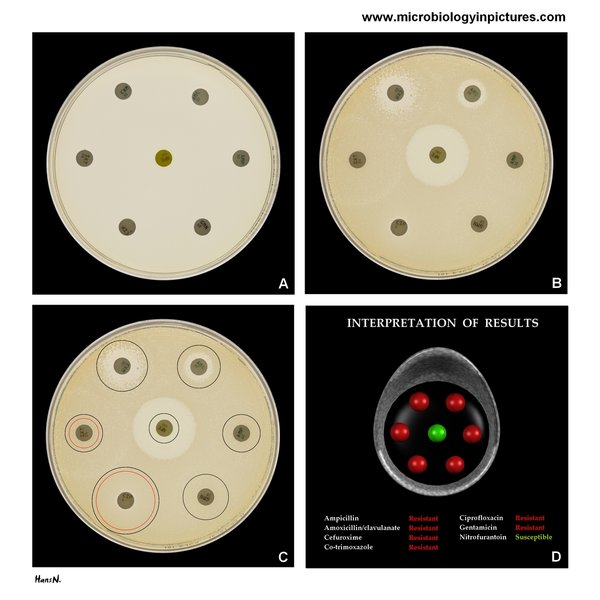
An example of a Kirby-Bauer disk diffusion test demonstrating zones of inhibition around antimicrobial-impregnated disks.
Minimum Inhibitory Concentration (MIC)
The MIC is defined as the lowest concentration of an antimicrobial agent that prevents visible growth of a microorganism after an appropriate incubation period. It is typically determined using broth microdilution or agar dilution methods. For quercetin, MIC values provide a quantitative measure of its bacteriostatic potency against specific bacterial strains.
Minimum Bactericidal Concentration (MBC)
The MBC is the lowest concentration of an antimicrobial agent that kills 99.9% of the initial bacterial inoculum after a specified incubation time. While MIC indicates inhibition of growth, MBC confirms the bactericidal (killing) effect. MBC values are usually equal to or higher than MIC values.
Quercetin's Efficacy Against Specific Gram-Negative Pathogens
Research consistently highlights quercetin's antibacterial potential against a range of Gram-negative bacteria, including those commonly implicated in infections.
Escherichia coli (E. coli)
Escherichia coli is a common bacterium, with some strains causing severe gastrointestinal and extraintestinal infections. Quercetin has shown notable inhibitory effects against E. coli.
MIC and MBC Values for E. coli
- Reported MIC values for quercetin against E. coli typically range from 100–250 µg/mL.
- MBC values are often found to be 200–400 µg/mL, indicating its bactericidal action. Some studies have reported a killing efficiency of up to 99.9% of E. coli at an MIC of 128 µg/mL.
Mechanism and Synergistic Effects
Quercetin's antibacterial action against E. coli is attributed to its ability to disrupt bacterial membrane integrity, leading to leakage of intracellular components and ultimately cell death. It can also prevent biofilm development, a critical virulence factor for many bacterial pathogens. Furthermore, quercetin has been shown to enhance the antibacterial activity of other antibiotics, such as polymyxin E, suggesting its potential in combination therapies to combat resistant E. coli strains.
Pseudomonas aeruginosa (P. aeruginosa)
Pseudomonas aeruginosa is an opportunistic pathogen known for its intrinsic resistance to many antibiotics and its ability to form robust biofilms, making infections challenging to treat. Quercetin demonstrates promising activity against this bacterium.
MIC and MBC Values for P. aeruginosa
- MIC values for quercetin against P. aeruginosa generally fall within the range of 125–500 µg/mL.
- MBC values have been observed between 250–1000 µg/mL.
Anti-biofilm Activity and Synergy
Beyond its direct antibacterial effects, quercetin exhibits significant anti-biofilm activity against P. aeruginosa, even at sub-MIC concentrations. This is particularly important given the role of biofilms in chronic infections and antibiotic resistance. When combined with conventional antibiotics, quercetin can enhance their activity and improve anti-biofilm effects against P. aeruginosa.
Klebsiella pneumoniae (K. pneumoniae)
Klebsiella pneumoniae is a Gram-negative bacterium frequently associated with hospital-acquired infections, especially pneumonia and bloodstream infections, and is increasingly known for its multidrug-resistant phenotypes, including carbapenem-resistant Enterobacteriaceae (CRE).
MIC and MBC Values for K. pneumoniae
- MIC values for quercetin against K. pneumoniae are reported to be in the range of 175–500 µg/mL.
- MBC values are typically 325–800 µg/mL.
Synergy with Antibiotics
Quercetin has shown notable synergistic activity with antibiotics like colistin and meropenem against K. pneumoniae, particularly against carbapenem-resistant strains. This synergy indicates that quercetin could be a valuable adjuvant in treating highly resistant Klebsiella infections, potentially lowering the effective dose of conventional antibiotics and mitigating resistance development.

Illustration depicting the anti-biofilm and antibacterial activities of quercetin and rutin.
Comparative Efficacy of Quercetin Against Pathogens
While specific Kirby-Bauer disk diffusion zone results for quercetin against these exact strains are not uniformly provided across all sources, the available MIC and MBC data offer a clear picture of its effectiveness. The following table summarizes the typical ranges reported for quercetin's activity:
| Bacterium | MIC Range (µg/mL) | MBC Range (µg/mL) | Key Mechanisms / Notes |
|---|---|---|---|
| Escherichia coli | 100–250 | 200–400 | Membrane disruption, biofilm inhibition, synergy with polymyxin E. |
| Pseudomonas aeruginosa | 125–500 | 250–1000 | Strong anti-biofilm activity, suppression of virulence factors (e.g., elastase), synergy with antibiotics. |
| Klebsiella pneumoniae | 175–500 | 325–800 | Synergy with colistin and meropenem, relevant for carbapenem-resistant strains. |
These values demonstrate that quercetin possesses significant activity, often in concentrations achievable in biological systems, especially when considering its synergistic potential with other antimicrobial agents.
Factors Influencing Quercetin's Activity
The observed variations in MIC and MBC values for quercetin can be attributed to several factors:
Bacterial Strain Variation
Different strains of the same bacterial species may exhibit varying levels of susceptibility to quercetin. Genetic differences, presence of efflux pumps, and other resistance mechanisms can influence the MIC and MBC values.
Methodology Differences
Variations in experimental protocols, such as inoculum density, growth media, incubation conditions, and the specific method used for MIC/MBC determination (e.g., broth microdilution vs. agar dilution), can impact results. For the Kirby-Bauer method, factors like disk concentration, agar depth, and incubation temperature are critical for reproducibility.
Formulation and Purity of Quercetin
The purity of the quercetin used and its formulation (e.g., solubility, delivery system) can affect its bioavailability and effective concentration at the site of action, thereby influencing observed antimicrobial activity.
The Mechanism of Action: How Quercetin Fights Bacteria
Quercetin's multifaceted mechanism of action contributes to its broad-spectrum antibacterial activity.
Membrane Disruption
One of the primary ways quercetin exerts its antibacterial effect is by damaging bacterial cell membranes. It can intercalate into the lipid bilayer, increasing membrane permeability, which leads to leakage of essential intracellular components such as ions, ATP, and nucleic acids. This disruption compromises cellular integrity and function, ultimately causing cell death.
Biofilm Inhibition
Biofilms are structured communities of bacteria encased in an extracellular polymeric substance, making them highly resistant to antibiotics and host immune responses. Quercetin effectively inhibits the formation of bacterial biofilms and can even disperse pre-formed biofilms. This activity is crucial for combating chronic and recurrent infections.
Inhibition of Virulence Factors
Beyond direct killing and biofilm inhibition, quercetin can also interfere with bacterial virulence factors, such as quorum sensing, enzyme production (e.g., elastase in P. aeruginosa), and toxin production. By disrupting these processes, quercetin reduces the pathogen's ability to cause disease.
Radar chart illustrating the opinionated effectiveness scores of Quercetin's various antibacterial mechanisms.
The Power of Combination Therapy with Quercetin
One of the most promising aspects of quercetin's antibacterial profile is its ability to act synergistically with conventional antibiotics. This is particularly relevant in an era of increasing antibiotic resistance.
Mindmap illustrating the multifaceted role of quercetin in antibacterial therapy, encompassing its direct actions, synergistic potential, and target pathogens.
By combining quercetin with existing drugs, it may be possible to:
- Lower effective antibiotic dosages: Reducing the amount of antibiotic needed can decrease side effects and slow down the development of resistance.
- Re-sensitize resistant bacteria: Quercetin can interfere with bacterial resistance mechanisms, making previously ineffective antibiotics potent again.
- Broaden the spectrum of activity: The combination may cover a wider range of pathogens than either compound alone.
Bar chart comparing representative MIC and MBC values of quercetin against Escherichia coli, Pseudomonas aeruginosa, and Klebsiella pneumoniae.
This YouTube video provides a visual overview of the Kirby-Bauer test, which is fundamental to determining antimicrobial susceptibility:
This video explains the methodology and interpretation of the Kirby-Bauer disk diffusion test, a standard procedure for assessing bacterial susceptibility to antimicrobial agents.
Future Directions and Clinical Relevance
The consistent demonstration of quercetin's antibacterial activity against critical Gram-negative pathogens like E. coli, P. aeruginosa, and K. pneumoniae underscores its significant potential as a therapeutic agent. Further research is needed to:
- Standardize methodologies: More consistent reporting of Kirby-Bauer zone diameters and MIC/MBC values using standardized protocols would enhance comparability across studies.
- Investigate in vivo efficacy: While in vitro data are promising, studies in animal models and ultimately human clinical trials are essential to confirm its effectiveness and safety in complex biological systems.
- Elucidate optimal combinations: Identifying the most effective synergistic combinations of quercetin with existing antibiotics could lead to new treatment strategies for multidrug-resistant infections.
- Develop improved formulations: Enhancing quercetin's bioavailability and targeted delivery could maximize its therapeutic impact.
Frequently Asked Questions (FAQ)
What is the main difference between MIC and MBC?
Why is the Kirby-Bauer method important?
Can quercetin be used as a standalone antibiotic?
What does "synergy" mean in the context of antibiotics?
Conclusion
Quercetin stands out as a promising natural compound with demonstrable antibacterial activity against important Gram-negative pathogens like Escherichia coli, Pseudomonas aeruginosa, and Klebsiella pneumoniae. Its ability to disrupt bacterial membranes, inhibit biofilm formation, and act synergistically with conventional antibiotics positions it as a valuable candidate for future antimicrobial strategies. As antibiotic resistance continues to be a global health crisis, the exploration and development of compounds like quercetin, particularly in combination therapies, offer a beacon of hope for novel and effective treatments.
Recommended Further Reading
- What are the primary mechanisms by which bacteria develop antibiotic resistance?
- Which other natural compounds exhibit significant antimicrobial properties?
- How do bacterial biofilms contribute to persistent infections and antibiotic treatment failure?
- What are the current advances in synergistic drug combinations for treating infectious diseases?