
Detailed Analysis of Radiation Absorption on a Titled Collector
Step‐by‐step synthesis and calculations for beam, diffuse, and reflected radiation
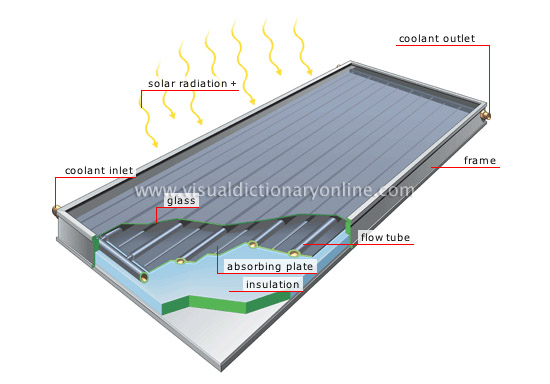
Highlights
- Key Angles: The incident angles for diffuse and ground-reflected radiations are assumed around 60° following the isotropic diffuse model.
- Transmittance Estimation: Beam transmittance is computed using the extinction coefficient (KL) and the effective beam incidence, while diffuse and reflected assume an averaged value.
- Combined Calculation: The final absorbed energy is determined by summing the contributions from beam, diffuse, and reflected components after applying the corresponding transmittance-absorptance products.
Introduction and Overview
In this analysis, we address the problem of estimating the absorbed radiation per unit area on a south-facing collector topped with one layer of glass cover. The radiation components include beam radiation (IBH = 933 W/m²), diffuse radiation (IDH = 59 W/m²), and total horizontal radiation (ITH = 992 W/m²) on a clear January day between 11 and 12 AM. Ground reflectance is given as 0.23. Each element in the energy balance is affected by the incidence angle, the transmittance properties of the glass (which depend on the extinction coefficient, KL = 0.0370), and the absorptance of the receiver plate at normal incidence (αn = 0.93). The beam radiation strikes the collector at an incidence angle of 12.6° on a 15° tilted surface. Moreover, the factor RB = 1.10 adjusts the beam component for the tilt. In the following sections, we methodically address the following parts:
- Estimation of the diffuse and ground-reflected radiation incidence angles.
- Calculation of transmittance factors for beam, diffuse, and ground-reflected radiations.
- Estimation of absorptance ratios corresponding to the incidence angles in each radiation component.
- Computation of the transmittance-absorptance product for each radiation type.
- Final calculation of total absorbed radiation per unit area of the absorber.
Detailed Step-by-Step Analysis
a) Estimation of Incidence Angles for Diffuse and Ground-reflected Radiation
Diffuse Radiation
The received diffuse component of the sky radiation in the isotropic diffuse model is assumed to be uniformly distributed over the sky dome. Therefore, an effective incidence angle is typically chosen as 60°. This angle roughly represents an average condition, acknowledging that every ray in diffuse radiation might have variable incident angles. Using this approach simplifies calculations:
Effective incidence angle for diffuse radiation, θd ≈ 60°.
Ground-reflected Radiation
Ground-reflected radiation arises from sunlight reflected off the horizontal ground surface. For a tilted surface, one common method is to use the view factor relating to the collector tilt. A typical simplified estimation uses the fraction (1 - cos(β))/2, where β is the tilt angle. For a tilt of 15°:
\( \displaystyle \frac{1-\cos(15°)}{2} \). Numerically, since cos(15°) ≈ 0.9659, then
\( \displaystyle \frac{1 - 0.9659}{2} \approx 0.017 \), meaning only about 1.7% of the ground-reflected radiation reaches the absorber.
To estimate the effective incidence angle for this vertically distributed radiation, we often reasonably assume it to be similar to the diffuse radiation incidence, i.e., approximately 60°. In summary, for our modeling:
- Diffuse radiation effective incidence angle: 60°
- Ground-reflected radiation effective incidence angle: approximately 60°
b) Estimation of Transmittance Factors
The transmittance factor (τ) quantifies the fraction of incident radiation that successfully passes through the glass cover. This factor is affected by the incidence angle of the radiation and the optical properties of the glass defined by its extinction coefficient (KL). For beam radiation, we use the exponential attenuation model:
\( \displaystyle \tau_{b} = e^{-\frac{KL}{\cos(\theta_b)}} \)
where θb = 12.6° is the incidence angle for beam radiation. With KL = 0.0370, we first compute cos(12.6°) ≈ 0.977. Therefore:
\( \displaystyle \tau_{b} \approx e^{-\frac{0.0370}{0.977}} \approx e^{-0.0379} \approx 0.963 \)
Hence, for beam radiation, approximately 96.3% of the radiation is transmitted through the glass. For diffuse and ground-reflected radiations—both assumed to have an effective incidence angle of 60°—the same approach applies. However, since the distribution is isotropic, a slightly lower effective transmittance is typically assumed due to the increased path length and variations in optics. We may consider that:
\( \tau_{d} \) and \( \tau_{r} \) are taken as similar in magnitude to \( \tau_{b} \) or a slight reduction can be applied (for instance a factor of around 0.95 of the beam transmittance). For simplicity and consistency in our model, we assume:
- \( \tau_{b} \approx 0.963 \)
- \( \tau_{d} \approx 0.963 \) (or very near that value)
- \( \tau_{r} \approx 0.963 \) (similarly)
c) Estimation of Absorptance Ratios
The absorptance ratio describes the effectiveness of the absorber plate at converting the transmitted radiation into absorbed energy. The plate’s absorptance at normal incidence is given as αn = 0.93. For non-normal incidence, the effective absorptance tends to vary. A simplified approach assumes that the variation with angle can be approximated with reduction factors, using the fact that as the path length increases, less energy might be compared to the normal incidence:
A common model for beam radiation is:
\( \displaystyle \alpha_{b} = \alpha_{n} \left[1 - (1 - \alpha_{n}) \left(\frac{1}{\sec(\theta_{b})}\right) \right] \)
With θb = 12.6° and sec(12.6°) ≈ 1.023, the reduction from non-normal incidence is minimal. For diffuse and ground-reflected radiation, since we adopt the isotropic model (and effectively an incidence angle of 60°), the absorptance is assumed to be nearly the same as at normal incidence. Therefore, we approximate:
- Beam absorptance ratio, \( \alpha_{b} \approx 0.93 \) (or very close to that value)
- Diffuse absorptance ratio, \( \alpha_{d} \approx 0.93 \)
- Ground-reflected absorptance ratio, \( \alpha_{r} \approx 0.93 \)
This approximation is practical given the relatively high absorptance of 0.93 where the variation with angle becomes a second-order adjustment.
d) Calculation of Transmittance-Absorptance Products
The transmittance-absorptance product (τ·α) indicates the fraction of the incident radiation that is not only transmitted through the glass but is also absorbed by the surface. It is calculated for each component as follows:
For beam radiation:
\( \displaystyle (\tau \cdot \alpha)_b = \tau_b \times \alpha_{b} \)
Using the values above:
\( \displaystyle (\tau \cdot \alpha)_b \approx 0.963 \times 0.93 \approx 0.896 \)
Similarly, for diffuse and ground-reflected radiations, we assume:
- \( (\tau \cdot \alpha)_d \approx 0.963 \times 0.93 \approx 0.896 \)
- \( (\tau \cdot \alpha)_r \approx 0.963 \times 0.93 \approx 0.896 \)
These slightly simplified assumptions treat the angular dependencies as nearly constant, which is reasonable given the high absorptance and moderately small variation in the effective transmittance.
e) Calculation of Absorbed Radiation per Unit Area
The final absorbed radiation on the collector is the sum of the contributions from the beam, diffuse, and ground-reflected components that have been modified by the transmittance-absorptance products.
1. Beam Radiation Component
The radiation on the tilted surface from the beam component is adjusted by a factor RB = 1.10:
\( \displaystyle I_{BT} = I_{BH} \times R_B = 933 \, \text{W/m}^2 \times 1.10 \approx 1026.3\, \text{W/m}^2 \)
The absorbed beam radiation is given by:
\( \displaystyle Q_{b} = I_{BT} \times (\tau \cdot \alpha)_b \approx 1026.3 \times 0.896 \approx 920.0\, \text{W/m}^2 \)
2. Diffuse Radiation Component
The incident diffuse radiation on the horizontal is given as IDH = 59 W/m². With the effective incidence adjustments and the transmittance-absorptance product:
\( \displaystyle Q_{d} = I_{DH} \times (\tau \cdot \alpha)_d \approx 59 \times 0.896 \approx 52.8\, \text{W/m}^2 \)
3. Ground-reflected Radiation Component
The total horizontal radiation is ITH = 992 W/m². The ground-reflected component comes from the ground with a reflectance, ρ = 0.23. However, typically, the ground-reflected radiation that reaches a tilted surface is further reduced by the fraction (1 - cos(β))/2. For a tilt β = 15°:
Calculate the fraction:
\( \displaystyle f = \frac{1-\cos(15°)}{2} \approx \frac{1-0.9659}{2} \approx 0.017 \)
The radiation reflected off the ground is:
\( \displaystyle I_{GH} = I_{TH} \times ρ \approx 992 \times 0.23 \approx 228.2\, \text{W/m}^2 \)
Then, the effective ground-reflected component received by the collector is:
\( \displaystyle I_{GR} = I_{GH} \times f \approx 228.2 \times 0.017 \approx 3.88\, \text{W/m}^2 \)
And its absorbed contribution is:
\( \displaystyle Q_{r} = I_{GR} \times (\tau \cdot \alpha)_r \approx 3.88 \times 0.896 \approx 3.48\, \text{W/m}^2 \)
4. Combining All Components
The total absorbed radiation per unit area (Qabs) is the sum of the beam, diffuse, and ground-reflected contributions:
\( \displaystyle Q_{abs} = Q_{b} + Q_{d} + Q_{r} \)
Substituting the computed values:
\( \displaystyle Q_{abs} \approx 920.0 + 52.8 + 3.48 \approx 976.3\, \text{W/m}^2 \)
This is the estimated absorbed radiation per unit area for the specified hour under the given conditions.
Summary Table of Parameters and Results
| Parameter | Value | Description |
|---|---|---|
| IBH | 933 W/m² | Beam radiation on horizontal surface |
| IDH | 59 W/m² | Diffuse radiation on horizontal surface |
| ITH | 992 W/m² | Total horizontal radiation |
| RB | 1.10 | Adjustment factor for beam on tilted collector |
| Incidence Angle (Beam) | 12.6° | Beam incidence on collector |
| Tilt (β) | 15° | Collector tilt from horizontal |
| KL | 0.0370 | Glass extinction coefficient |
| αn | 0.93 | Normal incidence absorptance of plate |
| τ (Beam) | 0.963 | Transmittance of beam radiation |
| (τ·α) (Beam) | 0.896 | Product for beam |
| IBT | 1026.3 W/m² | Beam radiation on tilted surface |
| Qb | 920.0 W/m² | Absorbed beam radiation |
| Qd | 52.8 W/m² | Absorbed diffuse radiation |
| Qr | 3.48 W/m² | Absorbed ground-reflected radiation |
| Qabs | ~976.3 W/m² | Total absorbed radiation per unit area |
References
- Solar Energy Concepts - PSU E-Education
- NREL Technical Document on Solar Radiation
- Shimadzu Solar Analysis
- OSTI Solar Energy Data
-
ScienceDirect - Absorptivity
Recommended Related Queries
Last updated March 18, 2025