
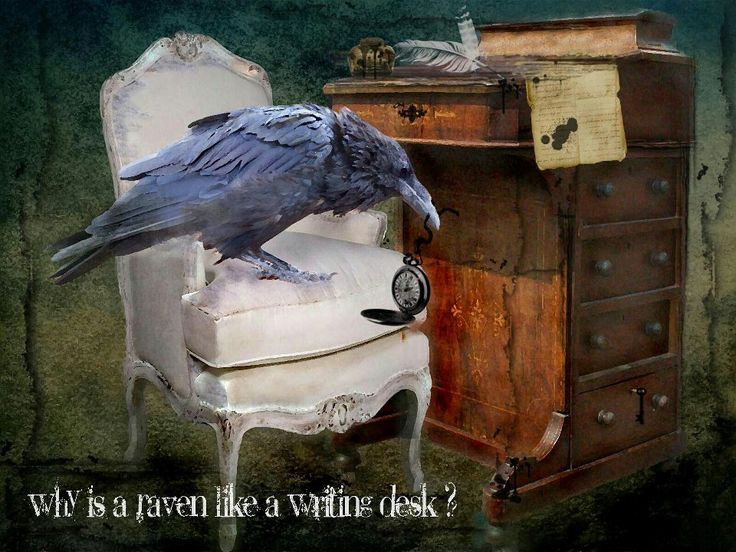
Why is a Raven Like a Writing Desk?
Exploring one of literature’s most fanciful enigmas
Key Insights
- Nonsensical Origins: The riddle was originally intended to have no answer and epitomizes the whimsical absurdity of Carroll’s work.
- Carroll’s Playful Answer: Lewis Carroll himself later proposed, “Because it can produce a few notes, though they are very flat; and it is never put with the wrong end in front!”
- Enduring Interpretations: Various creative wordplays and interpretations have emerged over time, each offering a different playful perspective.
Historical Context and Background
In Lewis Carroll’s celebrated novel, Alice’s Adventures in Wonderland, the riddle “Why is a raven like a writing desk?” is presented during the Mad Hatter’s tea party, a scene that epitomizes the absurdity and playful inversion of logic that defines the narrative. Carroll deliberately crafted the riddle as a paradox without a conventional answer, reflecting the dream-like, unpredictable nature of Wonderland.
Initially, readers were left to ponder a question that, by design, defied traditional logic and rational interpretation. This ambiguity not only amplified the enigmatic atmosphere of the story but also prompted imaginative responses from audiences, leading to a rich tradition of alternate answers proposed by both literary critics and enthusiastic fans.
Lewis Carroll’s Own Answer
Faced with mounting curiosity and inquiries about the riddle, Carroll eventually provided his own answer in an 1897 revision of the book. His reply was:
“Because it can produce a few notes, though they are very flat; and it is never put with the wrong end in front!”
This answer exemplifies Carroll’s characteristic blend of literary wit and linguistic playfulness. The “notes” allude both to musical tones and written messages, while the phrase about not being “put with the wrong end in front” reinforces the idea of proper orientation, treating the riddle as a double entendre and pun. In this response, a dual layer of meaning emerges that ties together the concept of writing and music, highlighting how two seemingly disparate objects share common playful associations.
Diverse Interpretations Over Time
The inherent ambiguity of the riddle has spurred a multitude of creative interpretations. Some of the more popular interpretations include:
Wordplay and Puns
Several responses play with the sound and structure of the words involved:
- Some suggest that both ravens and writing desks are related to “notes.” Ravens produce harsh, flat sounds—akin to musical notes—while writing desks are places where one writes notes. The word “notes” in both cases connects the two concepts through a pun on the word's multiple meanings.
- Others focus on the physical and metaphorical elements, inventing clever wordplay such as “flapping fits” for ravens and “fitting flaps” for desks. These playful twists show how language can bend logic, inviting readers to engage with the riddle in a humorous, light-hearted manner.
- There is also an interpretation where one is “good for writing books” and the other “better for biting rooks,” showcasing how similar sounds and playful imagery can be combined to form an amusing juxtaposition.
Symbolic and Metaphorical Interpretations
Beyond mere wordplay, some interpretations explore deeper symbolic meanings:
- The raven, a creature often associated with mystery, foreboding, and even death (as seen in the works of Edgar Allan Poe), carries with it a weight of literary symbolism. In contrast, a writing desk is associated with the process of creation and documentation. Thus, the riddle may suggest a bridge between death (symbolized by the raven) and the creative act (symbolized by writing), hinting at the cyclical nature of ending and beginning.
- The juxtaposition may also be read as a commentary on the absurdity of seeking logic in art and literature. In Wonderland, where conventional reason is subverted, the impossibility of discovering a coherent connection between a raven and a writing desk mirrors the broader theme of chaos masked as order.
Cultural and Literary Impact
Over the decades, the riddle has transcended its original literary confines to become a cultural touchstone. Its presence in discussions across different media—from literary analyses to internet forums—demonstrates how Carroll’s playful inquiry has sparked continuous debate:
- Literary critics often cite the riddle as an example of the absurdist tone of Alice’s Adventures in Wonderland, a work that challenges the conventional boundaries between logic and nonsense.
- Academics have interpreted the riddle as a manifestation of the modernist exploration of meaninglessness, where attempts to derive structured truth from absurdity become a commentary on modern life’s inherent contradictions.
- Casual readers and fans have adapted the riddle into various contexts, using it as a playful prompt to stretch the imagination and engage in community rituals of shared wordplay.
Comparative Analysis: Common Answer Variations
To provide a broader view of the creative solutions proposed over the years, the following table summarizes several popular interpretations alongside Carroll’s own explanation:
| Interpretation | Description | Key Elements |
|---|---|---|
| Carroll’s Official Answer | It can produce a few notes (both literal and figurative) and is never oriented incorrectly. | Wordplay, dual meaning of “notes”, orientation pun |
| Musical Note Connection | Ravens produce cawing notes while writing desks allow for the creation of written notes, paralleling musical notes that are flat. | Punning on “notes”, flat sounds, creative imagery |
| Physical Attributes | Both are described with elements like “legs” or “flaps,” invoking a playful comparison between natural behavior and inanimate structure. | Flapping, physical resemblance, wordplay |
| Symbolism and Duality | The contrast between a creature linked to mystery and a tool of creation demonstrates the dichotomy between life and art, death and writing. | Symbolism, literary references, metaphor |
| Cultural Commentary | The riddle is seen as a reflection on the absurdity inherent in life, urging readers to embrace the nonsensical rather than insisting on rational answers. | Absurdity, cultural impact, existential musings |
Further Discussion on Thematic Elements
Delving deeper into the themes inspired by the riddle, one may observe the following elements that bind the interpretations:
Absurdity in Literature
The riddle serves as a quintessential example of literary absurdity. In the context of Alice’s Adventures in Wonderland, it functions as a narrative device that encourages readers to question the necessity for coherent meaning in a fantastical world. The very act of proposing a question that defies logic challenges the reader to let go of conventional expectations and embrace ambiguity.
This embrace of the nonsensical is mirrored in the work of other modernist authors who have used similar devices to explore themes of existential uncertainty and the breakdown of traditional narrative forms.
Wordplay and the Flexibility of Language
Language itself is at the heart of Carroll’s riddle. The interplay between the multiple meanings of the word “notes” exemplifies how language can be manipulated to create humorous and unexpected connections. In this way, the riddle celebrates the fluidity of language and its potential for both clarity and confusion, inviting readers into a space where rigid definitions are cast aside.
The resultant playful ambiguity is a reminder that words can evoke multiple images and ideas simultaneously, a notion that has made the riddle a rich source for both scholarly debate and casual amusement.
The Role of Interpretation in Meaning-Making
One of the most compelling aspects of the riddle is its open-ended nature, which has encouraged an ongoing dialogue about the nature of meaning itself. While Carroll’s official answer offers a clever play on words, the countless alternative responses highlight the subjective nature of interpretation. Each answer reflects a different facet of creativity, with some focusing on physical or phonetic similarities and others exploring metaphorical or symbolic connections.
This plurality of interpretations is significant in that it underscores how meaning is not fixed but is instead continuously constructed through cultural, literary, and individual lenses. As readers contribute their own interpretations, they engage in an active process where the riddle transforms into a communal and evolving conversation about art, language, and absurdity.
The Riddle’s Legacy in Modern Thought
Influence on Literary Criticism and Popular Culture
Over the years, the riddle has seeped into various corners of popular culture, often cited in discussions on literature, philosophy, and even psychology. Its seemingly nonsensical structure resonates with modernist themes, where the breaking down of established forms reflects broader shifts in societal and cultural paradigms.
Moreover, its cleverly ambiguous nature has made it a favorite reference in academic circles and casual conversations alike, reinforcing the impact of Lewis Carroll’s work on contemporary thought and the enduring power of imaginative literature.
Public Engagement and Creative Interpretations
The riddle continues to inspire creative responses on internet forums, social media platforms, and literary gatherings. Fans often craft their own versions of the answer, adding humorous twists and even memes that connect the riddle to everyday experiences. This lively engagement highlights the ways in which a piece of literature can grow beyond its original context to become a living and evolving part of cultural discourse.
A Comparative Table of Notable Responses
Below is a table summarizing some of the creative responses to this riddle, illustrating the diversity in interpretation:
| Response Category | Example Answer | Interpretative Angle |
|---|---|---|
| Carroll’s Official Answer | It can produce a few notes, though they are very flat; and it is never put with the wrong end in front! | Wordplay with "notes" and object orientation |
| Phonetic Wordplay | Both possess elements like “flapping fits” and “fitting flaps” | Playful comparison of physical actions |
| Symbolic Association | A raven as a harbinger of death and a writing desk as a repository for creative life | Dualism between creation and inevitable end |
| Literal Interpretation | Both have "legs" - physical supports for a living creature and an inanimate object | Physical similarities drawn from structure |
Conclusion
In conclusion, the riddle “Why is a raven like a writing desk?” remains one of the most delightful and enduring enigmas in literary history, largely because it resists a single, unequivocal answer. Initially crafted as an exercise in absurdity by Lewis Carroll, the riddle embodies a playful subversion of logical expectations. Carroll’s own answer—a clever play on the dual meanings of “notes”—captures the essence of the whimsical humor found throughout Alice’s Adventures in Wonderland.
Over time, the riddle has invited a rich array of interpretations. Creative enthusiasts have explored puns, wordplay, and symbolic implications, linking the raven and the writing desk in imaginative ways that include both physical similarities and abstract dualities. Whether one emphasizes the acoustic, literary, or existential aspects of the riddle, its open-ended nature has made it a constant source of debate and inspiration across different eras and disciplines.
The enduring charm of this riddle lies in its invitation to think outside conventional boundaries. It challenges us to embrace ambiguity and appreciate the multifaceted connections that can exist between disparate elements of language and life. In a broader sense, the riddle reflects the creative potential inherent in every act of inquiry—reminding us that sometimes, the beauty of a question lies in its very lack of a definitive answer.
References
- Why Is a Raven Like a Writing Desk? - Writers Write
- Raven Writing Desk Riddle Answer - Brainly
- Why is a Raven Like a Writing Desk? - Literature StackExchange
- Weekly Notes & Queries - The Guardian
- Why is a Raven Like a Writing Desk? - SciFi StackExchange
Recommended Queries
 mysteriesland.wordpress.com
 terrytao.wordpress.com
Last updated February 24, 2025