
The Interconnectivity Impasse: Why RCS/RBM's Fractured Network Stifles Its Messaging Revolution
Unpacking the critical barriers hindering Rich Communication Services from achieving universal reach and challenging established giants.
Rich Communication Services (RCS) and its enterprise-focused counterpart, RCS Business Messaging (RBM), represent a significant evolution in mobile communication, aiming to transcend the limitations of traditional SMS and MMS. By offering features like high-resolution photo and video sharing, read receipts, typing indicators, interactive carousels, and verified business profiles, RCS promises a messaging experience comparable to popular Over-The-Top (OTT) applications. However, the realization of this potential is severely constrained by a fundamental challenge: the lack of seamless interconnectivity between Mobile Network Operators (MNOs), both within individual countries and across international borders. This pervasive issue directly impacts market coverage, creates substantial hurdles for large enterprises, and weakens RCS/RBM's ability to compete effectively against established messaging titans like Meta's WhatsApp and Messenger.
Key Insights: The Core of the RCS Interconnectivity Challenge
- Fragmented Ecosystem: The primary roadblock to RCS/RBM's widespread success is the inconsistent and often absent interconnectivity among MNOs, leading to a siloed and unreliable user experience.
- Restricted Market Penetration: Interconnectivity gaps significantly limit the overall market reach of RCS/RBM, diminishing its attractiveness for both individual consumers and businesses seeking broad, consistent communication channels.
- Enterprise Adoption Dilemma: For large enterprises, the promise of RBM for enhanced customer engagement is undermined by unreliable message delivery and feature degradation across networks, making full-scale adoption risky and complex.
- Competitive Disadvantage: To effectively challenge globally unified OTT platforms like those offered by Meta, RCS/RBM must first solve its fundamental interconnectivity problems to offer a truly ubiquitous and feature-rich alternative.
Understanding RCS/RBM and the Interconnectivity Imperative
The Foundation of Modern Mobile Messaging
Unlike OTT messaging apps that operate over internet data connections independently of mobile carriers, RCS is a communication protocol standard designed to be an evolution of SMS/MMS, delivered through MNO networks. It relies on the IP Multimedia Subsystem (IMS) infrastructure. RBM is specifically the application-to-person (A2P) component, enabling businesses to send rich, interactive messages to consumers.
Interconnectivity in the RCS context refers to the capability of MNOs to seamlessly exchange RCS messages between their respective subscribers, ensuring that all rich features (e.g., read receipts, typing indicators, high-resolution media, interactive buttons) are preserved regardless of the sender's or recipient's network. This is far more complex than traditional SMS interconnectivity, which handles simple text and has long-established global agreements. RCS's richer feature set requires more sophisticated and standardized technical integrations and commercial agreements between MNOs.
The GSMA's Universal Profile is a specification intended to standardize RCS features and facilitate interoperability. However, its adoption and consistent implementation across all MNOs remain a significant hurdle.
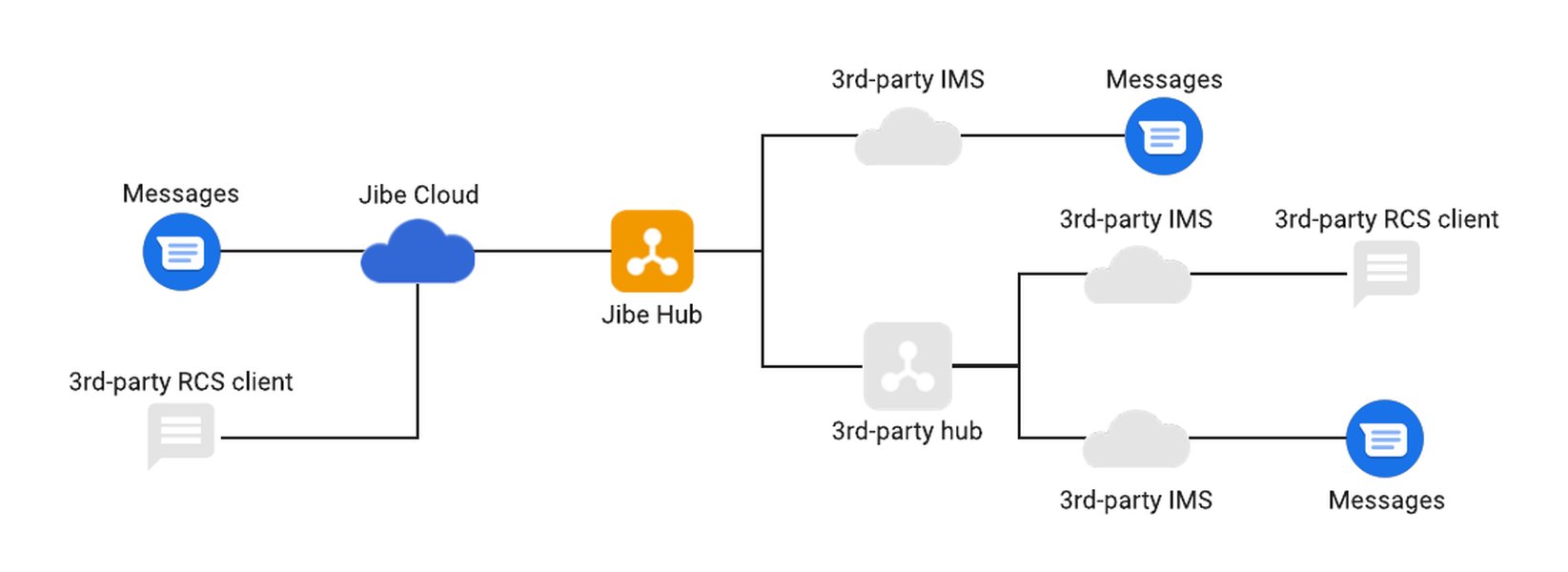
RCS Architecture: A network-centric approach to rich messaging.
The Domestic Divide: Interconnectivity Issues Within National Borders
Fragmentation on Home Ground
Even within a single country, achieving full RCS interconnectivity among all MNOs has proven challenging. Several factors contribute to this domestic fragmentation:
Siloed Deployments and Inconsistent Standards
Many MNOs have launched their own RCS services, but often without ensuring full interconnection with competing operators' RCS networks. This can lead to situations where an RCS message sent from a user on Carrier A to a user on Carrier B (both within the same country) might lose its rich features and revert to basic SMS, or fail to deliver properly if the networks are not seamlessly linked. For instance, in markets like the United States, there have been historical challenges in achieving full inter-carrier RCS functionality between major players like Verizon and AT&T, though progress is ongoing. Discrepancies in implementing different versions or configurations of the RCS Universal Profile can also lead to interoperability problems.
Commercial and Competitive Concerns
MNOs may hesitate to fully interconnect due to commercial considerations. Concerns about revenue sharing for RBM traffic, maintaining control over their customer base, or fear of enabling competitors can slow down or prevent comprehensive domestic interconnectivity agreements. The business model for RBM, particularly A2P messaging, necessitates clear agreements on traffic handling and monetization, which can be complex to negotiate among domestic rivals.
Impact on User Experience and Adoption
This domestic fragmentation leads to an inconsistent and often frustrating user experience. If users cannot reliably send or receive RCS messages with all their contacts, regardless of their mobile operator, they are less likely to adopt RCS as their primary messaging platform. This, in turn, affects the perceived value and reach of RBM for businesses aiming to engage domestic customers.
The International Labyrinth: Cross-Border Interconnectivity Challenges
Global Reach Hindered by Complexity
The problem of RCS/RBM interconnectivity becomes even more acute at the international level. Sending an RCS message from one country to another involves navigating a more complex web of technical, commercial, and regulatory challenges:
Diverse Operator Landscapes and Technical Variations
The global mobile landscape is a patchwork of hundreds of MNOs, each with varying degrees of RCS adoption, different versions of the Universal Profile (if adopted at all), and disparate network capabilities. Establishing bilateral or multilateral interconnectivity agreements between all these operators is a monumental task. Routing messages internationally while preserving all RCS features requires compatible systems and protocols across all involved networks.
Lack of a Unified Global Framework
Unlike SMS, which benefits from long-standing global roaming and interconnect agreements, RCS currently lacks a universally adopted global clearinghouse or interconnect hub system that can seamlessly bridge all MNOs. While some hub providers are working to fill this gap, their coverage is not yet universal, leading to "ecosystem fragmentation" where certain regions or operators remain isolated.
Regulatory and Roaming Complexities
Cross-border data transfer regulations, privacy laws (like GDPR), and anti-spam policies differ significantly between countries. MNOs must ensure compliance when exchanging richer RCS data internationally, adding layers of complexity to interconnectivity agreements. Furthermore, managing billing and settlement for international RBM traffic requires robust systems and agreements.
Impact on Market Coverage: A Restricted Horizon
The direct consequence of these domestic and international interconnectivity failures is severely limited market coverage for RCS/RBM. For RCS to become a truly viable alternative to SMS or dominant OTT apps, it needs to achieve a critical mass of users who can communicate seamlessly with each other. Fragmentation prevents this:
- Reduced Reach: If users on different networks or in different countries cannot reliably exchange RCS messages, the effective reach of the service is confined to intra-network communication or within small clusters of interconnected MNOs. This limits the potential audience for both P2P (Person-to-Person) RCS and A2P RBM.
- The Fallback Dilemma: When an RCS message cannot be delivered with its rich features due to interconnectivity issues, it often defaults to a basic SMS. This "fallback" not only degrades the user experience but also negates the core advantages of RCS, making it appear unreliable or no better than older technologies.
- Stifled Growth and Adoption: Inconsistent experiences and limited reach discourage both consumer adoption and enterprise investment in RBM. If businesses cannot be confident that their rich messages will reach their entire target audience effectively, they are less likely to prioritize RBM in their communication strategies. This creates a vicious cycle of low demand and insufficient MNO collaboration on interconnectivity.
Even with significant developments like Apple's announcement to support RCS on iOS (starting with iOS 18), which is poised to dramatically increase the number of RCS-capable devices, the underlying issue of MNO interconnectivity must be resolved to fully capitalize on this expanded potential user base. Without it, the promise of a unified messaging experience across Android and iOS will remain partially unfulfilled.
Critical Importance for Large Enterprises: The RBM Conundrum
Large enterprises, from retail and banking to travel and healthcare, see immense potential in RBM for transforming customer communication. RBM offers features that can significantly enhance engagement, build trust, and streamline services:
- Rich, Interactive Campaigns: Sending messages with high-resolution images, videos, carousels, suggested replies, and interactive buttons.
- Verified Business Profiles: Increasing customer trust and reducing spam by displaying official brand logos and verification checkmarks.
- Improved Customer Service: Facilitating two-way conversations, appointment scheduling, order tracking, and support directly within the messaging app.
However, the lack of seamless interconnectivity directly undermines these benefits for enterprises:
The Enterprise Impact of Interconnectivity Gaps
The table below illustrates how interconnectivity problems affect key RBM features and their value to large businesses:
| RBM Feature | Potential Enterprise Benefit | Impact of Poor Interconnectivity |
|---|---|---|
| High-Resolution Media (Images, Videos) | Visually engaging product showcases, tutorials, and brand storytelling. | Messages may fallback to SMS (no media) or MMS (lower quality, less reliable), losing visual impact. |
| Interactive Buttons & Suggested Replies | Streamlined customer interactions, quick feedback, easy navigation to websites or apps. | Buttons may not render, forcing users into more cumbersome interaction methods or message fallback to plain text. |
| Carousels | Showcasing multiple products, services, or options in a single, interactive message. | Carousel functionality lost on fallback; message content may become disjointed or undeliverable as intended. |
| Verified Sender Profile & Branding | Enhanced brand recognition, trust, and reduced phishing/spam concerns. | Verification and branding may not display if the message traverses non-interconnected networks or if the recipient's client doesn't fully support it, eroding trust. |
| Read Receipts & Typing Indicators | Better understanding of message engagement and real-time conversation flow. | These features are often lost across non-interconnected networks, diminishing conversational context for customer support. |
| Consistent Global Campaigns | Ability for multinational corporations to deploy unified RBM strategies across all markets. | International interconnectivity gaps force businesses to use different messaging strategies per region or default to SMS, increasing complexity and cost, and reducing campaign effectiveness. |
This unreliability means businesses cannot depend on RBM for mission-critical communications or large-scale marketing campaigns if a significant portion of their customer base might not receive the intended rich experience. This uncertainty forces enterprises to maintain parallel communication strategies (e.g., relying heavily on SMS or email as primary channels), thus increasing operational complexity and costs, and diluting the potential ROI from RBM investments.
The Competitive Arena: RCS/RBM vs. Meta's Messaging Dominance
RCS, backed by MNOs and major tech players like Google, is often positioned as the telecom industry's answer to the overwhelming dominance of OTT messaging applications, particularly WhatsApp and Facebook Messenger, both owned by Meta. These OTT platforms have captured billions of users worldwide by offering rich features, cross-platform availability, and, crucially, seamless global interoperability that operates independently of MNO network boundaries (beyond requiring data access).
The interconnectivity woes of RCS/RBM significantly weaken its competitive stance against these giants:
Visualizing the Competitive Landscape
The following mindmap illustrates the key challenges RCS faces in its bid to compete, with interconnectivity at its core:
Key Competitive Disadvantages Stemming from Interconnectivity:
- Uniformity vs. Fragmentation: Meta's platforms offer a consistent, rich experience to all users globally. In contrast, RCS users may experience a downgraded service when communicating across different networks or internationally due to interconnectivity failures. This makes RCS less appealing to users accustomed to the seamless nature of OTT apps.
- Reach and Reliability: Businesses are drawn to platforms like WhatsApp Business API because of their massive, interconnected user base and reliable delivery of rich messages. RBM struggles to offer comparable guarantees as long as its reach is fragmented.
- Network Effects: OTT platforms benefit from strong network effects – the more users a platform has, the more valuable it becomes. RCS's growth and ability to build similar network effects are stunted by the barriers that prevent universal communication.
- Pace of Innovation and Deployment: OTT players can often innovate and deploy new features globally more rapidly than the MNO-driven RCS ecosystem, which requires coordination among many independent operators to ensure interoperability of new functionalities.
Unless the interconnectivity puzzle is solved, RCS/RBM will find it challenging to dislodge users and businesses from Meta's well-entrenched messaging services, limiting MNOs' ability to reclaim a significant share of the messaging market, especially for A2P communications.
Bridging the Gaps: Efforts and Solutions for RCS Interconnectivity
Addressing the interconnectivity challenge is paramount for the future of RCS/RBM. Various industry efforts are underway, though progress can be slow:
Advancing the Universal Profile
The GSMA continues to promote the Universal Profile as a common standard for RCS features and technical specifications. Wider and more consistent adoption by MNOs globally is crucial for reducing technical incompatibilities that hinder interconnection.
Interconnect Hubs and Aggregators
Several companies operate or are developing RCS interconnect hubs. These hubs act as intermediaries, connecting multiple MNO networks and simplifying the process of establishing bilateral agreements. By connecting to a hub, an MNO can potentially gain reach to many other operators. Aggregators also play a role in enabling businesses to send RBM messages across various networks, often navigating some of the underlying interconnect complexities on behalf of enterprises.
Commercial Frameworks and Collaboration
There's a growing recognition among MNOs of the need for more collaborative commercial models for RCS, including transparent revenue-sharing for RBM traffic and standardized agreements. Industry forums and consortiums are working on these aspects.
Regulatory Influence
In some regions, regulators may play a role by encouraging or even mandating greater interoperability between communication services to benefit consumers and promote competition. However, direct regulatory intervention in RCS interconnectivity is not widespread.
Technological Advancements
Ongoing developments in IMS core networks and messaging platforms aim to make RCS deployment and interconnection more efficient and cost-effective for MNOs.
RCS/RBM Potential vs. Current Reality: An Interconnectivity Perspective
The following chart visualizes key aspects of RCS/RBM, comparing its current state (often limited by interconnectivity) with its potential if interconnectivity challenges were fully resolved. The scores are illustrative, representing a qualitative assessment.
This chart underscores that while RCS/RBM has high inherent potential in terms of features, its actualized benefits in market coverage, user experience, and competitive strength are significantly dampened by the prevailing interconnectivity issues. Overcoming these is key to bridging the gap between current performance and future promise.
This video discusses the future of messaging with RCS, touching upon deployment, carrier support, and global adoption challenges, which are directly related to the interconnectivity issues discussed.
Frequently Asked Questions (FAQ)
What exactly is RCS/RBM interconnectivity and why is it a major problem?
RCS/RBM interconnectivity refers to the ability for Rich Communication Services messages to be seamlessly exchanged between users on different Mobile Network Operators (MNOs), both domestically and internationally, while retaining all their rich features (like high-res images, read receipts, interactive buttons). It's a major problem because many MNOs have not fully established these connections. This results in a fragmented service where messages might revert to basic SMS, lose features, or not deliver reliably, undermining the core value proposition of RCS as a universal, enhanced messaging standard.
How does poor interconnectivity specifically impact large enterprises using RBM?
For large enterprises, poor interconnectivity means they cannot reliably reach their entire customer base with the rich, interactive RBM experience they design. Campaigns may suffer from inconsistent delivery, with messages falling back to less effective SMS for a portion of recipients. This limits the ROI of RBM investments, complicates campaign management (as businesses must account for these inconsistencies), reduces customer engagement potential, and can damage brand perception if the messaging experience is flawed. It also hinders the ability to use RBM for critical global communications if international interconnectivity is weak.
Can RCS/RBM truly compete with Meta's messaging platforms (like WhatsApp) without solving these interconnectivity issues?
It's highly unlikely. Meta's platforms (WhatsApp, Facebook Messenger) offer a globally seamless, feature-rich, and consistent user experience, independent of mobile operator networks. This is a key reason for their dominance. RCS/RBM, being carrier-dependent, needs to achieve a similar level of ubiquity and reliability through comprehensive interconnectivity. Without it, RCS remains a fragmented offering that cannot match the unified experience of its OTT competitors, making it difficult to persuade users and businesses to switch or prioritize it as their primary messaging channel.
What steps are being taken to improve RCS interconnectivity?
Several efforts are ongoing, including:
- Promotion of the GSMA's Universal Profile to standardize RCS implementations across MNOs.
- Development and utilization of RCS interconnect hubs and aggregation platforms that simplify linking multiple MNO networks.
- Industry collaborations to establish common commercial frameworks, revenue-sharing models, and anti-spam measures.
- Technological advancements in IMS and messaging platforms to ease RCS deployment and interconnection for operators.
Recommended Reads & Further Exploration
- What are the specific technical challenges MNOs face when trying to interconnect their RCS platforms?
- How does Apple's adoption of RCS impact the urgency for MNOs to solve interconnectivity problems?
- Explore case studies of successful RBM campaigns and how they navigated market coverage limitations.
- What is the role of RCS interconnect hubs and how effective are they in creating a unified global RCS network?
References
Last updated May 19, 2025