
Finding the Reactor Shell Jacket Area
Comprehensive guide on calculating jacket areas for reactors
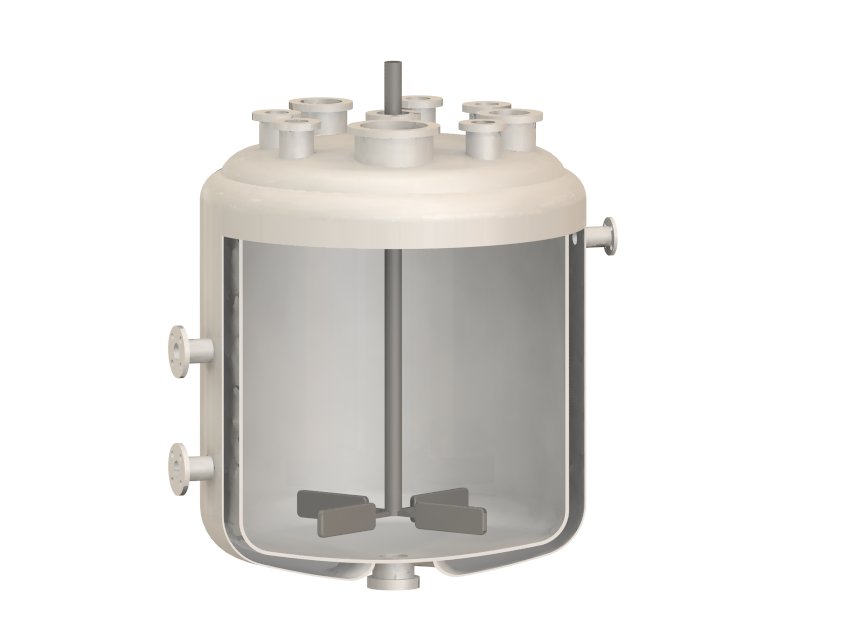
Key Highlights
- Calculation Methods: Use the cylindrical perimeter and dish formulas including adjustments for jacket types.
- Jacket Types Matter: Different designs (annular, half-pipe, limpet coil) affect effective heat transfer area.
- Overall Approach: Combine the heat transfer area of the cylinder with end areas (e.g., torispherical) and apply occupancy factors if necessary.
Understanding the Reactor Shell and Jacket Concepts
When calculating the reactor shell jacket area, the goal is to determine the surface area in contact with the jacket that facilitates heat exchange. The design and operation of reactors often require precise understanding of the heat transfer capabilities offered by the jacket area. This area is not only essential for maintaining optimum temperature conditions inside the reactor but also for ensuring that treatments such as cooling or heating are carried out efficiently.
Composition of the Jacket
The heat transfer area is generally composed of two main parts:
- Cylindrical Surface Area: The lateral surface of the reactor’s vertical cylindrical section.
- End Areas: Depending on vessel design, these can be torispherical, hemispherical, or semi-elliptical. Each type has its own specific calculation method, with the torispherical dish being one of the more common configurations in many reactors.
Importance of Jacket Type
The design and type of jacket greatly influence both the overall heat transfer coefficient and the effective heat transfer area. For instance:
- Conventional Annular Jackets: The most basic type, where the effective area is calculated primarily from the cylindrical surface.
- Limpet Coil Jackets: These are designed with a series of contiguous coil rings whose gaps increase the effective surface area. Typically, the effective heat transfer area here is approximately 90% of the total coil surface area.
- Half-Pipe Jackets: These incorporate a curved design element which requires consideration of additional surface enhancements when determining the heat transfer area.
Step-by-Step Calculation Procedure
To determine the reactor shell jacket area, follow these well-defined steps. The overall method typically consists of evaluating the cylindrical surface and the jacketed ends, and then summing these areas. Most calculations assume that the reactor and jacket are perfectly matched, but some adjustments might be necessary based on the actual occupancy or design efficiency.
Step 1: Calculate the Cylindrical Surface Area
Formula
For the cylindrical part of the reactor, imagine “unrolling” the surface to form a rectangle. The length of the rectangle is the circumference (perimeter) of the cylinder, and the width is the height of the cylindrical section (H). The formula is given by:
\( A_{cylinder} = \pi \times D \times H \)
Here, D represents the outer diameter of the reactor shell while H is the height of the cylindrical portion.
Step 2: Calculate the End or Dish Area
Torispherical Ends
For reactors with a torispherical bottom (or top), the dish area is considered using an approximated regression formula:
\( A_{dish} \approx 1.147 \times \left(\frac{\pi \times D^2}{4}\right) \)
This equation takes into account the curvature effects of the torispherical design, where D is again the outer diameter of the vessel. If the reactor features two ends (for example, when both ends are jacketed), calculate the area for each end as needed.
Hemispherical or Semi-elliptical Ends
For hemispherical ends, use:
\( A_{hemispherical} = 3\pi r^2 \)
where r is the radius. For semi-elliptical ends, the area is calculated by:
\( A_{semi-elliptical} = \frac{\pi}{2} \times a \times b \)
with a and b representing the semi-major and semi-minor axes respectively.
Step 3: Adjusting for Jacket Type and Efficiency
It is common to apply a correction factor based on the specific design of the jacket or the percentage of the jacket actually being used for effective heat transfer. For example, if only 70% of the jacket surface is in effective contact due to design constraints, multiply the initially calculated total area by this factor:
\( A_{effective} = Occupancy \times A_{total} \)
In heaters with limpet coils, the effective area might be taken as approximately 90% of the coil's total surface area due to the spacing between coils.
Step 4: Summing the Areas
After calculating the individual areas for the cylinder and any required end sections, sum these areas to obtain the total reactor shell jacket area:
\( A_{total} = A_{cylinder} + A_{dish} \)
If the reactor includes jacketed ends on both sides, you may need to calculate and add the area of both ends.
Example Calculation
Consider a reactor with the following specifications:
- Diameter, D: 1.85 meters
- Cylindrical Height, H: 2.2 meters
- Jacketed End: A torispherical bottom only
Calculating the Cylindrical Surface Area
Applying the formula:
\( A_{cylinder} = \pi \times 1.85 \, m \times 2.2 \, m \)
This results in approximately:
\( A_{cylinder} \approx 12.78 \, m^2 \)
Calculating the Torispherical Dish Area
Since a torispherical end is present, use the following formula:
\( A_{dish} \approx 1.147 \times \left(\frac{\pi \times (1.85)^2}{4}\right) \)
On calculating, you get:
\( A_{dish} \approx 3.53 \, m^2 \)
Determining the Total Jacket Area
As only the bottom end is jacketed in this example, the total heat transfer area becomes:
\( A_{total} = 12.78 \, m^2 + 3.53 \, m^2 \approx 16.31 \, m^2 \)
This value represents the total surface area for heat transfer provided by the reactor jacket.
In-Depth Analysis of Various Jacket Designs
Conventional Annular Jackets
Conventional annular or full jackets commonly wrap around the entire cylindrical surface of the reactor. The heat transfer area here is derived solely from the lateral area of the cylinder. This simple approach makes it easy to calculate the effective heating or cooling surface. Its straightforward design allows engineers to quickly apply the perimeter-based formulas.
Limpet Coil Jackets
Limpet coil jackets are designed to maximize the effective heat transfer area. Instead of using a smooth, continuous surface, these designs incorporate multiple coils with spaces between them. The gaps, which might appear as inefficiencies, are actually factored into the calculation as additional surface area when adjusting the effective heat transfer percentage. Typically, engineers estimate the heat transfer area to be about 90% of the total geometrical surface area of the coils.
Half-Pipe Jackets
A half-pipe jacket covers a section of the reactor circumference and is often used when reduced heat transfer requirements or design flexibility is needed. The calculation for a half-pipe jacket may require additional adjustments to account for its partial coverage along with enhancements due to its curved design. In these cases, engineers might incorporate design-specific multipliers to capture the increased surface area provided by the geometry.
Practical Table of Calculations
Below is a table summarizing key parameters, formulas, and example values typically encountered when calculating reactor shell jacket areas.
| Parameter | Formula | Example Calculation | Unit |
|---|---|---|---|
| Cylindrical Surface | \( \pi \times D \times H \) | \( \pi \times 1.85 \times 2.2 \approx 12.78 \) | m² |
| Torispherical Dish | \( 1.147 \times \frac{\pi \times D^2}{4} \) | \( 1.147 \times \frac{\pi \times (1.85)^2}{4} \approx 3.53 \) | m² |
| Total Jacket Area | \( A_{cylinder} + A_{dish} \) | \( 12.78 + 3.53 \approx 16.31 \) | m² |
| Effective Area (Occupancy Factor) | \( Occupancy \times A_{total} \) | For 70% occupancy: \( 0.70 \times 16.31 \approx 11.42 \) | m² |
Additional Considerations in Design
Overall Heat Transfer Coefficient (U)
Beyond the geometric calculation of the jacket area, it is crucial to remember the role of the overall heat transfer coefficient (\( U \)). This coefficient depends on several factors including the process fluid properties, the jacket fluid, wall material, and any fouling or insulating layers present. Typically, once the area (\( A \)) is determined, engineers use the relationship:
\( Q = U \times A \times \Delta T_{LM} \)
where \( Q \) is the heat transfer rate and \( \Delta T_{LM} \) is the log mean temperature difference between the reactor contents and the jacket fluid. The selection of an appropriate \( U \) value is therefore paramount and often derived from experimental data or standard values aligned with the materials and conditions involved.
Complex Geometries and Software Modelling
In modern reactor designs, especially in large industrial applications, the reactor jacket may not adhere to a perfectly cylindrical shape. Complex geometries, various occupancy percentages, and internal structures like baffles can all impact the calculation. In these cases, simulation software tools and detailed spreadsheets are utilized to run numerous iterations and fine-tune the exact effective heat transfer area.
Factors such as turbulence, differential heating, and local variations in temperature are typically managed by applying correction factors to the basic geometrical area, ensuring that the design remains robust and reliable.
Comprehensive Summary
To summarize, finding the reactor shell jacket area is a multi-step process:
- Determine the reactor geometry: Identify the cylindrical section and the nature of the end caps (torispherical, hemispherical or semi-elliptical).
- Calculate the individual surface areas using standard formulas. For the cylindrical shell, use \( \pi \times D \times H \); for a torispherical end, use \( 1.147 \times \left(\frac{\pi \times D^2}{4}\right) \).
- Factor in adjustments for the specific jacket design, such as using an occupancy factor or the effective area percentage for limpet coils.
- Finally, apply the computed total area in broader heat transfer equations to design or analyze the reactor’s heating or cooling system accurately.
This method ensures that every aspect from basic geometry to design-related enhancements is covered, leading to improved safety and performance in industrial applications.
Conclusion and Final Thoughts
The calculation of the reactor shell jacket area is a critical engineering task that enables precise control over the thermal management within a reactor. Whether using a conventional annular jacket or more complex designs like limpet coil or half-pipe jackets, the principles remain consistent: identify the reactor geometry, apply appropriate area formulas, and adjust for effective heat transfer conditions. This detailed approach not only aids in the correct sizing of heating or cooling systems but also contributes to overall process efficiency and safety.
In summary, careful consideration must be given to each component of the reactor’s jacket area, including the cylinder and end designs, adjusted by occupancy or efficiency factors when applicable. Modern reactor designs might benefit from advanced simulation tools to capture local variations and support rigorous design requirements. By following these detailed steps, engineers can ensure that the thermal performance of the reactor meets operational needs and maintains safe, effective temperature control.
References
- How To Find Reactor Heat Transfer Area - Pharma Calculations
- Jacket Area Calculation Document - Scribd
- Jacketed Vessel Heat Transfer Calculation - CheCalc
- Heating with Coils and Jackets - Spirax Sarco
- Jacketed Vessel Design - CheGuide
Recommended Related Queries
Last updated February 25, 2025