
Unveiling the Mind: What Are the Latest Scientific Theories on Consciousness?
Delving into the cutting-edge research and compelling frameworks attempting to unravel the mystery of awareness, as of early 2025.
Key Insights: Understanding Today's Consciousness Research
- Two Dominant Theories Tested: Recent landmark studies, notably by the Cogitate Consortium in 2025, have put Integrated Information Theory (IIT) and Global Neuronal Workspace Theory (GNWT) to rigorous empirical tests, yielding complex results that challenge and refine both.
- Shift in Neural Correlates: Current evidence suggests that consciousness may be less reliant on the prefrontal cortex than previously thought, with a greater emphasis on posterior cortical areas and perception-related processing.
- A Multi-faceted Approach: No single theory fully explains consciousness yet; the field is moving towards more integrative models that combine insights from neuroscience, philosophy, and cognitive science, also considering Higher-Order Theories and Predictive Processing.
The Enduring Quest to Define Consciousness
The nature of consciousness—our subjective awareness of ourselves and the world—remains one of science's most profound and debated mysteries. While a universally accepted definition is still elusive, the scientific pursuit of its origins and mechanisms has made significant strides. Researchers employ neuroimaging techniques, behavioral experiments, and theoretical modeling to understand how physical processes in the brain give rise to the rich tapestry of conscious experience. The "hard problem" of consciousness, which refers to the challenge of explaining subjective experience (qualia), continues to drive much of this inquiry. As of early 2025, several theories have gained prominence, particularly those that are empirically testable and can account for observable neural correlates of consciousness.
An illustrative overview of different theoretical approaches to consciousness, highlighting their diverse foundations.
Leading Theories of Consciousness in the Spotlight
The landscape of consciousness research is dynamic, with several theories offering compelling explanations and undergoing continuous empirical scrutiny. Here are some of the most recent and convincing frameworks:
1. Integrated Information Theory (IIT)
The Fabric of Experience: Consciousness as Integrated Information
Developed by Giulio Tononi and colleagues, Integrated Information Theory (IIT) posits that consciousness is identical to a system's capacity to integrate information. The theory proposes a quantitative measure, Φ (phi), representing the amount of integrated information a system generates. A system possesses consciousness to the degree that it can differentiate a large repertoire of states (information) and do so in a unified way (integration).
Core Idea: Consciousness arises from the causal power of a system's interconnected components to affect its own past and future states in an irreducible manner. It's not about what a system *does*, but what it *is* intrinsically.
Recent Insights: The landmark Cogitate Consortium study in 2025, which involved 256 participants and multiple neuroimaging techniques, tested specific predictions of IIT. While some findings were consistent with IIT's predictions concerning information integration in posterior brain regions, the theory did not fully account for all observed neural activity patterns associated with conscious visual perception, indicating areas for refinement. The study highlighted that consciousness might be more closely tied to activity in posterior cortical hot zones rather than being evenly distributed or solely dependent on prefrontal areas as some interpretations of IIT might suggest.
Strengths: IIT offers a mathematically precise framework, makes specific predictions about the neural substrates of consciousness (e.g., posterior cortical 'hot zone'), and attempts to explain the qualitative aspects of experience (qualia). It also allows for consciousness to be a graded phenomenon, potentially present in various systems beyond humans.
2. Global Neuronal Workspace Theory (GNWT)
The Spotlight of Awareness: Consciousness as Global Information Broadcast
Initially proposed by Bernard Baars and further developed by neuroscientists like Stanislas Dehaene, the Global Neuronal Workspace Theory (GNWT) suggests that consciousness emerges when information is broadcast across a widespread network of brain regions, the "global workspace." This workspace, thought to involve long-range connections primarily involving prefrontal and parietal cortices, allows information to be made available to various specialized, unconscious processors.
Core Idea: A piece of information becomes conscious when it gains access to this global workspace, leading to its widespread availability for report, decision-making, and other cognitive functions. This is often analogized to a "spotlight" of attention illuminating specific content.
Recent Insights: The 2025 Cogitate Consortium study also rigorously tested GNWT. The results provided partial support, particularly for the involvement of widespread brain activation during conscious processing. However, the study challenged the primacy of the prefrontal cortex as the central hub for consciousness, suggesting that while it plays a role in reporting and executive control related to conscious content, the core phenomenal experience might originate more posteriorly. GNWT's prediction of a sharp, "all-or-none" ignition event for conscious access was not consistently observed for all types of stimuli.
Strengths: GNWT aligns well with empirical findings on the neural correlates of conscious access, particularly the rapid, widespread brain activation observed when stimuli cross the threshold into awareness. It provides a plausible mechanism for how information becomes reportable and available for flexible cognitive operations.

Illustration of brain networks potentially involved in conscious processing, highlighting the interconnectedness explored by theories like GNWT.
3. Higher-Order Theories (HOT)
Thinking About Thinking: Consciousness as Meta-Representation
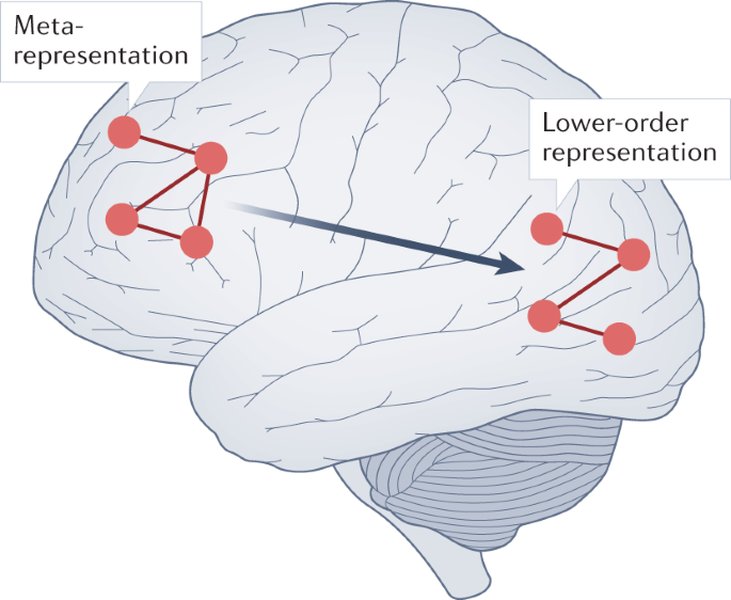
Higher-Order Theories (HOT) propose that a mental state becomes conscious when one has a higher-order representation—a thought or perception—about that state. In essence, consciousness involves a form of meta-cognition: you are not just having an experience, but you are (implicitly or explicitly) aware *of* having that experience.
Core Idea: Consciousness arises from the brain representing its own states. For example, seeing a red apple becomes a conscious experience when a higher-order cognitive process represents the visual state of "seeing red apple."
Recent Insights: HOTs continue to be influential, particularly in explaining the subjective feeling of knowing and self-awareness. While not directly pitted against IIT and GNWT in the same way in the Cogitate study, the findings regarding the role of prefrontal cortex (often associated with higher-order functions) are relevant. If consciousness primarily arises from posterior regions, as some recent data suggest, then the role of prefrontal-dependent higher-order representations might be more related to conscious report or reflection rather than the generation of phenomenal experience itself.
Strengths: HOTs offer an explanation for the difference between unconscious and conscious processing and can account for introspective aspects of consciousness. They connect consciousness to self-monitoring and reflective capacities.
4. Predictive Processing (PP) / Predictive Coding
The Brain as a Prediction Machine: Consciousness in Error Correction
Predictive Processing (PP), also known as predictive coding, views the brain as a hierarchical prediction machine. It constantly generates models or predictions about the causes of its sensory inputs and updates these predictions based on "prediction errors"—the mismatch between predicted and actual sensory information.
Core Idea: Conscious experience arises from this dynamic interplay of top-down predictions and bottom-up error signals. Consciousness might be related to the process of minimizing prediction errors, resulting in a stable and coherent model of the world.
Recent Insights: PP is a rapidly developing framework that offers a unifying account of perception, action, and learning. It is increasingly used to bridge neural mechanisms and subjective experience. Recent research explores how PP might explain specific aspects of consciousness, such as the sense of presence or the nature of hallucinations. It integrates well with other theories, for instance, by suggesting how the global workspace might prioritize the broadcast of significant prediction errors.
Strengths: PP provides a comprehensive framework for understanding brain function and can explain various perceptual phenomena, including illusions and the subjective experience of a coherent reality. It emphasizes the active, constructive nature of perception.
5. Recurrent Processing Theory (RPT) / Re-entry
Echoes in the Brain: Consciousness via Neural Feedback Loops
Theories focusing on recurrent processing (RPT) or **re-entrant signaling** emphasize the importance of sustained, reverberating neural activity, particularly feedback loops between different brain areas (e.g., between higher and lower visual areas, or thalamo-cortical loops).
Core Idea: Consciousness does not arise from simple feedforward sweeps of information but requires recurrent interactions that allow for the integration and stabilization of neural representations over time. Neural synchrony across different frequencies is often considered a key mechanism supporting this.
Recent Insights: Evidence continues to accumulate supporting the role of recurrent processing in conscious perception. For example, disrupting recurrent signals via techniques like TMS can selectively impair conscious awareness while leaving initial, unconscious processing intact. Some recent studies (2024-2025) also highlight the crucial role of the thalamus in gating and modulating these recurrent cortical dynamics, supporting its role as a critical hub for consciousness.
Strengths: RPT is well-supported by neurophysiological data and offers a mechanistic explanation for how transient sensory information can lead to sustained, conscious experience. It complements other theories like GNWT by detailing the potential neural dynamics within the workspace.
Comparing Key Theories of Consciousness
To better understand the landscape of consciousness theories, the following radar chart provides a comparative overview based on several key attributes. The scores are illustrative, reflecting general consensus and recent findings in the field as of early 2025. Attributes include Empirical Support (how well the theory is backed by experimental data), Testability (ease of formulating and testing hypotheses), Explanatory Power (ability to explain subjective aspects of consciousness), Recent Validation (impact of very recent studies like Cogitate 2025), and Predictive Accuracy (how well it predicts neural or behavioral outcomes).
This chart visualizes how different theories might fare across various evaluation criteria, highlighting their unique strengths and areas where further development or evidence is needed. For instance, IIT scores high on mathematical rigor but faced mixed results in recent validation, while GNWT shows strong empirical support for access consciousness but may have less explanatory power for purely subjective aspects compared to IIT or HOT.
Visualizing the Interconnections: A Mindmap of Consciousness Theories
The study of consciousness involves a complex web of ideas, empirical findings, and philosophical considerations. This mindmap illustrates the main theoretical families and some of their core concepts or related areas of investigation, providing a conceptual overview of the field.
This mindmap aims to capture the primary theoretical clusters and their distinguishing features. For example, IIT is characterized by its mathematical formalism (Φ) and focus on intrinsic causal power, while GNWT emphasizes the role of a widespread neural "workspace" for information sharing. HOT highlights meta-cognitive aspects, and PP offers a dynamic view of the brain actively constructing its reality. Other approaches, like RPT and those focusing on the thalamus, often provide mechanistic details that can underpin broader theories.
Summary Table of Leading Consciousness Theories
The following table provides a concise summary of the key features, proposed neural basis, and current status of the most influential theories of consciousness discussed.
| Theory | Key Feature | Proposed Neural Basis | Current Status & Evidence (as of early 2025) |
|---|---|---|---|
| Integrated Information Theory (IIT) | Consciousness as integrated information (Φ); intrinsic causal power. | Posterior cortical 'hot zone'; specific complex of neurons. | Mathematically rigorous; some predictions supported, others challenged by Cogitate study; strong on explaining phenomenal structure. |
| Global Neuronal Workspace Theory (GNWT) | Global broadcast of information to specialized modules. | Widespread network including prefrontal, parietal, and cingulate cortices; long-range connections. | Strong empirical support for access consciousness; some aspects (e.g., prefrontal primacy) revised by recent studies like Cogitate. |
| Higher-Order Theories (HOT) | Consciousness via meta-representation of first-order mental states. | Prefrontal cortex and other areas involved in self-monitoring and meta-cognition. | Philosophically compelling for explaining self-awareness; experimental testing is challenging but ongoing. |
| Predictive Processing (PP) | Hierarchical prediction error minimization; brain as a generative model. | Hierarchical cortical circuits, interplay of top-down predictions and bottom-up error signals. | Growing empirical backing; powerful explanatory framework for perception and learning, increasingly applied to consciousness. |
| Recurrent Processing Theory (RPT) | Consciousness requires sustained recurrent neural activity. | Local and long-range feedback loops, thalamo-cortical circuits; neural synchrony. | Strong neurophysiological support; often seen as a mechanism underpinning other theories. |
Exploring New Frontiers in Consciousness Research
The field of consciousness research is constantly evolving. The video below features insights from leading researchers Anil Seth and Donald Hoffman, who discuss new frontiers and challenges in understanding consciousness. Their discussion touches upon the complexities of defining and measuring consciousness, the relationship between perception and reality, and the philosophical implications of current scientific theories. This provides a broader context to the ongoing scientific efforts to unravel one of life's greatest mysteries.
Donald Hoffman & Anil Seth discussing new frontiers in the science of consciousness, offering perspectives on the complexities and future directions of the field.
Frequently Asked Questions (FAQ)
What is the "hard problem" of consciousness?
The "hard problem" of consciousness, a term coined by philosopher David Chalmers, refers to the challenge of explaining why and how we have subjective, qualitative experiences (qualia)—like the redness of red or the feeling of pain. While science can explain brain functions (the "easy problems" like information processing, attention, reportability), it's much harder to explain how these physical processes give rise to subjective awareness itself.
How did the 2025 Cogitate Consortium study impact theories of consciousness?
The Cogitate Consortium's large-scale study, which adversarially tested Integrated Information Theory (IIT) and Global Neuronal Workspace Theory (GNWT), provided crucial empirical data. The results were complex: neither theory was fully supported nor entirely refuted. Key takeaways included findings that challenged the central role of the prefrontal cortex (as emphasized by some interpretations of GNWT) and suggested that activity in posterior brain regions is more critical for conscious experience (partially aligning with IIT). It highlighted the need for refinement in both theories and potentially for new, integrative models.
Can consciousness be measured quantitatively?
Some theories attempt to quantify consciousness. Integrated Information Theory (IIT) proposes a measure called Φ (phi), which quantifies the degree of integrated information in a system and is hypothesized to correspond to the level of consciousness. Other approaches look for "neural correlates of consciousness" (NCCs)—specific brain activity patterns that consistently co-occur with conscious experience. While these are steps towards quantification, measuring subjective experience directly remains a significant challenge.
Are there any theories that suggest consciousness exists outside the brain?
Most mainstream scientific theories locate consciousness within the physical processes of the brain. However, some philosophical perspectives and more speculative theories (like certain interpretations of panpsychism, which IIT can be related to) propose that consciousness might be a fundamental property of the universe, or that it can extend beyond the individual brain (e.g., theories of extended cognition, though these usually refer to cognitive processes rather than phenomenal consciousness itself). These views are generally less supported by current empirical neuroscience but contribute to the broader philosophical debate.
Recommended Further Exploration
- How do Integrated Information Theory and Global Neuronal Workspace Theory compare after the 2025 Cogitate Consortium findings?
- What is the emerging role of the posterior cortex in generating conscious experience?
- How does the Predictive Processing framework attempt to explain subjective aspects of perception and self-awareness?
- What are the major philosophical implications stemming from current scientific theories of consciousness?
References
Last updated May 13, 2025