

A Red-Black Tree is a sophisticated type of self-balancing binary search tree (BST) that plays a crucial role in computer science, ensuring efficient data management. Unlike a simple BST, which can degrade to O(n) performance in worst-case scenarios (e.g., when data is inserted in a sorted order), a Red-Black Tree employs a clever coloring scheme and a strict set of rules to maintain balance. This balance guarantees that fundamental operations like searching, insertion, and deletion consistently achieve logarithmic time complexity, O(log n), even in the face of frequent modifications.
Essential Insights into Red-Black Trees
- Self-Balancing Mechanism: Red-Black Trees use node coloring (red or black) and a set of five invariant properties to automatically adjust their structure during insertions and deletions, preventing them from becoming unbalanced and ensuring consistent O(log n) performance.
- Guaranteed Efficiency: The strict properties ensure that the height of a Red-Black Tree remains logarithmic, meaning that search, insert, and delete operations are always executed in O(log n) time complexity, making them highly predictable and efficient.
- Widespread Applications: These trees are fundamental to many standard library implementations (e.g., C++
std::map/std::set, JavaTreeMap), database indexing, operating system schedulers, and network routing, highlighting their practical importance in high-performance computing.
Understanding the Core: What Defines a Red-Black Tree?
At its heart, a Red-Black Tree is a binary search tree where each node holds a key, pointers to its left and right children, and, crucially, a color attribute: either red or black. This color, combined with a set of five invariant properties, is what enables the tree to self-balance. This self-balancing act is critical because it prevents the tree from becoming skewed, which would otherwise lead to linear time complexity for operations in the worst case, defeating the purpose of a tree structure.
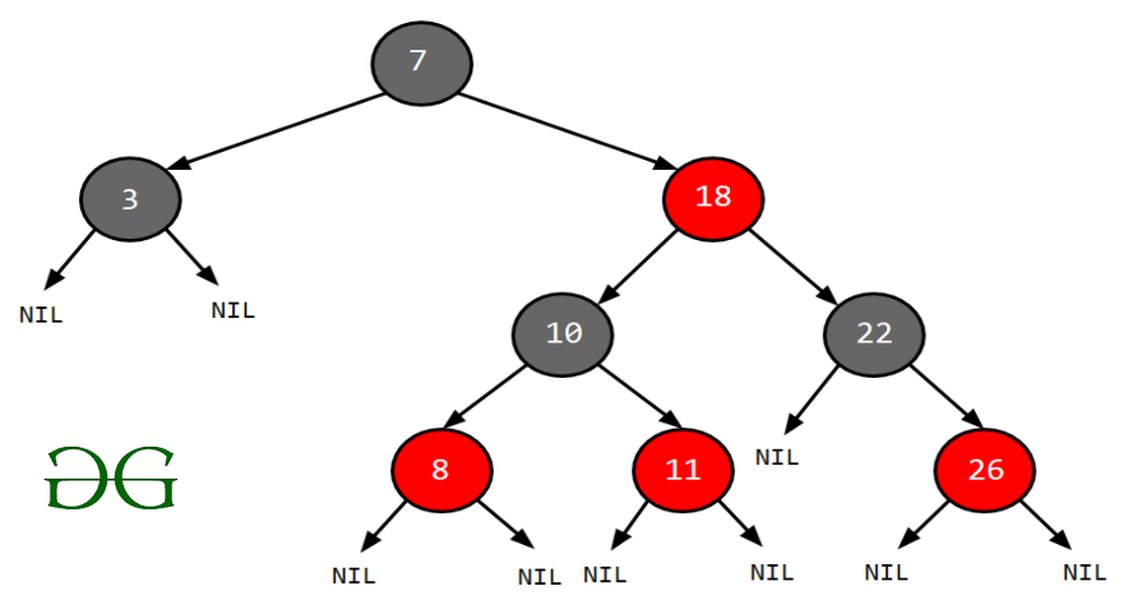
An illustrative example of a Red-Black Tree, showcasing the distinct red and black nodes that contribute to its balanced structure.
The Five Invariant Properties: The Pillars of Balance
The integrity and efficiency of a Red-Black Tree are maintained by adhering to five strict properties. These invariants are the backbone of its self-balancing mechanism, ensuring that the tree never grows disproportionately tall in any direction.
- Node Color Property: Every node in the tree is either red or black. This binary coloring is the foundational element that distinguishes it from a simple BST.
- Root Property: The root of the tree is always black. This property simplifies balancing rules and provides a consistent starting point for path analysis.
- Leaf Property: All leaves, often represented as NIL (null) nodes, are considered black. These "sentinel" nodes help in simplifying the algorithms for insertion and deletion by providing a consistent termination point for paths.
- Red Node Children Property (No Two Reds Adjacent): If a node is red, then both of its children must be black. This critical rule prevents the formation of long paths of red nodes, which would otherwise violate the black-height property.
- Black Height Property: Every simple path from a given node to any of its descendant leaf nodes contains the same number of black nodes. This property is the ultimate guarantor of balance, ensuring that the longest path from the root to a leaf is never more than twice the length of the shortest path.
These properties collectively ensure that the maximum height of a Red-Black Tree with n nodes is at most 2 * log(n + 1). This logarithmic height is what guarantees the O(log n) time complexity for all major operations.
How Red-Black Trees Maintain Balance
The self-balancing aspect of Red-Black Trees is particularly fascinating, distinguishing them from other binary search trees. When a new node is inserted or an existing node is deleted, these operations might temporarily violate one or more of the five invariant properties. The tree then performs a series of localized transformations, primarily through recoloring and rotations, to restore these properties.
Insertion Process and Balancing Acts
When a new node is inserted into a Red-Black Tree, it is initially treated as a standard BST insertion. The new node is typically colored red. This is because coloring it black immediately could violate the Black Height Property. If the parent of the newly inserted red node is also red, a violation of the "No Two Reds Adjacent" property occurs. To fix this, the tree performs a combination of recoloring and rotations:
- Recoloring: This often involves changing the color of a node and its siblings/parent to restore properties.
- Rotations: These are structural changes (left or right rotations) that rearrange nodes to maintain the BST properties while also helping to resolve red-red violations and ensure black-height consistency.
This video demonstrates the insertion process in Red-Black Trees, showcasing how recoloring and rotations are used to maintain balance after adding new nodes.
Deletion Process: A More Involved Balancing Act
Deletion in a Red-Black Tree is generally more complex than insertion. After removing a node, the tree might suffer violations of its properties, particularly the Black Height Property. The algorithm for deletion involves finding a successor, removing the node, and then performing a series of recoloring and rotations to restore balance. This can involve several cases depending on the color of the deleted node and its children. Despite its complexity, deletion also guarantees an O(log n) time complexity.
Comparison with AVL Trees
While Red-Black Trees and AVL Trees are both self-balancing binary search trees, they differ in their balancing strictness and performance characteristics. AVL trees maintain a stricter balance, ensuring that the height difference between the left and right subtrees of any node is at most one. This often leads to fewer search comparisons. However, this stricter balance typically requires more rotations during insertions and deletions. Red-Black Trees, on the other hand, are less strict in their balance but often require fewer rotations for updates, making them a preferred choice in scenarios with frequent insertions and deletions.
Performance Characteristics and Operational Efficiency
The self-balancing nature of Red-Black Trees directly translates into predictable and efficient performance for critical data structure operations. The guaranteed logarithmic height ensures that the time taken for these operations scales very well with the number of nodes in the tree.
Time Complexity for Key Operations
For a Red-Black Tree containing n nodes, the worst-case time complexity for the following operations is consistently O(log n):
- Search (Lookup): Finding an element in the tree.
- Insertion: Adding a new element to the tree.
- Deletion: Removing an existing element from the tree.
This consistent logarithmic performance is a significant advantage over unbalanced BSTs, where operations can degrade to linear time.
Space Complexity
Red-Black Trees require O(n) space to store n elements, similar to other BSTs. The "extra bit" per node for color adds minimal overhead, typically fitting within existing node structures without significantly increasing memory consumption.
The Wide-Ranging Applications of Red-Black Trees
Due to their robust performance guarantees, Red-Black Trees are not just theoretical constructs; they are fundamental components in many real-world systems and software libraries. Their ability to maintain balance and ensure efficient operations under dynamic conditions makes them invaluable.
Key Areas of Use
- Standard Library Implementations: Many programming languages use Red-Black Trees as the underlying data structure for their ordered map and set implementations.
- In C++,
std::mapandstd::setoften utilize Red-Black Trees. - In Java,
TreeMapandTreeSetare built upon Red-Black Trees.
- In C++,
- Database Indexing: They are used in database systems to create efficient indexes, allowing for fast retrieval of sorted data.
- Operating Systems:
- The Linux kernel employs Red-Black Trees in its Completely Fair Scheduler (CFS) to manage processes efficiently.
- They are also used in memory management systems.
- Networking: Red-Black Trees can be found in network routers for managing routing tables.
- Functional Programming: They are sometimes used to implement associative arrays in functional programming languages.
The widespread adoption of Red-Black Trees in these critical applications underscores their reliability and efficiency in handling dynamic, ordered data.
The Mechanism of Self-Balancing: Rotations and Recoloring
The true elegance of Red-Black Trees lies in their ability to dynamically adjust their structure to maintain balance. This is achieved through a set of carefully defined operations: rotations and recoloring. These operations are performed locally after an insertion or deletion to restore any violated properties, ensuring that the tree remains logarithmically balanced.
Rotations: Reshaping the Tree
Rotations are fundamental structural changes that re-arrange nodes in the tree without violating the binary search tree property (left children are smaller, right children are larger). There are two main types:
- Left Rotation: Transforms a right child into its parent, effectively moving the parent down and to the left.
- Right Rotation: The inverse of a left rotation, transforming a left child into its parent, moving the parent down and to the right.
These rotations are crucial for resolving red-red violations (where a red node has a red child) and maintaining the black-height property by balancing the paths.
Recoloring: Changing Node Attributes
Recoloring involves changing the color of one or more nodes (from red to black or black to red) to satisfy the Red-Black Tree properties. This is often used in conjunction with rotations, especially during insertion. For instance, if a red node is inserted and its parent is also red, recoloring its parent and uncle (if they exist) can often resolve the violation without immediate rotation.
This mindmap visually outlines the fundamental aspects of Red-Black Trees, including their definition, the crucial five invariant properties that maintain balance, the efficiency of their operations, the underlying balancing mechanisms (rotations and recoloring), and their diverse applications in real-world computing systems.
Comparative Overview: Red-Black Trees vs. Other Data Structures
To truly appreciate the value of Red-Black Trees, it's helpful to compare their characteristics against other common data structures. This table highlights how Red-Black Trees strike a balance between efficiency, complexity, and performance guarantees.
| Feature | Red-Black Tree | Unbalanced Binary Search Tree (BST) | AVL Tree | Hash Map (Average) |
|---|---|---|---|---|
| Search Time Complexity | O(log n) | O(log n) (Avg), O(n) (Worst) | O(log n) | O(1) |
| Insertion Time Complexity | O(log n) | O(log n) (Avg), O(n) (Worst) | O(log n) | O(1) |
| Deletion Time Complexity | O(log n) | O(log n) (Avg), O(n) (Worst) | O(log n) | O(1) |
| Balancing Mechanism | Recoloring & Rotations | None | Rotations (stricter) | N/A (uses hash function) |
| Space Complexity | O(n) | O(n) | O(n) | O(n) |
| Strictness of Balance | Moderate (max height 2 log n) | None | Strict (max height 1.44 log n) | N/A |
| Primary Use Cases | Ordered maps/sets, OS schedulers | Simple ordered data (if input mostly random) | Ordered maps/sets (when searches are frequent) | Fast lookups, caches (unordered) |
This table offers a comparative analysis of Red-Black Trees against other prominent data structures, highlighting their unique strengths in balancing performance, complexity, and application suitability.
Frequently Asked Questions About Red-Black Trees
What makes a Red-Black Tree "self-balancing"?
What is the main difference between an AVL Tree and a Red-Black Tree?
Why is the root of a Red-Black Tree always black?
Can a Red-Black Tree have two consecutive red nodes?
Where are Red-Black Trees commonly used in practice?
std::map and Java's TreeMap), are integral to the Linux kernel's process scheduler, used in database indexing for efficient data retrieval, and play a role in network routing algorithms.Conclusion: The Enduring Significance of Red-Black Trees
Red-Black Trees stand as a testament to elegant algorithmic design, offering a powerful solution for maintaining ordered data efficiently in dynamic environments. By employing a clever coloring scheme and a strict set of invariant properties, these trees guarantee logarithmic time complexity for crucial operations like search, insertion, and deletion. Their ability to self-balance through localized recoloring and rotations ensures predictable performance, making them indispensable in a vast array of applications, from standard library implementations to operating system kernels and database systems. Understanding Red-Black Trees is key to comprehending the foundations of high-performance data management in modern computing.
Recommended Further Exploration
- Delving deeper into Red-Black Tree balancing algorithms
- Practical examples of Red-Black Tree implementation in C++
- Comparison between Red-Black Trees and B-trees for database indexing
- How Red-Black Trees are used in the Linux kernel scheduler