

Key Insights into Red-Black Tree Insertion
- New nodes are always inserted as RED: This strategic choice minimizes immediate violations of the black-height property, simplifying the subsequent fix-up process.
- Fix-up involves recoloring and rotations: When Red-Black Tree properties are violated (most commonly a red-red conflict), specific algorithms are applied, primarily involving changing node colors and performing tree rotations to restore balance.
- Efficiency is preserved: The entire insertion process, including the fix-up operations, maintains an optimal time complexity of O(log N), ensuring the tree remains highly efficient for all operations.
Red-Black Trees are a sophisticated type of self-balancing binary search tree, crucial for maintaining optimal performance in dynamic data structures. The insertion process is particularly intricate, as it must not only add a new element but also preserve the tree's five fundamental properties. This document will delve into the precise steps and strategies involved in inserting a new node into a Red-Black Tree, ensuring its continued balance and efficiency.
The Foundational Properties of Red-Black Trees
Before exploring the insertion mechanism, it's essential to understand the core rules that define a Red-Black Tree. These properties are the backbone of its self-balancing nature:
- Every node is either red or black.
- The root node is always black.
- All leaves (NIL nodes) are black. These are conceptual nodes that represent the absence of a child and are crucial for property calculations.
- If a node is red, then both its children must be black. This prevents consecutive red nodes (a "red-red" conflict).
- Every simple path from a given node to any of its descendant NIL leaves contains the same number of black nodes. This is known as the "black-height" property, and it's key to maintaining balance.
Adherence to these properties guarantees that the longest path from the root to any leaf is at most twice the length of the shortest path, thus ensuring the tree remains approximately balanced and operations like search, insertion, and deletion maintain a logarithmic time complexity.
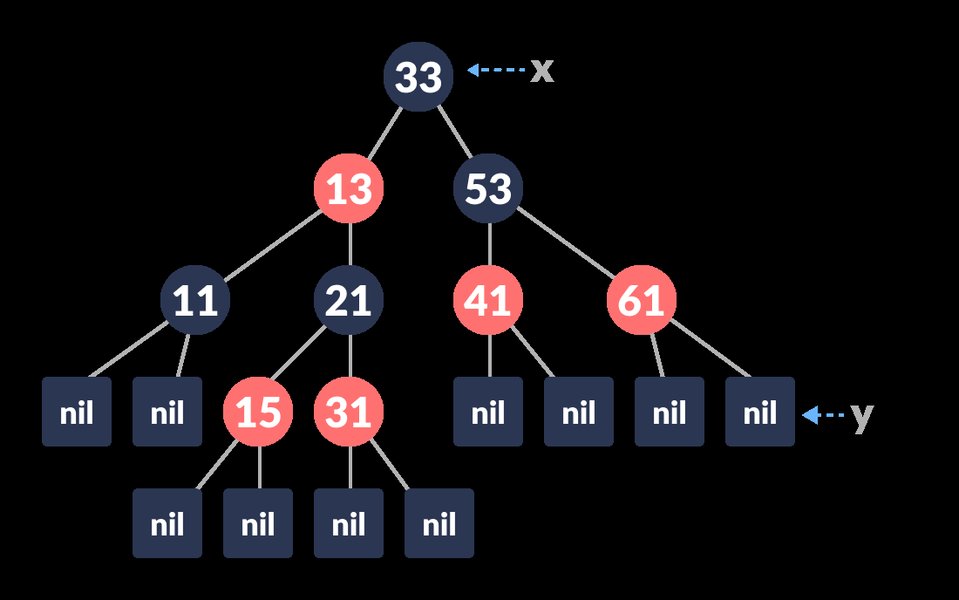
An example of a Red-Black Tree, illustrating node colors and structure.
The Two-Phase Insertion Process
Inserting a node into a Red-Black Tree is a two-step process: first, a standard Binary Search Tree (BST) insertion, followed by a "fix-up" phase to re-establish Red-Black Tree properties.
Inserting as a Red Node
The initial step is identical to inserting a node into a regular Binary Search Tree. The new node is traversed down the tree until an appropriate leaf position is found, where it is then inserted. Critically, this new node is always colored red. This choice is deliberate: inserting a red node is less likely to immediately violate the black-height property (property 5) compared to inserting a black node. A red node preserves the black-height of paths passing through it, as it doesn't add to the black count.
The children of this new red node are conceptually set to NIL (black) nodes. If the tree was initially empty, the newly inserted node becomes the root and is immediately colored black to satisfy property 2.
Visualizing the initial BST insertion of a red node.
Potential Violations After Initial Insertion
After inserting a red node, the primary property at risk of violation is property 4: "If a node is red, then both its children must be black." If the newly inserted red node's parent is also red, a "red-red" conflict arises, requiring immediate resolution during the fix-up phase. If the parent is black, no properties are violated by the new red child, and the insertion is complete.
Phase 2: The Fix-Up Algorithm (Rebalancing)
The fix-up process commences when a red-red violation occurs, meaning the newly inserted node's parent is also red. The strategy for resolution depends heavily on the color of the "uncle" node (the sibling of the parent). The fix-up ensures that the tree's properties are restored by a combination of recoloring and rotations.
Case 1: Red Uncle
If the parent of the new red node is red, and its uncle (the sibling of the parent) is also red, the following operations are performed:
- The parent and the uncle are recolored to black.
- The grandparent (the parent of the red parent) is recolored to red.
- The fix-up process then continues upwards, with the grandparent becoming the new node under consideration. This "propagates" the potential red-red violation up the tree, which might require further adjustments.
This recoloring effectively "pushes" blackness down the tree and redness up, maintaining the black-height from the grandparent's perspective while potentially creating a new red-red conflict higher up.
Case 2 & 3: Black Uncle (or NULL) - Rotations and Recolorings
When the uncle of the new red node is black (or is a NIL node, which is implicitly black), rotations become necessary in addition to recoloring. These cases are further divided based on the configuration of the parent and the newly inserted node relative to the grandparent.
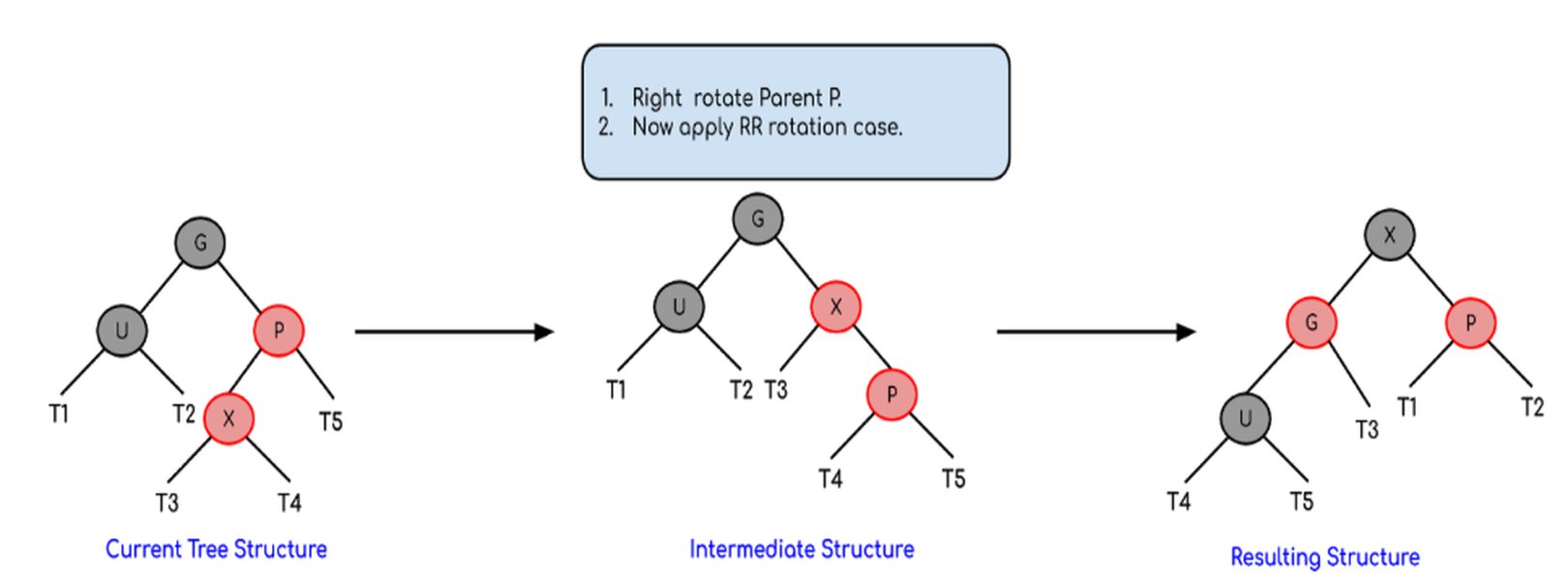
- Case 2 (Preparation for Rotation): If the new node
xis a right child and its parentpis a left child (LR case), or symmetrically, ifxis a left child andpis a right child (RL case), a preliminary rotation is performed. For example, in the LR case, a left rotation on the parentpconverts the configuration into an LL case (wherexbecomes the left child of its new parentp'). The new nodexthen becomes the parent, and the fix-up proceeds to Case 3 with this new configuration. - Case 3 (Final Rotation and Recolor): After any necessary preliminary rotation (or if the configuration was already LL or RR), the primary rotation and recoloring occur.
- If it's an LL case (new node
xis a left child of parentp, which is a left child of grandparentg):- Recolor parent
pto black and grandparentgto red. - Perform a right rotation on grandparent
g.
- Recolor parent
- If it's an RR case (new node
xis a right child of parentp, which is a right child of grandparentg):- Recolor parent
pto black and grandparentgto red. - Perform a left rotation on grandparent
g.
- Recolor parent
- If it's an LL case (new node
These rotations and recolorings effectively "balance" the sub-tree rooted at the grandparent, resolving the red-red violation and ensuring that the black-height property is maintained across all paths. The fix-up process typically stops after this case unless the initial root was recolored red, in which case it needs to be colored black again.
The Role of Rotations
Rotations are fundamental operations in self-balancing trees. They rearrange nodes to alter the tree's structure while preserving the in-order traversal property (and thus the BST property). A left rotation on a node promotes its right child to its position, while a right rotation promotes its left child. Each rotation takes O(1) time and involves adjusting a few pointers.
Step-by-Step Breakdown of Insertion Cases
To provide a clearer understanding, let's summarize the fix-up cases and their actions once a red-red violation is detected between a new node x and its parent p:
| Scenario | Uncle Node Color | Action Taken | Result |
|---|---|---|---|
New node x's parent p is red, uncle u is red. |
Red | Recolor p to black, u to black, grandparent g to red. Set x = g and repeat fix-up. |
Violation pushed upwards, black-height preserved. |
New node x's parent p is red, uncle u is black/NIL. x is right child, p is left child (LR case). |
Black/NIL | Left rotate on p. x becomes new parent. Then treat as LL case (below). |
Transforms LR to LL, prepares for final rotation. |
New node x's parent p is red, uncle u is black/NIL. x is left child, p is left child (LL case). |
Black/NIL | Recolor p to black, grandparent g to red. Right rotate on g. |
Violation resolved, tree balanced. |
New node x's parent p is red, uncle u is black/NIL. x is left child, p is right child (RL case). |
Black/NIL | Right rotate on p. x becomes new parent. Then treat as RR case (below). |
Transforms RL to RR, prepares for final rotation. |
New node x's parent p is red, uncle u is black/NIL. x is right child, p is right child (RR case). |
Black/NIL | Recolor p to black, grandparent g to red. Left rotate on g. |
Violation resolved, tree balanced. |
| If the root is recolored red at any point. | N/A | Recolor the root to black. | Ensures Property 2 (root is black). |
This table encapsulates the core logic of the fix-up process, highlighting how different structural configurations and uncle colors dictate the necessary recoloring and rotation actions to restore Red-Black Tree properties.
Visualizing the Process
Visual aids are incredibly helpful in understanding the dynamic nature of Red-Black Trees. The following video provides a practical demonstration of insertions, showcasing how the tree adapts to maintain its balance.
This video, "Red-black trees in 5 minutes — Insertions (examples)", offers clear examples of how nodes are inserted and how the tree undergoes recoloring and rotations to maintain its properties. It's particularly useful for grasping the practical application of the theoretical steps discussed.
The Conceptual Landscape of Red-Black Tree Insertion
To further consolidate the understanding of the Red-Black Tree insertion process, a mindmap provides a hierarchical overview of the key concepts, from the initial insertion to the various fix-up scenarios.
This mindmap provides a structured overview of the entire Red-Black Tree insertion process, from the initial node placement to the intricate fix-up operations that ensure tree balance.
Frequently Asked Questions (FAQ)
Why are new nodes always inserted as red?
What is a "red-red" violation?
When are rotations necessary during insertion?
What is the black-height property and why is it important?
Does insertion always require a fix-up?
Conclusion
The insertion algorithm for Red-Black Trees is a testament to the ingenious design of self-balancing data structures. By meticulously following a two-phase process—initial BST insertion as a red node, followed by an intelligent fix-up mechanism involving recoloring and rotations—Red-Black Trees efficiently integrate new data while strictly adhering to their defining properties. This rigorous maintenance guarantees an optimal O(log N) time complexity for all operations, making Red-Black Trees indispensable in scenarios requiring consistent high performance in dynamic data management.
Recommended Further Reading
- Red-Black Tree deletion algorithm explained
- Comparison of self-balancing BSTs: AVL vs Red-Black
- Detailed explanation of tree rotations in data structures
- Applications of Red-Black Trees in real-world systems