

- Relative pronouns act as vital connectors, bridging dependent clauses to main clauses and enhancing descriptive power.
- A main clause forms the independent core of a sentence, expressing a complete thought on its own.
- Relative clauses, introduced by relative pronouns, function as adjectives, adding essential or supplementary information about nouns within the main clause.
In the intricate tapestry of the English language, understanding the roles of relative pronouns, main clauses, and relative clauses is fundamental to constructing clear, concise, and compelling sentences. These grammatical components work in concert to allow speakers and writers to combine simpler ideas into more sophisticated, information-rich expressions. By linking additional details directly to specific nouns or pronouns, they prevent repetition and create a more fluid flow of information.
Decoding the Core Components of Complex Sentences
To fully grasp their interaction, it's crucial to first define each element individually.
The Self-Sufficient Statement
A main clause, often referred to as an independent clause, is the backbone of any sentence. It's a group of words that contains both a subject and a predicate (typically a verb phrase) and can stand alone as a complete sentence because it expresses a complete thought. Without a main clause, a sentence would be incomplete or fragmented.
For example, in the sentence "The cat slept peacefully," "The cat slept peacefully" is a main clause. It has a subject ("The cat") and a verb ("slept") and conveys a full idea.
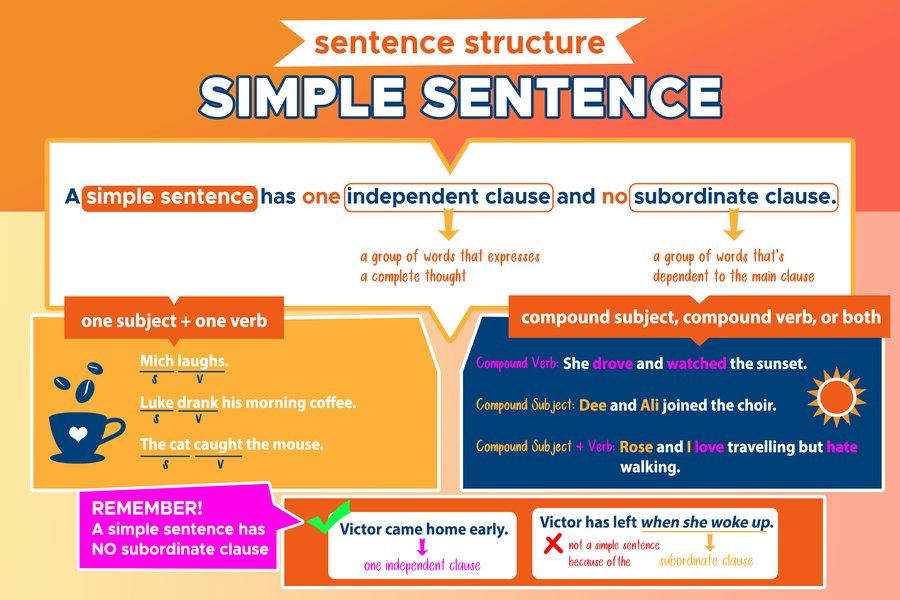
A simple sentence, which essentially consists of a main clause.
Words That Bridge and Describe
Relative pronouns are specific words that serve two primary functions: they introduce a relative clause and connect it to a noun or pronoun in the main clause. They also act as a subject or object within their own clause, referring back to an antecedent (the noun or pronoun they modify) in the main clause. The most common relative pronouns in English are:
- Who: Used for people, often as the subject of the relative clause.
- Whom: Used for people, typically as the object of a verb or preposition in the relative clause (more formal).
- Whose: Indicates possession for people, animals, or things.
- Which: Refers to animals or things.
- That: Can refer to people, animals, or things, primarily in restrictive clauses.
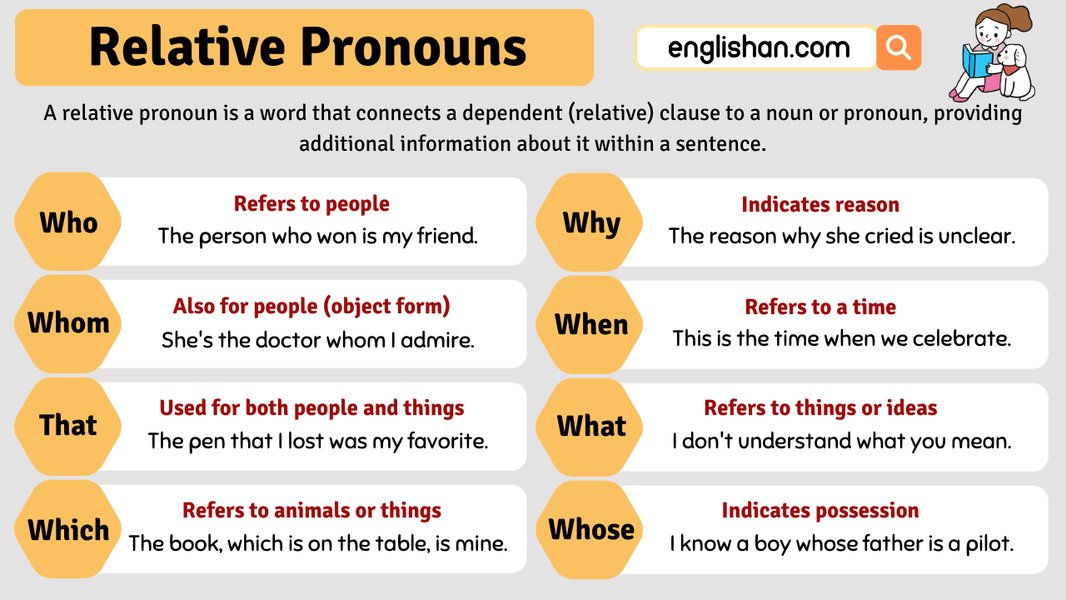
Visual representation of common relative pronouns and their usage.
Some grammatical contexts also include "when" and "where" as relative adverbs, which function similarly to relative pronouns by introducing clauses that provide additional information about time or place.
Dependent Clauses That Act Like Adjectives
A relative clause (also known as an adjective clause) is a type of dependent clause that modifies or describes a noun or pronoun in the main clause. Because it's dependent, it cannot stand alone as a complete sentence. It always begins with a relative pronoun (or sometimes a relative adverb) and provides additional, often crucial, information about the antecedent.
Consider the sentence: "The book, which I borrowed from the library, was fascinating." Here, "which I borrowed from the library" is the relative clause, introduced by "which," and it provides more information about "The book."
The Symbiotic Relationship: How They Interact
The beauty of these elements lies in their ability to combine simple ideas into complex, nuanced sentences without resorting to multiple short, choppy sentences. The relative pronoun serves as the explicit link, replacing a noun that would otherwise be repeated and thereby creating a more elegant and efficient sentence structure.
For instance, instead of saying: "The student is intelligent. The student won the award." we can combine these using a relative pronoun and clause: "The student who won the award is intelligent." Here, "who" refers back to "student" and connects the descriptive clause "who won the award" directly to the noun it modifies.
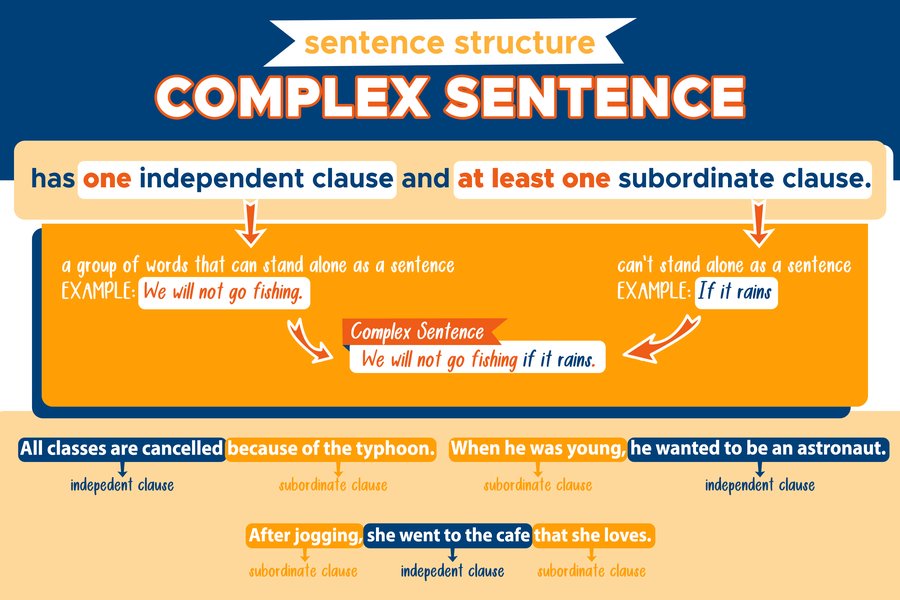
A complex sentence illustrating the relationship between independent and dependent clauses.
Types of Relative Clauses: Restrictive vs. Non-Restrictive
Understanding the distinction between these two types is critical for correct punctuation and conveying precise meaning.
Essential Information Without Commas
A restrictive relative clause provides information that is essential to identify or define the noun it modifies. If you remove a restrictive clause, the meaning of the main clause would change significantly or become unclear. These clauses are NOT set off by commas.
Example: "The car that is parked over there belongs to my brother." Here, "that is parked over there" is essential to specify *which* car belongs to the brother. Without it, "The car belongs to my brother" is vague.
For restrictive clauses, "that" is often preferred for things, though "which" can also be used. "Who" is used for people.
Additional Information Set Off by Commas
A non-restrictive relative clause provides additional, non-essential information about the noun. The main clause's meaning remains clear even if this clause is removed. These clauses ARE always set off by commas.
Example: "My oldest car, which is a classic model, is still running well." Here, "which is a classic model" adds extra detail about the car, but "My oldest car is still running well" still makes perfect sense on its own. The listener already knows which car is being discussed.
For non-restrictive clauses, "which" is used for things and "who" for people. "That" is generally NOT used in non-restrictive clauses.
A Deep Dive into Relative Pronoun Usage
Choosing the correct relative pronoun depends on the antecedent and its function within the relative clause.
Who and Whom: Navigating People-Specific Pronouns
Who functions as the subject of the relative clause, meaning it performs the action. For example: "The student who submitted the best essay received an award." ("Who" is the subject of "submitted.")
Whom functions as the object of the relative clause, meaning it receives the action or is the object of a preposition. It is more formal and less common in everyday speech. For example: "The author whom I admire most spoke at the conference." ("Whom" is the object of "admire.") A good trick is to see if you can replace it with "him" or "her" (object pronouns). If so, "whom" is likely correct.
Whose: Indicating Possession
Whose shows possession for people, animals, or things. It can be used in both restrictive and non-restrictive clauses. For example: "The artist whose painting was featured won first prize." or "My neighbor, whose dog often barks, is very friendly."
Which and That: Distinguishing Between Things and Clauses
Which is used for animals and inanimate objects. As mentioned, it is mandatory for non-restrictive clauses, where it is preceded by a comma. Example: "The old house, which had stood for centuries, was finally demolished."
That is versatile and can refer to people, animals, or things, but it is almost exclusively used in restrictive clauses. It is often interchangeable with "which" in restrictive clauses about things, but many style guides prefer "that" for clarity in these cases. Example: "This is the book that I told you about."
Here's a table summarizing the common usage of relative pronouns:
| Relative Pronoun | Refers To | Function in Clause | Clause Type | Punctuation | Example |
|---|---|---|---|---|---|
| Who | People | Subject | Restrictive / Non-Restrictive | No comma / Comma | The scientist who discovered the cure was honored. / Dr. Lee, who is a brilliant researcher, lectured today. |
| Whom | People | Object | Restrictive / Non-Restrictive | No comma / Comma | The colleague whom I met yesterday is here. / My boss, whom I respect greatly, approved the project. |
| Whose | People, Animals, Things | Possession | Restrictive / Non-Restrictive | No comma / Comma | The student whose essay was chosen got a scholarship. / The company, whose profits soared, expanded rapidly. |
| Which | Animals, Things | Subject / Object | Non-Restrictive (primarily) | Comma (mandatory) | The ancient artifact, which was found in the ruins, is now in a museum. |
| That | People, Animals, Things | Subject / Object | Restrictive (primarily) | No comma (mandatory) | This is the car that I want to buy. |
Visual Learning: Enhancing Your Understanding
For those who prefer a dynamic explanation, YouTube offers a wealth of resources. The following video provides an excellent overview of relative clauses and their usage, reinforcing the concepts discussed above.
This video, "Relative Pronouns & Clauses: who(m), which, that | English Grammar | B2-Upper Intermediate", offers a clear and concise explanation of how relative pronouns and clauses function in English grammar, including practical examples. It's particularly useful for visual learners seeking to solidify their understanding of the various relative pronouns and their appropriate application in different clause types.
Common Errors and Best Practices
Even advanced English speakers can make mistakes with relative pronouns and clauses. Here are some key points to remember:
- Comma Usage: The most common error is misplacing or omitting commas with non-restrictive clauses. Remember: essential information (restrictive) = no commas; extra information (non-restrictive) = commas.
- "That" vs. "Which": While "that" and "which" can sometimes be interchangeable in restrictive clauses, many prefer "that" for restrictive clauses and "which" exclusively for non-restrictive clauses. This simplifies the rule for many.
- "Who" vs. "Whom": If you're unsure, try replacing the pronoun with "he/she" (for "who") or "him/her" (for "whom"). If "he/she" works, use "who." If "him/her" works, use "whom."
- Omitting Relative Pronouns: In some restrictive clauses, especially when the relative pronoun is the object of the clause, it can be omitted. Example: "This is the book (that) I read." However, if the pronoun is the subject, it cannot be omitted. Example: "The person who lives next door is friendly." (You cannot say "The person lives next door is friendly.")
FAQ: Your Questions Answered
What is the primary function of a relative pronoun?
Can a relative clause stand alone as a sentence?
When should I use "who" versus "whom"?
What is the difference between a restrictive and a non-restrictive relative clause?
Is it always necessary to include the relative pronoun?
Conclusion: Mastering the Art of Complex Sentences
The interplay between relative pronouns, main clauses, and relative clauses is a cornerstone of sophisticated English grammar. By skillfully employing these elements, you can transform simple, disjointed statements into elegant, information-rich sentences that convey precise meanings and enhance the overall clarity and flow of your communication. Mastering these structures allows for greater descriptive power and contributes significantly to both written and spoken eloquence.
Recommended Further Exploration
- How do relative adverbs like "when" and "where" expand sentence complexity?
- Under what specific conditions can relative pronouns be omitted in English grammar?
- Can sentence diagramming further clarify the structure of relative clauses?
- What are the most frequent grammatical errors made with relative clauses and how can they be avoided?