
Unveiling the Invisible Waves: A Deep Dive into RF Protocols and Frequency Spectrums
Explore the fascinating world of radio frequencies, from the rules that govern wireless communication to how you can explore these signals yourself.
Key Insights into RF Communication
- Regulatory Framework: RF protocols operate within frequency bands strictly allocated by international and national bodies (like the ITU and FCC) to prevent interference and ensure orderly use of the radio spectrum.
- Protocol Diversity: A wide array of RF protocols (e.g., Wi-Fi, Bluetooth, Zigbee, LoRa) exist, each tailored for specific applications, balancing range, data rate, power consumption, and cost.
- Channel Management: Many protocols enhance reliability and performance by operating across multiple channels within a band, using techniques like frequency hopping or selecting the clearest available channel.
Understanding RF Protocols: The Language of Wireless Devices
Defining Radio Frequency (RF) Protocols
Radio Frequency (RF) protocols are essentially the sets of rules and procedures that dictate how data is transmitted and received wirelessly using radio waves. These waves are part of the electromagnetic spectrum, typically ranging from 3 kHz to 300 GHz. RF protocols ensure that wireless devices can communicate reliably and efficiently by defining critical parameters such as data encoding, modulation techniques (how data is superimposed onto radio waves), timing, error correction mechanisms, channel access methods, and security measures.
Think of an RF protocol as the grammar and vocabulary for a specific wireless conversation. Without these agreed-upon rules, the radio waves would be a cacophony of unintelligible noise. These protocols are fundamental to the functioning of countless wireless technologies we use daily.
Key Functions and Prominent Examples
RF protocols manage several crucial aspects of wireless communication:
- Modulation and Demodulation: Converting digital data into an analog RF signal for transmission and vice-versa at the receiver.
- Channel Access: Determining when and how a device can transmit to avoid collisions with other devices using the same frequency.
- Error Control: Implementing methods to detect and correct errors that occur during transmission due to noise or interference.
- Data Framing: Structuring data into packets with headers and trailers for proper interpretation by the receiving device.
- Security: Providing encryption and authentication to protect data from unauthorized access.
Numerous RF protocols have been developed, each optimized for different needs. Some well-known examples include:
- Wi-Fi (IEEE 802.11 standards): Used for high-speed wireless local area networks (WLANs), enabling internet access for computers, smartphones, and other devices. It often supports higher-level protocols like MQTT for IoT applications.
- Bluetooth: Designed for short-range communication between devices, commonly used for wireless headsets, keyboards, and data transfer between mobile phones.
- Bluetooth Low Energy (BLE): An ultra-low-power version of Bluetooth, ideal for battery-operated devices like wearables and IoT sensors.
- Zigbee (IEEE 802.15.4): A low-power, low-data-rate protocol often used in home automation, smart lighting, and industrial control systems to create mesh networks.
- LoRa (Long Range): A proprietary low-power wide-area network (LPWAN) protocol designed for long-range communication (several kilometers) with small amounts of data, suitable for IoT applications like smart cities and agriculture.
- NFC (Near Field Communication): Enables extremely short-range communication (a few centimeters), primarily used for contactless payments and data exchange by tapping devices together.
- DECT (Digital Enhanced Cordless Telecommunications): Commonly used for cordless phones, offering reliable voice communication.
The choice of protocol depends heavily on the specific application requirements, such as desired range, data throughput, power consumption, and cost.
The World of RF Frequency Bands: Organizing the Airwaves
The radio frequency spectrum is a finite natural resource. To manage its use effectively and prevent a chaotic free-for-all, it is divided into segments called frequency bands.
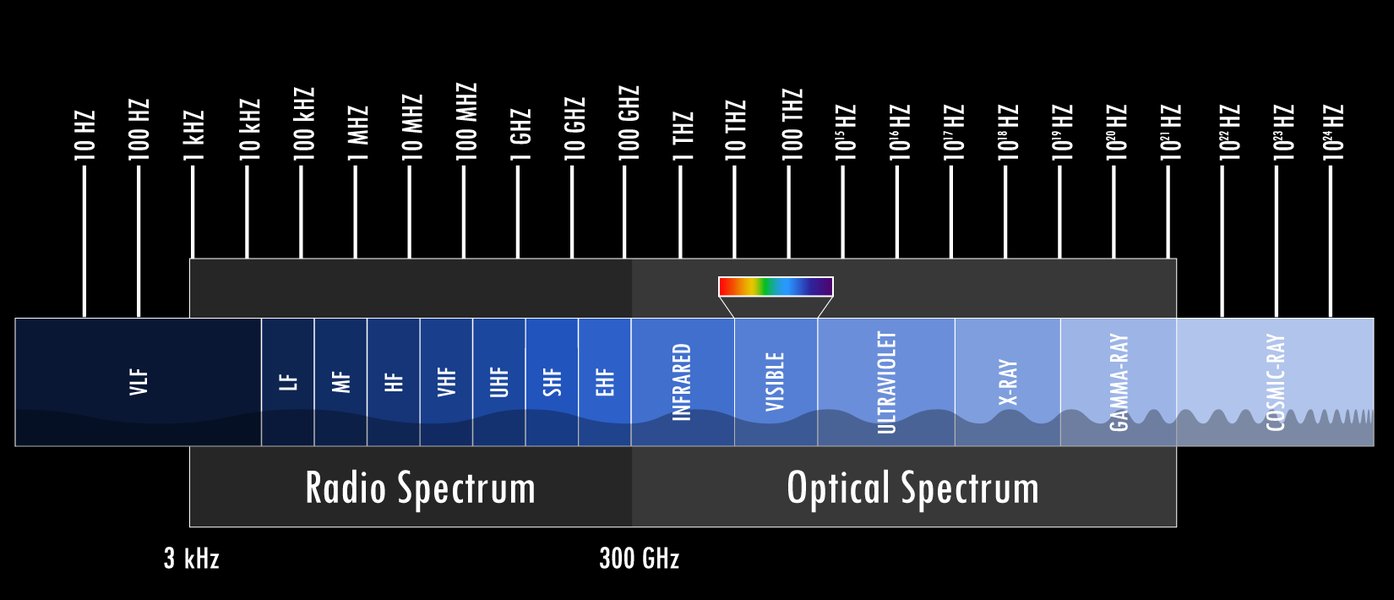
A chart illustrating various spectrum band designators and their uses. Image courtesy of NASA.
How Frequency Bands Operate
Frequency bands are contiguous ranges of frequencies within the radio spectrum. Each band exhibits different propagation characteristics: lower frequencies (e.g., LF, MF) can travel longer distances and penetrate obstacles better but typically support lower data rates. Higher frequencies (e.g., SHF, EHF) offer much larger bandwidths (allowing for higher data rates) but have shorter ranges and are more susceptible to absorption by atmospheric gases and obstacles, often requiring line-of-sight communication. For instance, frequencies above 30 GHz (millimeter-wave band) experience significant atmospheric absorption.
These bands are allocated for specific types of services or applications to ensure that different wireless technologies can coexist without interfering with each other. For example, some bands are dedicated to FM radio broadcasting, television broadcasting, mobile phone services, satellite communication, radar systems, amateur radio, and unlicensed uses like the Industrial, Scientific, and Medical (ISM) bands.
Designation and Allocation of Bands
The designation and allocation of frequency bands are managed by international and national regulatory bodies.
International Telecommunication Union (ITU)
The ITU, a specialized agency of the United Nations, plays a crucial global role in coordinating the shared global use of the radio spectrum and standardizing telecommunication protocols. It allocates frequency bands to different radio services and regions worldwide to ensure harmonization and prevent cross-border interference.
National Regulatory Authorities
Within countries, national authorities like the Federal Communications Commission (FCC) in the United States manage domestic spectrum allocation, licensing, and enforcement. They ensure that spectrum users comply with regulations and operate within their assigned frequencies.
IEEE and Other Standardizing Bodies
Organizations like the Institute of Electrical and Electronics Engineers (IEEE) contribute by developing standards that often include specifications for frequency band usage. For example, the IEEE has established letter designations for microwave frequency bands (e.g., L, S, C, X, Ku, K, Ka bands) widely used in radar, satellite, and terrestrial applications.
Common Band Designations Table
Here's a table summarizing some broadly recognized RF band designations, their frequency ranges, and typical applications:
| Band Designation | Frequency Range | Wavelength | Typical Applications |
|---|---|---|---|
| Very Low Frequency (VLF) | 3 kHz – 30 kHz | 100 km – 10 km | Submarine communication, time signals, navigation |
| Low Frequency (LF) | 30 kHz – 300 kHz | 10 km – 1 km | AM longwave broadcasting, navigation (beacons), RFID |
| Medium Frequency (MF) | 300 kHz – 3 MHz | 1 km – 100 m | AM mediumwave broadcasting, maritime and aviation communication |
| High Frequency (HF) | 3 MHz – 30 MHz | 100 m – 10 m | Shortwave broadcasting, amateur radio, over-the-horizon radar, RFID |
| Very High Frequency (VHF) | 30 MHz – 300 MHz | 10 m – 1 m | FM radio, television broadcasting, air traffic control, land mobile radio |
| Ultra High Frequency (UHF) | 300 MHz – 3 GHz | 1 m – 10 cm | Television broadcasting, mobile phones (GSM, LTE), Wi-Fi (2.4 GHz), Bluetooth, GPS, microwave ovens |
| Super High Frequency (SHF) | 3 GHz – 30 GHz | 10 cm – 1 cm | Wi-Fi (5 GHz, 6 GHz), satellite communication, radar, microwave links |
| Extremely High Frequency (EHF) | 30 GHz – 300 GHz | 1 cm – 1 mm | Radio astronomy, high-speed point-to-point communication, 5G mmWave, automotive radar |
The ISM bands (e.g., 2.4 GHz band used by Wi-Fi and Bluetooth) were initially reserved for non-communication purposes like microwave ovens but are now widely used for unlicensed low-power communication devices.
Navigating Multiple RF Channels: Enhancing Wireless Performance
Within a designated frequency band, the spectrum is often further divided into smaller segments called channels. This allows multiple devices or networks to operate simultaneously within the same band without interfering with each other, or allows a single protocol to improve its performance.
Channels vs. Bands: A Clarification
A frequency band is a broad range of frequencies (e.g., the 2.4 GHz ISM band spans from 2.400 GHz to 2.4835 GHz). An RF channel is a narrower, specific frequency range within that band (e.g., Wi-Fi channel 1 in the 2.4 GHz band typically uses frequencies from 2.401 GHz to 2.423 GHz, with a center frequency of 2.412 GHz). Protocols define how these channels are used.
Techniques for Multi-Channel Operation
Some RF protocols are designed to operate across multiple channels to enhance reliability, throughput, and coexistence with other wireless systems. Key techniques include:
- Fixed Channel Assignment: Devices operate on a pre-assigned channel. While simple, this can lead to congestion if many devices use the same channel. Users can often manually select a less crowded channel (e.g., in Wi-Fi routers).
- Dynamic Channel Allocation/Selection: Devices can scan available channels and automatically select the one with the least interference or best signal quality.
- Frequency Hopping Spread Spectrum (FHSS): The transmitter and receiver rapidly switch (hop) between multiple channels in a predetermined, pseudo-random sequence. This makes the communication resistant to narrowband interference and more secure. Bluetooth is a classic example of an FHSS system, hopping across 79 channels in the 2.4 GHz band.
- Direct Sequence Spread Spectrum (DSSS): The signal is spread over a wider bandwidth (often encompassing multiple channels or a very wide single channel) using a chipping code. This also provides resistance to interference and allows multiple users to share the same band (e.g., CDMA). Early Wi-Fi standards (802.11b) used DSSS.
- Orthogonal Frequency Division Multiplexing (OFDM): This technique, used in modern Wi-Fi (802.11a/g/n/ac/ax), LTE, and 5G, divides a wide channel into many closely spaced, orthogonal sub-carriers. Each sub-carrier can transmit data independently, providing high data rates and robustness against multipath interference.
By employing these strategies, protocols can effectively utilize the available spectrum, minimize interference, and provide more robust wireless links.
Comparative Analysis of Common RF Protocols
Different RF protocols are designed with varying strengths to suit diverse applications. The radar chart below offers a visual comparison of some popular protocols based on key performance characteristics. These are generalized assessments, and specific implementations can vary.
This chart helps illustrate the trade-offs involved in selecting an RF protocol. For instance, LoRaWAN excels in range and low power consumption but offers very low data rates, making it suitable for sensor networks that transmit small, infrequent packets. In contrast, Wi-Fi provides high data rates over moderate ranges but consumes more power.
Identifying and Exploring RF Frequencies
Understanding the specific frequencies a device or protocol uses, and how to explore these frequencies, is key for development, troubleshooting, or simply curiosity.
Determining a Protocol's Operating Frequency (MHz)
To find out the exact MHz (or GHz) range a specific RF protocol or device operates within, you can consult several sources:
- Protocol Standards Documents: Official specifications published by standardizing bodies (e.g., IEEE for Wi-Fi and Zigbee, Bluetooth SIG for Bluetooth) detail the frequency bands and channels used.
- Device Datasheets and Manuals: Manufacturers provide documentation for their wireless devices (e.g., routers, IoT modules, transceivers) that specifies operating frequencies, power levels, and supported protocols.
- Regulatory Databases: National regulatory authorities (like the FCC) maintain databases of certified devices and frequency allocations. These can be searched to find information about specific products or licensed frequency bands.
- Product Markings: Sometimes, the operating frequency or band is printed directly on the device or its packaging.
Getting Started with RF Experimentation
"Playing around" with radio frequencies, especially transmitting, is subject to strict regulations to prevent harmful interference with licensed services and critical communications. Unauthorized transmission can be illegal and dangerous. However, for learning and experimentation within legal boundaries, here are some approaches:
Tools for Exploration
- Software-Defined Radios (SDRs): SDRs are versatile radio receivers (and sometimes transceivers) where components traditionally implemented in hardware (e.g., mixers, filters, modulators) are instead implemented by means of software on a personal computer or embedded system. Affordable SDR dongles (often based on TV tuner chips) combined with open-source software (like GQRX or SDR#) allow you to scan wide portions of the radio spectrum, visualize signals, and decode many common protocols. This is primarily for listening.
- RF Transceiver Modules: For specific protocols like Bluetooth, Wi-Fi, Zigbee, or LoRa, development kits and modules (e.g., ESP32, nRF series, LoRa modules) are available. These are designed to operate legally within their specified bands and protocols, making them suitable for building projects.
- Spectrum Analyzers: Professional spectrum analyzers provide detailed views of RF signals, showing their power versus frequency. While traditionally expensive, more affordable options, including USB-based and handheld units, are becoming available for hobbyists and small labs. Some SDRs can also perform basic spectrum analysis.
- Antennas: The correct antenna is crucial for both receiving and transmitting. Different frequencies require different antenna designs and sizes.
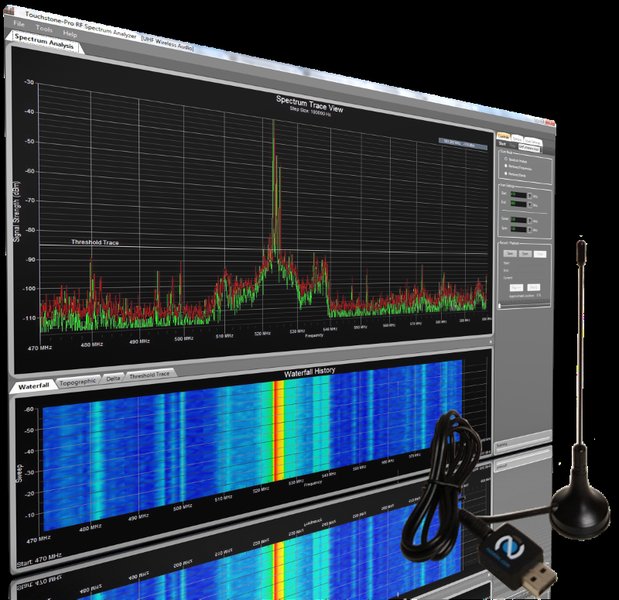
Example of an RF spectrum view using an SDR dongle and software. Image related to RF Viewer by Nuts About Nets.
Safety and Regulatory Compliance
Crucially, always adhere to local laws and regulations:
- Receiving is generally permissible: Listening to radio signals (e.g., with a scanner or SDR) is usually allowed, though there may be restrictions on intercepting certain types of communications (e.g., encrypted signals, phone calls).
- Transmitting requires authorization: Transmitting radio signals typically requires a license (e.g., an amateur radio license for ham bands) or the use of certified equipment that operates within unlicensed bands (like ISM bands) at legally permitted power levels.
- Understand Unlicensed Bands: Even in unlicensed bands (e.g., 2.4 GHz, 900 MHz ISM), there are rules regarding maximum transmission power, emissions, and interference avoidance. Devices like Wi-Fi routers and Bluetooth gadgets are pre-certified to comply with these rules.
- Start with low-power, certified modules: If you plan to transmit, begin with pre-certified modules designed for hobbyist use within unlicensed bands.
Experimenting responsibly allows for fascinating insights into the invisible world of radio waves while ensuring safety and legality.
Visualizing RF Communication Concepts
To better understand the interconnectedness of these concepts, the mindmap below illustrates the key elements involved in radio frequency communication, from the fundamental protocols to the regulatory landscape and practical applications.
This mindmap provides a hierarchical overview, connecting the core idea of RF communication to its various facets, including the types of protocols, how the spectrum is organized, the regulatory bodies involved, techniques for using multiple channels, common applications, and considerations for those looking to experiment with RF technologies.
Fundamentals of RF and Wireless Communications Explained
To further delve into the foundational concepts of radio frequency and wireless communications, the following video provides an excellent overview. It covers the basic principles that underpin all RF systems, making it a valuable resource for anyone looking to build a solid understanding of this technology.
This video, "Fundamentals of RF and Wireless Communications," discusses essential aspects such as basic RF functions and key parameters. Understanding these fundamentals is crucial before diving into specific protocols or attempting to experiment with RF signals, as it lays the groundwork for how these invisible waves carry information across distances.
Frequently Asked Questions (FAQ)
What is the main difference between an RF band and an RF channel?
An RF band is a broad range of frequencies within the radio spectrum (e.g., the 2.4 GHz ISM band). An RF channel is a much narrower, specific segment of frequencies located *within* a band (e.g., Wi-Fi Channel 6 within the 2.4 GHz band). Bands are like highways, and channels are like individual lanes on that highway, each allowing for a separate stream of communication.
Why are there so many different RF protocols?
Different applications have vastly different wireless communication needs. Some require long range but can tolerate low data rates and infrequent transmissions (like environmental sensors using LoRa). Others need very high data rates over shorter distances (like video streaming over Wi-Fi). Some prioritize ultra-low power consumption for battery-powered devices (like BLE). Each protocol is a trade-off between factors like range, data rate, power consumption, cost, security, and robustness to interference, leading to a diverse ecosystem of specialized protocols.
Is it legal to use a radio scanner or SDR to listen to any frequency?
In many jurisdictions, it is generally legal to own and use a radio scanner or SDR to listen to publicly accessible radio transmissions (e.g., amateur radio, FM/AM broadcasts, weather channels, some public safety dispatch). However, laws vary by country and region. It is typically illegal to intercept, record, or divulge private communications such as cellular phone calls, encrypted signals, or any communication for which you are not an intended recipient. Always check your local laws before operating such equipment.
What are ISM bands, and why are they important for protocols like Wi-Fi and Bluetooth?
ISM stands for Industrial, Scientific, and Medical. These are specific frequency bands (e.g., 900 MHz, 2.4 GHz, 5.8 GHz) that were originally set aside internationally for non-telecommunication purposes, such as RF heating in microwave ovens or medical diathermy equipment. Because these devices could cause interference, these bands were made available for low-power, unlicensed communication devices. This unlicensed status is crucial for the widespread adoption of technologies like Wi-Fi, Bluetooth, Zigbee, and many cordless phones, as manufacturers don't need to obtain individual licenses for each device, and users don't need licenses to operate them, provided they meet regulatory power and emission limits.
Recommended Further Exploration
- How does Frequency Hopping Spread Spectrum (FHSS) improve wireless communication reliability?
- What are the specific regulations for operating amateur radio equipment in my region?
- Compare the advantages and disadvantages of mesh networking protocols like Zigbee versus star topology protocols.
- How do Software-Defined Radios (SDRs) work and what are their common applications beyond hobbyist use?
References
Last updated May 8, 2025