
Unleashing Agility: The Ingenuity Behind Robotic Dog Legs and Canine Mobility Solutions
Explore the cutting-edge design, biomechanics, and diverse applications that power today's most advanced robotic canines and aid real dogs.
Key Insights into Robotic Leg Technology
- Bio-Inspired Design: Robotic dog legs are meticulously engineered, drawing inspiration from the kinematics of real animals like dogs, horses, and cheetahs, to achieve natural and efficient locomotion. This includes replicating the "backward knee" design for enhanced stability and agility.
- Advanced Mobility and Versatility: Modern robotic dog legs feature multiple degrees of freedom (DOF) and high-torque actuators, enabling a wide range of gaits—from walking and trotting to dynamic movements like jumping, climbing, and even manipulating objects while maintaining balance.
- Applications Across Fields: From industrial inspection and search-and-rescue operations to research platforms and companion robotics, the sophisticated design of robotic dog legs facilitates their use in environments that are challenging or inaccessible for humans. The technology also extends to creating advanced prosthetics and exoskeletons for actual dogs, significantly improving their mobility and quality of life.
The term "robotic dog leg" encompasses a fascinating spectrum of technological advancements, spanning from the sophisticated design and engineering of limbs for quadruped robots—colloquially known as "robot dogs"—to innovative prosthetic and exoskeleton solutions aimed at enhancing the mobility of real canines. This field is a testament to the powerful synergy between biomechanics, advanced materials, artificial intelligence, and robotics, pushing the boundaries of what these intelligent machines and assistive devices can achieve.
The Engineering Marvel: Robotic Dog Leg Design and Mechanics
At the heart of every agile robot dog lies its meticulously engineered legs. These components are not merely simple supports but complex systems designed to mimic the unparalleled agility and stability of their biological counterparts. Typically, each leg incorporates multiple degrees of freedom (DOF), often three or more, allowing for precise control over hip, knee, and ankle movements—much like a real dog’s anatomy.
Biomechanical Inspiration: The Backward Knee
A crucial design principle in many robotic dog legs is the "backward knee" configuration. This biomechanically inspired design, where the knee joint bends towards the rear of the robot, is not just an aesthetic choice; it significantly enhances stability, maneuverability, and energy efficiency. This design allows for better ground clearance, particularly when navigating obstacles or stairs, and contributes to a lower center of gravity, which is vital for dynamic stability during various gaits.

A robot dog, reminiscent of Boston Dynamics' Spot, navigating uneven terrain, showcasing the flexibility and range of its leg joints.
Actuation and Control Systems
High-torque actuators and servo motors are the muscles of these robotic limbs, providing the power and precision needed for movement. These motors are often strategically placed, sometimes at the hip, connected via belts or linkages to the knee and foot, to optimize weight distribution and reduce inertia. Embedded sensors, such as rotary encoders, provide real-time positional feedback, which is crucial for the robot’s sophisticated control algorithms.
Modern robotic dogs leverage advanced control systems, including inverse kinematics and AI-powered gait adjustments. Inverse kinematics enables the robot to calculate the precise joint angles required to achieve a desired leg position, while AI and machine learning allow the robot to adapt its gait dynamically to different terrains, learn new movements, and maintain balance even in unpredictable environments. Reinforcement learning, in particular, has proven effective in teaching robots complex tasks like coordinating limbs to open doors or pick up objects.
Material Science and Compliance
The materials used in robotic dog legs are selected for a balance of strength, lightweight properties, and compliance. Many designs incorporate reinforced ribs, hollow truss-like structures, and even topology-optimized compliant components. This combination ensures structural integrity while minimizing self-weight, which is vital for energy efficiency and dynamic performance.
Compliance, the ability of the leg to "give" or deform under external forces and then return to its original shape, is a critical feature. This can be achieved passively through materials like rubber in the feet or flexible joint designs, or actively through "dynamic compliant simulated springs" where motors behave as springs and dampers. This compliance allows the robot to absorb shocks, navigate uneven surfaces smoothly, and reduce the impact of falls, enhancing both durability and stability.
Diverse Locomotion and Advanced Capabilities
The sophisticated design of robotic dog legs enables a remarkable array of locomotion gaits and advanced functionalities, making these robots highly versatile for various applications.
Mastering Diverse Gaits
Robotic dogs are capable of executing a wide spectrum of gaits, from stable walking and efficient trotting to dynamic galloping and even specialized movements like upside-down walking and adaptive roll-over. Trotting is often favored for its efficiency and stability in moderate-speed locomotion. The ability to switch between gaits dynamically allows the robot to adapt seamlessly to changing terrain and mission requirements.
Object Manipulation and Interaction
Beyond locomotion, some advanced robotic dogs can use their legs for object manipulation. Robots like "LocoMan" demonstrate the capability to balance on their hind legs while using their front legs as manipulators to pick up or handle objects. This integration of locomotion and manipulation extends the robot's utility significantly, allowing it to perform complex 6D manipulation tasks without compromising its agility.
Real-time Adaptation and Sensing
To ensure robust performance in dynamic environments, robotic dog legs are equipped with various sensors. These include rotary encoders for precise leg movement tracking, touch sensors for ground contact feedback, ultrasonic sensors for obstacle detection, and Inertial Measurement Units (IMUs) in the torso for overall body orientation and acceleration. This real-time sensor data is fed into the robot's control system, allowing it to adjust leg movements, navigate obstacles, and maintain balance instantaneously.
The Spectrum of Robotic Dog Applications
The versatility and robust capabilities of robotic dog legs open doors to numerous applications across various sectors, demonstrating their utility in challenging and specialized roles.
Industrial and Commercial Use
Robotic dogs are increasingly deployed in industrial settings for monitoring and inspection tasks. Their ability to traverse difficult terrains, climb stairs, and navigate confined spaces makes them ideal for inspecting infrastructure, pipelines, and hazardous environments that are unsafe or inaccessible for humans. Companies like Unitree Robotics and Ghost Robotics offer commercial solutions, such as the Unitree Go2, which is known for its stability and autonomous navigation capabilities.
Search, Rescue, and Security
In disaster response and search-and-rescue operations, robotic dogs equipped with advanced leg systems can access rubble and hazardous areas, locate survivors, and deliver supplies. Their rugged design and agile mobility are invaluable in such critical situations. Similarly, in security and defense, these robots can perform surveillance, patrol, and even protect personnel in dangerous scenarios.
Research, Education, and Companionship
Many robotic dog platforms serve as versatile tools for research in robotics, AI, and human-robot interaction. Their open-source programming capabilities and modular designs make them excellent educational kits for students and hobbyists to explore complex robotics concepts, from kinematics to gait programming. Furthermore, some robotic dogs, like Xiaomi's CyberDog 2, are designed as interactive pets and companions, capable of performing tricks, dancing, and engaging with humans, blurring the lines between technology and companionship.
Navigating the Robotic Landscape: Performance Analysis
The performance of robotic dog legs can be assessed across several critical dimensions, including stability, agility, adaptability, and energy efficiency. This radar chart provides a comparative, opinionated analysis of typical robotic dog legs versus advanced bio-inspired designs, highlighting the impact of cutting-edge research and development.
The radar chart illustrates the nuanced differences between a typical commercial robotic dog leg and a more advanced, research-driven bio-inspired design. While commercial models often prioritize cost-effectiveness and robust performance for common tasks, cutting-edge designs excel in areas like stability on highly uneven terrains, agility, and the ability to adapt to novel situations or perform complex manipulation. Energy efficiency remains a significant challenge for all sophisticated robotic systems due to the power demands of dynamic leg movements, though advanced designs are making strides by optimizing actuator efficiency and incorporating spring-like dynamics.
Robotic Solutions for Canine Mobility: Prosthetics and Exoskeletons
Beyond the realm of autonomous robot dogs, the principles of robotic leg design are profoundly impacting the lives of real canines through advanced prosthetic and exoskeleton technologies.
Canine Prosthetics: Restoring Mobility
For dogs with limb loss or severe deformities, custom-made prosthetics are transforming their quality of life. These devices leverage advanced materials like lightweight composites and are often custom-fabricated using 3D printing, ensuring a precise and comfortable fit to the dog’s unique anatomy. The primary objectives of canine prosthetics include restoring mobility, preventing secondary joint issues, reducing limb length discrepancies, and allowing dogs to engage in daily activities with reduced pain or degeneration.
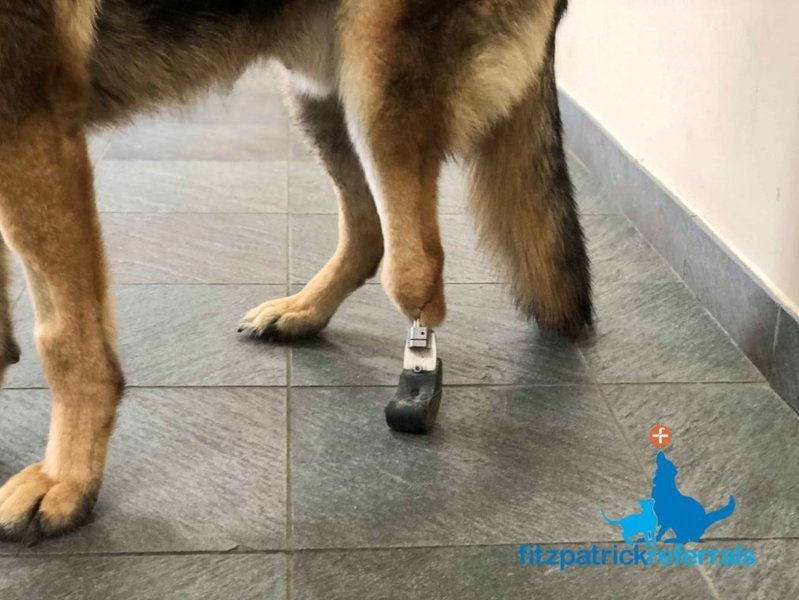
A close-up view of a dog fitted with a custom-made prosthetic limb, illustrating the integration of advanced materials for improved mobility.
While fully robotic, electronically actuated prosthetics for amputee dogs are not yet widespread, the integration of biomechanical principles with innovative manufacturing techniques represents a significant leap forward. Future advancements may see these passive prosthetics evolve to incorporate AI for adaptive responses, learning from the dog’s natural gait to provide real-time adjustments.
Canine Exoskeletons: Supporting Weakened Limbs
Canine exoskeletons are another innovative application of robotics, designed to assist dogs with weak, paralyzed, or recovering limbs. These wearable robotic devices supplement or restore walking abilities by providing structural support and powered assistance. Equipped with sensors and controlled by robotics technology, exoskeletons can be tailored to a canine’s specific biomechanical needs, aiding in rehabilitation after orthopedic surgery or providing long-term support for neurological conditions.
A video showcasing the development and use of an exoskeleton for a three-legged dog. This highlights how robotics can provide personalized mobility solutions for pets with disabilities, adapting to their unique needs and challenges.
The video above illustrates a custom-built exoskeleton for a three-legged dog, demonstrating how robotic assistance can dramatically improve mobility and quality of life for animals with physical challenges. This example underscores the compassionate application of robotics in veterinary medicine, where technology is harnessed to restore natural movement and support recovery.
Key Technologies Driving Robotic Leg Innovation
The development of advanced robotic dog legs, whether for autonomous robots or canine prosthetics, relies on a confluence of cutting-edge technologies. Understanding these core components is essential to grasp the current capabilities and future potential of the field.
A Technological Ecosystem for Agile Limbs
The following mindmap outlines the interconnected technologies and concepts that underpin the design, control, and application of robotic dog legs. From the foundational mechanical elements to the advanced software layers, each component plays a vital role in achieving sophisticated locomotion and interaction.
This mindmap visually represents the intricate ecosystem of technologies contributing to the advancement of robotic dog legs. It highlights how mechanical design, control systems, and artificial intelligence converge to enable diverse applications, from industrial automation to compassionate veterinary care. Each node signifies a crucial area of focus, underscoring the interdisciplinary nature of this exciting field.
Comparative Analysis: Key Features and Objectives
While both robot dogs and canine prosthetics leverage advanced leg technology, their core objectives and design considerations differ significantly. The table below provides a comparative overview of their key features and ultimate goals.
| Feature/Objective | Robotic Dog Legs (for Robot Dogs) | Robotic Legs (for Canine Prosthetics/Exoskeletons) |
|---|---|---|
| Primary Goal | Autonomous mobility, environmental interaction, task execution, exploration. | Restoring natural mobility, preventing further health issues, improving quality of life for disabled dogs. |
| Degrees of Freedom (DOF) | Typically 3+ DOF per leg for complex, dynamic movements. | Often passive or limited active DOF; focus on biomechanical alignment. |
| Actuation | High-torque electric motors, sophisticated servo systems. | Generally passive materials; future may include integrated sensors or minimal powered assistance. |
| Material Focus | Strength, lightweight, durability for various terrains (e.g., metals, advanced plastics). | Comfort, custom fit, biocompatibility, durability for long-term wear (e.g., lightweight composites, 3D printed polymers). |
| Control System | Complex algorithms (inverse kinematics, AI/ML for gait generation, balance). | Minimal to no active control; biomechanical alignment and fit are paramount. |
| Adaptability | Dynamic adaptation to unknown terrains, learned behaviors (e.g., object manipulation, obstacle avoidance). | Adaptation primarily through custom fitting; long-term comfort and functional integration. |
| Cost Considerations | High due to advanced robotics, sensors, and computing power. | Customization and specialized veterinary care contribute to significant cost. |
This table highlights the divergence in design philosophies, driven by distinct ultimate goals. Robot dogs are engineered for autonomous operation and interaction within complex environments, whereas canine prosthetics and exoskeletons are tailored to provide therapeutic and functional support for individual animals, emphasizing comfort and integration with biological systems.
Frequently Asked Questions
Are there fully robotic legs for real dogs that have lost a limb?
What makes robotic dog legs so stable on uneven terrain?
Can robotic dog legs perform tasks other than walking?
What are the main challenges in developing robotic dog legs?
Conclusion
The field of "robotic dog legs" stands at the intersection of advanced engineering, biological inspiration, and artificial intelligence, driving innovation for both autonomous machines and assistive technologies for real animals. From the intricate mechanical design that mimics natural canine kinematics to sophisticated AI algorithms that enable dynamic locomotion and object manipulation, these legs are pivotal to the capabilities of modern robot dogs. Concurrently, the principles of robotic design are being applied to create custom-fitted prosthetics and supportive exoskeletons that significantly enhance the mobility and quality of life for dogs with disabilities. As research continues to push the boundaries of materials science, actuation, and intelligent control, the future promises even more agile, adaptable, and integrated robotic leg solutions, further bridging the gap between biological and artificial locomotion.
Recommended Further Exploration
- How is AI used in robot dog locomotion?
- What are the latest advancements in canine prosthetic limbs?
- Compare Boston Dynamics Spot and Unitree Go2 leg designs
- Future applications of quadruped robots in hazardous environments