
Root Exudates and Microbial Degradation of Pollutants
Exploring the critical role of plant root exudates in enhancing the breakdown of environmental contaminants
Key Highlights
- Nutrient Provision and Microbial Support: Root exudates supply essential organic compounds that fuel bacterial activity.
- Enhanced Bioavailability: They mobilize pollutants, making them more accessible for microbial degradation.
- Microbial Community Modulation: These exudates shape and stimulate a diverse microbial ecosystem specialized in pollutant breakdown.
Overview
Root exudates are a mixture of organic compounds secreted by plant roots into the surrounding soil. Their chemical composition includes sugars, amino acids, organic acids, and various secondary metabolites. These compounds play an indispensable role in shaping the soil microbiome and actively influence the breakdown of organic pollutants. In this comprehensive discussion, we explore the multiple mechanisms through which root exudates enhance microbial degradation of pollutants, including nutrient provisioning, the modulation of microbial communities, and the activation of metabolic pathways.
Mechanisms of Influence
Nutrient Provisioning for Microbial Growth
One of the most significant effects of root exudates is their role as a nutrient source for soil microorganisms. Comprising a diverse mixture of organic acids, amino acids, sugars, and secondary metabolites, these exudates serve as easily assimilable carbon sources that are critical for microbial metabolism. When plants release these compounds, they effectively provide the metabolic energy and building blocks necessary for microbial growth and reproduction. This enhanced microbial proliferation leads to increased enzymatic activity in the soil, thereby accelerating the degradation of various organic pollutants.
Enhanced Bioavailability of Pollutants
Environmental pollutants, such as polycyclic aromatic hydrocarbons (PAHs) and petroleum hydrocarbons, can be tightly bound to soil particles, limiting their availability for microbial attack. Root exudates play a pivotal role in overcoming this limitation by altering the physicochemical properties of the soil. They facilitate the desorption of pollutants from soil matrices, effectively increasing their solubility and mobility. This process enhances the bioavailability of these contaminants, ensuring that degrading microbes can access and metabolize them more efficiently.
Microbial Community Recruitment and Modulation
Recruitment of Specific Microorganisms
The compounds present in root exudates often act as signaling molecules that attract microbial populations with specialized catabolic capabilities. This recruitment is crucial for establishing a rhizosphere microbial community that is tailored for the breakdown of specific pollutants. For instance, certain organic acids and amino acids found in exudates are known to selectively stimulate the growth of bacteria that possess the enzymatic machinery to degrade complex organic contaminants.
Reshaping Microbial Community Structure
Beyond recruitment, root exudates influence the overall microbial community composition in the rhizosphere. They create niche environments that boost the prevalence of pollutant-degrading microbial consortia. This dynamic adjustment not only increases the abundance of beneficial microbes but also enhances their collective metabolic activities, thereby fostering synergistic interactions that further promote the breakdown of environmental pollutants.
Activation of Enzymatic Pathways
Enzymatic activation is another mechanism through which root exudates facilitate pollutant degradation. The presence of specific compounds in exudates can induce the expression of catabolic genes in microorganisms. This induction leads to the production of degradation-specific enzymes that can break down a variety of pollutants. The upregulation of such enzymes, facilitated by the continuous supply of root exudates, ensures that the microbial community in the soil remains metabolically active and proficient in degrading contaminants.
Synergistic Effects in the Rhizosphere
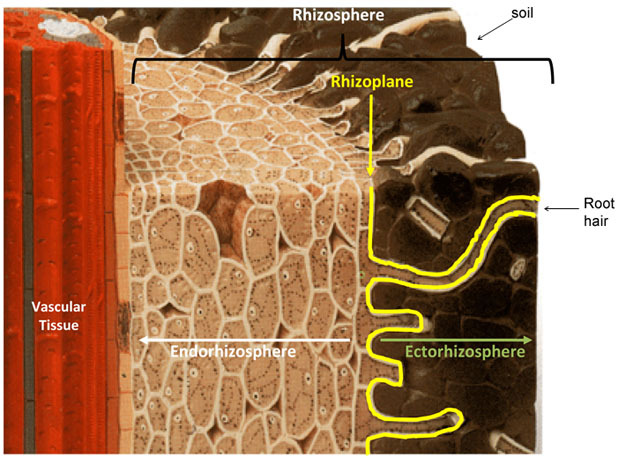
The rhizosphere—the narrow region of soil influenced by root secretions—becomes a hotspot for bioremediation processes due to the synergistic effects induced by root exudates. Within this zone, various interactions occur between plants and microbes that lead to enhanced pollutant degradation. These interactions include:
- Rhizosphere Biodegradation: Microorganisms directly degrade pollutants in the rhizosphere, supported by the nutrient-rich environment created by exudates.
- Phytostabilization: In certain cases, root exudates contribute to binding pollutants in forms that are less mobile and toxic, reducing their spread while still being accessible for gradual microbial degradation.
- Metabolic Synergies: The co-metabolic processes occurring among diverse microbial communities are enhanced by the continuous supply of flexible carbon sources from root exudates.
In-Depth Analysis via a Comparative Table
The table below summarizes key mechanisms by which root exudates affect microbial degradation of pollutants, providing insights into their diverse roles and contributions in the rhizosphere.
| Mechanism | Key Actions | Impact on Pollutant Degradation |
|---|---|---|
| Nutrient Provisioning | Supply of sugars, amino acids, and organic acids. | Boosts microbial growth and enzymatic activity. |
| Enhanced Bioavailability | Mobilization of pollutants via desorption and solubilization. | Makes pollutants more accessible to microbes. |
| Microbial Recruitment | Attraction of specialized pollutant-degrading bacteria. | Enhances the capacity of the microbial community to degrade contaminants. |
| Enzymatic Activation | Induction of catabolic pathways in microbes. | Increases breakdown and transformation of complex pollutants. |
| Community Modulation | Restructuring of microbial consortia for optimal functioning. | Promotes synergistic microbial interactions for efficient bioremediation. |
Illustrative Examples and Applications
Various studies have illustrated how the interaction between root exudates and microbial communities enhances pollutant degradation in different environmental contexts:
Case Study: Polycyclic Aromatic Hydrocarbons (PAHs)
PAHs are a group of persistent organic pollutants that often accumulate in contaminated soils. Research has demonstrated that root exudates can increase the bioavailability of PAHs, allowing degradation-specific bacteria to break down these compounds more effectively. This increase in bioavailability is due to the ability of organic acids in root exudates to reduce the binding of PAHs to soil particles, thereby enhancing microbial access.
Case Study: Petroleum Hydrocarbons
In the remediation of petroleum-contaminated soils, plants such as Medicago sativa have been found to produce exudates that significantly stimulate the microbial degradation of petroleum hydrocarbons. This enhanced degradation is primarily due to the synergistic effect of increased nutrient availability and the mobilization of hydrocarbon molecules, rendering them more accessible for microbial action.
Key Influencers and Catalysts in the Rhizosphere
The dynamic interaction between plant roots and soil microorganisms ultimately creates an environment conducive to the breakdown of pollutants. The catalytic influence of root exudates can be summarized as follows:
Direct Involvement in Degradation Processes
Some enzymes present in the root exudates directly participate in the biochemical degradation of pollutants. Such direct involvement further amplifies the overall degradation process by acting in tandem with microbial enzymes.
Stimulation of Microbial Metabolic Activity
The constant influx of metabolites from roots keeps the microbial community highly active. This metabolic stimulation not only accelerates pollutant breakdown but also maintains a steady-state niche where efficient degradation pathways are continually upregulated.
Integration of Findings from Research
Extensive research on the role of root exudates reveals a consistent theme: by transforming the soil environment, these secretions create a zone of enhanced biochemical activity. The induced changes in soil pH, nutrient gradients, and moisture levels jointly favor the survival and proliferation of pollutant-degrading microbes. Furthermore, the capacity of root exudates to reshape the microbial community emphasizes their role as natural catalysts for bioremediation.
The integration of multiple mechanisms—ranging from direct chemical interactions to the activation of microbial enzymes—illustrates the complex and highly efficient processes at work in the rhizosphere. In practical applications, understanding these roles has enabled the development of enhanced bioremediation strategies that leverage the natural synergy between plants and soil microbes.
References
-
Elucidating the significant roles of root exudates in organic pollutant - NCBI
- Detailed insights on root exudate interactions - Nature
- Impact of root exudates on soil microbial diversity - Frontiers in Microbiology
- Role of root exudates in pollutant degradation - Nature
-
Mechanisms of root exudate-induced biodegradation - PMC
Recommended Next Steps for Exploration
Last updated March 5, 2025