
Mastering Test Case Creation and Usage in RTL Design
A Comprehensive Guide to Ensuring Robust Hardware Functionality
Creating effective test cases is paramount in Register Transfer Level (RTL) design to ensure the correct functionality and reliability of hardware before fabrication. RTL design, a crucial stage in the digital circuit design flow, involves describing the circuit's behavior in terms of data flow between registers and the logical operations performed on that data. Testing at this level is focused on verifying that the design behaves as intended under various conditions, including expected inputs, edge cases, and even erroneous scenarios.
The primary goal of RTL testing is to identify and rectify design flaws early in the development cycle, significantly reducing the cost and time associated with later-stage corrections. This guide delves into the methodologies, best practices, and essential tools for crafting comprehensive test cases and effectively utilizing them in RTL design verification.
Key Highlights of RTL Test Case Development
- User-Centric Approach: Modern testing methodologies, particularly those influenced by philosophies like React Testing Library (RTL) in software, emphasize testing the user's perspective or the observable behavior of the system, rather than internal implementation details. This principle translates to RTL design by focusing on the functional correctness of the hardware as it interacts with its environment and other components.
- Comprehensive Coverage: Effective RTL test cases must aim for high coverage, encompassing various aspects such as functional correctness, timing constraints, corner cases, and error handling. This includes both directed tests, which target specific functionalities, and randomized tests, which explore a broader range of input combinations to uncover unexpected issues.
- Automation and Reusability: Automating test case generation and execution is vital for efficiency in complex RTL designs. Utilizing standardized frameworks like Universal Verification Methodology (UVM) and scripting languages enables the creation of reusable testbenches and test sequences, significantly accelerating the verification process.
Understanding RTL Design and the Need for Rigorous Testing
What is RTL Design?
RTL design is an abstraction level in the design of digital circuits that describes the synchronous digital circuit in terms of data flow and how the data is transformed between hardware registers. It sits above the gate-level and transistor-level descriptions, allowing designers to focus on the functionality and architecture of the system rather than the minute details of logic gates. Hardware Description Languages (HDLs) like Verilog and VHDL are commonly used to describe RTL designs.
Why is Testing Crucial in RTL Design?
Testing in RTL design is critical for several reasons:
- Early Bug Detection: Identifying design errors at the RTL stage is far less costly and time-consuming than discovering them in later stages like physical design or after fabrication.
- Functional Verification: Ensures that the circuit performs its intended operations according to the specifications.
- Performance and Timing Validation: Checks if the design meets performance requirements and timing constraints, crucial for high-speed circuits.
- Robustness and Reliability: Verifies the design's behavior under various conditions, including unusual inputs and error scenarios, leading to a more robust final product.
- Test-Driven Development (TDD) in Hardware: Applying TDD principles to RTL encourages thinking about how to test the design before writing the actual code, leading to better design decisions and easier verification.
Foundational Principles of RTL Test Case Creation
The User-Centric Philosophy: Beyond Implementation Details
While often associated with software testing, the principle of testing "what the user sees" or "how the system behaves" is highly applicable to RTL design. In hardware, the "user" could be another hardware block, a software driver, or even a human interacting with the system. The focus should be on the observable outputs and state changes of the RTL design in response to various inputs, rather than the intricate internal logic gates or specific register names.
This approach makes tests more robust to internal design changes. If the external behavior remains consistent, internal optimizations or refactoring should not break existing tests. This is a core tenet of effective verification, promoting maintainability and reducing test suite fragility.
Identifying Test Scenarios and Functional Requirements
Before writing any test cases, it's essential to thoroughly understand the RTL design's functional requirements. This involves:
Analyzing Specifications
Detailed design specifications, block diagrams, and interface definitions are the primary sources for identifying what needs to be tested. List all expected functionalities, inputs, outputs, and behaviors.
Breaking Down Complexity
For complex designs, break down the system into smaller, manageable modules. This allows for unit testing of individual components before integrating them into a larger system for integration testing.
Considering Edge Cases and Corner Cases
Beyond typical operational scenarios, it's crucial to identify boundary conditions (e.g., minimum/maximum input values, full/empty buffers) and corner cases (unusual combinations of inputs or states) that might expose subtle bugs.
Error Handling and Recovery
How should the RTL design behave when invalid inputs are provided, or unexpected events occur? Test cases should cover these error conditions to ensure proper error detection, reporting, and recovery mechanisms.
Techniques for Designing Effective RTL Test Cases
Directed Tests: Precision and Control
Directed tests are meticulously crafted test vectors or sequences designed to verify specific functionalities or paths within the RTL design. They are highly effective for targeting known behaviors and ensuring specific requirements are met.
- Stimulus Generation: Creating precise input signals and sequences to exercise particular functions.
- Expected Output Prediction: Determining the exact expected outputs for a given set of inputs. This often requires a "golden reference" model or a deep understanding of the design's logic.
- Assertion-Based Verification (ABV): Using assertions (e.g., SystemVerilog Assertions - SVA) embedded within the RTL code or testbench to formally specify expected behaviors and properties, which are then checked during simulation. This automatically flags violations.
Randomized Tests: Exploring the Design Space
Randomized tests, particularly constrained-random verification (CRV), are powerful for exploring a vast design space and uncovering unforeseen bugs that might be missed by directed tests. They generate random inputs within specified constraints.
- Constrained Random Generation: Instead of purely random, inputs are generated randomly but adhere to predefined constraints (e.g., valid data ranges, protocol sequences). This focuses the randomness on meaningful scenarios.
- Functional Coverage: Metrics are used to track which parts of the design (e.g., states, transitions, input combinations) have been exercised by the random tests. This helps identify areas that need more attention.
- Self-Checking Testbenches: The testbench includes logic to automatically compare actual outputs with expected outputs or to check for protocol violations, reducing manual observation.
Combining Directed and Randomized Approaches
The most effective verification strategies often combine both directed and randomized testing. Directed tests can quickly verify core functionalities and known edge cases, while randomized tests provide broad coverage and expose subtle interactions. Functional coverage metrics are key to understanding the effectiveness of the combined approach.
Structuring Your RTL Testbench and Test Cases
The Role of the Testbench
A testbench is a hardware description language (HDL) module used to verify the functionality of an RTL design (Design Under Test - DUT). It provides the necessary inputs, monitors the outputs, and checks for correct behavior.
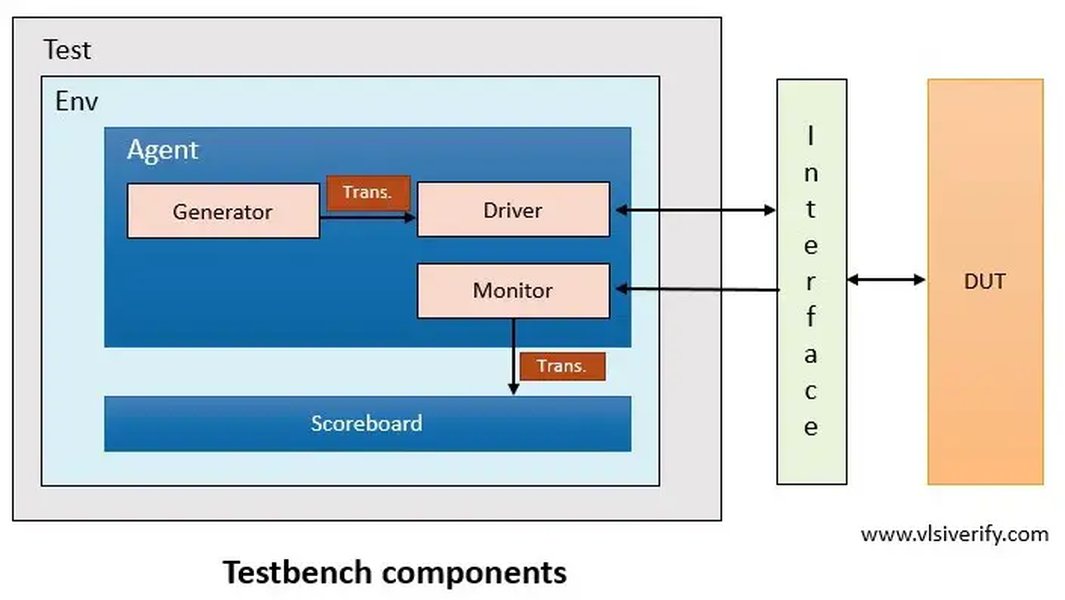
Figure 1: Key Components of a Standard Testbench for RTL Verification.
Typical components of an RTL testbench include:
- Stimulus Generator: Applies input signals to the DUT.
- Reference Model/Scoreboard: Predicts expected outputs based on inputs and compares them with the actual outputs from the DUT.
- Monitors: Observe signals and data flows within the DUT and the testbench for coverage collection or assertion checking.
- Clock and Reset Generation: Provides the necessary timing and reset signals for the synchronous design.
Organizing Test Cases
For large and complex designs, organizing test cases is crucial for maintainability and scalability:
- Modular Test Files: Group related test cases into separate files or modules. For instance, tests for a specific interface or a particular functional block can reside in their own test file.
- Test Suites: Combine individual test cases into logical test suites to run different sets of tests (e.g., smoke tests, regression tests, full functional tests).
- Descriptive Naming: Use clear and descriptive names for test files, test cases, and test functions to indicate what they are testing.
Here's a simplified example of how you might structure a test case in a pseudo-HDL or verification environment:
module my_component_tb;

  // DUT instance
  my_component dut (
    .clk(clk),
    .reset_n(reset_n),
    .input_data(input_data),
    .input_valid(input_valid),
    .output_data(output_data),
    .output_valid(output_valid)
  );

  // Clock and Reset generation
  initial begin
    clk = 0;
    forever #5 clk = ~clk; // 10ns clock period
  end

  initial begin
    reset_n = 0;
    #100; // Hold reset for 100ns
    reset_n = 1;
  end

  // Test Case 1: Simple Data Transfer
  task test_simple_data_transfer;
    begin
      // Apply initial conditions
      input_data = 8'h00;
      input_valid = 0;
      #10; // Wait a few cycles

      // Apply stimulus
      input_data = 8'hA5;
      input_valid = 1;
      #10; // Wait for one clock cycle

      // Expect output
      @(posedge clk);
      if (output_valid == 1 && output_data == 8'hA5) begin
        $display("Test Case 1 PASSED: Simple data transfer successful.");
      end else begin
        $error("Test Case 1 FAILED: Expected A5, got %h (valid: %b)", output_data, output_valid);
      end
      input_valid = 0; // De-assert input_valid
    end
  endtask

  // Test Case 2: Handling multiple data transfers
  task test_multiple_data_transfer;
    // ... similar logic for multiple data inputs and outputs
  endtask

  // Main test sequence
  initial begin
    // Reset the DUT
    @(negedge reset_n); // Wait for reset to be applied
    @(posedge clk);     // Wait for first clock edge after reset

    // Run test cases
    test_simple_data_transfer();
    test_multiple_data_transfer();

    $finish; // End simulation
  end

endmodule
Advanced RTL Testing Methodologies
Universal Verification Methodology (UVM)
UVM is a standardized methodology for verifying RTL designs. It provides a robust, reusable, and scalable framework for building complex testbenches. UVM leverages object-oriented programming concepts in SystemVerilog to create highly modular and configurable test environments. It's particularly useful for large-scale projects where reusability across different designs and teams is essential.
Video: This tutorial explains how a testbench is written to verify an RTL DESIGN, demonstrating how a RAM Verilog module can be verified using a testbench.
The video above provides a practical example of how a testbench is constructed to verify an RTL design, specifically a RAM Verilog module. This aligns perfectly with the principles of creating and utilizing test cases to ensure the functional correctness of hardware components. Understanding such examples is crucial for anyone looking to apply these concepts in real-world RTL verification.
Formal Verification
Unlike simulation-based testing, formal verification uses mathematical proofs to exhaustively verify properties of a design. It can prove the absence of certain types of bugs, whereas simulation can only show the presence of bugs. Formal verification techniques like Model Checking and Equivalence Checking are often used alongside simulation for critical properties or design comparisons.
Essential Tools and Frameworks for RTL Testing
The landscape of RTL testing is supported by a rich ecosystem of tools:
Hardware Description Languages (HDLs)
- Verilog & VHDL: The primary languages for describing RTL designs and testbenches. SystemVerilog, an extension of Verilog, is particularly popular for verification due to its advanced features like classes, constraints, and assertions.
Simulators
- Cadence Xcelium, Synopsys VCS, Mentor Graphics QuestaSim/ModelSim: These are industry-standard simulators that execute HDL code, allowing designers to observe the behavior of their RTL designs over time. They are crucial for running test cases and debugging.
Verification IP (VIP)
- Pre-verified and reusable components that implement standard protocols (e.g., AXI, PCIe, USB). Using VIPs for stimulating and checking compliance with these protocols significantly speeds up testbench development.
Coverage Tools
- Integrated within simulators or as standalone tools, these measure various types of coverage (e.g., functional coverage, code coverage, toggle coverage) to assess the completeness of the test suite.
Scripting Languages
- Python, Perl, Tcl: Often used for automating test flows, generating test vectors, processing simulation logs, and orchestrating verification campaigns.
Best Practices for Robust RTL Test Cases
Adhering to best practices ensures test cases are effective, maintainable, and provide high confidence in the design:
- Readability and Maintainability: Write clean, well-commented test code. Use meaningful variable names and modularize your testbench components.
- Reproducibility: Ensure that test cases produce consistent results every time they are run, regardless of the environment or execution order.
- Self-Checking: Design test cases to automatically verify results against expected outcomes, rather than requiring manual inspection of waveforms.
- Isolation: When possible, test individual components in isolation before combining them for integration testing. This helps pinpoint the source of bugs.
- Regression Testing: Maintain a suite of regression tests that are run regularly to ensure that new changes or bug fixes do not introduce new issues or reintroduce old ones.
- Test Prioritization: Prioritize test cases based on criticality, complexity, and risk. Focus on core functionalities and high-risk areas first.
Impact of Test Case Quality on RTL Design Verification
The quality of your test cases directly impacts the effectiveness and efficiency of your RTL verification process. Poorly designed test cases can lead to a false sense of security, missed bugs, and increased verification time. Conversely, well-designed test cases accelerate the development cycle and improve design quality.
To better illustrate the multifaceted impact of test case quality, let's examine various attributes on a radar chart. This chart reflects the subjective yet critical aspects influenced by the rigor and thoughtfulness put into developing RTL test cases.
This radar chart visually represents how strong test case creation impacts various aspects of RTL verification. For example, higher scores in "Bug Detection Rate" and "Verification Efficiency" indicate more effective test cases. Similarly, "Maintainability" and "Reusability" reflect the long-term benefits of well-structured tests. "Confidence in Design" is the ultimate goal, showing how thoroughly tested a design is, making it ready for fabrication.
A Comparative Overview of Testing Methodologies in Hardware and Software
While the specifics differ, there are notable parallels between test case usage in RTL design and software development, particularly with approaches like React Testing Library (RTL). Both aim to verify functionality from an external, user-centric perspective.
| Aspect | RTL Design (Hardware) | React Testing Library (Software) |
|---|---|---|
| Primary Goal | Verify hardware behavior against specifications before physical fabrication; ensure no functional bugs in the silicon. | Verify component behavior from the user's perspective; ensure UI works as expected. |
| "User" Perspective | Another hardware block, a software driver, or the overall system interaction. | A human user interacting with the UI (clicks, typing, visual elements). |
| Focus | External interfaces, data flow, state transitions, timing compliance. | DOM elements, accessibility attributes, user events (click, change), rendered output. |
| Testing Medium | HDL (Verilog, VHDL, SystemVerilog) in a simulator. | JavaScript/TypeScript in a browser-like environment (e.g., Jest with JSDOM). |
| Key Philosophies | Constrained-random verification, formal verification, functional coverage, self-checking testbenches. | "The more your tests resemble the way your software is used, the more confidence they can give you." (Kent C. Dodds) |
| Tools/Frameworks | UVM, SystemVerilog Assertions (SVA), Industry-standard simulators (Xcelium, VCS, QuestaSim). | Jest, Vitest, React Testing Library utilities (render, screen, fireEvent, userEvent). |
| Debugging | Waveform viewers, debuggers integrated with simulators. | screen.debug(), browser developer tools, Jest's test output. |
This comparison highlights that while the underlying technologies differ, the core principles of effective test case design—focusing on observable behavior, aiming for comprehensive coverage, and structuring tests for maintainability—are universal across hardware and software domains.
Frequently Asked Questions About RTL Test Cases
Recommended Further Exploration
- Explore the intricate architecture of UVM testbenches and their components.
- Understand the various functional coverage metrics and their role in comprehensive VLSI verification.
- Discover the mathematical power of formal verification techniques in proving hardware correctness.
- Learn strategies for effectively maintaining and scaling large RTL test suites over time.
References
Last updated May 21, 2025