
Comprehensive Guide to the Rules of Algebra
Master the foundational principles that govern mathematical expressions and equations.
Key Takeaways
- Understanding the fundamental properties of algebra, such as commutative, associative, and distributive laws, is essential for simplifying and solving equations.
- Mastery of exponent rules and operations with fractions enhances the ability to manipulate complex algebraic expressions.
- Applying the rules of equality and inequality ensures the accuracy and validity of solutions in algebraic problem-solving.
Fundamental Algebraic Properties
1. Commutative Property
The commutative property states that the order in which two numbers are added or multiplied does not affect the result.
Addition
For any two real numbers, a and b, the addition is commutative:
a + b = b + a
Multiplication
Similarly, the commutative property of multiplication is expressed as:
a × b = b × a
2. Associative Property
The associative property indicates that the grouping of numbers does not change the sum or product.
Addition
For any three real numbers, a, b, and c:
(a + b) + c = a + (b + c)
Multiplication
Similarly, for multiplication:
(a × b) × c = a × (b × c)
3. Distributive Property
The distributive property connects addition and multiplication, allowing the distribution of multiplication over addition or subtraction.
a × (b + c) = a × b + a × c
a × (b - c) = a × b - a × c
Rules of Equality
1. Reflexive Property
Any number is equal to itself.
a = a
2. Symmetric Property
If one number equals a second number, then the second number equals the first.
If a = b, then b = a
3. Transitive Property
If one number equals a second number, and the second number equals a third number, then the first number equals the third number.
If a = b and b = c, then a = c
4. Addition and Subtraction Properties
You can add or subtract the same value from both sides of an equation without changing the equality.
If a = b, then a + c = b + c
If a = b, then a - c = b - c
5. Multiplication and Division Properties
Multiplying or dividing both sides of an equation by the same non-zero number maintains the equality.
If a = b, then a × c = b × c
If a = b and c ≠ 0, then a ÷ c = b ÷ c
Rules of Exponents
1. Product of Powers
When multiplying two exponents with the same base, add their exponents.
am × an = am+n
2. Quotient of Powers
When dividing two exponents with the same base, subtract the exponent of the denominator from the exponent of the numerator.
am ÷ an = am-n
3. Power of a Power
When raising an exponent to another power, multiply the exponents.
(am)n = am×n
4. Power of a Product
The exponent distributes over a product.
(a × b)n = an × bn
5. Power of a Quotient
The exponent distributes over a quotient.
(a ÷ b)n = an ÷ bn
6. Zero Exponent
Any non-zero base raised to the power of zero equals one.
a0 = 1
7. Negative Exponent
A negative exponent indicates the reciprocal of the base raised to the opposite positive exponent.
a-n = 1 ÷ an
| Exponent Rule | Formula | Example |
|---|---|---|
| Product of Powers | am × an = am+n | a2 × a3 = a5 |
| Quotient of Powers | am ÷ an = am-n | a5 ÷ a2 = a3 |
| Power of a Power | (am)n = am×n | (a2)3 = a6 |
| Power of a Product | (a × b)n = an × bn | (2 × 3)2 = 22 × 32 = 4 × 9 = 36 |
| Zero Exponent | a0 = 1 | 50 = 1 |
| Negative Exponent | a-n = 1 ÷ an | 2-3 = 1 ÷ 23 = 1/8 |
Properties of Zero and One
1. Additive Identity (Zero)
Adding zero to any number does not change the number.
a + 0 = a
2. Multiplicative Identity (One)
Multiplying any number by one does not change the number.
a × 1 = a
3. Additive Inverse
The additive inverse of a number is its negative, which when added to the original number results in zero.
a + (-a) = 0
4. Multiplicative Inverse
The multiplicative inverse of a number is its reciprocal, which when multiplied by the original number results in one.
a × (1/a) = 1 (where a ≠ 0)
Operations with Fractions
1. Adding and Subtracting Fractions
To add or subtract fractions, find a common denominator.
(a/b) + (c/d) = (ad + bc) / (bd)
(a/b) - (c/d) = (ad - bc) / (bd)
2. Multiplying Fractions
Multiply the numerators together and the denominators together.
(a/b) × (c/d) = (a × c) / (b × d)
3. Dividing Fractions
Multiply by the reciprocal of the divisor.
(a/b) ÷ (c/d) = (a/b) × (d/c) = (a × d) / (b × c)
Rules for Inequalities
1. Addition and Subtraction
Similar to equations, you can add or subtract the same number from both sides without changing the inequality.
If a < b, then a + c < b + c
If a > b, then a - c > b - c
2. Multiplication and Division
Multiplying or dividing both sides of an inequality by a positive number maintains the inequality.
If a < b and c > 0, then a × c < b × c
However, if you multiply or divide by a negative number, you must reverse the inequality sign.
If a < b and c < 0, then a × c > b × c
Combining Like Terms
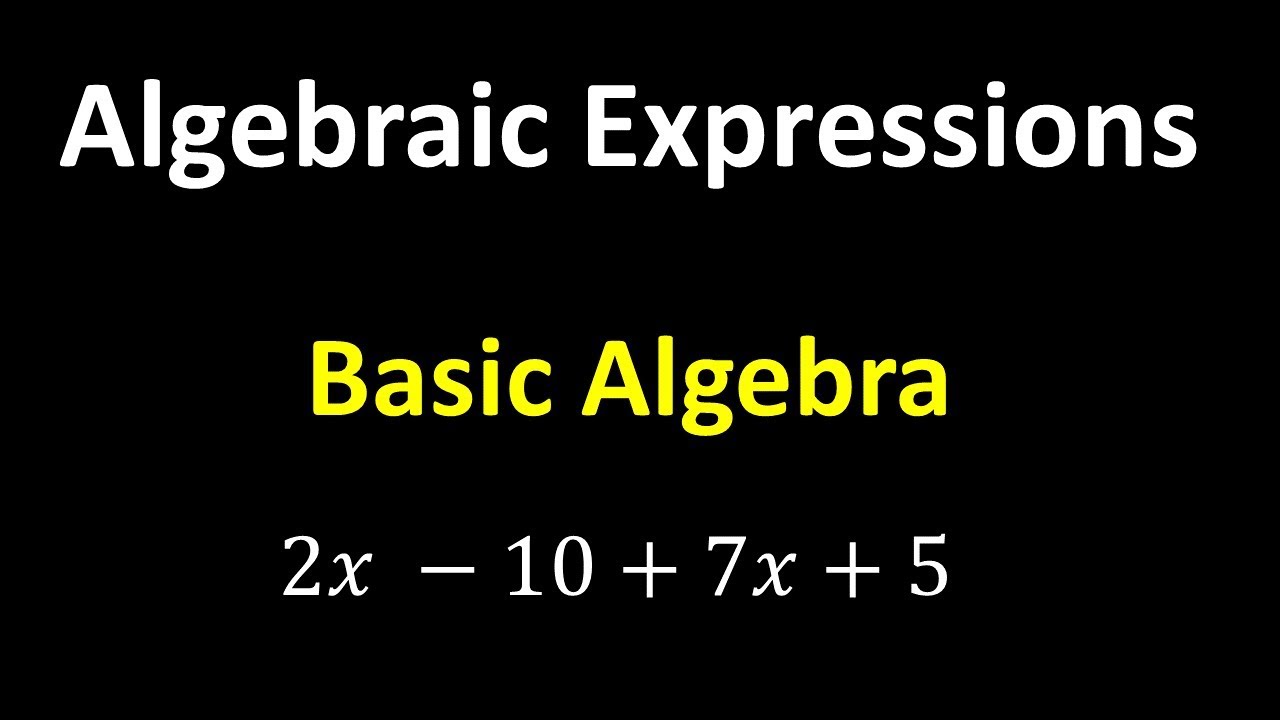
Like terms are terms that have the same variable part raised to the same power. They can be combined by adding or subtracting their coefficients.
Example: 3x + 5x = (3 + 5)x = 8x
Identifying Like Terms
Terms must have identical variable components with the same exponents to be considered like terms.
Simplifying Expressions
Combine like terms to simplify algebraic expressions, making it easier to solve equations.
Factoring Techniques
1. Factoring Out the Greatest Common Factor (GCF)
Identify and factor out the largest common factor from each term in the expression.
Example: 2ax + 2ay = 2a(x + y)
2. Special Products
Difference of Squares
An expression in the form of a2 - b2 can be factored as:
a2 - b2 = (a - b)(a + b)
Perfect Square Trinomials
Expressions like (a + b)2 and (a - b)2 can be expanded and factored accordingly:
(a + b)2 = a2 + 2ab + b2
(a - b)2 = a2 - 2ab + b2
Order of Operations
When evaluating algebraic expressions, it's crucial to follow the order of operations to obtain the correct result.
PEMDAS/BODMAS
The acronym PEMDAS stands for:
-
Parentheses / Brackets
-
Exponents / Orders
-
Multiplication and Division (from left to right)
-
Addition and Subtraction (from left to right)
Adhering to this sequence ensures that expressions are evaluated consistently and correctly.
Advanced Concepts
1. Polynomial Operations
Polynomials are algebraic expressions consisting of variables and coefficients. Operations involving polynomials include addition, subtraction, multiplication, and division.
Addition and Subtraction
Combine like terms to add or subtract polynomials.
Multiplication
Distribute each term in one polynomial across each term in the other polynomial.
Division
Use polynomial long division or synthetic division to divide polynomials.
2. Solving Algebraic Equations
Solving equations involves finding the value of the variable that makes the equation true. This process often requires applying multiple algebraic rules and properties.
Linear Equations
Equations of the first degree, typically in the form ax + b = c, are solved by isolating the variable.
Quadratic Equations
Second-degree equations, such as ax² + bx + c = 0, can be solved using factoring, completing the square, or the quadratic formula.
System of Equations
Multiple equations involving the same variables can be solved using substitution, elimination, or matrix methods.
Practical Applications of Algebraic Rules
The rules of algebra are not confined to abstract mathematics; they have numerous practical applications in various fields:
1. Engineering and Physics
Algebraic principles are fundamental in formulating and solving equations related to forces, motion, and electrical circuits.
2. Economics and Finance
Algebra is used in modeling economic trends, calculating interest rates, and optimizing financial portfolios.
3. Computer Science
Algorithm design, computer graphics, and cryptography heavily rely on algebraic concepts and operations.
4. Medicine and Pharmacology
Dosage calculations, statistical data analysis, and medical imaging technologies utilize algebraic equations and models.
Common Mistakes and How to Avoid Them
1. Ignoring the Order of Operations
Neglecting PEMDAS/BODMAS can lead to incorrect results. Always adhere to the sequence of operations when evaluating expressions.
2. Misapplying the Distributive Property
Ensure that multiplication is correctly distributed over addition or subtraction within parentheses.
3. Combining Unlike Terms
Only like terms (identical variable parts with the same exponents) can be combined. Avoid adding or subtracting unlike terms.
4. Sign Errors
Be cautious with positive and negative signs, especially when dealing with negative exponents or subtracting negative numbers.
5. Incorrect Factoring
Ensure that all common factors are identified and correctly factored out to simplify expressions effectively.
Conclusion
Understanding and applying the fundamental rules of algebra is crucial for solving mathematical problems efficiently and accurately. From the basic properties like commutative and associative laws to more advanced concepts involving exponents, fractions, and inequalities, each rule serves as a building block for more complex computations. Mastery of these principles not only enhances problem-solving skills in mathematics but also equips individuals with the analytical tools necessary for various real-world applications across diverse fields such as engineering, economics, and computer science. Consistent practice and a clear grasp of these algebraic rules pave the way for success in both academic pursuits and professional endeavors.
References
Last updated February 11, 2025