
Unveiling SAE/EIA-649C: The Cornerstone of Configuration Management Excellence
Explore the universally adopted principles and functions of the SAE/EIA-649C standard, crucial for maintaining product integrity and managing complex changes across diverse industries.
Key Insights into SAE/EIA-649C
- Foundational Standard: SAE/EIA-649C is the premier consensus standard for Configuration Management (CM), offering a flexible, principle-based framework applicable across commercial, government, and defense sectors worldwide.
- Five Core Functions: The standard meticulously outlines five essential CM functions—Planning, Identification, Change Management, Status Accounting, and Verification & Audit—providing a structured approach to managing product lifecycle integrity.
- Adaptable and Non-Prescriptive: Unlike rigid mandates, SAE/EIA-649C emphasizes principles over specific terminology or tools, allowing organizations to tailor its guidance to their unique environments and contractual requirements.
Understanding SAE/EIA-649C: A Definitive Framework for Consistency
The SAE/EIA-649C, formally known as the "Configuration Management Standard," stands as the most current and widely recognized industry benchmark for configuration management (CM). Published on February 7, 2019, by SAE International, this standard provides a robust and comprehensive framework for organizations to establish and maintain consistency between product requirements, the actual product, and all associated configuration information throughout its entire lifecycle. Its definition of CM as a "technical and management process applying appropriate resources, processes, and tools to establish and maintain consistency between the product requirements, the product, and associated product configuration information" underscores its critical role in ensuring precision and reliability in complex systems.
The flexibility embedded within SAE/EIA-649C is one of its most compelling attributes. It offers guidance and principles rather than mandating specific terminology or rigid implementation methods. This approach allows organizations to adapt the standard to their unique operational contexts, whether in commercial product development, government contracts, or defense initiatives. This adaptability has cemented its status as a vital resource for enhancing data management, reducing risks, and improving communication across diverse stakeholder groups.
The Evolution of Configuration Management Standards
The journey to SAE/EIA-649C began in 1994, when the Electronic Industries Alliance’s (EIA) G-33 Committee on Data and Configuration Management embarked on creating an industry-wide CM standard. The initial version, ANSI/EIA-649, was conceived as a national consensus standard, aiming to provide overarching CM requirements and best practices without imposing specific implementation approaches. This foundational work laid the groundwork for subsequent iterations.
Over the years, the standard underwent significant refinements. ANSI/EIA-649-A was released in 2004, followed by SAE/EIA-649-B in 2011. Each revision integrated new insights and adapted to evolving industry needs, particularly within the defense and space sectors. The culmination of these efforts is SAE/EIA-649C (2019), which incorporates lessons learned from practical applications and reinforces its principle-based approach. Notably, the U.S. Department of Defense (DoD) officially adopted SAE/EIA-649C on September 10, 2019, solidifying its importance in government and defense procurement by replacing older military standards like MIL-STD-973. This historical progression highlights the standard's continuous adaptation to technological advancements and operational realities.
The radar chart above illustrates a comparative analysis of SAE/EIA-649C principles against more traditional or "legacy" Configuration Management (CM) approaches. It highlights how SAE/EIA-649C excels in areas like universal applicability and flexibility, providing a modern and adaptable framework for CM across various sectors. The chart also demonstrates its strong emphasis on the five core CM functions, portraying its comprehensive nature in contrast to older, potentially less integrated methods. This visual representation underscores the standard's advanced and flexible design, which prioritizes adaptable principles over rigid procedures, making it highly effective for contemporary organizational needs.
The Five Pillars of Configuration Management (CM)
At the heart of SAE/EIA-649C are five fundamental CM functions, which collectively form the backbone of any effective configuration management program. These functions, detailed in Section 5 of the standard, are designed to ensure comprehensive control and integrity of product configurations throughout their lifecycle.
1. CM Planning and Management
This initial function involves establishing the overall CM strategy. It encompasses defining the processes, assigning responsibilities, and selecting the appropriate tools for CM activities. Effective planning ensures that CM is integrated from the outset of a project, setting the stage for organized and controlled development. This phase is critical for defining the scope, policies, and procedures that will govern all subsequent CM efforts.
2. Configuration Identification
Configuration Identification focuses on defining and documenting the functional and physical characteristics of configuration items (CIs). CIs can be products, components, software, or any other element that requires formal management. This function involves assigning unique identifiers and establishing baselines, which serve as formally agreed-upon snapshots of a product's configuration at specific points in its lifecycle. Accurate identification is paramount for traceability and understanding the relationships between different components within a complex system.
3. Configuration Change Management
Perhaps one of the most critical functions, Change Management (also known as Configuration Control), outlines the processes for controlling modifications to baselines and configuration items. This includes procedures for requesting, evaluating, approving, and implementing changes. The goal is to ensure that all modifications are authorized, documented, and properly tracked, thereby preventing unauthorized changes and maintaining product integrity. This rigorous control mechanism is essential for mitigating risks and managing the inevitable evolution of products.
4. Configuration Status Accounting
Status Accounting involves maintaining comprehensive records of the status of configuration items and all change activities. This includes tracking the current state of CIs, their history, and the status of any change requests and their implementation. It provides a reliable audit trail, offering transparency and accountability. This function ensures that stakeholders have accurate and up-to-date information on the configuration of all managed items, facilitating informed decision-making.
5. Configuration Verification and Audit
The final function, Verification and Audit, ensures that the actual configuration of a product or system matches its documented configuration. This involves conducting formal audits and verification activities to confirm compliance with established requirements and baselines. It also checks that CM processes themselves are being followed correctly. This function provides assurance that the implemented changes and the current configuration accurately reflect the approved documentation, thereby validating the integrity of the CM process.
SAE/EIA-649C in Action: A Mindmap of Its Core
(Strategy & Policy)"] id1_2["Configuration Identification
(Define & Baseline CIs)"] id1_3["Change Management
(Control & Track Changes)"] id1_4["Configuration Status Accounting
(Record & Report Status)"] id1_5["Verification & Audit
(Ensure Conformance)"] id2["Key Principles"] id2_1["Universal Applicability
(Commercial, Gov, Defense)"] id2_2["Guidance Not Mandate
(Flexible & Tailorable)"] id2_3["Consistency & Integrity
(Product Lifecycle)"] id2_4["Risk Mitigation
(Controlled Changes)"] id2_5["Improved Communication
(Stakeholder Alignment)"] id3["Historical Context"] id3_1["Initiated 1994 (EIA G-33)
(ANSI/EIA-649)"] id3_2["Revised 2004 (A) & 2011 (B)
(Continuous Improvement)"] id3_3["Published Feb 7, 2019 (C)
(Latest Revision)"] id3_4["DoD Adoption Sep 10, 2019
(Tier I Standard)"] id4["Related Standards & Handbooks"] id4_1["SAE EIA-649-1A
(Defense Contracts)"] id4_2["SAE EIA-649-2
(NASA Enterprises)"] id4_3["GEIA-HB-649A
(Implementation Handbook)"] id4_4["ISO 10007, ITIL, AS9100
(Aligned CM Principles)"] id5["Benefits & Importance"] id5_1["Structured Approach
(Consistency & Control)"] id5_2["Reduced Errors & Rework
(Quality Assurance)"] id5_3["Enhanced Traceability
(Accountability)"] id5_4["Supports Lean Practices
(Efficiency)"]
The mindmap above provides a comprehensive visual summary of the SAE/EIA-649C standard, illustrating its core components and interconnectedness. It clearly branches out into the five core CM functions, key underlying principles, its historical development, related standards, and the significant benefits it offers. This visual aid helps to quickly grasp the breadth and depth of the standard, demonstrating how its various elements contribute to a robust and effective configuration management system.
Broader Applicability and Industry Recognition
SAE/EIA-649C is not confined to a single sector; its principles are designed for universal applicability across various commercial and governmental enterprises globally. This means it is highly relevant for internal enterprise information, processes, and supporting systems (Enterprise CM), as well as for managing external interactions with suppliers and partners (Acquirer/Supplier CM). Its broad adoption reflects its proven ability to standardize CM processes across diverse industries.
The standard is widely regarded as the most well-known and accepted industry standard for CM, applicable to hardware, software, organizations, and IT infrastructure. Its influence extends to other significant industry standards and requirements, including ISO 10007 (Guidance on Configuration Management), ITIL (Information Technology Infrastructure Library) CM requirements, and aerospace standards like AS9100. These standards often share the same fundamental principles defined within SAE/EIA-649C, underscoring its foundational status in the realm of configuration management.
Supporting Standards and Resources
SAE/EIA-649C is often complemented by a suite of related standards and handbooks that provide more specific guidance for particular contexts:
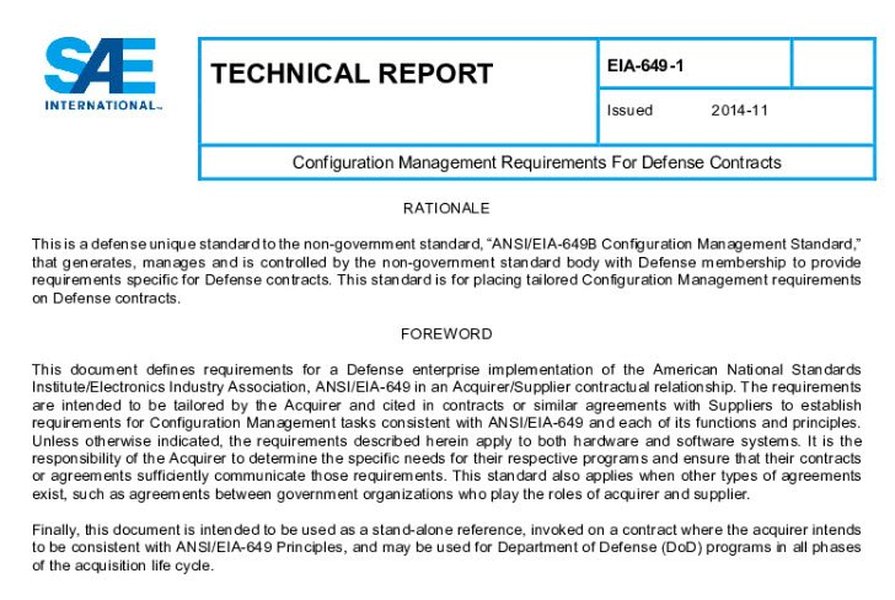
- SAE EIA-649-1A "Configuration Management Requirements for Defense Contracts": This defense-specific standard supplements the base 649 standard by providing tailor-made terminology and "shall" statements to contractually obligate suppliers to CM principles when working on defense projects.
- SAE EIA-649-2 "Configuration Management Requirements for NASA Enterprises": Released in April 2015, this companion standard provides a consistent set of requirements for managing Configuration Items (CIs) delivered to or produced by NASA, reflecting the unique demands of space and aeronautics.
- GEIA-HB-649A "649 Handbook": This handbook provides practical guidance and harmonized terminology to aid in the implementation of the SAE/EIA-649 standard.
Access to the standard itself is typically through purchase from SAE International or authorized distributors. Furthermore, training programs, such as those offered by the Configuration Management Process Improvement Center (CMPIC), provide certification and in-depth understanding, helping professionals to effectively implement and audit CM programs according to the standard's guidance. These resources ensure that organizations can leverage the full potential of SAE/EIA-649C.
Image: A representation of the SAE/EIA-649C Configuration Management Standard document, symbolizing its authoritative role in industry.
The Benefits of Adopting SAE/EIA-649C
Implementing SAE/EIA-649C offers numerous benefits for organizations aiming to achieve excellence in configuration management:
| Benefit Area | Description | Impact |
|---|---|---|
| Consistency & Control | Maintains consistency between product design, production, and operations. | Ensures product integrity throughout its lifecycle. |
| Risk Mitigation | Controls changes and verifies configuration states, reducing operational risks. | Minimizes product failures and costly rework. |
| Improved Communication | Provides a common CM framework, facilitating better interaction. | Enhances trust and collaboration among stakeholders, suppliers, and customers. |
| Efficiency & Lean Management | Supports lean practices through effective planning and elimination of redundant information. | Increases operational efficiency and reduces waste. |
| Industry Recognition & Compliance | Adherence to a national consensus standard adopted globally. | Promotes compliance, interoperability, and market acceptance. |
This standard helps organizations to prevent configuration errors that could lead to significant financial losses or safety issues. By fostering a culture of precise documentation, controlled changes, and regular audits, SAE/EIA-649C ensures that products and systems are managed with accountability and precision, making it an indispensable reference for any technical field.
Understanding the SAE EIA-649 Standard for Configuration Management
The video below offers an insightful overview of the SAE EIA-649 standard for Configuration Management. It delves into the foundational aspects of the standard, explaining its principles and practical applications in various contexts. This video is highly relevant as it directly addresses the core subject, providing a visual and auditory explanation that complements the textual information on the standard's functions and importance. It helps viewers understand how the principles of EIA-649, which are central to SAE/EIA-649C, are applied in real-world scenarios, particularly within government and commercial environments.
Frequently Asked Questions (FAQ)
What is the primary purpose of SAE/EIA-649C?
When was SAE/EIA-649C published and adopted by the DoD?
Does SAE/EIA-649C mandate specific tools or terminology?
How does SAE/EIA-649C relate to other industry standards?
Conclusion
SAE/EIA-649C represents the pinnacle of modern configuration management standards. Its robust, principle-based framework, coupled with its emphasis on flexibility and universal applicability, makes it an indispensable tool for organizations navigating the complexities of product development and lifecycle management. By adhering to its five core functions—CM Planning, Configuration Identification, Change Management, Status Accounting, and Verification & Audit—companies can ensure consistency, mitigate risks, and enhance communication across their operations. As of today, May 28, 2025, SAE/EIA-649C continues to be the definitive guide for achieving excellence in configuration management, providing a clear path to maintain integrity and control in an ever-evolving technological landscape.
Recommended Queries for Deeper Insight
- How is SAE/EIA-649C implemented in Agile environments?
- What are the challenges of applying SAE/EIA-649C in software development?
- Comparing SAE/EIA-649C with ISO 10007 for Configuration Management
- Best practices for auditing configuration management processes per SAE/EIA-649C