
Sakurajima's Enduring Legacy: Unpacking the Environmental Toll of its Continuous Eruptions
A deep dive into the multifaceted environmental impacts of Sakurajima's volcanic activity since March 2017, affecting everything from air quality to agriculture.
Key Environmental Impacts of Sakurajima's Continuous Activity
- Persistent Ashfall: Since March 2017, Sakurajima has continuously ejected approximately 30 km³ of ash annually, causing widespread disruptions to urban areas, agriculture, and infrastructure in Kagoshima City and surrounding regions.
- Air Quality Degradation: The eruptions release significant amounts of sulfur dioxide (SO₂) and fine particulate matter, leading to reduced visibility, acid rain, and elevated concentrations of pollutants that exceed safety guidelines and pose serious health risks.
- Ecological and Agricultural Damage: Ashfall damages crops by inhibiting photosynthesis and altering soil chemistry, while also impacting wildlife habitats and aquatic ecosystems through the deposition of volcanic materials and potential heavy metal contamination.
The Sakurajima volcano, a prominent stratovolcano on Kyushu Island, Japan, has been in a state of continuous eruption since March 25, 2017. Its proximity to Kagoshima City, a mere 8 km away, means its ongoing activity has profound and continuous environmental impacts on the local populace and ecosystems. This persistent eruptive phase has led to a cascade of environmental challenges, ranging from immediate physical alterations to long-term atmospheric and ecological shifts.
The Relentless Veil: Ashfall and its Far-Reaching Effects
One of the most immediate and pervasive environmental impacts of Sakurajima's continuous eruptions is the incessant ashfall. Annually, an estimated 30 km³ of ash is ejected, blanketing Kagoshima City and the surrounding areas. This continuous deposition poses a demanding environmental burden, affecting various aspects of daily life and natural systems.
Socio-Environmental Disruptions and Infrastructure Damage
The accumulation of ash creates significant challenges for urban and rural populations. Roads become hazardous due to reduced visibility, leading to traffic disruptions and increased accident risks. Infrastructure, including electricity lines and buildings, is vulnerable to damage from the weight of accumulated ash, with collapses reported in some instances. The relentless clearing of ash from urban areas becomes a regular, labor-intensive task, adding to the economic strain on the local community.
Volcanic ash blankets Kagoshima City, demonstrating the pervasive nature of Sakurajima's eruptions.
Agricultural Woes and Soil Alterations
Agriculture, a vital component of the local economy, suffers extensively from persistent ashfall. Crops are damaged directly by ash layers that inhibit photosynthesis and clog stomata, affecting plant growth and yield. The ash can also disrupt soil chemistry, reducing fertility and making it challenging for farmers to maintain productive land. In some cases, farmlands have been buried under deep layers of ash and debris, altering the landscape and making it inhospitable for cultivation.
The Invisible Threat: Air Quality and Health Implications
Beyond visible ashfall, Sakurajima's eruptions release a complex mixture of gases and fine particulate matter, significantly degrading air quality and posing serious health concerns for nearby communities.
Volcanic Gases and Atmospheric Chemistry
The volcano emits substantial amounts of sulfur dioxide (SO₂), with recorded levels ranging from 1,900 to 3,500 tons per day during certain periods. SO₂, along with other volcanic gases, contributes to acid rain, which can corrode structures, damage vegetation, and acidify local water bodies. The ash plumes can reach impressive heights, sometimes over 10 km, drifting across wide regions and affecting atmospheric conditions far from the crater.
This video captures a dramatic eruption of Sakurajima, showcasing an ash plume rising thousands of meters, a direct visual representation of the atmospheric impact. Such events contribute significantly to the ashfall and air quality issues discussed.
Studies have also revealed the impact of volcanic ash on local atmospheric chemistry. The fallout of crust-derived natural radionuclides, such as Potassium-40 ($^{40}\text{K}$), Lead-212 ($^{212}\text{Pb}$), and Bismuth-214 ($^{214}\text{Bi}$), has been correlated with heavy ashfall in Kagoshima City, indicating a unique atmospheric environment influenced by the volcano's continuous activity.
Respiratory Illnesses and Long-Term Health Risks
The fine particulate matter within volcanic ash can be easily inhaled, leading to respiratory problems such as asthma, bronchitis, and general irritation for residents. Long-term exposure to these emissions has even been linked to increased cancer rates in the area, highlighting the severe public health implications of continuous volcanic activity. The concentrations of suspended particulate matter (SPM) and SO₂ have, at times, exceeded recommended exposure limits set by international health organizations.
Landscape Transformation and Ecological Disruption
The physical forces of Sakurajima's eruptions, including lava flows, pyroclastic materials, and volcanic bombs, directly alter the landscape, leading to significant ecological and geological consequences.
Physical Alterations and Habitat Loss
Explosive events produce volcanic bombs, which are pieces of molten rock ejected from the volcano. These bombs can create impact craters on roads and farms and cause damage to cars and houses. Historical records and contemporaneous reports indicate that lava flows have destroyed villages and buried vast areas of farmland, fundamentally changing the physical environment and contributing to habitat loss for local flora and fauna. The continuous deposition of tephra (ash, pumice, and rock fragments) also impacts soil composition and topography, altering water drainage patterns.

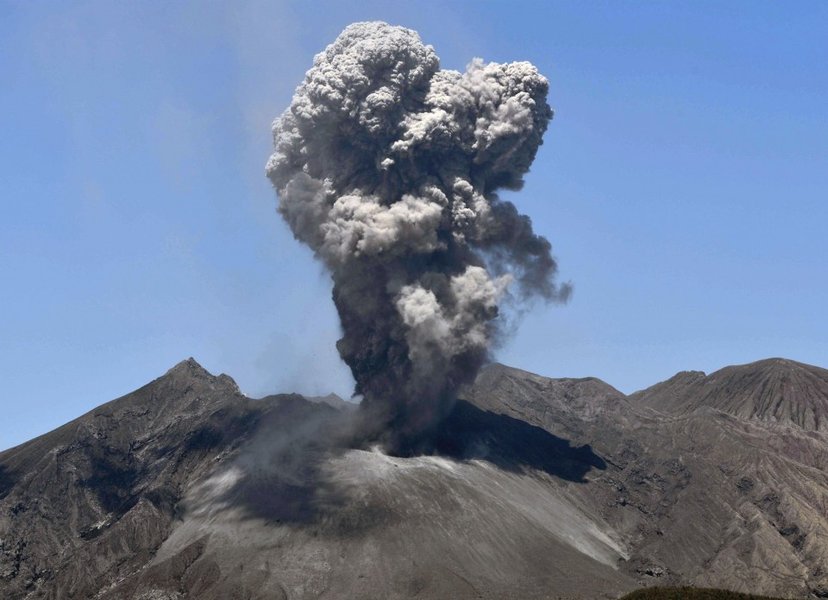
A major eruption from Mount Sakurajima, illustrating the scale of material ejected during its continuous activity.
Impact on Biodiversity and Aquatic Ecosystems
Vegetation around the volcano suffers not only from ash accumulation but also from the effects of volcanic gases that inhibit photosynthesis and damage leaves. This can lead to widespread die-off of native species and a reduction in biodiversity. Aquatic ecosystems, particularly in Kagoshima Bay, are also vulnerable. Ash and pyroclastic materials entering waterways can alter pH levels and oxygen content, potentially smothering marine life and coral reefs. Long-term studies indicate that continuous volcanic activity can lead to cumulative soil contamination, with elements like mercury accumulating in soil profiles, posing risks to groundwater and food chains through bioaccumulation.
Broader Repercussions: Aviation Hazards and Regional Impacts
The environmental impacts of Sakurajima extend beyond its immediate vicinity, posing significant challenges to regional infrastructure and safety, especially for aviation.
Threat to Air Traffic Safety
Volcanic ash plumes from Sakurajima frequently reach altitudes that threaten air traffic safety. These ash clouds can affect flight routes over Kyushu and broader Japanese airspace. A large-scale explosive eruption could potentially impact at least 40% of air traffic in Japanese airspace, highlighting the broader environmental and infrastructural implications of the volcano's activity.
Influence of Topography on Ash Dispersal
The complex mountainous topography of Kyushu Island significantly influences the transport and deposition of volcanic ash. Orographic effects, where mountains influence wind patterns, cause ash to spread unevenly across the landscape, creating localized but complex fallout patterns that can intensify impacts in specific areas.
Understanding Environmental Impact Factors: A Radar Chart Analysis
To better visualize the diverse environmental impacts and their relative severity, a radar chart can illustrate key factors. This chart reflects an opinionated analysis of the documented effects, providing a comparative view of the different environmental challenges posed by Sakurajima's ongoing eruptions.
The radar chart above presents a comparative assessment of several environmental impact categories related to Sakurajima's continuous eruptions. Each axis represents a distinct environmental factor, and the data points, based on a qualitative evaluation of the information, indicate the perceived intensity or frequency of that impact. For instance, "Ashfall Severity" and "Air Quality Degradation" are shown with higher values, reflecting the consistent and widespread nature of these issues. "Infrastructure Damage" and "Agricultural Disruption" also score highly due to the direct physical and economic costs. "Health Impacts" are rated significantly, emphasizing the ongoing concerns for human well-being. "Ecological Alteration" encompasses the broader changes to flora, fauna, and water systems. This visual representation helps to quickly grasp the multifaceted nature of the environmental challenges posed by Sakurajima's activity, highlighting that no single impact occurs in isolation, but rather they interact to create a complex environmental burden.
Mapping the Interconnected Environmental Impacts
The various environmental impacts of Sakurajima's eruption are not isolated but rather form an interconnected web of consequences. A mindmap can illustrate these relationships, showing how one impact can lead to or exacerbate others, forming a comprehensive picture of the environmental burden.
The mindmap illustrates the interconnectedness of the various environmental impacts caused by Sakurajima's ongoing eruptions since March 2017. The central node branches out into primary categories such as "Ashfall & Atmospheric Effects," "Physical & Geological Alterations," "Ecological & Agricultural Consequences," and "Health & Socio-Economic Impacts." Each of these main branches further expands into specific, related consequences. For example, "Ashfall & Atmospheric Effects" leads to "Air Quality Degradation," which in turn causes "Elevated SO₂ & Particulates" and "Acid Rain." This structure visually demonstrates how the volcano's activity creates a complex and reinforcing system of environmental challenges, impacting multiple facets of the local environment and human life.
Summary of Environmental Impacts
The table below synthesizes the primary environmental impacts of Sakurajima's eruption since March 2017, categorized for clarity.
| Impact Category | Specific Environmental Effects | Consequences |
|---|---|---|
| Ashfall | Continuous deposition of approximately 30 km³ of ash annually. | Damage to crops and farmland, disruption of urban life (e.g., visibility, clearing), infrastructure damage (electricity lines, buildings). |
| Atmospheric Pollution | Release of sulfur dioxide (SO₂), fine particulate matter, and radionuclides ($^{40}\text{K}$, $^{212}\text{Pb}$, $^{214}\text{Bi}$). | Reduced visibility, acid rain, elevated pollutant concentrations exceeding safety limits, altered atmospheric chemistry. |
| Health Impacts | Inhalation of ash particles and prolonged exposure to volcanic emissions. | Respiratory problems (asthma, irritation), potential links to increased cancer rates. |
| Physical Landscape Alteration | Lava flows, pyroclastic materials, volcanic bombs, tephra deposits. | Destruction of villages and farmland, creation of impact craters, altered soil composition and topography, changes in water drainage patterns. |
| Ecological Disruption | Ash accumulation on vegetation, volcanic gas effects, entry of volcanic materials into waterways. | Inhibition of photosynthesis, damage to leaves, widespread die-off of native species, reduced biodiversity, potential alteration of pH and oxygen in aquatic ecosystems, heavy metal (e.g., mercury) accumulation in soils and food chains. |
| Aviation and Regional Impacts | Ash plumes reaching high altitudes. | Threats to air traffic safety, potential disruption of significant portions of Japanese airspace, complex ash dispersal patterns influenced by local topography. |
This table provides a concise overview of the diverse and interconnected environmental consequences stemming from Sakurajima's persistent eruptive activity since 2017. The impacts are far-reaching, affecting everything from the air people breathe to the land they cultivate and the broader regional infrastructure.
Frequently Asked Questions (FAQ)
Conclusion
The eruption of Sakurajima volcano, commencing on March 25, 2017, and continuing actively to the present day, has had a profound and multifaceted impact on the environment of Kagoshima Prefecture and beyond. The continuous emission of volcanic ash, estimated at 30 km³ annually, has led to widespread agricultural damage, infrastructural strain, and significant degradation of air quality, posing direct health risks to the populace. Furthermore, the release of volcanic gases and fine particulate matter contributes to acid rain and alterations in atmospheric chemistry, while the physical forces of eruptions reshape landscapes and disrupt delicate ecosystems. The far-reaching implications, including threats to aviation and long-term soil contamination, underscore the complex and enduring environmental challenges posed by Sakurajima's persistent activity. Ongoing monitoring and scientific research are crucial for understanding and mitigating these impacts, ensuring the safety and resilience of the communities living in the shadow of this formidable volcano.
Recommended Further Exploration
- Explore the long-term environmental impacts of active volcanoes.
- Discover how volcanic ash impacts human health.
- Understand the economic consequences of volcanic eruptions.
- Learn about volcano disaster preparedness strategies in Japan.