
Unlocking RESB Insights: Advanced Data Vault Strategies for High-Volume SAP Data
Taming the RESB beast: Navigate rapid data growth in SAP with intelligent Data Vault 1.0 modeling for sustained performance and crucial business insights.
Integrating SAP's RESB table, which handles "Reservation/dependent requirements," into a Data Vault 1.0 architecture presents unique challenges, especially with rapidly increasing data volumes. Your current setup, featuring a hub for RESB's business key and a single satellite for all other attributes, can become a bottleneck. This response explores alternative modeling approaches within Data Vault 1.0 to enhance performance and ensure continuous delivery of vital business insights from your RESB data.
Key Strategies for Optimizing RESB in Data Vault
- Split Satellites: Decompose the large RESB satellite into smaller, more manageable units based on attribute volatility or business context to improve load and query performance.
- Refined Relationship Modeling: Utilize Link tables more effectively to represent relationships between RESB data and other core business entities like materials or production orders, distributing data logically.
- Strategic Data Handling: Implement filtering, archival, and consider incorporating fact-like structures for transactional elements to manage volume and enhance analytical capabilities.
Deep Dive into SAP's RESB Table
The RESB table is a cornerstone in SAP ERP systems for managing reservations and dependent material requirements. It's an application table storing both master and transaction data. Understanding its structure is crucial for effective data modeling.
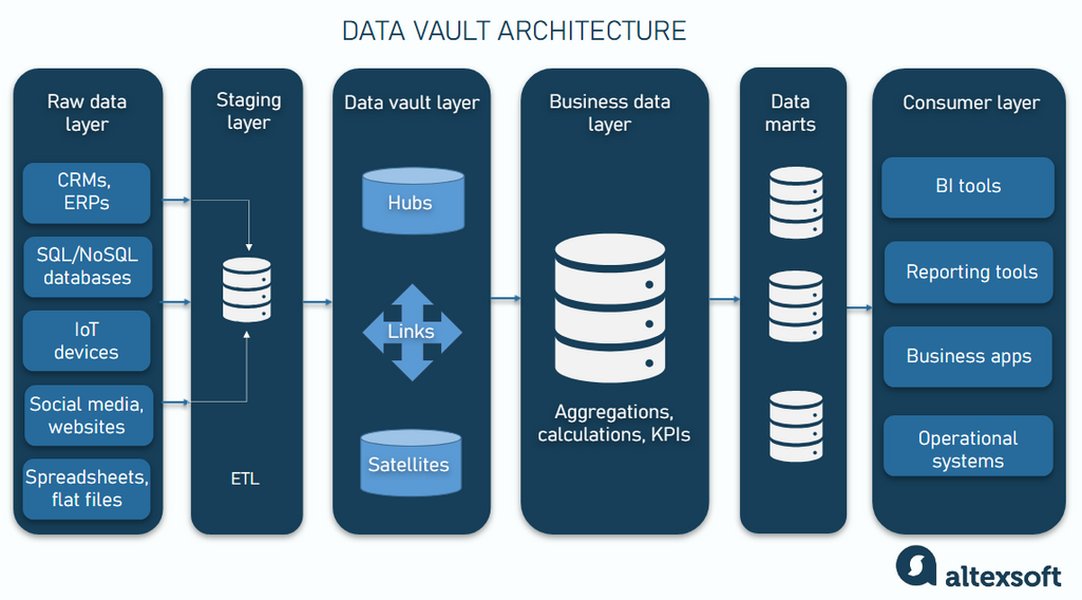
A typical Data Vault architecture, illustrating the interconnected Hubs, Links, and Satellites used to model business processes.
Key Fields in RESB
The RESB table contains numerous fields critical for tracking material reservations. Some of the most important include:
RSNUM: Reservation Number (often part of the business key)RSPOS: Item number of reservation (often part of the business key)MATNR: Material NumberWERKS: PlantLGORT: Storage LocationBDMNG: Requirement QuantityENMNG: Quantity WithdrawnMEINS: Base Unit of MeasureAUFNR: Order Number (e.g., production order)SHKZG: Debit/Credit IndicatorXLOEK: Deletion IndicatorRSART: Record TypeBDART: Requirement TypeEWAHR: Usage probability in % (for alternative items)
The transactional nature of RESB means it records frequent changes and additions, leading to the rapid data growth you're experiencing. Its data is pivotal for insights into material availability, production planning, and inventory movements.
Challenges of the Current "Hub and Large Satellite" Model
While a single Hub for the business key (e.g., RSNUM + RSPOS) and one Satellite for all descriptive and transactional attributes is a standard Data Vault 1.0 starting point, it encounters issues with high-volume, frequently updated tables like RESB:
- Performance Degradation: Loading vast amounts of data into a single, wide satellite, and subsequently querying it, becomes increasingly slow. Every minor change to any attribute can necessitate updating a large satellite row or inserting a new one, leading to storage bloat and inefficient reads.
- Increased ETL/ELT Complexity: Managing changes across many attributes in one satellite complicates the data loading logic.
- Reduced Query Efficiency: Analysts querying specific subsets of attributes are forced to scan a much wider table than necessary, impacting response times for delivering business insights.
- Scalability Concerns: As data volume continues to grow, the single satellite becomes a significant bottleneck, hindering the overall scalability of the data warehouse.
Alternative Data Vault 1.0 Modeling Approaches for RESB
To address these challenges, several alternative modeling strategies can be employed within the Data Vault 1.0 framework, focusing on breaking down complexity and improving efficiency.
1. Splitting the RESB Satellite
Decomposing the monolithic RESB satellite into multiple, smaller, more focused satellites is a primary strategy. This can be done based on:
By Data Volatility
Group attributes by their rate of change. For example:
- Static/Semi-Static Attributes Satellite: Contains fields that rarely change after the initial reservation creation, such as
MATNR(Material Number),WERKS(Plant), or initial requirement details. - Transactional/Volatile Attributes Satellite: Holds frequently updated fields like
BDMNG(Requirement Quantity - if it can be adjusted),ENMNG(Quantity Withdrawn), status fields, or deletion indicators (XLOEK).
By Subject Area or Business Context
Divide attributes based on logical business groupings. For instance:
- Quantity & Unit Satellite: Fields like
BDMNG,ENMNG,MEINS. - Status & Control Satellite: Fields like
SHKZG,XLOEK,RSSTA(Status). - Planning Attributes Satellite: Fields like
BDART(Requirement Type),EWAHR(Usage Probability).
This approach reduces the width of individual satellites, making loads faster and queries more targeted. History is still tracked per satellite, preserving auditability.
2. Introducing Fact-like Structures or Transactional Links
While Data Vault 1.0 doesn't explicitly define "fact tables" in the same way dimensional modeling does, certain transactional aspects of RESB can be modeled more effectively using Link tables that carry transactional data, or by creating satellites off Links that store these measures.
Transactional Link Satellites
If a reservation item (RESB record) represents a transaction between, say, an Order and a Material, a Link table would connect the Order Hub, Material Hub, and potentially a Date Hub. Transactional details from RESB (like BDMNG, ENMNG) could then be stored in a satellite attached to this Link. This is conceptually similar to how Data Vault 2.0 uses Non-Historized Links or Satellites on Links for transactional data.
Separate Transactional Hub and Satellite
In some interpretations, very granular, high-volume transactional events could even have their own Hub (e.g., a "Reservation Event" Hub) if the event itself has a business key and descriptive attributes stored in its satellite. However, for RESB, linking existing Hubs (Order, Material, Reservation) is often more appropriate.
3. Leveraging Point-in-Time (PIT) and Bridge Tables
To improve query performance for reporting and analysis, especially when dealing with multiple split satellites, Point-in-Time (PIT) tables and Bridge tables are valuable constructs:
- PIT Tables: These tables provide snapshots of which satellite versions were active at specific points in time (e.g., end of day). They contain the Hub key, a snapshot timestamp, and the load date/sequence numbers for each associated satellite. This allows queries to join the Hub to the PIT table and then directly to the correct historical versions of the split satellites, avoiding complex date range joins on multiple large satellite tables.
- Bridge Tables: Bridge tables assist in resolving many-to-many relationships or providing pre-joined views of related Hubs and Links. For RESB, a bridge table could help in analyzing reservations across multiple dimensions like orders, materials, and plants.
4. Enhanced Use of Link Tables for Context
Ensure all key business relationships inherent in RESB data are explicitly modeled using Link tables. For example:
- Link RESB Hub to Production Order Hub (via
AUFNR). - Link RESB Hub to Material Hub (via
MATNR). - Link RESB Hub to Plant Hub (via
WERKS).
This allows for flexible querying of the relationships without overloading a single RESB satellite with foreign keys that might be better represented as connections between Hubs.
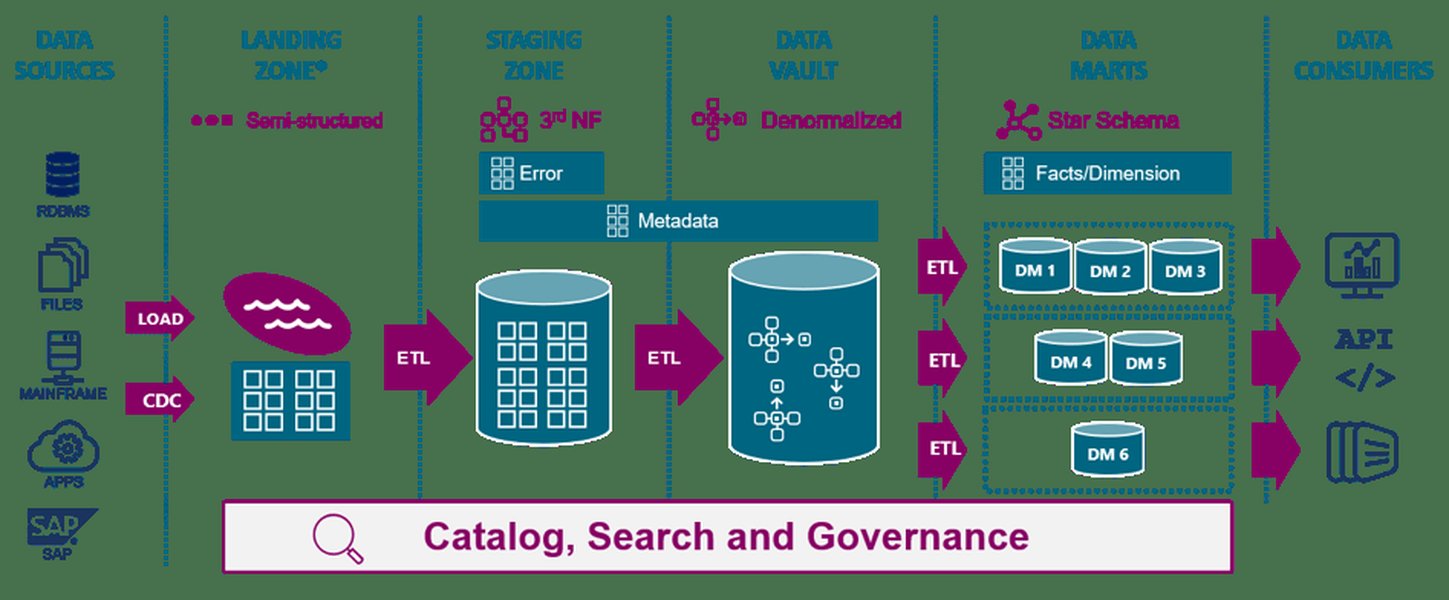
Visual representation of Data Vault components: Hubs (blue), Satellites (green), and Links (orange), illustrating their relationships.
Comparative Analysis of Modeling Approaches
The choice of modeling approach impacts various aspects of your data warehouse. The radar chart below provides a conceptual comparison of different strategies against key criteria. "Current Model" refers to a single Hub and a large Satellite. "Split Satellites" refers to breaking down the large satellite. "Transactional Links/Satellites" involves modeling transactional data on or around Link tables. "DV 2.0 Inspired" hints at incorporating more advanced concepts like hash diffs or effectivity satellites if considering a future evolution.
This chart suggests that while the current model is simpler to initiate, approaches like splitting satellites or using transactional links offer better performance and scalability for high-volume data like RESB, albeit with a moderate increase in modeling complexity.
Visualizing a Refined Data Vault Model for RESB
The mindmap below illustrates a potential structure for modeling RESB data within Data Vault, incorporating split satellites and explicit links to related business entities. This provides a clearer, more modular way to manage and query reservation data.
(RSNUM, RSPOS)"] hub_material["Material Hub
(MATNR)"] hub_order["Order Hub
(AUFNR)"] hub_plant["Plant Hub
(WERKS)"] id_links["Links"] link_resb_order["RESB-Order Link
(Connects RESB Hub, Order Hub)"] link_resb_material["RESB-Material Link
(Connects RESB Hub, Material Hub)"] link_resb_order_material["RESB-Order-Material Link
(Connects all three for context)"] id_satellites["Satellites"] sat_resb_qty["RESB Quantity Satellite
(BDMNG, ENMNG, MEINS)
Attached to RESB Hub or Link"] sat_resb_status["RESB Status Satellite
(SHKZG, XLOEK, RSSTA)
Attached to RESB Hub"] sat_resb_desc["RESB Descriptive Satellite
(RSART, BDART, EWAHR)
Attached to RESB Hub"] sat_material_details["Material Details Satellite
Attached to Material Hub"] sat_order_details["Order Details Satellite
Attached to Order Hub"] sat_plant_details["Plant Details Satellite
Attached to Plant Hub"] id_pit_bridge["Query Assistance Structures"] pit_resb["RESB PIT Table
(Snapshot of Satellite versions)"] bridge_reservations["Reservation Bridge Table
(Facilitates complex queries)"]
This mindmap shows how breaking down the RESB data into more granular Hubs, Links, and Satellites can improve organization and queryability. For example, quantity information (BDMNG, ENMNG) is in its own satellite, distinct from status or descriptive attributes.
Delivering Key Business Insights
Regardless of the chosen modeling approach, the primary goal is to effectively deliver business insights. A well-structured Data Vault model for RESB should readily support queries related to:
- Material Availability and Consumption: Comparing required quantities (
BDMNG) versus withdrawn quantities (ENMNG) for materials. - Order Fulfillment Tracking: Monitoring reservations linked to specific production orders (
AUFNR) and their statuses. - Reservation Trends: Analyzing patterns in material reservations over time, by plant, or by material type.
- Requirement Planning: Understanding dependent requirements (
BDART) and their impact on inventory. - Data Lineage and Auditability: Tracing every piece of data back to its source and understanding its changes over time, a core strength of Data Vault.
Splitting satellites and using clear Link structures directly supports these insights by making the relevant data easier and faster to access.
Technical Optimizations and Considerations
Beyond the logical model, several technical aspects can improve performance:
- Indexing: Ensure appropriate database indexes are created on Hub business keys, Link foreign keys, and frequently queried attributes in Satellites. For RESB, indexing
AUFNRhas been noted to improve performance. - Partitioning: Partition large satellite tables, especially by date (e.g., load date), to improve query performance and manageability of historical data.
- Optimized ETL/ELT Processes: Review and refine data loading processes. Use delta detection mechanisms effectively to load only changes into satellites. For SAP, consider using tools or techniques that can efficiently extract deltas from RESB.
- Filtering and Archiving: Implement strategies to filter out irrelevant data during the load process or archive historical data that is rarely accessed to keep active tables lean. For RESB, change logs are typically not active by default in standard SAP, so delta capture might need custom solutions or reliance on change pointers if configured.
- SAP Specifics:
- Explore using SAP CDS (Core Data Services) Views for Reservation as a source if you are on S/4HANA. These can provide pre-optimized and semantically rich access to data.
- Function modules like
CS_BOM_EXPL_MAT_V2can be used to get Bill of Material (BOM) items, which then might be used to retrieve corresponding goods movements from RESB, potentially offering a more targeted data extraction approach.
This video provides a general overview of Data Vault architecture, which can be helpful in understanding the foundational concepts discussed.
Comparing Modeling Approaches for RESB
The following table summarizes key characteristics of the current approach versus some of the suggested alternatives for handling RESB data in Data Vault 1.0:
| Aspect | Current Model (Hub + Single Large Satellite) | Split Satellites Approach | Transactional Links & Satellites on Links |
|---|---|---|---|
| Data Granularity in Satellites | All attributes in one place | Attributes grouped by volatility/context | Transactional measures potentially on Link satellites |
| Query Performance (for specific attributes) | Potentially slow due to wide table scans | Improved, as queries target narrower tables | Optimized for transactional analysis around relationships |
| Load Performance | Can be slow with many attribute changes | Generally faster due to smaller, focused updates | Depends on link complexity but can be efficient for transactions |
| Scalability with Data Volume | Low, prone to bottlenecks | Moderate to High, more manageable growth | High, designed for transactional volumes |
| Model Complexity | Low initially | Moderate, more objects to manage | Moderate to High, requires careful Link design |
| Key Business Insights Supported | Possible, but may be slow to retrieve | Well-supported with better performance | Strong for relationship-based transactional insights |
| Ease of Historical Tracking | Standard DV, but performance can hinder access | Standard DV, easier access to specific attribute history | Standard DV, history of transactions tied to relationships |
This table highlights that while the initial single satellite model is simpler, evolving to split satellites or using link-centric designs for transactions offers significant advantages for performance and scalability with a table like RESB.
Frequently Asked Questions (FAQ)
What are the primary business keys for the RESB Hub?
Typically, the business key for an RESB Hub would be a composite key, often including the Reservation Number (RSNUM) and the Item Number of Reservation (RSPOS). These two fields together usually uniquely identify a reservation line item. Depending on specific SAP configurations or business needs, other fields might be considered as part of the key or for creating distinct Hubs (e.g., AUFNR for an Order Hub).
How does splitting satellites affect data loading (ETL/ELT)?
Splitting satellites requires more ETL/ELT jobs or transformations, as each satellite will have its own loading process. However, these individual jobs are often simpler and faster because they deal with fewer attributes and potentially smaller datasets if changes are isolated. Delta detection logic needs to be applied per group of attributes destined for each satellite. While it increases the number of objects, it often improves overall load parallelism and manageability.
Can I evolve my Data Vault 1.0 model towards Data Vault 2.0 concepts for RESB?
Yes, you can gradually incorporate Data Vault 2.0 concepts. For instance, you could start using hash keys for business keys and hash diffs for change detection in satellites to improve load performance and parallelism, even within a predominantly DV 1.0 environment. Introducing concepts like Effectivity Satellites (for managing true effective date ranges of relationships) or Transactional Links (Links that hold transactional attributes directly) can also be beneficial for RESB's transactional nature. A full migration to DV 2.0 is a larger effort but incorporating specific performance-enhancing elements can be done incrementally.
What kind of business insights can I expect from modeling RESB data effectively?
Effective modeling of RESB data allows for crucial insights such as: tracking required quantities (BDMNG) vs. actual withdrawn quantities (ENMNG) for materials, monitoring reservations tied to specific production orders (AUFNR), analyzing material reservation trends over time, understanding the impact of dependent requirements (BDART) on inventory, and assessing the fulfillment status of reservations. This data is vital for production planning, inventory management, and cost control.
Recommended Next Steps & Further Exploration
- Investigate the practical implementation of Point-in-Time (PIT) tables for optimizing queries on historically tracked RESB satellite data.
- Explore advanced techniques for efficient delta detection and incremental loading specifically for high-volume SAP tables like RESB into a Data Vault architecture.
- Understand the trade-offs between splitting satellites in Data Vault 1.0 versus adopting Data Vault 2.0 Effectivity Satellites for managing changes in RESB attributes.
- Learn about effective strategies for archiving or tiering older RESB data to maintain performance in the active Data Vault warehouse.
References
 bmcintroduction.wordpress.com
Last updated May 8, 2025