
When Saviors Become Destroyers: Unpacking the Hero's Tragic Transformation in Sci-Fi
An exploration of iconic science fiction narratives where protagonists journey from heroism to villainy.
The journey from hero to villain is a powerful and recurring motif in science fiction, offering a dark mirror to our ideals and exploring the fragile nature of morality. These narratives delve into the psychological and circumstantial pressures that can corrupt even the noblest intentions, transforming saviors into tyrants, protectors into predators. This exploration reveals not only the complexities of the characters themselves but also profound commentaries on power, trauma, ideology, and the very essence of good and evil.
Essential Insights: The Fall From Grace
- Psychological Depth: The hero-to-villain arc provides a rich ground for exploring complex character psychology, showing how internal flaws, trauma, or fear can lead to catastrophic moral decay.
- Thematic Resonance: These stories often serve as cautionary tales, interrogating the corrupting influence of power, the dangers of ideological extremism, and the consequences of unchecked ambition within speculative settings.
- Audience Engagement: Witnessing a beloved hero's descent is often heartbreaking and compelling, fostering a deeper connection and a more nuanced understanding of the villain's motivations.
Landmark Transformations in Film and Television
Science fiction cinema and television have gifted us with some of the most memorable and tragic descents into villainy. These visual mediums powerfully depict the internal and external struggles that forge a villain from a hero's ashes.
Anakin Skywalker's Descent to Darth Vader (Star Wars)
Perhaps the most iconic hero-to-villain transformation in sci-fi, Anakin Skywalker's journey is central to the Star Wars saga. Initially a prodigious Jedi Knight hailed as the "Chosen One," Anakin's path to becoming the Sith Lord Darth Vader is paved with fear, loss, and manipulation. His intense fear of losing his loved ones, particularly his wife Padmé Amidala, coupled with the subtle grooming by Chancellor Palpatine (Darth Sidious), erodes his faith in the Jedi Order. His arrogance, impatience, and inability to control his emotions make him susceptible to the dark side's promises of power to prevent death. This tragic arc, detailed extensively in the prequel trilogy, showcases how personal vulnerabilities and a desperate desire for control can lead to unimaginable atrocities, transforming a galactic hero into its most feared oppressor.
The visual design of a character often reflects their internal moral state, a common theme in hero-to-villain transformations.
Erik Lehnsherr's Path to Magneto (X-Men Franchise)
Erik Lehnsherr's transformation into the formidable Magneto is a story of profound trauma and radicalization. A Holocaust survivor, Erik witnesses humanity's capacity for cruelty firsthand. This shapes his worldview and his fierce determination to protect mutantkind from a similar fate. Initially a friend and ally to Charles Xavier, his methods diverge drastically. While Xavier advocates for peaceful coexistence, Erik's experiences convince him that mutants can only be safe through dominance over humans. His descent is not into senseless evil, but into a ruthless extremism born from a twisted sense of justice and protection. Films like X-Men: First Class highlight this tragic evolution, portraying a man whose understandable pain and fear curdle into a dangerous ideology, making him an antagonist who often believes his actions are righteous.
Sylar's Emergence (Heroes)
Gabriel Gray, later known as Sylar, from the TV series Heroes, presents a chilling transformation driven by an insatiable hunger for power and understanding. Initially a mild-mannered watchmaker, Sylar possesses the power of "intuitive aptitude"—an ability to understand complex systems. This leads him to discover how other evolved humans' powers work, and he begins murdering them to steal their abilities. His transformation is terrifyingly rapid, shifting from a potentially sympathetic character seeking self-understanding to a remorseless serial killer. Sylar's journey highlights how unique abilities, when combined with psychological instability and a lack of moral guidance, can corrupt an individual completely, turning potential into monstrosity.
Dr. Seth Brundle's Metamorphosis (The Fly, 1986)
David Cronenberg's The Fly offers a visceral and horrifying transformation. Scientist Seth Brundle begins as an ambitious, brilliant, and likable protagonist on the verge of a scientific breakthrough: teleportation. A fateful error during a self-experiment—a common housefly entering the telepod with him—initiates a gradual and grotesque fusion of his DNA with the insect's. This physical transformation is mirrored by a mental and moral decay. His initial excitement and enhanced abilities give way to aggression, paranoia, and a loss of humanity. Brundle's descent into the monstrous "Brundlefly" is a tragic tale of scientific hubris gone wrong, where the pursuit of knowledge leads to the obliteration of the self, turning a hero of science into a pitiable and dangerous creature.
Gaius Baltar's Complicity (Battlestar Galactica, 2004)
Dr. Gaius Baltar's journey in the reimagined Battlestar Galactica is a complex study in ambition, cowardice, and manipulation. A brilliant scientist, Baltar unwittingly aids the Cylons in their devastating attack on the Twelve Colonies due to his relationship with a Cylon agent, Caprica Six. While not starting as a conventional hero, he holds a position of influence and potential for good. However, his subsequent actions are consistently driven by self-preservation, fear, and a susceptibility to Six's manipulations (both real and imagined). His path is less a direct embrace of evil and more a slippery slope of compromised ethics, leading him to betray humanity repeatedly, making him a reluctant and often tormented villainous figure.
Literary Landscapes of Fallen Heroes
Science fiction literature often provides deeper, more introspective explorations of a hero's corruption, allowing for nuanced portrayals of psychological decay and moral compromise.
Stephen R. Donaldson's The Gap Cycle
This dark space opera series is renowned for its unflinching portrayal of moral degradation. Characters who might initially possess heroic or at least redeemable qualities are subjected to extreme trauma, betrayal, and the corrupting influence of power. For instance, Morn Hyland, an ensign for the United Mining Companies Police, and Nick Succorso, a pirate, both undergo horrifying transformations. The series explores how individuals can regress, adopting cruelty and manipulation as survival mechanisms or tools for advancement, ultimately becoming villains in their own right. Donaldson masterfully charts these descents, showing how environments of extreme violence and political maneuvering can erode humanity.
Paul Atreides' Burden (Dune by Frank Herbert)
While Paul Atreides is the protagonist and often viewed as the hero of Dune, Frank Herbert's narrative, particularly when considering the sequels, presents a more complex and arguably tragic trajectory. Paul's prescient abilities and his rise to power as the Fremen messiah, Muad'Dib, lead to a galactic jihad that costs billions of lives. Though he initially seeks justice for his family and liberation for Arrakis, the weight of his destiny and the inexorable path shown by his prescience trap him. His transformation is not into a cackling villain, but into a figure who, despite his intentions, unleashes catastrophic violence upon the universe. This challenges the traditional hero narrative, suggesting that even a figure with noble goals can become a destructive force when wielding immense power and grappling with a seemingly unavoidable future.
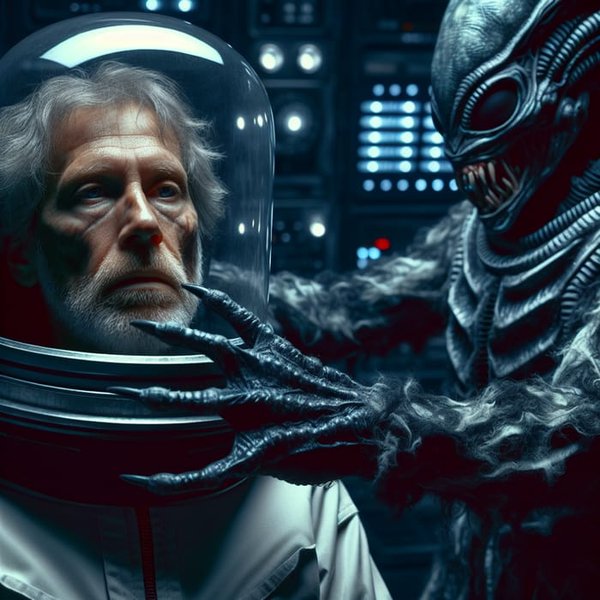
Transformations in sci-fi can be both physical and psychological, often reflecting a character's descent.
Gully Foyle in Alfred Bester's The Stars My Destination
Gulliver Foyle begins as an uneducated, brutish, and sole survivor of a shipwrecked freighter. Abandoned and left for dead, his singular motivation becomes revenge against the ship Vorga that ignored his distress signals. This burning desire transforms him from a victim into a terrifying force of nature. As he gains education, wealth, and even learns to "jaunte" (teleport) through sheer willpower, his quest for vengeance becomes all-consuming, leading him to commit heinous acts and threaten entire societies. While he might be considered an anti-hero for much of the novel, his relentless and destructive path often crosses firmly into villainous territory, showcasing how an obsession with revenge can utterly corrupt an individual.
The Anatomy of a Fall: Common Catalysts and Themes
The descent from hero to villain is rarely a sudden switch. It's often a process fueled by a confluence of internal vulnerabilities and external pressures. Science fiction, as a genre, provides unique contexts for these transformations, involving advanced technology, alien influences, or superhuman abilities.
Key Drivers of Heroic Corruption
The following radar chart visualizes a subjective analysis of the primary drivers behind the villainous transformations of several notable sci-fi characters. These drivers—Thirst for Power, Impact of Trauma/Loss, Ideological Conviction, Hubris/Ambition, and External Manipulation—are common threads in these tragic narratives. The scores (out of 10, where 10 is a very strong influence) reflect the prominence of each factor in their respective falls from grace.
This chart illustrates how different characters are swayed by varying combinations of these potent factors. For example, Anakin Skywalker's fall is heavily influenced by trauma/loss and external manipulation, while Sylar's is predominantly driven by a thirst for power and hubris.
Visualizing the Descent: A Mindmap of Transformation
The following mindmap provides a conceptual overview of the typical internal and external factors, as well as sci-fi specific elements, that contribute to a hero's transformation into a villain. It highlights the multifaceted nature of these character arcs.
(e.g., Anakin's fear of losing Padmé)"] idTrauma["Trauma & Grief
(e.g., Magneto's Holocaust experiences)"] idAmbition["Unchecked Ambition & Hubris
(e.g., Seth Brundle's scientific pursuits)"] idPower["Corruption by Power
(e.g., Sylar absorbing abilities)"] idIdealism["Twisted Idealism
(e.g., Magneto's mutant supremacy goal)"] idExternal["External Pressures"] idManipulation["Manipulation & Deceit
(e.g., Palpatine's influence on Anakin)"] idBetrayal["Betrayal & Disillusionment
(e.g., The Gap Cycle protagonists' experiences)"] idSystemic["Systemic Oppression/Injustice
(e.g., Fueling Magneto or Marco Inaros)"] idCircumstance["Desperate Circumstances
(e.g., Forcing morally grey choices)"] idTransformationNature["Nature of Transformation"] idGradual["Gradual Moral Erosion over Time"] idSudden["Sudden Snap due to Tragic Event"] idJustified["Perceived Justification for Actions"] idSciFiElements["Sci-Fi Specific Accelerants"] idTech["Advanced Technology
(e.g., The Fly's teleporter, cybernetics, AI)"] idPowers["Superhuman Abilities/Psionics
(e.g., Sylar, Carrie, The Force, Mutant powers)"] idCosmic["Cosmic Stakes/Prophecy
(e.g., Dune's prescience, Star Wars' prophecy)"] idAlien["Alien Influence or Biology
(e.g., Xenomorph influence, Cylon manipulation)"]
As the mindmap illustrates, the journey to villainy is rarely linear. It's a complex interplay of a character's inner world clashing with external forces, often amplified by the unique possibilities inherent in science fiction settings.
Comparative Analysis: From Heroic Ideals to Villainous Acts
Understanding these transformations often involves comparing the character's initial heroic attributes with their eventual villainous persona and identifying the key sci-fi elements that facilitated or defined their fall. The table below offers such a comparison for several prominent figures.
| Character | Original Heroic Trait(s) | Primary Cause(s) of Transformation | Resulting Villainous Persona | Key Sci-Fi Element(s) Involved |
|---|---|---|---|---|
| Anakin Skywalker | Prodigious Jedi, protector, "Chosen One" | Fear of loss, manipulation by Palpatine, anger, arrogance | Darth Vader: Ruthless Sith Lord, enforcer of the Empire | The Force (Light and Dark Sides), Jedi/Sith prophecy, advanced space technology |
| Erik Lehnsherr (Magneto) | Advocate for mutant rights, survivor seeking justice | Trauma from persecution, radicalization, belief in mutant supremacy | Magneto: Militant mutant leader, often an anti-villain | Mutant powers, genetic discrimination, advanced technology |
| Dr. Seth Brundle | Ambitious and brilliant scientist | Failed teleportation experiment, scientific hubris, genetic fusion | Brundlefly: Monstrous, decaying human-fly hybrid | Teleportation technology, genetic engineering (accidental) |
| Sylar (Gabriel Gray) | Watchmaker with curiosity, seeking understanding | Insatiable hunger for power/abilities, intuitive aptitude, moral detachment | Sylar: Serial killer of super-powered individuals | Acquired superhuman abilities, unique brain structures |
| Paul Atreides | Noble heir, skilled warrior, potential messiah | Prescience, political necessity, burden of destiny, righteous fury | Muad'Dib: Emperor leading a galactic jihad (complex villainy/tragic figure) | Spice Melange, prescience (psychic ability), Bene Gesserit breeding program, ecological transformation |
| Marco Inaros (The Expanse) | Charismatic Belter freedom fighter | Extremism, desire for power, warped sense of justice for the Belt | Terrorist leader, architect of mass destruction | Space colonization, resource warfare, advanced stealth technology, asteroid physics |
| Harvey Dent (The Dark Knight) | Idealistic District Attorney, Gotham's "White Knight" | Severe trauma (disfigurement, loss of Rachel Dawes), manipulation by Joker | Two-Face: Nihilistic criminal basing decisions on chance | (Primarily crime genre, but technology of Gotham and Joker's methods have sci-fi undertones) |
This table highlights the diversity in paths to villainy. While some, like Anakin, are manipulated and driven by personal fears, others like Magneto are forged in the fires of ideology and trauma. Sci-fi elements, from the mystical Force to tangible technologies, often play crucial roles as either tools, catalysts, or the very source of power that corrupts.
Understanding the Appeal: Why We're Drawn to Fallen Heroes
The hero-to-villain transformation is a potent narrative device. It taps into fundamental questions about human nature, morality, and the choices that define us. These stories often elicit strong emotional responses because they subvert expectations and show the potential for darkness within even the most promising individuals.
The embedded video, "Rethinking the Hero-Villain Dynamic," delves into the complexities of crafting compelling heroes and villains. While not exclusively about transformations, it touches upon the nuanced relationship between protagonists and antagonists, which is central to understanding why the fall of a hero can be so impactful. Such narratives challenge simplistic notions of good and evil, suggesting that these are not fixed states but rather points on a spectrum, and that circumstances can push anyone across that line. The relatability of the initial hero, combined with the often understandable (though not excusable) motivations for their descent, makes these villains particularly chilling and memorable.
Frequently Asked Questions (FAQ)
What is the most common reason heroes turn into villains in sci-fi?
While there's no single "most common" reason, several themes recur frequently. A combination of factors often leads to a hero's downfall. Key drivers include:
- Trauma and Loss: Unresolved grief or past trauma can warp a hero's perspective (e.g., Anakin Skywalker, Magneto).
- The Seduction of Power: Access to immense power, whether technological, political, or superhuman, can corrupt (e.g., Sylar, Paul Atreides).
- Ideological Extremism: A righteous cause taken to an extreme can turn a hero into a fanatic (e.g., Magneto, Marco Inaros).
- Fear and Desperation: Overwhelming fear, especially of loss, can drive a hero to make compromising choices (e.g., Anakin Skywalker).
- Manipulation: Cunning antagonists can exploit a hero's weaknesses to lead them astray (e.g., Palpatine's influence on Anakin).
Are there any sci-fi stories where the villain believes they are still the hero?
Yes, many of the most compelling transformed villains operate under the conviction that their actions are justified, necessary, or even heroic from their perspective. Magneto, for instance, genuinely believes he is fighting for the survival and supremacy of mutantkind against an oppressive humanity. Paul Atreides in Dune takes on the burden of a galactic jihad, seeing it as a terrible necessity or an unavoidable consequence of his prescient path. Even Darth Vader initially believed he was bringing order to the galaxy and saving his wife. This conviction makes them more complex and terrifying, as they are driven by a twisted sense of righteousness rather than simple malice.
How does technology play a role in hero-to-villain transformations?
Technology in science fiction often serves as a powerful catalyst or tool in a hero's downfall:
- Source of Corrupting Power: Advanced technology can grant abilities or control that proves too tempting or overwhelming, leading to hubris and moral decay (e.g., Seth Brundle's telepods).
- Means to an Extreme End: Technology can provide the means for a hero-turned-villain to enact their destructive plans on a grand scale (e.g., superweapons, surveillance systems).
- Dehumanizing Factor: Over-reliance on or fusion with technology can sometimes lead to a loss of empathy or humanity (e.g., some portrayals of cyborgs or AI-influenced characters).
- Catalyst for Desperation: A technological disaster or threat might push a hero into making villainous choices out of perceived necessity.
Why is the hero-to-villain arc so popular in storytelling?
The hero-to-villain arc is popular for several reasons:
- Tragedy and Pathos: It's inherently tragic to watch someone with heroic potential succumb to darkness, evoking strong emotions in the audience.
- Complexity and Nuance: It moves beyond simplistic good vs. evil narratives, creating villains with understandable (if not justifiable) motivations and backstories.
- Exploration of Human Nature: It allows writers to explore themes of temptation, corruption, the nature of morality, and the idea that anyone can fall.
- Relatability (to a degree): While audiences may not condone the villain's actions, they might relate to the initial struggles, fears, or desires that set the character on their dark path.
- Subversion of Expectations: It can be a powerful way to surprise the audience and challenge their perceptions of a character they initially admired.
Recommended Further Exploration
- Explore the psychological profiles of sci-fi villains who were once heroes.
- What are some common narrative tropes associated with a hero's fall from grace in science fiction?
- Discover sci-fi stories where the line between hero and villain is intentionally blurred.
- Investigate the role of societal pressures in the transformation of sci-fi protagonists into antagonists.
References
 nerdybookclub.wordpress.com
Last updated May 7, 2025