

Key Insights into Sparse Matrix Techniques
- Memory and Computational Efficiency: Sparse matrices significantly reduce memory usage and accelerate computations by storing only non-zero elements, crucial for large datasets where most values are zero.
- Compressed Sparse Row (CSR) Format: CSR is a highly efficient storage format for sparse matrices, particularly well-suited for fast row-wise access, matrix-vector products, and arithmetic operations.
- Applications Across Domains: Sparse matrix techniques are fundamental in diverse fields such as machine learning, natural language processing, graph theory, and scientific computing, enabling efficient handling of large, sparse datasets.
In the expansive landscape of numerical analysis and scientific computing, matrices are ubiquitous. However, not all matrices are created equal. Many real-world datasets, especially in fields like machine learning, natural language processing, and network theory, result in matrices where a vast majority of elements are zero. These are known as sparse matrices.
The concept of sparsity is immensely valuable because it allows for significant computational and storage savings. Instead of allocating memory and processing power to store and manipulate countless zero values, specialized algorithms and data structures can be employed to focus only on the non-zero elements. This exploitation of sparsity is not just a convenience; it's often a necessity when dealing with large-scale problems.
Understanding Sparse Matrices: A Foundation for Efficiency
A sparse matrix is formally defined as a matrix where most of its elements are zero. While there isn't a strict universal threshold for the proportion of zeros to qualify a matrix as "sparse," a common guideline suggests that if the number of non-zero elements is roughly equal to the number of rows or columns, it's considered sparse. Conversely, if most elements are non-zero, the matrix is deemed dense.
Consider a simple analogy: imagine a line of balls connected by springs only to their immediate neighbors. This system's interactions would correspond to a sparse matrix. If, however, every ball were connected to every other ball, the system would be represented by a dense matrix. This distinction highlights why specialized methods are vital for sparse matrices: standard dense-matrix operations become prohibitively slow and inefficient as they waste processing and memory on zeros.
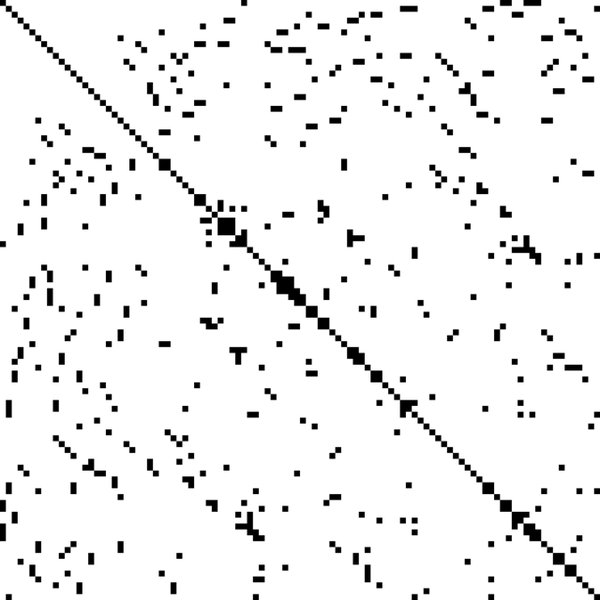 Illustration of a sparse matrix, highlighting the distribution of non-zero elements.
The Inefficiencies of Dense Storage for Sparse Data
Storing a sparse matrix using traditional dense array representations leads to several inefficiencies:
- Memory Wastage: A significant portion of memory is occupied by zero values, which carry no information relevant to computation.
- Computational Overhead: Operations like matrix multiplication involve iterating through all elements, including zeros, leading to unnecessary computations and increased time complexity.
To overcome these challenges, various specialized storage formats and algorithms have been developed for sparse matrices, enabling more efficient memory utilization and faster computations.
Diving Deep into the Compressed Sparse Row (CSR) Format
Among the various sparse matrix storage formats, the Compressed Sparse Row (CSR) format (also known as the Yale Format) stands out for its efficiency in specific operations. CSR is a row-major format, meaning it organizes data primarily by rows, making it highly advantageous for operations that benefit from row-wise access.
How CSR Stores Data
The CSR format represents a sparse matrix \( M \) (of dimensions \( m \times n \)) using three one-dimensional arrays:
data(A): This array stores all the non-zero values of the matrix in row-major order.indices(JA): This array stores the column indices corresponding to the non-zero values in thedataarray.indptr(IA): This array (also called row pointers) stores the starting index in thedataandindicesarrays for each row. Specifically,indptr[i]gives the index indata(andindices) where the non-zero elements of rowibegin, andindptr[i+1]-1gives the index where they end. The length ofindptris \( m+1 \), withindptr[0]always being 0 andindptr[m]being the total number of non-zero elements.
Let's illustrate with an example:
        // Original Sparse Matrix
        // [[1, 0, 2],
        //  [0, 0, 3],
        //  [4, 5, 6]]

        // CSR Representation:
        // data = [1, 2, 3, 4, 5, 6]
        // indices = [0, 2, 2, 0, 1, 2]
        // indptr = [0, 2, 3, 6]
In this example:
- Row 0's non-zeros are 1 (at column 0) and 2 (at column 2).
indptr[0]=0,indptr[1]=2. So,data[0:2]contains[1, 2]andindices[0:2]contains[0, 2]. - Row 1's non-zero is 3 (at column 2).
indptr[1]=2,indptr[2]=3. So,data[2:3]contains[3]andindices[2:3]contains[2]. - Row 2's non-zeros are 4 (at column 0), 5 (at column 1), and 6 (at column 2).
indptr[2]=3,indptr[3]=6. So,data[3:6]contains[4, 5, 6]andindices[3:6]contains[0, 1, 2].
Advantages and Disadvantages of CSR
| Aspect | Advantages of CSR | Disadvantages of CSR |
|---|---|---|
| Memory Efficiency | Stores only non-zero elements, plus row pointers and column indices, leading to significant memory savings for sparse matrices. | Requires additional arrays (indices, indptr) beyond just the non-zero values. |
| Computational Performance | Excellent for fast matrix-vector products (\( A \cdot x \)), matrix-matrix multiplication, and row slicing. Optimized for operations that iterate through rows. | Inefficient for column-wise operations, element insertion, or deletion due to the need for data shifting. Conversion to CSC is less efficient than conversion from LIL to CSR. |
| Construction | Generally built efficiently from formats like Coordinate (COO) or List of Lists (LIL) after initial data population. | Not ideal for incremental construction or modifying individual elements directly, as it requires reconstructing the arrays or shifting data. |
| Slicing/Indexing | Fast row slicing and access. | Slower column slicing. |
Comparing Sparse Matrix Formats
While CSR is highly effective for many tasks, it's one of several sparse matrix formats, each with its own strengths. The choice of format depends heavily on the specific operations being performed.
Other Common Sparse Matrix Formats
- Compressed Sparse Column (CSC): This is the column-analogue of CSR. Instead of compressing rows, it compresses columns. CSC is efficient for column-wise operations and column slicing.
- Coordinate (COO): Stores non-zero elements as a list of (row, column, value) triplets. It's memory-efficient and easy to construct, making it ideal for initial matrix building, but not computationally efficient for arithmetic operations without conversion.
- Dictionary of Keys (DOK): Stores non-zero elements in a dictionary where keys are (row, column) tuples and values are the matrix elements. Efficient for setting individual elements (random access) but less so for iterating.
- List of Lists (LIL): Stores one list per row, where each list contains (column index, value) pairs for that row. It's flexible for incrementally building a matrix (adding rows or elements) and efficient for row slicing, but less efficient for column operations. Conversion to CSR is efficient.
The SciPy library in Python, specifically its scipy.sparse package, provides robust implementations of these sparse matrix types. It's recommended to build matrices using flexible formats like COO, DOK, or LIL, and then convert them to CSR or CSC for efficient computations like matrix multiplication.
Applications and Impact of Sparse Matrices
The ability to efficiently handle sparse matrices has a profound impact across various computational domains. Here are some key application areas:
- Machine Learning:
- Recommender Systems: User-item interaction matrices are typically sparse, as users only interact with a small fraction of available items. Sparse matrix techniques are crucial for collaborative filtering algorithms.
- Feature Extraction and Dimensionality Reduction: Many machine learning models benefit from sparse matrices when dealing with sparse data inputs, such as in TF-IDF representations for text or one-hot encodings.
- Natural Language Processing (NLP):
- Text data represented as term-document matrices (e.g., using Count Vectorizer or TF-IDF) is inherently sparse. Efficient sparse matrix operations are vital for tasks like text classification, topic modeling, and information retrieval.
- Graph Theory:
- Adjacency matrices of graphs, especially large networks, are often sparse. Storing these as sparse matrices allows for efficient graph traversal algorithms and network analysis.
- Scientific Computing and Engineering:
- Solving partial differential equations (PDEs), finite element analysis (FEA), and structural analysis often lead to large sparse linear systems. Specialized sparse solvers leverage these formats for computational efficiency.
- Computational Fluid Dynamics (CFD) and other simulation areas heavily rely on sparse matrix computations.
The efficiency gained by using sparse matrix techniques translates directly into faster model training, reduced memory footprint, and the ability to tackle larger, more complex problems that would be intractable with dense matrix representations.
This mindmap provides a structured overview of sparse matrix techniques, branching out from the core concept to their benefits, key storage formats (including CSR and its components), and diverse applications across scientific and data-intensive fields. It visually organizes the interconnected ideas surrounding sparse matrix optimization.
Implementing CSR in Practice
Libraries like SciPy in Python provide high-level abstractions for working with CSR matrices, making it straightforward for developers to leverage their benefits without diving into the low-level array management.
For instance, to create a CSR matrix in SciPy:
        import numpy as np
        from scipy.sparse import csr_matrix

        # Example dense matrix
        dense_matrix = np.array([
            [1, 0, 2, 0],
            [0, 0, 3, 0],
            [4, 5, 0, 6]
        ])

        # Convert to CSR format
        csr_mat = csr_matrix(dense_matrix)
        print("CSR Matrix:")
        print(csr_mat)

        # To view the dense form (for small matrices)
        print("\nDense form of CSR Matrix:")
        print(csr_mat.toarray())

        # Example of matrix-vector multiplication (highly efficient for CSR)
        vector = np.array([1, 1, 1, 1])
        product = csr_mat @ vector
        print("\nMatrix-vector product:")
        print(product)
SciPy's csr_matrix class is a powerful tool, providing methods for various arithmetic operations (addition, subtraction, multiplication, division, matrix power), efficient slicing, and conversion to other sparse or dense formats. When performing matrix multiplication, using the @ operator or specific functions from scipy.sparse is recommended, as direct NumPy functions might treat sparse arrays as generic Python objects, leading to incorrect or inefficient results.
Below is a video that provides an excellent tutorial on implementing the CSR format for sparse matrices, specifically in the C programming language. While the example uses C, the fundamental concepts of how data, indices, and pointers are managed in CSR are universally applicable across languages and libraries. This video visually breaks down the structure and logic behind CSR, making it easier to grasp how memory is efficiently utilized by storing only the non-zero elements and their corresponding metadata. Understanding this low-level implementation can provide deeper insights into why CSR is so effective for certain computational tasks, particularly fast matrix-vector products and row-wise operations, which are common in numerical analysis and machine learning.
A tutorial on how to code the CSR format for sparse matrices in C programming language.
Frequently Asked Questions (FAQ)
What makes a matrix sparse?
Why is CSR preferred for certain operations?
Can sparse matrices be used in arithmetic operations?
What are the main benefits of using sparse matrices?
When should I convert a sparse matrix to a dense array?
.toarray() in SciPy) should only be done if the resulting dense matrix is small enough to fit comfortably in memory and if subsequent operations are better suited for dense arrays. For large sparse matrices, converting to dense will likely lead to memory errors or severe performance degradation.Conclusion
Sparse matrix techniques, with the Compressed Sparse Row (CSR) format at the forefront for many applications, are indispensable tools in modern computational science and data analysis. By intelligently storing only the non-zero elements, these methods drastically reduce memory footprint and accelerate computations, making it feasible to work with massive, real-world datasets that are inherently sparse. From powering advanced machine learning algorithms and natural language processing tasks to enabling complex scientific simulations, the efficient handling of sparse data through formats like CSR is a cornerstone of high-performance computing.
Recommended Further Queries
- Understanding CSC (Compressed Sparse Column) format
- Efficient sparse matrix operations in SciPy
- Applications of sparse matrices in machine learning
- Comparison of sparse matrix storage formats performance