
The Encroaching Tide: What to Expect from Sea Level Rise in the Next 20 Years
An in-depth look at projections, impacts, and the science behind our rising oceans from 2025 to 2045.
Our planet's oceans are on the rise, a clear and undeniable consequence of a warming climate. Understanding the trajectory of sea level rise over the next two decades is crucial for coastal communities, policymakers, and global citizens alike. This report synthesizes current scientific understanding to provide a comprehensive outlook on what we can anticipate by approximately 2045.
Highlights: Key Projections for 2025-2045
- Accelerating Rise: Global sea levels are not just rising; they are rising at an increasing pace. The rate has more than doubled in recent decades, with observations in 2024 showing an annual rise of approximately 0.59 cm (0.23 inches).
- Significant Increase Expected Globally: Over the next 20 years (by roughly 2045), global average sea levels are projected to rise by approximately 15 to 30 centimeters (6 to 12 inches). This range reflects ongoing scientific consensus but carries uncertainties tied to ice sheet dynamics.
- Regional Variances and Amplified Impacts: The actual amount of sea level rise will differ significantly from one coastal location to another due to local factors like land subsidence and ocean currents. This will lead to a sharp increase in the frequency of coastal flooding and pose substantial threats to communities and ecosystems.
Understanding the Rising Tides: Projections for 2025-2045
The Accelerating Trend of Global Sea Level Rise
For centuries, global sea levels remained relatively stable. However, since the late 19th century, and particularly in recent decades, this stability has given way to a persistent and accelerating rise. Since 1880, global mean sea level has risen by about 20 to 23 cm (8 to 9 inches). More alarmingly, the rate of this rise has intensified. While the average rate during the early 20th century was around 1.4 millimeters per year, recent satellite altimetry data (from 1993 to the present) indicates an average rate exceeding 3.5 mm per year, with some sources indicating it has reached approximately 4.5 mm per year between 2013 and 2022. Data for 2024 suggested an even higher annual rise of 0.59 cm (5.9 mm).
This acceleration is a critical aspect of current sea level rise. It means that the amount of rise witnessed in the last three decades (approximately 10 cm or 4 inches between 1993 and 2023) is likely to be surpassed more quickly in the coming years. The next 20 years are expected to see a continuation, and likely further intensification, of this accelerated trend.
Global Average Projections for the Next Two Decades (by ~2045)
Based on current scientific understanding and climate models, the global average sea level is projected to rise by an additional 15 to 30 centimeters (approximately 6 to 12 inches) by the year 2045, relative to levels at the beginning of the 21st century. It's important to recognize that this is a global average, and the actual experiences at specific locations will vary.
These near-term projections (over the next 20-25 years) are relatively less dependent on different future greenhouse gas emissions scenarios compared to longer-term projections (e.g., for 2100). This is because much of the sea level rise by mid-century is already "locked in" due to past and current emissions and the slow response time of oceans and ice sheets to warming. However, continued high emissions would significantly worsen the projections for the latter half of the century and beyond.
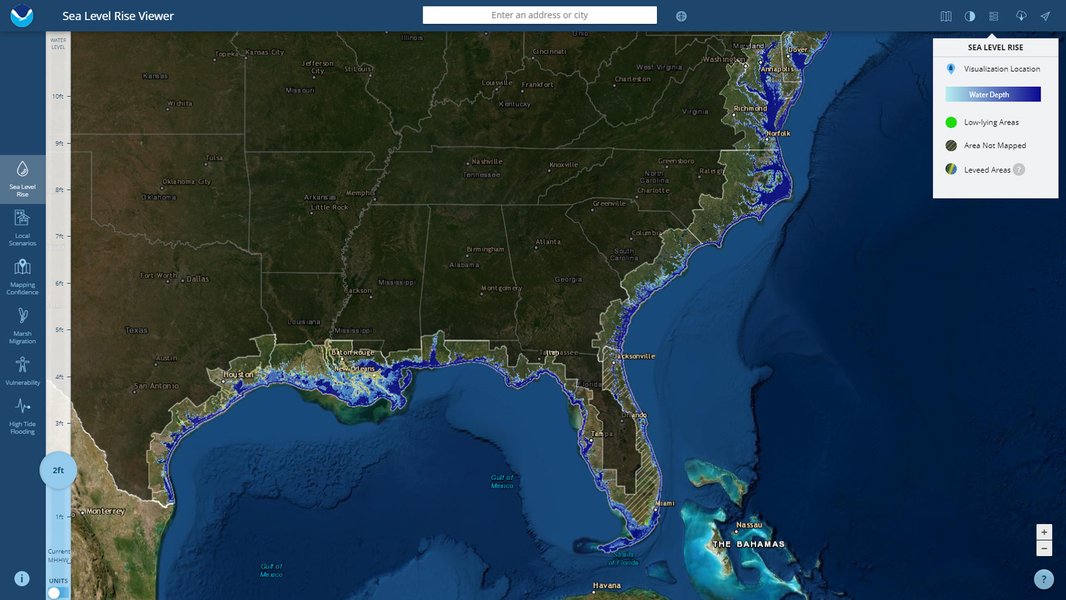
Visualization tools like NOAA's Sea Level Rise Viewer help communities understand and plan for future coastal changes.
Regional Realities: Why Location Matters
Sea level rise is not a uniform phenomenon like filling a bathtub. Various regional and local factors cause significant deviations from the global average. These include:
- Vertical Land Motion: Coastal land can be sinking (subsidence) or rising (uplift) due to geological processes like groundwater extraction, sediment compaction, or tectonic activity. Subsidence exacerbates local sea level rise, while uplift can counteract it.
- Ocean Dynamics: Changes in ocean currents, wind patterns, and the Earth's gravitational field (due to the redistribution of mass from melting ice sheets) can cause sea levels to rise more in some regions and less in others.
- Proximity to Melting Ice: Ironically, areas far from rapidly melting ice sheets (like Greenland and Antarctica) can experience greater sea level rise due to complex gravitational effects. As an ice sheet loses mass, its gravitational pull on nearby water lessens, causing local sea level to fall slightly, while sea levels rise more significantly further away.
Focus on U.S. Coastlines
For the contiguous United States, interagency reports project an average sea level rise of 10 to 12 inches (25 to 30 centimeters) by 2050 (relative to 2000 levels). A significant portion of this rise is anticipated to occur within the next 20 years (by 2045) due to the accelerating rates. However, this average masks considerable regional differences:
- U.S. East Coast: Generally projected to experience sea level rise greater than the global average. For example, Maryland's shorelines are very likely to see a rise of about one foot (30 cm) between 2000 and 2050, potentially reaching 1.5 feet. Cities in North Carolina, such as Duck, are projected to see around 0.5 meters (19.7 inches) of rise by 2050, while Beaufort and Wilmington might see closer to 0.4 meters (15.7 inches).
- Gulf Coast: Also highly vulnerable, with projections in some areas, like parts of Florida, potentially reaching 0.55 to 0.65 meters (22 to 26 inches) by 2050. Some reports suggest Florida could see more than 7 inches (18 cm) by 2040.
- West Coast: Projections are generally closer to the global average, though specific locations can vary due to tectonic activity and oceanographic conditions. Hawaii is projected to experience about 8 inches (20 cm) by 2050.
Key Drivers of Sea Level Rise
The primary contributors to current and near-future sea level rise are:
- Thermal Expansion of Seawater: As oceans absorb heat from the atmosphere (approximately 90% of the excess heat from global warming), the water expands in volume. This has been a major driver of sea level rise in recent decades and will continue to be significant.
- Melting of Land-Based Ice:
- Glaciers and Ice Caps: Mountain glaciers and ice caps around the world are shrinking at an accelerated rate, contributing substantial amounts of meltwater to the oceans.
- Ice Sheets: The massive ice sheets of Greenland and Antarctica are also losing ice at an increasing pace. The melt dynamics of these ice sheets, particularly Antarctica, represent one of the largest uncertainties in long-term sea level rise projections, but their contribution is growing.
- Changes in Land Water Storage: Human activities, such as groundwater depletion for agriculture and consumption, can transfer water from land to the oceans, contributing a smaller, but not insignificant, amount to sea level rise. Conversely, the construction of large dams can temporarily withhold water on land.
Visualizing the Complexity: Factors Influencing Future Sea Levels
The chart below provides a conceptual representation of the relative influence and uncertainty associated with key factors driving sea level rise, both historically and looking towards the next 20 years. "Influence" reflects the estimated contribution to sea level changes, while "Uncertainty" indicates the range of scientific confidence in projecting that factor's impact. Note that Land Subsidence and Ocean Currents are highly regional, so their global average influence might seem lower than their critical local impact.
This radar chart illustrates that while thermal expansion has been a dominant and relatively well-understood factor, the influence of ice sheet melt (particularly from Antarctica) is projected to increase significantly, and it also carries higher levels of uncertainty. Understanding these interacting factors is key to refining future projections.
The Ripple Effect: Anticipated Impacts
Even seemingly small amounts of sea level rise can have profound and far-reaching consequences for coastal regions, which are often densely populated and economically vital.

The devastating impact of coastal flooding, a risk magnified by rising sea levels, underscores the vulnerability of shoreline communities.
Increased Frequency and Severity of Coastal Flooding
One of the most immediate and noticeable impacts of rising sea levels is an increase in coastal flooding. This occurs in several ways:
- High-Tide Flooding (Nuisance Flooding): As the baseline sea level rises, high tides can reach further inland, causing regular flooding of low-lying streets, properties, and infrastructure even on sunny days without storm activity. Some U.S. coastal cities, like Annapolis, Maryland, and Wilmington, Delaware, are already experiencing this, and it's projected that by 2045, many coastal areas could see high-tide flooding three times a week or more (over 100 days per year).
- Amplified Storm Surges: Higher sea levels provide a "launching pad" for storm surges associated with hurricanes and coastal storms, allowing them to penetrate further inland and cause more extensive damage.
Threats to Coastal Communities and Ecosystems
Beyond direct flooding, rising seas pose numerous other threats:
- Infrastructure Damage: Roads, bridges, ports, wastewater treatment plants, power plants, and other critical infrastructure in coastal zones are increasingly at risk of damage or permanent inundation.
- Erosion: Higher water levels and increased wave action accelerate coastal erosion, leading to loss of beaches, bluffs, and coastal properties.
- Saltwater Intrusion: Rising seas can push saltwater further into freshwater aquifers and estuaries, contaminating drinking water supplies and harming freshwater-dependent ecosystems and agriculture.
- Ecosystem Disruption: Coastal ecosystems like salt marshes, mangroves, and seagrass beds, which provide vital habitat and coastal protection, can be drowned or degraded if they cannot migrate inland quickly enough.
- Displacement and Economic Loss: Ultimately, rising sea levels can lead to the displacement of coastal populations and significant economic losses from property damage, disrupted industries (like tourism and fishing), and the costs of adaptation or relocation.

Coastal infrastructure, like these shoreline structures in the Bay Area, faces increasing threats from rising waters and erosion.
Projected Sea Level Rise: A Summary Table
The following table summarizes key aspects of projected sea level rise for the next 20 years (up to approximately 2045), highlighting drivers, projections, and impacts.
| Factor Category | Specific Driver/Impact/Projection Detail | Relevance to Sea Level Rise (Next 20 Years: ~2025-2045) |
|---|---|---|
| Primary Drivers | Thermal Expansion of Water | A consistent and major contributor. As oceans continue to absorb heat, their volume will expand, significantly adding to sea level rise. |
| Melting Glaciers & Ice Sheets | Contributions from Greenland, Antarctica, and mountain glaciers are accelerating and will be a substantial factor in the rise observed over the next two decades. | |
| Global Projections (by ~2045) | Global Average Rise | Expected rise of approximately 15-30 cm (6-12 inches). This is a global mean; local variations will occur. |
| Rate of Rise | The current accelerated rate (recently observed at ~0.59 cm/year) is expected to continue, meaning more rapid changes than in past decades. | |
| Regional Projections (U.S. example) | U.S. Coastlines (average by 2050) | Projections point to 25-30 cm (10-12 inches) by 2050. A significant portion of this will manifest by 2045 due to acceleration. |
| Regional Hotspots (e.g., U.S. East & Gulf Coasts) | These areas are likely to experience higher than average sea level rise due to factors like land subsidence and changes in ocean currents. | |
| Key Impacts | Increased Coastal Flooding | Sharp increase in "nuisance" or high-tide flooding days. Storm surges will become more damaging and reach further inland. |
| Ecosystem Disruption | Threats to coastal habitats (e.g., wetlands, mangroves), and increased risk of saltwater intrusion into freshwater sources. | |
| Infrastructure & Economic Risks | Significant risks to coastal property, critical infrastructure (ports, roads), and local economies reliant on coastal resources. | |
| Influencing Factors | Greenhouse Gas Emissions | While the rise over the next 20 years is largely locked in by past emissions, current and future emission pathways will heavily dictate the severity of sea level rise beyond 2050. |
| Vertical Land Motion | Local land subsidence will exacerbate relative sea level rise, while uplift can mitigate it. This is a critical factor for local impact assessments. |
Mapping the Connections: Sea Level Rise Factors and Consequences
The mindmap below illustrates the interconnected nature of the drivers, projections, impacts, and influencing factors related to sea level rise over the next two decades. It highlights how physical processes translate into tangible consequences for both natural and human systems.
(Next 20 Years: 2025-2045)"] id1["Key Drivers"] id1a["Thermal Expansion of Oceans"] id1b["Melting Ice"] id1b1["Greenland Ice Sheet"] id1b2["Antarctic Ice Sheet"] id1b3["Mountain Glaciers"] id2["Global Projections"] id2a["Average Rise: 15-30 cm (6-12 inches) by ~2045"] id2b["Accelerating Rate of Rise"] id2b1["Rate more than doubled recently"] id2b2["2024 rate observation: ~0.59 cm/year"] id3["Regional Variations"] id3a["U.S. Coastlines: Significant portion of the 25-30 cm (10-12 inches) expected by 2050 will occur by 2045"] id3a1["U.S. East Coast (e.g., Maryland, North Carolina)"] id3a2["U.S. Gulf Coast (e.g., Florida)"] id3b["Local Influencing Factors"] id3b1["Land Subsidence / Uplift"] id3b2["Ocean Currents & Circulation"] id3b3["Gravitational Adjustments from Ice Melt"] id4["Anticipated Impacts"] id4a["Increased Coastal Flooding"] id4a1["More Frequent High-Tide (Nuisance) Flooding"] id4a2["Amplified Storm Surges & Damage"] id4b["Ecosystem Damage & Loss"] id4b1["Coastal Wetland Drowning / Squeeze"] id4b2["Saltwater Intrusion into Aquifers & Estuaries"] id4c["Socio-Economic Effects"] id4c1["Risk to Infrastructure (Roads, Ports, Buildings)"] id4c2["Potential Displacement of Populations"] id4c3["Impacts on Coastal Agriculture & Fisheries"] id5["Context & Scenarios"] id5a["Near-term rise (to ~2045) largely locked-in due to past emissions"] id5b["Long-term rise trajectory (beyond 2050) highly dependent on future global emission reductions"]
Recent Observations: A Sign of Things to Come
Recent data, such as NASA's announcement regarding the higher-than-expected sea level rise in 2024, underscores the dynamic and accelerating nature of these changes. The video below discusses these findings and their implications.
This report from BBC News, based on NASA findings, highlights that global sea levels rose by more than 0.43cm in 2024, exceeding initial expectations. Such observations reinforce the scientific consensus that sea level rise is not only occurring but is doing so at an accelerated pace, lending further urgency to the projections for the coming decades.
Frequently Asked Questions (FAQ)
Recommended Further Exploration
- What are the specific sea level rise projections for my coastal city by 2045?
- How do different greenhouse gas emission scenarios impact long-term sea level rise beyond 2050?
- What adaptation strategies are coastal communities implementing to deal with rising sea levels?
- What is the role of Antarctic and Greenland ice sheet melt in future sea level rise uncertainty?
References
Last updated May 6, 2025