
Beyond Inhibition: Unlocking the Potential of Second-Generation Pharmacological Chaperones
Discover how advanced molecular stabilizers are revolutionizing treatments for protein misfolding diseases.
Many debilitating genetic diseases arise from seemingly small errors: single mutations that cause essential proteins, often enzymes, to misfold. While the protein might still be capable of performing its function, its incorrect shape flags it for destruction by the cell's quality control systems. Pharmacological chaperones (PCs) are small molecules designed to combat this, binding to these misfolded proteins and helping them achieve a stable, functional shape. Second-generation pharmacological chaperones represent a significant leap forward in this therapeutic strategy.
Highlights: The Next Wave of Protein Stabilization
- Non-Inhibitory Action: Unlike many first-generation counterparts, second-generation PCs primarily bind away from the protein's active site, stabilizing its structure without hindering its essential function.
- Targeted Stabilization: They often interact with allosteric sites, unique pockets on the protein surface, promoting correct folding and preventing premature degradation.
- Broad Therapeutic Promise: This advanced approach holds significant potential for treating lysosomal storage disorders (LSDs) and a growing list of other conformational diseases linked to protein misfolding.
The Leap Forward: Defining Second-Generation Pharmacological Chaperones
Core Concept
Second-generation pharmacological chaperones are specifically engineered small molecules designed to address the core problem of protein misfolding diseases – the loss of protein function due to instability and degradation. They selectively bind to target mutant proteins, acting like molecular scaffolds to help them fold correctly and maintain their functional conformation.
Distinguishing Features from First-Generation PCs
The crucial difference lies in their mechanism and interaction site:
Non-Inhibitory Binding
First-generation PCs often function as competitive inhibitors, binding directly to the enzyme's active site. While this stabilizes the protein, it can also block its activity, creating a delicate balancing act for dosage and efficacy. Second-generation PCs largely overcome this by binding elsewhere.
Allosteric Site Targeting
Instead of the active site, these newer chaperones frequently bind to allosteric sites or previously unidentified pockets on the protein surface. Binding at these locations induces conformational changes that stabilize the protein without directly competing with the natural substrate.
Enhanced Specificity
Designed often through advanced screening and computational methods, second-generation PCs can exhibit higher selectivity for specific mutant protein forms, potentially reducing off-target effects and improving the therapeutic window.
Improved Cellular Stability & Trafficking
By effectively stabilizing the protein, they facilitate its escape from cellular quality control mechanisms like Endoplasmic Reticulum-Associated Degradation (ERAD). This allows the protein to traffic correctly to its designated cellular compartment (e.g., the lysosome) where it can perform its function.
Mechanism of Action: How They Rescue Misfolded Proteins
The therapeutic effect of second-generation pharmacological chaperones hinges on their ability to intervene in the protein lifecycle before degradation occurs.
Binding and Stabilization
Upon entering the cell, a second-generation PC seeks out its target misfolded protein. It binds selectively to an allosteric site, inducing subtle but critical changes in the protein's structure. This binding favors a more stable, near-native conformation, effectively lowering the protein's free energy state and making it less prone to aggregation or being recognized as defective.
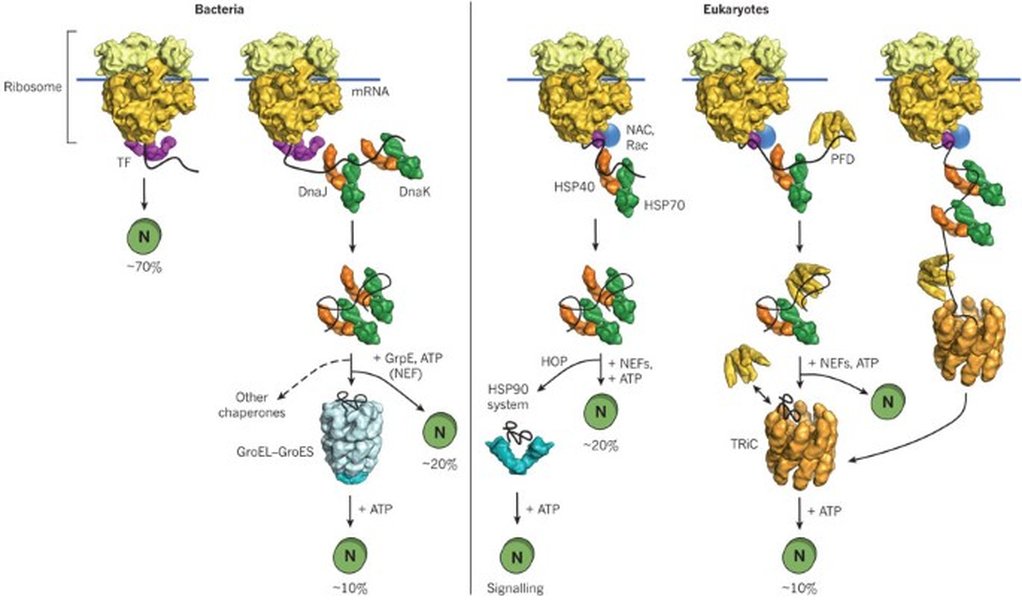
Conceptual illustration of cellular machinery (molecular chaperones) involved in protein folding, aggregation, and degradation pathways. Pharmacological chaperones aim to assist folding for specific mutant proteins.
Evading Degradation
A primary fate for misfolded proteins is destruction via the cellular quality control system, particularly ERAD. By stabilizing the protein's structure, the bound chaperone masks the signals that would normally target it for degradation. This allows the protein complex to successfully exit the endoplasmic reticulum.
Restoring Function via Trafficking and Dissociation
Once stabilized, the chaperone-protein complex can be correctly trafficked through the cellular machinery (e.g., Golgi apparatus) to its final destination. For many lysosomal enzymes involved in LSDs, this destination is the lysosome. The acidic environment (lower pH) within the lysosome is often key: it promotes the dissociation of the chaperone from the enzyme. Once unbound, the now correctly folded and localized enzyme can exert its residual catalytic activity, breaking down substrates and alleviating the disease pathology.
Visualizing the Chaperone Rescue Pathway
This mindmap illustrates the journey of a misfolded protein when treated with a second-generation pharmacological chaperone, highlighting the key steps involved in its rescue and functional restoration.
Comparative Strengths: First vs. Second Generation
This radar chart provides a visual comparison between typical characteristics of first-generation and second-generation pharmacological chaperones across several key parameters. Second-generation PCs generally aim for higher efficacy and specificity with lower inhibition risk, though their development can be more complex due to the need to identify novel binding sites.
Therapeutic Applications and Development
The non-inhibitory nature and targeted stabilization offered by second-generation PCs make them particularly attractive for diseases where residual enzyme activity is crucial.
Lysosomal Storage Disorders (LSDs)
LSDs are a primary focus for PC therapy. Many LSDs result from mutations causing lysosomal enzymes to misfold and degrade prematurely. Second-generation PCs offer a promising oral treatment strategy, potentially complementing or serving as an alternative to Enzyme Replacement Therapy (ERT).
Fabry Disease:
While the first-generation PC migalastat (an active site inhibitor) is approved for certain mutations, research explores second-generation, non-inhibitory chaperones to potentially broaden applicability and efficacy.Gaucher Disease:
Significant effort has gone into developing second-generation PCs, such as iminoxylitol derivatives, designed to stabilize mutant glucocerebrosidase (GCase) without inhibiting its function.Pompe Disease:
Non-inhibitory chaperones are being investigated to stabilize acid alpha-glucosidase (GAA) and enhance its activity, potentially offering advantages over ERT alone.
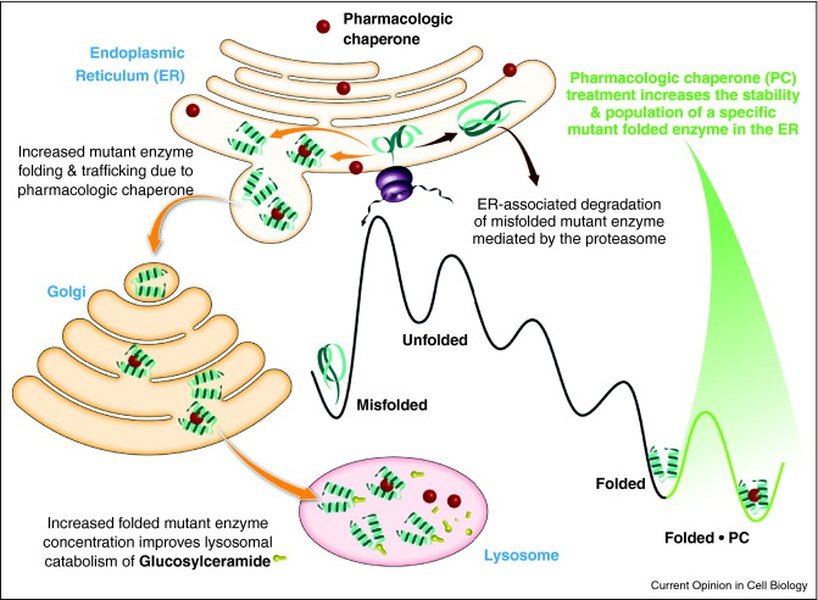
Illustration depicting how a pharmacological chaperone can bind to a misfolded lysosomal enzyme in the ER, facilitate its trafficking, and dissociate in the lysosome to allow substrate processing.
Other Potential Targets
The principles of second-generation PC therapy extend beyond LSDs:
Phenylketonuria (PKU):
Novel PCs are being developed for hyperphenylalaninemia, including PKU, aiming to stabilize the deficient enzyme phenylalanine hydroxylase.Cancer:
Specific mutant proteins involved in cancer, like p53-Y220C, are being targeted by advanced compounds (e.g., RIPTACs) that act as pharmacological chaperones to restore tumor suppressor function, showing superior efficacy in some studies compared to earlier PCs.Neurodegenerative Diseases:
While research is ongoing, the concept of using PCs to stabilize key proteins and prevent aggregation is being explored for conditions like Alzheimer's disease.Cystic Fibrosis:
Stabilizing the mutant CFTR protein is another area where chaperone-like molecules are investigated.
Development Strategies
Identifying and optimizing second-generation PCs requires sophisticated approaches:
High-Throughput Screening (HTS):
Searching large chemical libraries for molecules that stabilize the target protein without inhibiting it.Structure-Based Design:
Using knowledge of the protein's structure to computationally design molecules that fit into specific allosteric pockets.Advanced Platforms:
Specialized platforms like SEE-Tx (Site-directed Enzyme Enhancement Therapy) focus specifically on developing non-competitive PCs.Structure-Activity Relationship (SAR) Studies:
Systematically modifying lead compounds to improve their potency, selectivity, and pharmacokinetic properties.
Clinical Progress
Several second-generation PC candidates have progressed into preclinical and clinical trials. Early phase studies have often demonstrated good safety and tolerability profiles. Proving efficacy in larger patient populations and navigating the regulatory landscape are key ongoing steps in bringing these promising therapies to patients.
A Closer Look: Second-Generation PCs for Gaucher Disease
Gaucher disease, caused by deficient activity of the lysosomal enzyme glucocerebrosidase (GCase), provides a clear example of the rationale and development process for second-generation pharmacological chaperones. The table below summarizes key aspects:
| Aspect | Description |
|---|---|
| Target Enzyme | Glucocerebrosidase (GCase) |
| Disease Mechanism | Mutations cause GCase misfolding, leading to its premature degradation in the ER and reduced lysosomal activity. This results in the accumulation of glucocerebroside substrate. |
| First-Generation PC Approach | Competitive inhibitors binding to the GCase active site (e.g., isofagomine). These could stabilize the enzyme but risked inhibiting its residual activity. |
| Second-Generation PC Goal | Stabilize mutant GCase variants by binding to non-active (allosteric) sites, facilitating proper trafficking to the lysosome without compromising catalytic function. |
| Compound Examples | Derivatives of iminosugars like iminoxylitols (e.g., modifying alkyl chain positions), AT2101 (ambroxol - though its mechanism might be complex), and other non-inhibitory small molecules identified through screening. |
| Mechanism of Action | Binding to allosteric sites on GCase stabilizes its conformation, allowing it to pass ER quality control, traffic to the lysosome, and potentially dissociate to act on its substrate. |
| Key Findings & Potential | Studies (including preclinical and early clinical phases for some compounds) have shown that specific non-inhibitory chaperones can increase GCase levels and activity in patient-derived cells and models. Potential for oral administration and synergistic effects when combined with ERT in certain cases. |
Advantages and Hurdles
Benefits of the Second-Generation Approach
- Preservation of Function: Avoidance of active site inhibition is a major advantage, particularly for enzymes where even partial activity is beneficial.
- Enhanced Specificity: Targeting unique allosteric sites can lead to greater selectivity for the mutant protein.
- Oral Bioavailability: As small molecules, many PCs can be formulated for oral administration, improving patient convenience compared to intravenous therapies like ERT.
- Potential Cost-Effectiveness: Small molecule drug development can sometimes be more cost-effective than producing large biologic molecules like recombinant enzymes.
- Broader Applicability: May be effective for mutations unresponsive to first-generation PCs or ERT.
Challenges Remaining
- Identifying Binding Sites: Discovering suitable allosteric pockets requires significant research and advanced screening techniques.
- Dissociation Kinetics: Ensuring the chaperone releases the protein effectively in the target compartment (e.g., lysosome) is critical for restoring function.
- Mutation Specificity: The effectiveness of a PC can be highly dependent on the specific mutation affecting the protein's structure.
- Development Complexity: Designing molecules with the right balance of binding affinity, stability enhancement, cell permeability, and dissociation properties is challenging.
- Clinical Translation: Demonstrating clear clinical benefit in diverse patient populations requires extensive and rigorous clinical trials.
Frequently Asked Questions (FAQ)
What are protein misfolding diseases?
These are typically genetic disorders where a mutation causes a specific protein to fold incorrectly. This misfolding can prevent the protein from reaching its proper location in the cell or performing its function, and often leads to its premature destruction by the cell's quality control systems. Examples include lysosomal storage diseases (like Fabry, Gaucher, Pompe), cystic fibrosis, and certain forms of PKU.
How do second-gen PCs differ fundamentally from first-gen?
The main difference is the binding site and mechanism. First-generation PCs often bind to the protein's active site, acting as competitive inhibitors. This stabilizes the protein but can also block its function. Second-generation PCs are designed to bind to allosteric or non-active sites. This allows them to stabilize the protein's structure and aid its folding/trafficking without directly inhibiting its catalytic activity.
Are second-generation pharmacological chaperones safe?
Like all potential drugs, they undergo rigorous preclinical and clinical testing to evaluate safety. Early clinical trials for some second-generation PC candidates have reported good tolerability with no major safety concerns. However, safety profiles can vary between different compounds and depend on dosage and patient factors. Long-term safety data is still being gathered as these therapies progress through clinical development.
Can second-gen PCs replace treatments like Enzyme Replacement Therapy (ERT)?
In some cases, they might be an alternative, particularly for patients with specific mutations responsive to chaperone therapy. In other cases, they might be used in combination with ERT, where the chaperone could potentially stabilize both the patient's own residual enzyme and the administered enzyme. The suitability depends on the specific disease, the mutation, and the characteristics of the chaperone drug. They are often seen as a complementary strategy within the therapeutic landscape for LSDs.
What is an allosteric site?
An allosteric site is a location on a protein (like an enzyme) that is distinct from its active site (where the main reaction occurs). When a molecule binds to an allosteric site, it can change the protein's overall shape, including the shape of the active site, thereby influencing the protein's activity or stability. Second-generation pharmacological chaperones often leverage binding to these sites to stabilize the protein without blocking the active site itself.
Recommended Reading
- How do allosteric modulators work in drug therapy?
- What are the main challenges in developing treatments for lysosomal storage disorders?
- Compare pharmacological chaperones versus enzyme replacement therapy for Fabry disease.
- Explain the role of the endoplasmic reticulum-associated degradation (ERAD) pathway.
References
Last updated May 4, 2025