
Unveiling Evil: Can We Understand It Without Gods or Demons?
Exploring how secular thought interprets profound harm and moral transgression outside of religious frameworks.
When we encounter acts of profound cruelty, injustice, or destruction, the word "evil" often comes to mind. Traditionally, many cultures have relied on religious narratives involving supernatural forces, divine judgment, or inherent sinfulness to explain such phenomena. However, a secular, nonreligious interpretation approaches the concept of evil from a fundamentally different perspective, grounding it entirely within the human and natural world.
Highlights of Secular Evil Interpretation
- Evil Defined by Human Harm: Secular views define evil primarily as extreme, unjustifiable harm, suffering, or malice caused by human actions, intentions, or systemic failures, rather than attributing it to supernatural entities or cosmic forces.
- Focus on Natural Causes: Explanations for evil behavior are sought in psychology, sociology, biology, environmental factors, and flawed ethical reasoning, rejecting notions of demonic influence or inherent sin.
- Shift in the "Problem of Evil": The challenge shifts from reconciling evil with a benevolent deity to understanding why humans inflict profound suffering on each other and how to prevent or mitigate it within a naturalistic worldview.
Deconstructing Evil: A Human-Centered View
Removing the Supernatural Lens
The cornerstone of a secular interpretation of evil is the explicit rejection of supernatural explanations. Concepts like devils, demons, original sin, or divine retribution are set aside. Instead, evil is understood as a phenomenon arising from human agency, choices, character, societal structures, and ideologies. It's viewed not as an external force invading the world, but as a potentiality within human behavior and social systems.
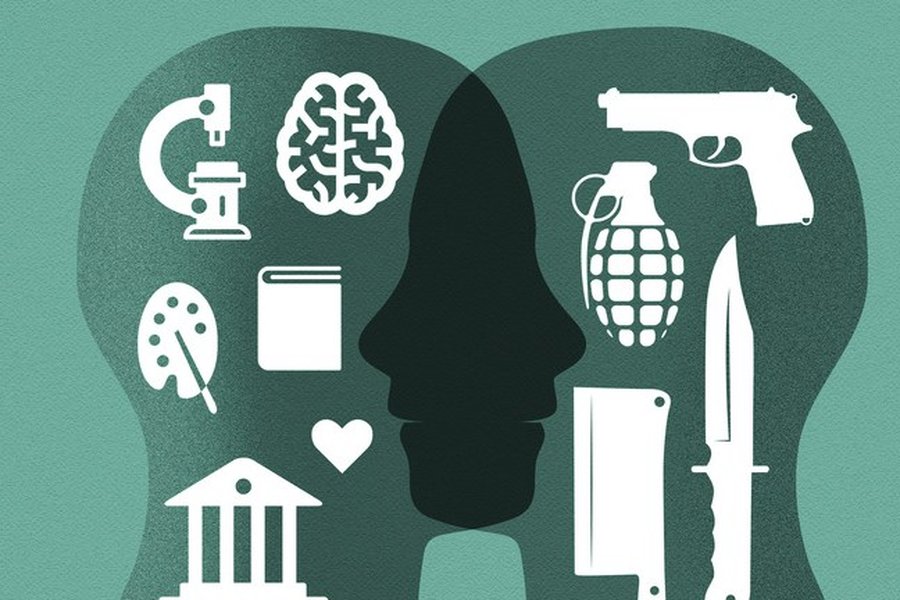
Secular interpretations often explore the duality within human nature and social systems as sources of both good and evil.
What Constitutes "Evil" in Secular Terms?
Defining Profound Harm and Malice
While there isn't one single, universally agreed-upon secular definition, common themes emerge. Evil generally refers to actions, intentions, or character traits that are profoundly harmful, malicious, or morally unjustifiable. It goes beyond simple wrongdoing or mistakes; it often implies an extreme degree of negative impact, deliberate cruelty, or a callous disregard for the well-being and rights of others.
Key characteristics often associated with secular conceptions of evil include:
- Extreme Harm and Suffering: Actions that cause significant, often irreparable, physical or psychological pain, suffering, or death.
- Intentionality and Malice: Actions driven by a desire to inflict harm, cruelty, or degradation, sometimes even without apparent rational self-interest ("unmotivated malice").
- Gross Negligence or Indifference: A profound failure to act to prevent foreseeable, catastrophic harm when one has the capacity and responsibility to do so.
- Moral Unjustifiability: Actions for which there are no adequate excuses, exemptions, or justifications based on widely accepted ethical principles.
- Systemic Injustice: Institutions, ideologies, or social structures that systematically perpetuate oppression, discrimination, and profound suffering (e.g., genocide, slavery, totalitarian regimes).
Distinguishing Evil from Wrongdoing
In secular ethics, a distinction is often made between everyday wrongdoing (lying, breaking promises, minor theft) and actions labeled as "evil." Evil typically denotes the most egregious moral failures – acts that shock the conscience due to their severity, cruelty, or scale. Philosophers sometimes referred to as "evil-revivalists" argue that the term "evil" is not merely a synonym for "very wrong" but captures a distinct and necessary concept in our moral vocabulary to identify and condemn the absolute worst actions and character traits.
Finding the Roots: Causes and Explanations
Psychological and Social Factors
Without recourse to supernatural explanations, secular interpretations delve into the complex interplay of psychological, social, and environmental factors that can lead individuals and groups to commit acts deemed evil. Instead of inherent sinfulness, the focus is on:
- Psychological Mechanisms: Factors like psychopathy, narcissism, sadism, lack of empathy, cognitive biases (e.g., dehumanization of victims), groupthink, and obedience to authority.
- Social and Environmental Influences: Upbringing, exposure to violence, poverty, inequality, political instability, cultural norms that condone harmful behavior, and ideologies that promote hatred or supremacy.
- Situational Pressures: Circumstances that can lead ordinary people to commit extraordinary acts of cruelty, as explored in studies like the Stanford Prison Experiment or analyses of wartime atrocities.
- Flawed Moral Reasoning: Egoism, failure to consider consequences, or adherence to distorted ethical frameworks.
The nonreligious worldview often posits that humans are not born inherently good or evil but are morally complex beings shaped significantly by their environment and choices.

Secular views examine how authority, obedience, and social context influence moral decision-making.
The Role of Ideology and Institutions
Secular analyses also highlight how ideologies (political, social, or economic) and institutions can be sources or facilitators of evil. Systems that dehumanize certain groups, justify violence, concentrate power without accountability, or prioritize profit or dogma over human well-being can create environments where large-scale harm occurs. Evil, in this sense, is not just an individual failing but can be embedded within social structures.
Moral Frameworks Without Divinity
Establishing Right and Wrong
A crucial question for secular ethics is how to ground moral judgments, including the condemnation of evil, without appealing to divine commands or religious texts. Secular morality relies on various foundations:
- Reason and Rationality: Ethical principles derived through logical reasoning about consistency, fairness, and the consequences of actions (e.g., Kantian ethics).
- Humanism and Well-being: Morality based on promoting human flourishing, happiness, empathy, and minimizing suffering (e.g., utilitarianism, consequentialism).
- Social Contract Theory: Moral rules understood as agreements (explicit or implicit) necessary for stable and cooperative societies.
- Evolutionary Ethics: Understanding moral sentiments like empathy and altruism as having evolved roots that contribute to species survival.
- Virtue Ethics: Focusing on developing good character traits (like compassion, justice, courage) rather than just following rules.
Within secular thought, there's debate about whether morality is objective (moral realism – stating that some actions are inherently wrong regardless of opinion) or subjective/relative (moral relativism or constructivism – viewing morality as dependent on cultural norms, individual perspectives, or social agreements). However, even within relativistic frameworks, actions causing extreme, unjustified harm are typically condemned based on shared human values or pragmatic societal needs.
Comparing Ethical Frameworks' Emphasis on Evil
Different secular ethical frameworks may place varying emphasis on the factors contributing to an act being labeled "evil." The radar chart below offers a conceptual visualization (not based on hard data) of how frameworks like Utilitarianism, Kantian Deontology, Virtue Ethics, and Social Contract Theory might prioritize aspects like the severity of harm, the intention behind the act, the negligence involved, the violation of rights/duties, and the impact on social order when evaluating profoundly immoral actions.
This chart illustrates how different ethical systems might weigh various factors when identifying an action as "evil," though all ultimately condemn profound, unjustifiable harm.
The Secular Problem of Evil
Confronting Human-Inflicted Suffering
In theology, the "problem of evil" traditionally asks how an all-powerful, all-knowing, and all-good God can coexist with the suffering and evil present in the world. The secular problem of evil, however, shifts the focus entirely. Without invoking a deity, the challenge becomes understanding and coping with the reality of evil – particularly the immense suffering humans inflict upon one another – given our knowledge of psychology, sociology, and history.
It grapples with questions like:
- Why do individuals and groups commit acts of extreme cruelty, often seemingly without rational motivation or benefit?
- How can societies best prevent or respond to such acts?
- How do we maintain hope or strive for moral progress in the face of humanity's capacity for profound harm?
The secular problem of evil is less about justifying a divine plan and more about understanding human nature, mitigating harm through ethical systems, law, education, and social reform, and finding meaning and resilience in a world where suffering exists without supernatural oversight.
This video discusses a common secular approach to defining evil – linking it to pain and suffering – and explores some of the philosophical challenges and critiques associated with this definition, highlighting the nuances within secular interpretations.
Mapping the Concept: A Secular View of Evil
The mindmap below provides a visual overview of the core components and related concepts within a secular, nonreligious understanding of evil.
(Empathy loss, Bias, Pathology)"] id2b["Social & Environmental Factors
(Upbringing, Culture, Inequality)"] id2c["Situational Pressures
(Authority, Groupthink)"] id2d["Ideological Roots
(Dehumanization, Supremacy)"] id2e["Institutional Structures
(Oppression, Corruption)"] id3["Moral Grounding (Non-Divine)"] id3a["Reason & Rationality"] id3b["Humanism & Well-being"] id3c["Social Contract"] id3d["Evolutionary Ethics"] id3e["Virtue Ethics"] id3f["Moral Realism vs. Relativism Debate"] id4["Secular Problem of Evil"] id4a["Focus on Human-Inflicted Suffering"] id4b["Understanding Motivations (incl. 'Unmotivated Malice')"] id4c["Coping without Divine Framework"] id4d["Challenge for Ethics & Society"] id5["Responses & Implications"] id5a["Emphasis on Human Responsibility"] id5b["Focus on Prevention (Education, Reform)"] id5c["Legal & Social Accountability"] id5d["Development of Ethical Systems"] id5e["Debate: Is 'Evil' a Necessary Concept?"]
This mindmap illustrates how secular thought approaches evil by defining it through human actions and consequences, exploring its naturalistic causes, grounding it in non-divine moral frameworks, reframing the "problem of evil," and focusing on human-centered responses.
Comparing Perspectives: Religious vs. Secular Evil
To further clarify the secular interpretation, the following table contrasts it with common elements found in many religious perspectives on evil.
| Aspect | Typical Religious Interpretation | Typical Secular Interpretation |
|---|---|---|
| Source of Evil | Supernatural forces (e.g., Satan, demons), inherent sinfulness (Original Sin), violation of divine law, misuse of free will against God's plan. | Human actions, intentions, psychology, social structures, ideologies, environmental factors, natural events (non-moral evil). |
| Nature of Evil | Often seen as a distinct force or entity, a cosmic opposition to good/God, a spiritual corruption. | A label for extreme moral wrongdoing, profound harm, or malicious behavior; a potential within human nature and society, not an external entity. |
| Definition Criteria | Violation of divine commands, rebellion against God, impurity, sin. | Causing profound suffering/harm, malicious intent, moral unjustifiability, violation of ethical principles (reason, humanism, social contract). |
| The "Problem of Evil" | How to reconcile the existence of evil/suffering with an all-powerful, all-good God. | How to understand, cope with, and prevent human-inflicted suffering and extreme immorality without divine explanations or intervention. |
| Response to Evil | Prayer, faith, adherence to religious law, divine judgment/intervention, exorcism, seeking salvation/redemption. | Ethical reasoning, education, social/political reform, legal justice, psychological understanding, promoting empathy and cooperation, human accountability. |
Note: This table presents generalizations; specific beliefs vary widely within both religious and secular traditions.
Frequently Asked Questions (FAQ)
Is there one single secular definition of evil?
No, there isn't a single, universally accepted definition. Secular interpretations of evil depend heavily on the underlying ethical framework adopted (e.g., utilitarianism, deontology, virtue ethics, humanism). However, most secular views converge on identifying evil with extreme, unjustifiable harm, suffering, or malicious intent rooted in human behavior or systems, distinct from supernatural causes.
How do secular views explain extreme acts like genocide or torture?
Secular explanations focus on a confluence of factors: psychological mechanisms (like dehumanization, obedience to authority, psychopathy), powerful ideologies that justify mass violence, social and political conditions (like instability, fear, scapegoating), failures of empathy, and the role of institutional structures in enabling and carrying out atrocities. They analyze these events as complex human phenomena resulting from specific historical, social, and psychological dynamics, rather than demonic influence or divine punishment.
Can something be objectively evil without religion?
This is a subject of debate within secular philosophy (metaethics). Secular moral realists argue that objective moral truths, including the wrongness of certain "evil" acts (like torture of the innocent), can exist and be known through reason or observation of human well-being, independent of divine commands. Others adopt more relativistic or constructivist views, holding that moral values are human creations (based on culture, agreement, or emotion). However, even non-realists typically condemn acts considered evil based on shared human values, empathy, or the pragmatic need for social order.
What's the difference between 'evil' and 'wrongdoing' in secular terms?
While both refer to morally incorrect actions, "evil" is typically reserved for the most extreme end of the spectrum. Wrongdoing might encompass everyday moral failings like lying or breaking a promise. "Evil" usually denotes actions characterized by profound harm, extreme cruelty, malicious intent, large scale negative consequences, or a deep-seated character flaw leading to such actions. It signifies a severity that goes far beyond ordinary immorality and often evokes a stronger sense of moral condemnation.
Recommended Further Exploration
- How do secular ethics compare and contrast with religious morality?
- What are the psychological explanations for human cruelty and aggression?
- What are different philosophical views on whether human nature is inherently good, evil, or neutral?
- What societal structures and strategies help prevent extreme harm and atrocities?
References
Last updated April 27, 2025