
The Role of the Securitizing Actor in Securitization
Understanding the Key Agent in Transforming Assets into Securities
Key Highlights of the Securitizing Actor's Role
- Identifies and pools assets: The securitizing actor selects and combines various illiquid assets into a pool to form the basis for a new security.
- Transforms assets into securities: Through financial engineering, the actor converts these assets into marketable securities that can be sold to investors.
- Manages and mitigates risks: The securitizing actor plays a role in managing the risks associated with the underlying assets, often using risk management tools to reduce idiosyncratic risk.
Defining the Securitizing Actor
In the realm of securitization, the securitizing actor is a crucial entity responsible for transforming assets into marketable securities. Securitization is the process of pooling illiquid assets, such as loans or receivables, and converting them into tradeable securities. This process allows investors to purchase shares in the pool of assets, receiving interest and principal payments generated by those assets. The securitizing actor plays a central role in initiating, structuring, and executing this transformation.
Core Responsibilities of the Securitizing Actor
The securitizing actor undertakes several key responsibilities to facilitate the securitization process:
- Asset Selection and Pooling: The securitizing actor identifies and gathers a diverse range of assets, such as loans, mortgages, or credit card receivables. These assets are then pooled together to form the underlying collateral for the new securities.
- Structuring the Securitization: The actor designs the structure of the securitization, determining the different tranches (or classes) of securities that will be issued. Each tranche has a different level of risk and return, catering to various investor preferences.
- Credit Enhancement: To make the securities more attractive to investors, the securitizing actor implements credit enhancement mechanisms. These mechanisms can include guarantees, insurance, or overcollateralization, which provide additional protection against potential losses.
- Security Issuance: The securitizing actor oversees the issuance of the new securities to investors in the financial markets. This involves preparing offering documents, marketing the securities, and ensuring compliance with regulatory requirements.
- Ongoing Management: Even after the securities are issued, the securitizing actor may retain some responsibilities for managing the underlying assets. This can include servicing the loans, collecting payments, and managing any defaults or delinquencies.
The Securitization Process Explained
The securitization process involves several key steps, with the securitizing actor at the heart of it:
- Origination: A lender (e.g., a bank) originates loans or other receivables.
- Pooling: The securitizing actor pools these assets together.
- Structuring: The actor structures the assets into different tranches, each with varying levels of risk and return.
- Issuance: Securities representing these tranches are sold to investors.
- Servicing: The securitizing actor or a third-party servicer manages the underlying assets and distributes payments to investors.
This process transforms illiquid assets into liquid, tradable securities, providing benefits to both the originator and the investors.
Benefits of Securitization Facilitated by the Securitizing Actor
Securitization offers several advantages, largely driven by the actions of the securitizing actor:
- Increased Liquidity: Converts illiquid assets into liquid securities, making them more attractive to investors.
- Risk Management: Allows originators to transfer risk to investors, reducing their exposure to potential losses.
- Access to Capital: Provides originators with a new source of funding, enabling them to originate more loans or receivables.
- Diversification: Enables investors to diversify their portfolios by investing in a variety of asset-backed securities.
- Improved Efficiency: Streamlines the process of financing assets, reducing costs and improving overall market efficiency.
Risk Mitigation and Management
One of the critical roles of the securitizing actor is to manage and mitigate risks associated with the securitized assets. This is achieved through various techniques:
- Credit Tranching: Dividing the securities into different tranches with varying levels of credit risk, allowing investors to choose the level of risk they are comfortable with.
- Overcollateralization: Providing more collateral than the value of the securities issued, offering a buffer against potential losses.
- Third-Party Guarantees: Obtaining guarantees from third-party institutions to protect investors against defaults.
Securitization in International Relations
In the context of international relations, securitization refers to the process by which an actor transforms an issue into a matter of security, thereby justifying extraordinary measures to address it. The securitizing actor, in this context, is the entity that makes the securitizing move by declaring a referent object (something that is to be protected) existentially threatened. This theoretical framework helps to understand how certain issues become prioritized and politicized in global politics.
Key Components of Securitization in International Relations
According to securitization theory, a securitization act involves several key components:
- Securitizing Actor: The entity that makes the securitizing move, such as a government, international organization, or non-state actor.
- Referent Object: The thing that is claimed to be existentially threatened, such as a state, a group, or a value.
- Existential Threat: The perceived threat to the referent object's survival or well-being.
- Audience: The target of the securitizing move, whose support is needed to legitimize extraordinary measures.
The success of a securitization act depends on convincing the audience that the threat is real and requires urgent action.
Practical Examples of Securitization
To illustrate how securitization works, consider a few practical examples:
Mortgage-Backed Securities (MBS)
A bank originates numerous mortgage loans and then pools them together. The bank, acting as the securitizing actor, creates securities backed by these mortgages. Investors purchase these MBS, and the cash flows from the mortgage payments are passed through to the investors. This allows the bank to free up capital and originate more mortgages.
Auto Loan Securitization
A finance company that provides auto loans pools these loans and creates asset-backed securities (ABS). These securities are then sold to investors. The payments from the auto loans are used to pay the investors. The finance company benefits by transferring the risk of default to investors and gaining access to additional funding.
Credit Card Receivables
A credit card company securitizes its credit card receivables by pooling them and issuing securities. Investors receive payments from the credit card balances, and the credit card company can use the proceeds to expand its lending operations.
Visualizing Securitization
Here are some visual aids to better understand the securitization process:
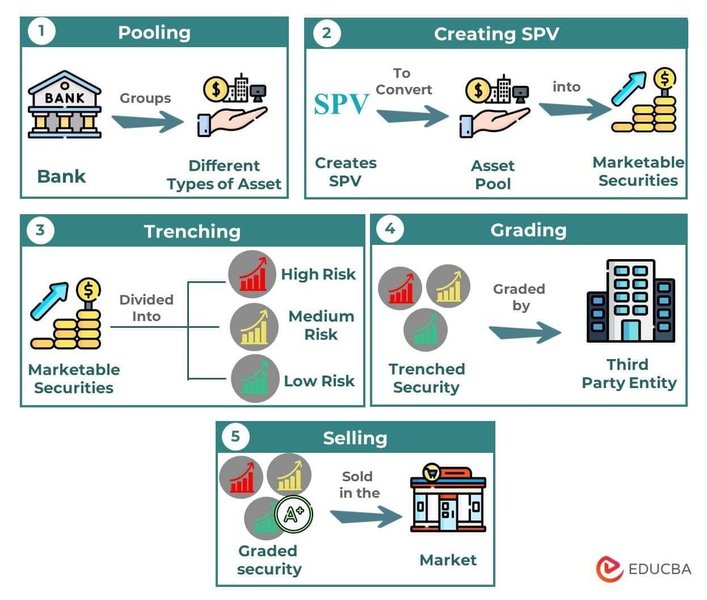
This image illustrates the typical flow of assets and payments in a securitization transaction.

This image represents how assets like mortgages are pooled and converted into securities, showing the transformation that occurs through securitization. The securitizing actor is the key player facilitating this transformation.
Understanding Securitization through an Example
Consider a scenario where a bank has a large portfolio of auto loans. Instead of holding these loans on its balance sheet, the bank decides to securitize them. Here’s how the process unfolds:
- Pooling of Assets: The bank pools together a large number of auto loans.
- Transfer to Special Purpose Entity (SPE): The loans are transferred to an SPE, which is a separate legal entity created specifically for this securitization.
- Structuring of Securities: The SPE issues securities (asset-backed securities or ABS) that are backed by the auto loans. These securities are divided into different tranches with varying levels of risk and return.
- Credit Enhancement: To make the securities more attractive, the SPE may obtain credit enhancement, such as a guarantee from a third-party insurer.
- Sale to Investors: The ABS are sold to investors in the financial markets.
- Cash Flow Distribution: The cash flows from the auto loans (i.e., the payments made by the borrowers) are used to pay interest and principal to the investors.
In this example, the bank acts as the securitizing actor by initiating and structuring the securitization. The SPE serves as a conduit for transferring the assets and issuing the securities. The investors provide the funding and bear the risk of the auto loans.
Role of Securitization in Financial Markets
Securitization plays a vital role in financial markets by enhancing liquidity, improving risk management, and facilitating access to capital. By transforming illiquid assets into liquid securities, securitization allows a broader range of investors to participate in the financing of these assets. This, in turn, can lead to lower borrowing costs and increased availability of credit.
Benefits for Issuers and Investors
Securitization provides benefits to both issuers (such as banks and finance companies) and investors:
- For Issuers: Securitization allows them to free up capital, reduce risk, and diversify their funding sources.
- For Investors: It provides access to a wider range of investment opportunities and the ability to tailor their risk exposure to their preferences.
Securitization vs. Traditional Lending
Securitization differs from traditional lending in several key respects:
-
Transfer of Risk: In traditional lending, the lender retains the risk of default. In securitization, this risk is transferred to investors.
-
Funding Source: Traditional lending relies on deposits or other forms of borrowing. Securitization provides a new source of funding through the issuance of securities.
-
Balance Sheet Impact: Traditional lending ties up capital on the lender's balance sheet. Securitization allows the lender to remove assets from its balance sheet, freeing up capital for other purposes.
Table Summarizing Securitization Concepts
The following table summarizes the key concepts related to securitization:
| Concept | Description | Role of Securitizing Actor |
|---|---|---|
| Securitization | The process of pooling assets and converting them into marketable securities. | Initiates and structures the securitization. |
| Securitizing Actor | The entity that initiates and structures the securitization. | Selects assets, structures securities, manages risks. |
| Assets | Loans, mortgages, or receivables that are pooled together. | Identifies and pools the assets. |
| Securities | Asset-backed securities (ABS) that are sold to investors. | Structures the securities to meet investor needs. |
| Investors | Entities that purchase the securities. | Provides investment capital. |
| Risk Management | Techniques used to mitigate the risk of default. | Implements credit enhancement and risk mitigation measures. |
Visual Explanation of Securitization
This video provides a clear explanation of securitization, detailing how assets are pooled and transformed into securities. It helps to visualize the role of the securitizing actor in this process, illustrating how they facilitate the conversion of illiquid assets into tradable securities. The video also touches on the benefits of securitization for various stakeholders, including issuers and investors. The Reserve Bank of India (RBI)'s updated norms for asset securitization are also discussed, which reduced the holding period for assets before they can be securitized.
FAQ
Frequently Asked Questions
What types of assets can be securitized?
A wide range of assets can be securitized, including mortgages, auto loans, credit card receivables, student loans, and even royalties.
What is a Special Purpose Entity (SPE)?
A Special Purpose Entity (SPE) is a legal entity created specifically for the purpose of securitizing assets. It is typically bankruptcy-remote, meaning that it is legally separate from the originator and is not affected by the originator's financial difficulties.
What are the risks associated with securitization?
Securitization involves several risks, including credit risk (the risk of default by the borrowers), prepayment risk (the risk that borrowers will repay their loans early), and market risk (the risk that the value of the securities will decline due to changes in market conditions).
How does securitization affect the overall economy?
Securitization can have both positive and negative effects on the economy. On the positive side, it can increase the availability of credit and lower borrowing costs. On the negative side, it can contribute to financial instability if not managed properly, as was seen during the 2008 financial crisis.
What is the role of credit rating agencies in securitization?
Credit rating agencies play a critical role in securitization by assessing the creditworthiness of the securities and assigning ratings. These ratings are used by investors to evaluate the risk of investing in the securities.
References
Last updated April 11, 2025