
Unlock Peak SEO: How Many Keywords Should Your Page Really Target?
Mastering the art of keyword optimization for maximum search visibility in 2025.
Determining the ideal number of SEO keywords for a single webpage is a cornerstone of effective search engine optimization. As of May 2025, the prevailing wisdom leans towards a focused, strategic approach that prioritizes user experience and topical relevance over sheer keyword volume. This guide synthesizes expert insights to help you optimize your pages for search engines and, more importantly, for your audience.
Key Highlights: Optimizing Your Keyword Strategy
- Focus on a Core Topic: Each page should ideally target one primary keyword that encapsulates its main subject matter.
- Leverage Supporting Keywords: Complement your primary keyword with 2-5 relevant secondary keywords, including synonyms, long-tail variations, and LSI (Latent Semantic Indexing) terms to broaden contextual understanding.
- Prioritize Natural Integration: Keywords must be woven into content naturally. The emphasis is on creating valuable, user-centric content, not on achieving arbitrary keyword densities. Keyword stuffing is detrimental.
The Core Strategy: Primary and Secondary Keywords Explained
A successful SEO strategy hinges on understanding the roles of different types of keywords and how they contribute to a page's ability to rank.
The Pillar: Your Primary Keyword
Every page on your website should have a singular focus, represented by one primary keyword (or keyphrase). This is the term you most want the page to rank for. It should accurately reflect the core content and purpose of the page. Your primary keyword is the anchor for all on-page optimization efforts, guiding the creation of titles, headings, and the main body content.
The Supports: Secondary and LSI Keywords
Supporting your primary keyword are secondary keywords. These typically include:
- Synonyms: Different words with similar meanings (e.g., "affordable laptops" and "cheap notebooks").
- Long-tail variations: More specific, often longer phrases that users might search for (e.g., if the primary is "running shoes," a long-tail could be "best running shoes for flat feet pronation").
- Subtopics: Related concepts that flesh out the main topic.
- LSI Keywords: Latent Semantic Indexing keywords are terms conceptually related to your primary keyword. Search engines use these to understand the context and depth of your content. For example, for a page about "baking bread," LSI keywords might include "yeast," "flour," "kneading," and "oven temperature."
Keyword Allocation: Does It Vary by Content Type?
Yes, the optimal number and type of keywords can indeed vary depending on the nature and purpose of the page. While the "one primary keyword" rule generally holds, the strategy for secondary keywords can be adjusted.
Tailoring Keywords to Page Purpose
Different types of pages serve different user intents and thus may benefit from nuanced keyword strategies. Here’s a general guideline:
| Page Type | Primary Keywords | Secondary Keywords | Key Considerations |
|---|---|---|---|
| Blog Post / Informational Article | 1 | 2-4 | Focus on comprehensive topic coverage, addressing user questions. Long-tail keywords and LSI terms are particularly valuable here. |
| Product Page | 1 | 3-5 | Target specific product names/models as primary. Secondary keywords can include features, benefits, model numbers, and transactional phrases (e.g., "buy," "discount"). |
| Service Page | 1 | 2-4 | Primary keyword should reflect the core service. Secondary keywords can specify location (for local SEO), variations of the service, or related problems the service solves. |
| Homepage | 1 (broad) | 1-3 | Often targets a broader, brand-related term or the main industry/niche. Secondary keywords can reflect the primary services or products offered. |
| Landing Page (Campaign-specific) | 1 | 1-2 | Highly focused on a specific offer or call to action. Keywords should be tightly aligned with ad copy and campaign goals. |
This table provides a structured approach to distributing keywords based on the page's role in your overall content strategy. The key is always to align keywords with the specific information or action the page is intended to deliver to the user.
Strategic Keyword Placement: Where to Weave Your Keywords
Simply choosing the right keywords isn't enough; they must be placed strategically within your page's HTML and content to signal relevance to search engines effectively. Natural integration is paramount to avoid penalties and ensure a good user experience.
Key On-Page Elements for Keyword Integration
1. Title Tag
The HTML title tag is one of the most crucial placement spots. Aim to include your primary keyword, preferably towards the beginning of the title.
2. Meta Description
While not a direct ranking factor, the meta description influences click-through rates. Including your primary keyword and relevant secondary terms can make your snippet more appealing in search results.
3. Header Tags (H1-H6)
Your H1 tag should almost always contain your primary keyword. Use H2-H6 tags for subheadings, incorporating secondary keywords and variations where they fit naturally and help structure the content logically.
4. Body Content
Integrate your primary keyword within the first 100-150 words of your main content. Sprinkle primary, secondary, and LSI keywords naturally throughout the body. The emphasis should be on readability and providing value, not forcing keywords in.
5. URL Slug
A concise, keyword-rich URL can help both users and search engines understand the page's topic. Include your primary keyword if possible.
6. Image Alt Text and Filenames
Use descriptive alt text for images, incorporating relevant keywords where appropriate. This helps with image search visibility and accessibility. Image filenames can also include keywords.
7. Internal Links
When linking to the page from other content on your site, use anchor text that includes variations of your target keywords.
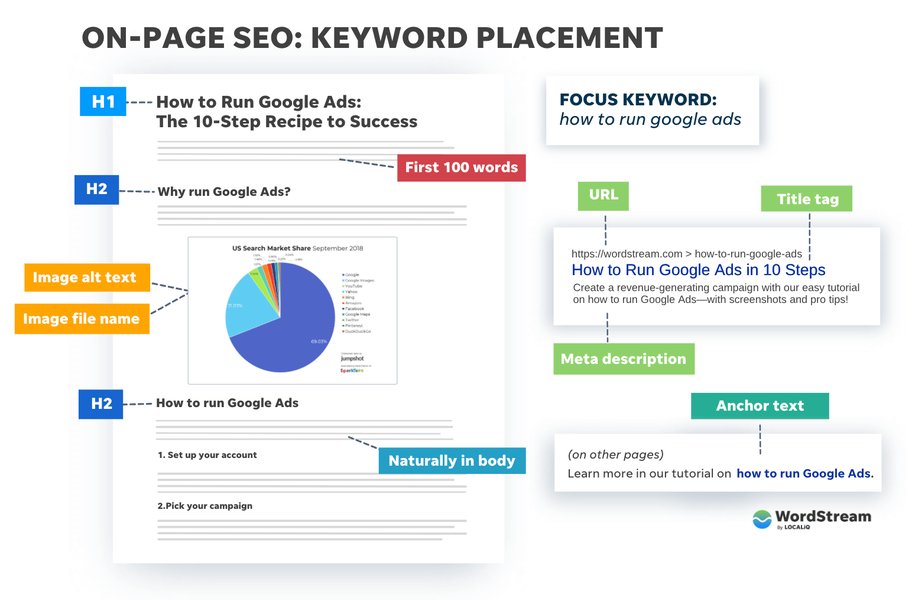
A visual guide to strategic keyword placement for on-page SEO.
The Role of Keyword Density in Modern SEO (2025)
Keyword density, traditionally defined as the percentage of times a keyword appears on a page relative to the total word count, was once a focal point of SEO. However, its importance has significantly diminished in recent years.
Beyond Percentages: Focus on Topical Authority
In 2025, search engines like Google employ sophisticated algorithms (like BERT and MUM) that understand context, synonyms, and user intent far better than older systems. This means:
- No Magic Number: There is no ideal keyword density percentage (e.g., 1-2%) that guarantees rankings. Chasing a specific density can lead to unnatural-sounding text and keyword stuffing.
- Natural Language First: Prioritize writing high-quality, comprehensive content that naturally incorporates your target keywords and related concepts. If the content thoroughly covers the topic, relevant terms will appear organically.
- User Experience is Key: Content should be written for humans, not search engine bots. Over-optimization can hurt readability and user engagement, which are important ranking signals.
- Semantic Relevance: Search engines look for a broad range of related terms (LSI keywords) that indicate topical authority, rather than just the repetition of a single keyword.
Instead of fixating on density, focus on ensuring your primary keyword appears in crucial locations (title, H1, introduction) and that your content comprehensively addresses the user's query, using a variety of related terms naturally.
Understanding User Intent and Topical Relevance
Modern SEO transcends simple keyword matching. It's about deeply understanding what users are looking for when they type a query (user intent) and providing content that comprehensively satisfies that intent (topical relevance).
Decoding User Intent
User intent generally falls into several categories:
- Informational: The user is looking for information (e.g., "how to bake sourdough bread").
- Navigational: The user wants to find a specific website or page (e.g., "Facebook login").
- Transactional: The user intends to make a purchase or perform a specific action (e.g., "buy iPhone 16").
- Commercial Investigation: The user is researching products or services before a potential purchase (e.g., "best DSLR cameras 2025").
Building Topical Relevance with Keyword Clusters
Instead of optimizing individual pages for isolated keywords, think in terms of "topic clusters." A pillar page covers a broad topic (e.g., "digital marketing"), and cluster content pages delve into specific subtopics (e.g., "SEO," "content marketing," "PPC advertising"), all linking back to the pillar page. This structure signals to search engines that you have comprehensive expertise in that domain. Your primary and secondary keywords on each page contribute to the overall topical authority of your site.
Comparative Keyword Focus Across Page Types
The following chart illustrates how the emphasis on different keyword types might vary across common page types. This is a conceptual representation based on typical strategic goals, where "Primary" refers to the main target keyword, "Secondary" to direct variations and synonyms, "Long-Tail" to more specific, longer phrases, and "LSI/Contextual" to thematically related terms.
As depicted, while primary keyword focus remains high across most page types, the emphasis on long-tail and LSI keywords might be greater for informational content like blog posts, aiming to capture a wider range of queries. Product pages might lean more heavily on secondary keywords that specify features or purchase intent.
Synergizing Your Keyword Strategy: A Visual Workflow
A successful keyword strategy is an ongoing process, not a one-time task. The mindmap below outlines the key stages involved in researching, implementing, and refining your keyword targeting for optimal SEO performance.
(Core topic of the page)"] id2_2["Support: 2-5 Secondary & LSI Keywords
(Synonyms, related terms, long-tail)"] id2_3["Tailor strategy to Content Type (Blog, Product, Service, Homepage)"] id2_4["Develop a Keyword Map for site structure"] id3["3. Natural Content Integration & On-Page SEO"] id3_1["Prioritize Readability & User Experience"] id3_2["Strategic Placement:
- Title Tags
- Meta Descriptions
- Header Tags (H1-H6)
- URL Slugs
- Body Content (esp. first 100 words)
- Image Alt Text & Filenames
- Internal Link Anchor Text"] id3_3["Avoid Keyword Stuffing & Over-optimization"] id3_4["Ensure Content Comprehensiveness & Quality"] id4["4. Performance Monitoring & Iteration"] id4_1["Track Keyword Rankings & Organic Traffic (Google Analytics, Search Console)"] id4_2["Analyze User Engagement Metrics (Bounce Rate, Time on Page)"] id4_3["Identify Keyword Gaps & Opportunities"] id4_4["Refine Keyword Strategy & Content Based on Data Insights"]
This workflow emphasizes a cyclical approach, where data from monitoring feeds back into research and targeting, ensuring your SEO efforts remain agile and effective in the dynamic search landscape.
Deep Dive: Keyword Optimization in Practice
To further illustrate how to approach keyword usage, the following video offers insights into balancing keyword focus for SEO. It discusses practical considerations for applying these principles to your webpages.
This video discusses how many keywords to target per page for effective SEO, reinforcing the idea of focused yet comprehensive optimization.
The core message from experts aligns: be deliberate and user-focused. While one page can technically rank for hundreds of keyword variations if the content is sufficiently rich and authoritative, your active optimization efforts should be concentrated on a select few. This targeted approach ensures clarity for search engines and a better experience for your visitors, ultimately leading to more meaningful traffic and engagement.
Frequently Asked Questions About SEO Keywords Per Page
What is a primary keyword?
A primary keyword is the main search term or phrase that you want a specific page on your website to rank for in search engine results. It should best represent the core topic of that page's content. All on-page SEO efforts for that page will revolve around this primary keyword.
What are secondary (or supporting) keywords?
Secondary keywords are terms and phrases that are closely related to your primary keyword. They include synonyms, long-tail variations, subtopics, and LSI (Latent Semantic Indexing) keywords. They help to add context, support the main topic, and allow the page to rank for a broader range of relevant search queries.
Is keyword density still important in 2025?
Keyword density (the percentage of times a keyword appears on a page) is far less important in 2025 than it used to be. Modern search engines prioritize natural language, user intent, and overall topical relevance. Focusing on a specific density can lead to unnatural content. Instead, concentrate on creating high-quality, comprehensive content where keywords appear naturally within context.
Can a page rank for keywords not explicitly targeted?
Yes, absolutely. If your content is comprehensive, well-written, and semantically rich, search engines can understand its broader context and rank it for many related keywords and long-tail variations, even if those exact phrases aren't heavily optimized for on the page. This is a benefit of focusing on topical authority.
What happens if I use too many keywords on a page?
Using too many keywords, a practice known as "keyword stuffing," can negatively impact your SEO. It makes content difficult to read for users, leading to a poor user experience (e.g., high bounce rates). Search engines can also penalize pages for keyword stuffing, as it's seen as an attempt to manipulate rankings rather than provide value. It can also dilute the focus of your page, making it harder to rank well for any specific term.
Recommended Next Steps
To deepen your understanding of keyword optimization and related SEO strategies, consider exploring these topics:
- How can I conduct effective keyword research for various content types in 2025?
- What are the current best practices for crafting meta titles and descriptions using primary and secondary keywords?
- In what ways does user search intent guide keyword selection and the creation of SEO-friendly content?
- Which tools are most effective for monitoring keyword performance and assessing on-page SEO?
References
Last updated May 9, 2025