
Unlocking Uranium: The Complex Processes Behind Separating It from Hexafluoride
Delve into the sophisticated techniques of isotopic enrichment and chemical deconversion essential for the nuclear fuel cycle.
Separating uranium from uranium hexafluoride (UF6) is a multifaceted task central to the nuclear fuel cycle. It doesn't usually mean extracting elemental uranium directly from the compound in a simple separation. Instead, it primarily refers to two distinct types of processes: the isotopic separation (or enrichment) of uranium isotopes while in the UF6 gaseous form, and the chemical deconversion of UF6 back into other, more stable uranium compounds for fuel fabrication or long-term storage. Both are critical steps, demanding advanced technology and stringent safety measures.
Key Insights into Uranium Separation from UF6
- Isotopic Enrichment: Uranium hexafluoride's unique volatility allows for the physical separation of uranium isotopes, primarily increasing the concentration of fissile 235U from the more common 238U. This is crucial for most nuclear reactor fuels and weapons.
- Chemical Deconversion: After enrichment, or for managing depleted UF6, the compound is chemically transformed back into stable forms like uranium dioxide (UO2) for fuel pellets or uranium octoxide (U3O8) for storage.
- Technological Complexity: Both enrichment and deconversion involve sophisticated chemical and physical processes, such as gas centrifuge technology and controlled hydrolysis or reduction reactions, all carried out in specialized facilities.
Understanding Uranium Hexafluoride (UF6)
Uranium hexafluoride, often referred to as "hex," is an inorganic compound with the formula UF6. It is a white, crystalline solid at room temperature but is highly volatile, subliming (transitioning directly from solid to gas) at 56.5 °C (133.7 °F) under atmospheric pressure. This unique property makes it indispensable for certain stages of the nuclear fuel cycle, particularly uranium enrichment.
Why UF6 is Crucial for Uranium Processing
Natural uranium primarily consists of two isotopes: uranium-238 (238U, about 99.27%) and uranium-235 (235U, about 0.72%). Most nuclear reactors require fuel with a higher concentration of 235U, typically 3% to 5%, because it is the fissile isotope that can sustain a nuclear chain reaction. Since isotopes of the same element have nearly identical chemical properties, separating them relies on physical methods that can exploit their slight mass difference. UF6 is ideal for this because:
- It is the only uranium compound that exists as a gas at relatively low temperatures and pressures.
- Fluorine has only one stable isotope (19F), so any mass differences in UF6 molecules are due solely to the uranium isotopes (235UF6 vs. 238UF6).
Before enrichment, uranium ore concentrate (yellowcake, typically U3O8) undergoes a conversion process to produce pure UF6. This involves several steps, including dissolution, purification, and fluorination reactions, first to uranium tetrafluoride (UF4, or "green salt") and then to UF6.
Isotopic Separation: Enriching Uranium using UF6
The primary goal of "separating uranium" in the context of UF6 is often to increase the proportion of 235U. This enrichment process uses UF6 in its gaseous state.
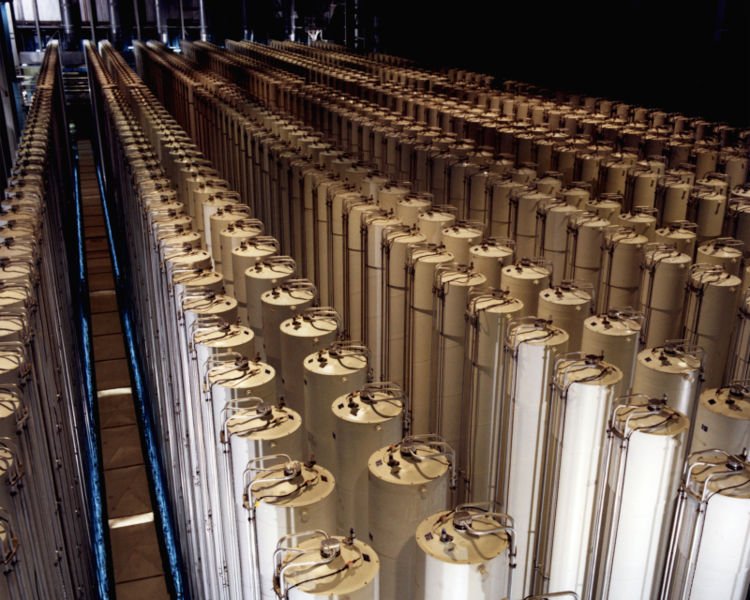
A schematic of a gas centrifuge cascade, illustrating how multiple centrifuges are interconnected to achieve desired enrichment levels.
Gas Centrifuge Method
This is the dominant technology for uranium enrichment worldwide due to its significantly higher energy efficiency compared to older methods. The process involves:
- Feeding UF6 gas into tall, vertical cylinders called centrifuges, which rotate at extremely high speeds.
- The centrifugal force pushes the heavier 238UF6 molecules slightly more towards the cylinder wall than the lighter 235UF6 molecules.
- A countercurrent flow established within the centrifuge further enhances this separation.
- Gas slightly enriched in 235U is drawn from near the center/top of the centrifuge, while gas depleted in 235U is drawn from near the periphery/bottom.
- Thousands of centrifuges are interconnected in series and parallel arrays (cascades) to progressively increase the 235U concentration to the desired level.
Gas centrifuges consume only about 2% to 2.5% of the energy required by gaseous diffusion plants for the same output.
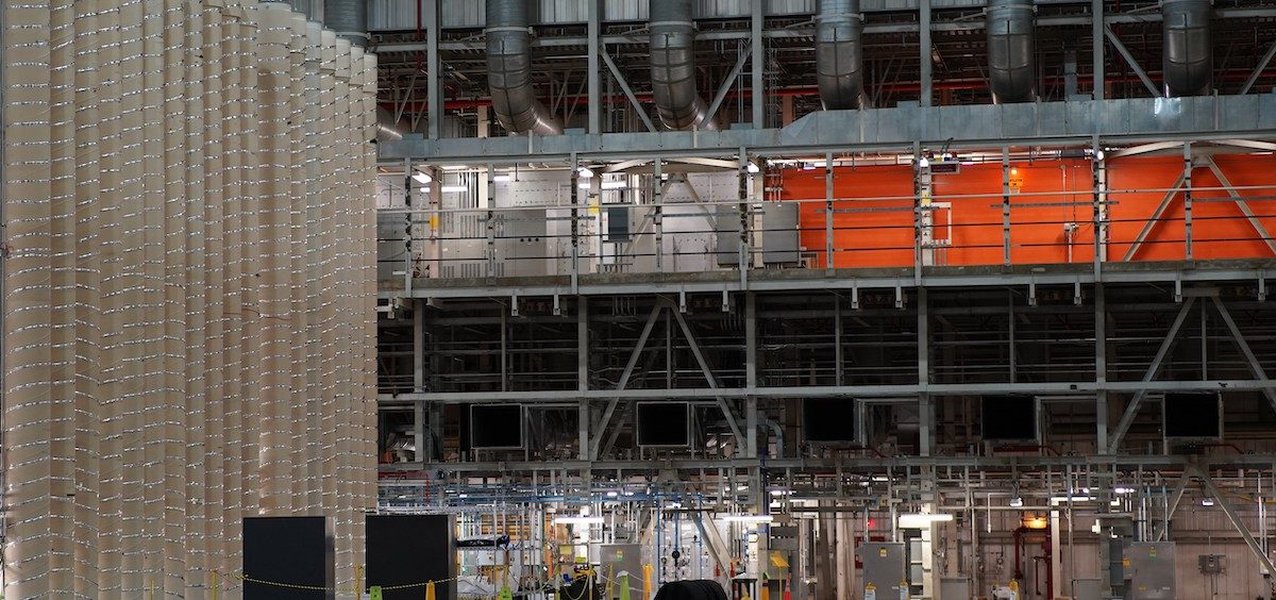
Gas centrifuges operating at the Piketon, Ohio, uranium enrichment facility.
Gaseous Diffusion Method
Historically significant (e.g., used in the Manhattan Project), gaseous diffusion is now largely obsolete due to its immense energy consumption. It works on the principle that lighter gas molecules pass through a porous barrier (membrane) slightly faster than heavier ones.
- UF6 gas is pumped under pressure through a series of stages, each containing a porous barrier.
- The 235UF6 molecules, being lighter, diffuse through the barrier at a slightly higher rate than 238UF6 molecules.
- The enrichment achieved in a single stage is very small, so hundreds to thousands of stages are required in a cascade.
Laser Isotope Separation (LIS)
LIS techniques offer the potential for higher separation factors and lower energy consumption. They use lasers precisely tuned to exploit the subtle differences in absorption spectra of 235U and 238U atoms or molecules.
- Atomic Vapor Laser Isotope Separation (AVLIS): Metallic uranium is vaporized. Lasers selectively excite and ionize 235U atoms, which are then separated using electromagnetic fields. Development faced technical difficulties and was largely discontinued for commercial scale.
- Molecular Laser Isotope Separation (MLIS): Lasers are used to selectively dissociate UF6 molecules containing 235U. For example, an infrared laser excites 235UF6, and then another laser (e.g., ultraviolet) breaks a fluorine-uranium bond, forming solid uranium pentafluoride (235UF5) which precipitates out. SILEX (Separation of Isotopes by Laser Excitation) is a third-generation LIS technology that has been developed and licensed for commercial use.
Comparative Analysis of Enrichment Methods
The choice of enrichment technology involves trade-offs between energy efficiency, capital cost, technological maturity, and proliferation concerns. The radar chart below provides a qualitative comparison of these methods across several key performance indicators.
Note: The radar chart presents a simplified, qualitative comparison. Actual values can vary based on specific plant designs and operational parameters. Proliferation risk is complex and depends on detectability and ease of clandestine operation.
Chemical Deconversion: Recovering Uranium from UF6
After enrichment, the UF6 (both the enriched product and the depleted tails, which consist mostly of 238U) must be converted into a more stable chemical form. This process is known as deconversion. The most common product for enriched uranium is uranium dioxide (UO2), which is used to fabricate nuclear fuel pellets. Depleted UF6 is often deconverted to uranium tetrafluoride (UF4) or uranium oxides (like U3O8) for long-term storage or potential future use.
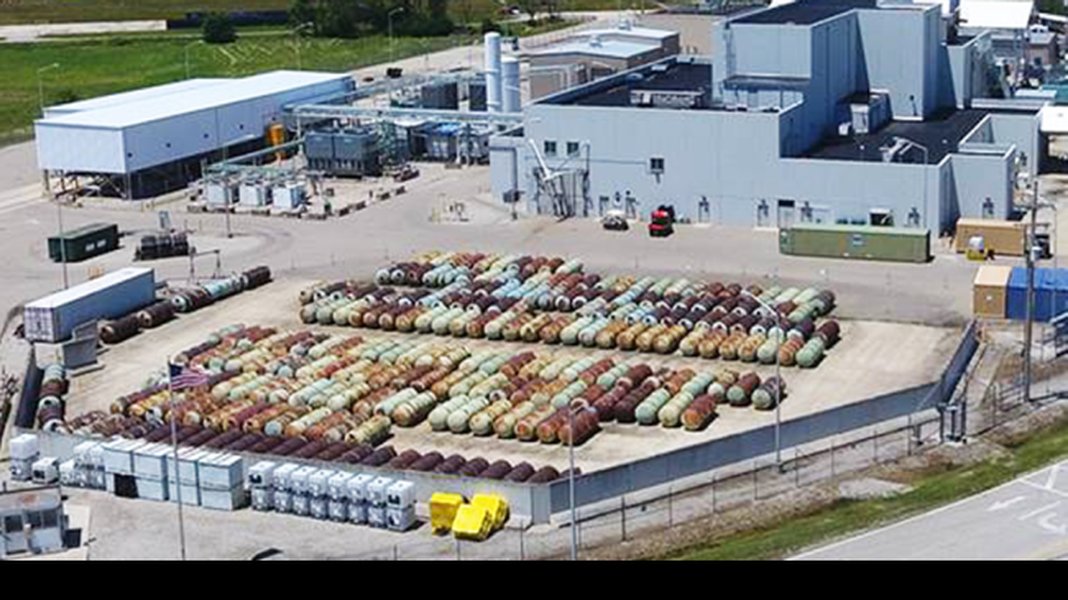
Cylinders containing depleted uranium hexafluoride awaiting deconversion or long-term management.
Wet Deconversion Processes
Wet processes involve reactions in aqueous solutions. A common route to produce UO2 from enriched UF6 involves:
- Hydrolysis: UF6 gas is reacted with water to form uranyl fluoride (UO2F2) and highly corrosive hydrofluoric acid (HF). \[ \text{UF}_6 \text{(g)} + 2\text{H}_2\text{O} \text{(l)} \rightarrow \text{UO}_2\text{F}_2 \text{(aq)} + 4\text{HF} \text{(aq)} \] This reaction is highly exothermic and must be carefully controlled.
- Precipitation: Ammonia (NH3) and often carbon dioxide (CO2) are added to the UO2F2 solution to precipitate ammonium diuranate (ADU) or ammonium uranyl carbonate (AUC). For example, with AUC: \[ \text{UO}_2\text{F}_2 + 2\text{H}_2\text{O} + 2\text{NH}_3 + \text{CO}_2 \rightarrow (\text{NH}_4)_2\text{UO}_2(\text{CO}_3)_2 \cdot \text{H}_2\text{O} \text{ (approx.)} \] The HF byproduct is typically neutralized, for example, with calcium hydroxide to form calcium fluoride (CaF2).
- Calcination and Reduction: The precipitate (ADU or AUC) is then dried, calcined (heated to high temperatures), and reduced with hydrogen gas (H2) to produce ceramic-grade UO2 powder. \[ \text{AUC (precipitate)} \xrightarrow{\Delta, \text{H}_2/\text{steam}} \text{UO}_2 \text{(s)} + \text{byproducts} \]
Dry Deconversion Processes
Dry processes avoid aqueous solutions and often involve gas-solid reactions at high temperatures. These are commonly used for deconverting both enriched and depleted UF6.
- Conversion to UO2: One common dry process involves reacting gaseous UF6 with superheated steam and hydrogen in a fluidized bed reactor or flame reactor. \[ \text{UF}_6 \text{(g)} + 2\text{H}_2\text{O} \text{(g)} + \text{H}_2 \text{(g)} \rightarrow \text{UO}_2 \text{(s)} + 6\text{HF} \text{(g)} \] The HF gas produced can be recovered and recycled.
- Conversion to U3O8 (for depleted UF6): Depleted UF6 can be deconverted to U3O8, a stable oxide suitable for long-term storage. This often involves hydrolysis and pyrohydrolysis steps. \[ \text{UF}_6 \text{(g)} + \text{H}_2\text{O} \text{(g)} / \text{O}_2 \text{(g)} \rightarrow \text{U}_3\text{O}_8 \text{(s)} + \text{HF} \text{(g)} \text{ (simplified)} \]
- Conversion to UF4: UF6 can also be reduced to UF4 (green salt) using hydrogen. \[ \text{UF}_6 \text{(g)} + \text{H}_2 \text{(g)} \rightarrow \text{UF}_4 \text{(s)} + 2\text{HF} \text{(g)} \] UF4 is more stable than UF6 and can be a precursor for uranium metal production or long-term storage.
Comparing Deconversion Routes
The choice between wet and dry deconversion processes depends on factors such as the scale of operation, desired product specifications, and strategies for managing byproducts like HF. The table below summarizes key characteristics:
| Feature | Wet Process (e.g., AUC route to UO2) | Dry Process (e.g., Fluidized Bed to UO2) |
|---|---|---|
| Primary Reactants | UF6, Water, Ammonia, CO2 | UF6, Steam, Hydrogen |
| Key Intermediates | UO2F2, Ammonium Uranyl Carbonate (AUC) | Direct conversion or minimal intermediates |
| Final Product(s) | UO2 powder | UO2 powder, U3O8, UF4 |
| Byproducts | Aqueous HF solutions (neutralized to fluoride salts), ammonium fluoride solutions | Gaseous HF (often recovered and recycled) |
| Complexity | Multiple liquid-phase steps, precipitation, filtration, drying | High-temperature gas-solid reactions, fewer distinct steps |
| Waste Streams | Liquid effluents, solid fluoride precipitates | Potentially fewer liquid wastes if HF is recycled efficiently |
| Advantages | Well-established, can produce UO2 with specific powder characteristics | Continuous process, efficient HF recovery, suitable for large throughputs |
| Disadvantages | More complex waste treatment, batch or semi-batch operations | High-temperature equipment, potential for dust handling issues |
The Uranium Processing Pathway: A Mindmap Overview
The journey of uranium from ore to its final usable forms or storage involves several interconnected stages. The mindmap below illustrates the central role of UF6 in isotopic enrichment and its subsequent deconversion.
Safety and Environmental Considerations
Working with uranium hexafluoride and its byproducts like hydrofluoric acid poses significant safety challenges:
- Toxicity: UF6 is highly toxic. Upon contact with moisture (e.g., in the air or lungs), it hydrolyzes to form UO2F2 and HF, both of which are corrosive and toxic. HF is particularly dangerous, causing severe burns and systemic poisoning.
- Corrosivity: UF6 and HF are highly corrosive to many materials, requiring specialized corrosion-resistant equipment (e.g., made of Monel, nickel, or specially treated aluminum).
- Radioactivity: Uranium is radioactive, and appropriate shielding and handling procedures are necessary to protect workers and the environment from radiation exposure.
- Criticality Safety: When handling enriched uranium, measures must be in place to prevent an accidental nuclear criticality (a self-sustaining chain reaction). This involves careful control of mass, geometry, and moderation of fissile materials.
Uranium processing facilities are designed with multiple safety barriers, ventilation systems, and emergency response plans to manage these risks. Environmental protection involves minimizing emissions and managing waste streams responsibly, including the safe storage or disposal of depleted uranium and other byproducts.
Visualizing Uranium Processing
The following video provides an overview of how uranium is extracted and processed, including aspects related to enrichment, which heavily involves UF6.
This video explains the journey of uranium from mining to its use in nuclear energy, touching upon the enrichment process.
Frequently Asked Questions (FAQ)
Recommended Further Exploration
- What are the detailed chemical reactions involved in converting uranium ore to uranium hexafluoride?
- How do modern laser enrichment technologies like SILEX compare to traditional gas centrifuge methods?
- What are the long-term management strategies and potential uses for depleted uranium hexafluoride?
- What specific safety protocols and engineering controls are implemented in facilities handling uranium hexafluoride?
References
Last updated May 21, 2025