

Key Insights into the Shell Method
- Conceptual Foundation: The Shell Method calculates the volume of solids of revolution by summing the volumes of infinitesimally thin cylindrical shells, formed by revolving strips parallel to the axis of rotation.
- Formulaic Simplicity: The core formula for the volume of a single shell is \(2\pi \cdot \text{radius} \cdot \text{height} \cdot \text{thickness}\), which translates into a definite integral for the total volume.
- Strategic Advantage: It often simplifies problems where the Disk or Washer Method would require more complex setups, particularly when integrating perpendicular to the axis of revolution or dealing with solids having central holes.
Understanding the Essence of the Shell Method
The Shell Method, also known as the method of cylindrical shells, is a fundamental technique within integral calculus used to determine the volume of a solid generated by revolving a two-dimensional region around an axis. Unlike the Disk or Washer Methods, which typically involve slicing the solid perpendicular to the axis of rotation, the Shell Method employs slices that are parallel to the axis of rotation. These thin slices, when revolved, form hollow cylindrical shells, much like nested, thin-walled cans.
The ingenuity of this method lies in its ability to often simplify the integration process, especially in scenarios where expressing the radius or height in terms of the variable of integration would be cumbersome using other methods. It effectively breaks down a complex three-dimensional shape into manageable, calculable parts.
The Core Principle: Building with Cylindrical Shells
The fundamental idea is to approximate the solid's volume by summing the volumes of these thin, concentric cylindrical shells. Imagine taking a very thin strip of the region, parallel to your axis of revolution. When this strip is rotated, it sweeps out a cylindrical shell. The volume of such an individual shell can be approximated as the product of its circumference, its height, and its infinitesimal thickness. As these thicknesses approach zero, the sum becomes a definite integral, providing the exact volume.
This approach is particularly intuitive for solids that might have a central void or a complex cross-section that would be difficult to define with a single function using the Disk/Washer method.
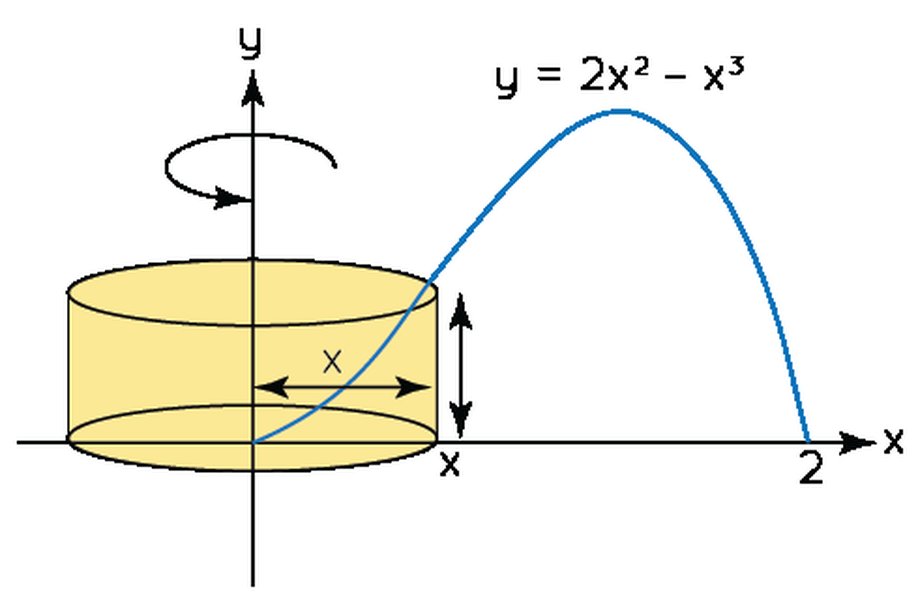
Illustration of a cylindrical shell and its dimensions.
The Mathematical Framework: Formulas and Setup
The volume of a single cylindrical shell is given by the product of its circumference, height, and thickness. This forms the basis for the integral formulas used in the Shell Method.
General Formula for a Cylindrical Shell
\[ \Delta V = 2 \pi \cdot (\text{radius}) \cdot (\text{height}) \cdot (\text{thickness}) \]Where:
- Radius: This is the distance from the axis of rotation to the representative strip. If revolving around the y-axis, the radius is often simply \(x\). If revolving around the x-axis, it's typically \(y\). For revolution around an arbitrary line, it's the perpendicular distance from that line to the strip.
- Height: This is the length of the representative strip. If the region is defined by \(y = f(x)\) from the x-axis, the height is \(f(x)\). If it's between two functions, say \(y = f(x)\) and \(y = g(x)\), the height is \(f(x) - g(x)\).
- Thickness: This is the infinitesimal width of the strip, denoted as \(dx\) if integrating with respect to \(x\), or \(dy\) if integrating with respect to \(y\).
Volume Calculation with Integration
To find the total volume of the solid of revolution, we sum up the volumes of all these infinitesimally thin shells using a definite integral. The specific setup depends on the axis of rotation and the variable of integration.
Rotation Around a Vertical Axis (e.g., y-axis or \(x=k\)): Integration with respect to \(x\)
If revolving around the y-axis or any vertical line \(x=k\), and the region is bounded by functions of \(x\), the formula is:
\[ V = \int_{a}^{b} 2\pi \cdot (\text{radius}_x) \cdot (\text{height}_x) \, dx \]Here, the radius is the distance \(x\) (or \(|x-k|\)) and the height is \(f(x)\) or \(f(x) - g(x)\).
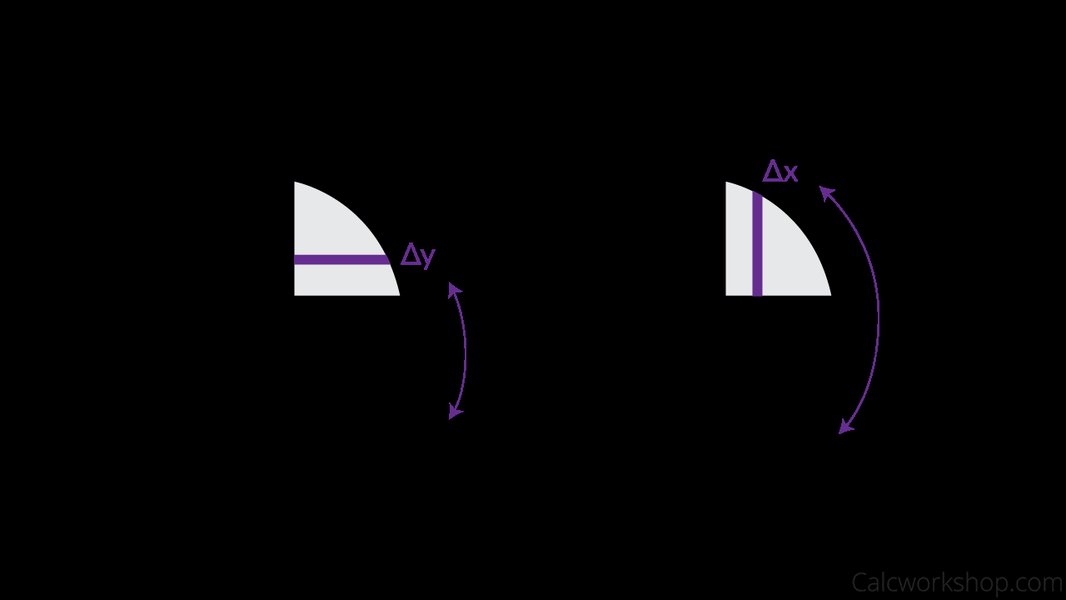
Applying the Shell Method for revolution around the y-axis.
Rotation Around a Horizontal Axis (e.g., x-axis or \(y=k\)): Integration with respect to \(y\)
Similarly, if revolving around the x-axis or any horizontal line \(y=k\), and the region is bounded by functions of \(y\), the formula is:
\[ V = \int_{c}^{d} 2\pi \cdot (\text{radius}_y) \cdot (\text{height}_y) \, dy \]In this case, the radius is the distance \(y\) (or \(|y-k|\)) and the height is \(f(y)\) or \(f(y) - g(y)\).
Strategic Advantages and When to Apply the Shell Method
The Shell Method provides significant advantages in certain scenarios, making it a preferred choice over the Disk or Washer Methods. Its flexibility often simplifies calculations that would otherwise be very complex.
Choosing the Right Method: Shell vs. Disk/Washer
The decision of whether to use the Shell Method or the Disk/Washer Method often boils down to the orientation of the axis of revolution relative to the integration variable and the complexity of the functions defining the region.
- Perpendicularity: If the axis of rotation is perpendicular to the axis of integration (e.g., revolving around the y-axis and integrating with respect to \(x\)), the Shell Method is often simpler. Conversely, if they are parallel (e.g., revolving around the x-axis and integrating with respect to \(x\)), the Disk/Washer Method might be more straightforward.
- Function Complexity: Sometimes, expressing the bounding curves as functions of \(x\) is easier than as functions of \(y\), or vice-versa. The Shell Method allows you to stick to the easier functional form, even if the axis of revolution suggests otherwise for the Disk/Washer Method.
- Solids with Holes: The Shell Method inherently handles solids with holes without requiring separate subtractions, which can simplify the setup compared to the Washer Method.
Practical Application and Illustrative Examples
To solidify understanding, let's consider some practical applications and worked examples that highlight the utility of the Shell Method.
Step-by-Step Application
- Visualize the Region and Axis: Sketch the bounded region and the axis of revolution. This helps in correctly identifying the radius and height of the cylindrical shells.
- Determine the Variable of Integration: Choose \(dx\) or \(dy\). For the Shell Method, the strip is parallel to the axis of revolution. If revolving around a vertical axis (e.g., y-axis), use \(dx\). If revolving around a horizontal axis (e.g., x-axis), use \(dy\).
- Define Radius and Height:
- Radius: The distance from the axis of revolution to the representative strip. For rotation around the y-axis, the radius is usually \(x\). For rotation around the x-axis, it's usually \(y\). If rotating around a line \(x=k\) or \(y=k\), the radius becomes \(|x-k|\) or \(|y-k|\), respectively.
- Height: The length of the representative strip. This is typically the difference between the upper and lower bounding functions (if integrating with respect to \(x\)) or the right and left bounding functions (if integrating with respect to \(y\)).
- Set Up the Integral: Substitute the expressions for radius, height, and thickness (\(dx\) or \(dy\)) into the Shell Method formula: \(V = \int_{a}^{b} 2\pi \cdot (\text{radius}) \cdot (\text{height}) \, dx/dy\).
- Evaluate the Integral: Compute the definite integral over the appropriate limits, which are determined by the boundaries of the region in the chosen variable.
Example: Region Bounded by \(y = 2x^2 - x^3\) and the x-axis, rotated around the y-axis
Consider the region bounded by \(y = 2x^2 - x^3\) and the x-axis from \(x=0\) to \(x=2\). When this region is rotated around the y-axis, the Shell Method is ideal. Here:
- The radius is \(x\).
- The height is \(y = 2x^2 - x^3\).
- The thickness is \(dx\).
The volume is given by:
\[ V = \int_0^2 2\pi x (2x^2 - x^3) \, dx \] \[ V = 2\pi \int_0^2 (2x^3 - x^4) \, dx \] \[ V = 2\pi \left[ \frac{2x^4}{4} - \frac{x^5}{5} \right]_0^2 \] \[ V = 2\pi \left[ \frac{x^4}{2} - \frac{x^5}{5} \right]_0^2 \] \[ V = 2\pi \left( \left( \frac{2^4}{2} - \frac{2^5}{5} \right) - \left( \frac{0^4}{2} - \frac{0^5}{5} \right) \right) \] \[ V = 2\pi \left( \left( \frac{16}{2} - \frac{32}{5} \right) - 0 \right) \] \[ V = 2\pi \left( 8 - \frac{32}{5} \right) \] \[ V = 2\pi \left( \frac{40 - 32}{5} \right) \] \[ V = 2\pi \left( \frac{8}{5} \right) = \frac{16\pi}{5} \]Understanding the Shell Method in Context
The Shell Method is an indispensable tool in a mathematician's or engineer's toolkit. It complements other methods for calculating volumes, offering an elegant solution for problems that might otherwise be cumbersome. Its ability to simplify integral setups by aligning the integration variable with the more natural representation of the function makes it highly valuable.
The Broader Picture: Applications of Integration
This mindmap illustrates the position of the Shell Method within the broader scope of applications of integration, highlighting its relation to other volume calculation techniques and other common applications.
Visualizing the Revolution
To fully grasp the Shell Method, it's incredibly helpful to visualize the process of forming these cylindrical shells. The following video offers a comprehensive introduction and multiple examples of the Shell Method, demonstrating its application in various scenarios. Understanding the visual aspect significantly aids in correctly setting up the integral.
This video, titled "Applications of Integration - Volume - Shell Method Part 1," provides an excellent introduction to the Shell Method, showing how different regions are revolved to form solids and how the cylindrical shells are generated. It covers fundamental examples that are crucial for building a strong conceptual understanding, making the abstract formulas concrete through visual demonstrations.
Summary of Key Differences and Similarities with Disk/Washer Method
While the Shell Method, Disk Method, and Washer Method all serve the purpose of calculating volumes of solids of revolution, they approach the problem differently. The choice of method often depends on the specifics of the region and the axis of rotation.
| Feature | Shell Method | Disk Method | Washer Method |
|---|---|---|---|
| Slice Orientation (relative to axis of rotation) | Parallel | Perpendicular | Perpendicular |
| Shape of Infinitesimal Element | Cylindrical Shell | Disk (Solid Cylinder) | Washer (Annulus) |
| Volume Formula per Element | \(2\pi \cdot r \cdot h \cdot \Delta x/y\) | \(\pi \cdot r^2 \cdot \Delta x/y\) | \(\pi \cdot (R^2 - r^2) \cdot \Delta x/y\) |
| When Preferred | When integration variable is perpendicular to axis of rotation, or for complex regions/holes. | When solid is compact and integration variable is parallel to axis of rotation. | When solid has a hole and integration variable is parallel to axis of rotation. |
| Typical Axis/Variable Pairing | Vertical axis (\(y\)-axis), integrate \(dx\); Horizontal axis (\(x\)-axis), integrate \(dy\). | Horizontal axis (\(x\)-axis), integrate \(dx\); Vertical axis (\(y\)-axis), integrate \(dy\). | Horizontal axis (\(x\)-axis), integrate \(dx\); Vertical axis (\(y\)-axis), integrate \(dy\). |
Frequently Asked Questions (FAQ)
What is the main difference between the Shell Method and the Disk/Washer Method?
When should I use the Shell Method?
What are the key components of the Shell Method formula?
Can the Shell Method be used for rotation around axes other than the x or y-axis?
Conclusion
The Shell Method stands as a vital technique in integral calculus, offering an effective and often simpler approach to calculating the volumes of solids of revolution. By conceptualizing the solid as a collection of infinitesimally thin cylindrical shells, it provides a powerful alternative to the Disk and Washer Methods. Its strategic advantage shines when the region is more conveniently described by functions of one variable, but the axis of revolution necessitates integration with respect to that same variable if using the Disk/Washer method, or when dealing with complex regions and holes. Mastering the Shell Method enhances one's ability to tackle a broader range of problems in calculus, engineering, and physics, making it an indispensable tool for understanding three-dimensional volumes.
Recommended Further Exploration
- How to apply the Disk and Washer Methods for volumes of revolution?
- What are other significant applications of integration in real-world problems?
- Can you provide more comparative examples between volumes of revolution techniques?
- Are there advanced problems demonstrating the Shell Method with complex functions?