
Short-Horizon Actor-Critic: A Comparative Analysis with Soft Actor-Critic and Proximal Policy Optimization
Understanding the Alignment and Distinctions in Modern Reinforcement Learning Algorithms
Key Takeaways
- Shared Actor-Critic Architecture: Both SHAC and PPO utilize an actor-critic framework, fostering similarities in policy evaluation and improvement mechanisms.
- On-Policy vs. Off-Policy Learning: SHAC aligns more closely with PPO through its on-policy methodology, contrasting with SAC's off-policy approach.
- Optimization and Stability: SHAC and PPO prioritize stability and efficient policy updates via truncated rollouts and policy clipping, whereas SAC emphasizes entropy maximization for exploration.
Introduction to Actor-Critic Methods
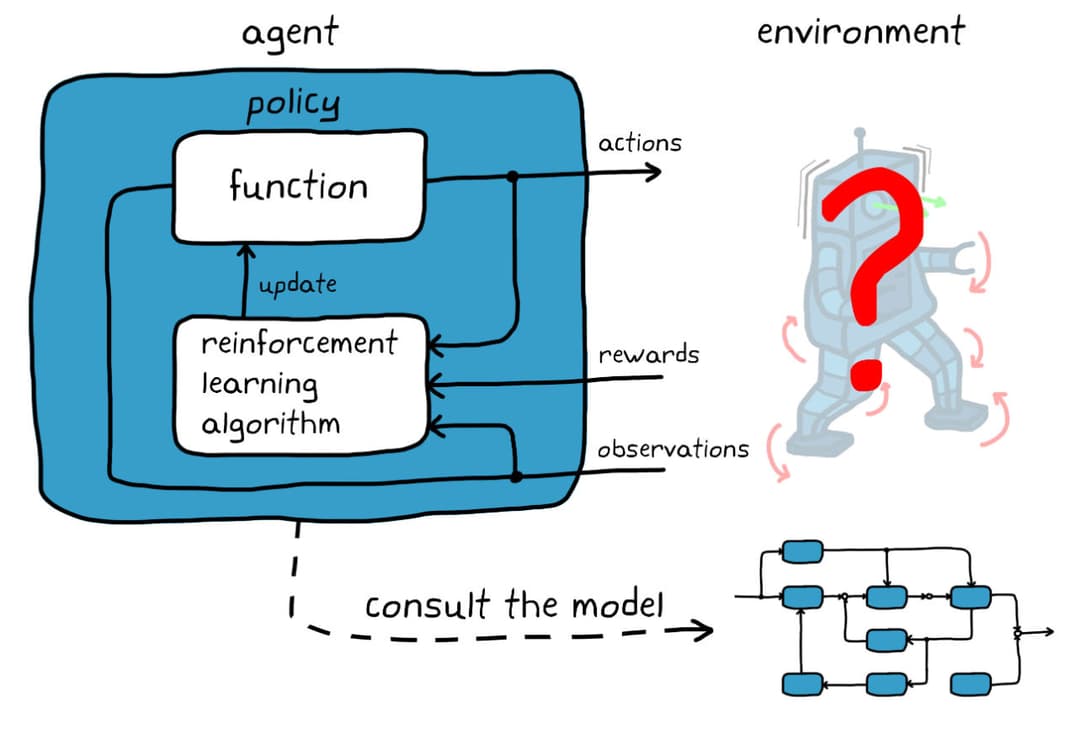
Actor-Critic methods are a cornerstone of reinforcement learning (RL), combining two components: the Actor, which proposes actions, and the Critic, which evaluates them. This dual mechanism enables efficient learning by continuously refining policies based on feedback from value estimations. Among the prominent Actor-Critic algorithms are Proximal Policy Optimization (PPO), Soft Actor-Critic (SAC), and Short-Horizon Actor-Critic (SHAC).
Proximal Policy Optimization (PPO)
Overview
PPO is an on-policy reinforcement learning algorithm renowned for its balance between simplicity and performance. It employs clipped probability ratios to prevent drastic policy updates, ensuring stable and reliable learning.
Key Features
- On-Policy Learning: PPO learns solely from data generated by the current policy, eliminating the need for a replay buffer.
- Clipped Objectives: By constraining the update step, PPO maintains policy stability and avoids large deviations that could destabilize training.
- Truncated Rollouts: PPO utilizes finite-length sequences of interactions, facilitating efficient and focused learning from recent experiences.
Soft Actor-Critic (SAC)
Overview
SAC is an off-policy algorithm that integrates the principle of maximum entropy into its learning process. This approach encourages exploration by maximizing both the expected return and the entropy of the policy.
Key Features
- Off-Policy Learning: SAC leverages a replay buffer to learn from a wide range of past experiences, enhancing sample efficiency.
- Entropy Regularization: By incorporating an entropy term, SAC promotes exploration and prevents premature convergence to suboptimal policies.
- Stochastic Policies: SAC learns probabilistic policies, allowing for diverse action selections and improved resilience in uncertain environments.
Short-Horizon Actor-Critic (SHAC)
Overview
SHAC is a reinforcement learning algorithm designed to optimize policies over shorter time horizons. By utilizing truncated rollouts and differentiable simulation gradients, SHAC aims to enhance sample efficiency and training stability, particularly in contact-rich environments.
Key Features
- On-Policy Learning: Similar to PPO, SHAC operates on-policy, focusing on learning from the most recent interactions with the environment.
- Truncated Rollouts: SHAC limits the horizon over which it backpropagates errors, reducing computational complexity and enhancing stability.
- Deterministic Gradients: Leveraging differentiable simulations, SHAC computes analytic gradients, accelerating and stabilizing policy updates.
Comparative Analysis
Architectural Similarities
All three algorithms—PPO, SAC, and SHAC—employ the actor-critic framework, wherein the actor proposes actions and the critic evaluates them. This common foundation facilitates a deeper comparison based on their distinct methodologies and design choices.
On-Policy vs. Off-Policy Learning
A fundamental distinction lies in the learning paradigms:
- SHAC and PPO: Both are on-policy methods, relying on data generated by the current policy without utilizing past experiences stored in a replay buffer.
- SAC: As an off-policy algorithm, SAC benefits from learning from a diverse set of past experiences, enhancing sample efficiency.
This alignment positions SHAC closer to PPO in terms of learning strategies, diverging from SAC's off-policy approach.
Policy Optimization and Stability
Stability during policy updates is crucial for effective learning:
- PPO: Utilizes clipped probability ratios to prevent large, destabilizing policy updates, ensuring gradual and controlled learning.
- SHAC: Employs truncated rollouts and analytic gradient computations through differentiable simulations, mitigating gradient explosion and enhancing stability.
- SAC: Focuses on entropy maximization to balance exploration and exploitation, fostering resilient policy learning in uncertain environments.
Both SHAC and PPO emphasize stability through mechanisms that constrain the extent of policy updates, whereas SAC adopts a different strategy by promoting exploration through entropy.
Sample Efficiency
Sample efficiency refers to how effectively an algorithm learns from interactions with the environment:
- SAC: Highly sample-efficient due to its off-policy nature, allowing reuse of past experiences from the replay buffer.
- SHAC: Enhances sample efficiency within an on-policy framework by leveraging differentiable simulations and short-horizon optimizations.
- PPO: Moderately sample-efficient, relying primarily on the quality of recent experiences without the benefits of a replay buffer.
While SAC leads in raw sample efficiency, SHAC compensates by optimizing the use of current data through its unique methodologies, making it more efficient than PPO in certain contexts.
Handling of Environments
The suitability of algorithms for specific environments varies:
-
SAC: Designed for a wide range of continuous control tasks, excelling in environments where exploration is critical.
-
PPO: Versatile across diverse environments, particularly effective in scenarios requiring stable and incremental policy updates.
-
SHAC: Tailored for contact-rich environments, utilizing differentiable simulations to manage complex dynamics and interactions.
SHAC's specialization makes it more suitable for environments with intricate contact dynamics, where its short-horizon focus and gradient computations offer distinct advantages over PPO and SAC.
Detailed Comparative Table
| Feature | Proximal Policy Optimization (PPO) | Soft Actor-Critic (SAC) | Short-Horizon Actor-Critic (SHAC) |
|---|---|---|---|
| Learning Paradigm | On-Policy | Off-Policy | On-Policy |
| Policy Type | Deterministic/Stochastic | Stochastic | Deterministic |
| Policy Update Mechanism | Clipped Probability Ratios | Entropy Maximization | Truncated Rollouts & Differentiable Simulations |
| Sample Efficiency | Moderate | High | Enhanced within On-Policy Framework |
| Use of Replay Buffer | No | Yes | No |
| Suitable Environments | General Continuous Control | Exploration-Heavy Continuous Control | Contact-Rich and Complex Dynamics |
| Main Advantage | Stability through Clipping | Exploration via Entropy | Stability and Efficiency through Short Horizons |
Implications of SHAC's Design Choices
Differentiable Simulations
SHAC leverages differentiable simulations to compute analytic gradients, which contrasts with PPO's reliance on sampled gradients and SAC's entropy-based updates. This approach allows SHAC to achieve more precise and stable policy updates, particularly beneficial in environments requiring meticulous control and response to dynamic interactions.
Short-Horizon Optimization
By focusing on shorter horizons, SHAC limits the scope of error backpropagation, thereby reducing computational overhead and mitigating the risk of gradient explosion. This strategy aligns with PPO's commitment to stable updates, albeit achieved through different mechanisms.
Sample Efficiency within On-Policy Learning
While on-policy methods typically suffer from lower sample efficiency compared to off-policy methods like SAC, SHAC compensates by optimizing the use of current data through its short-horizon and differentiable simulation strategies. This optimization enhances learning efficiency without relying on a replay buffer.
Conclusion
In the landscape of reinforcement learning, the Short-Horizon Actor-Critic (SHAC) algorithm exhibits a closer relationship to Proximal Policy Optimization (PPO) than to Soft Actor-Critic (SAC). This alignment is rooted in their shared on-policy learning paradigms, emphasis on policy stability, and utilization of finite or truncated trajectory segments for updates. While SAC differentiates itself through off-policy learning and entropy maximization for exploration, SHAC's innovations in short-horizon optimization and differentiable simulations position it as a specialized variant within the actor-critic family, closely paralleling PPO's focus on stable and efficient policy improvements.
References
Last updated January 31, 2025