
Unlock Chest Gains Without Shoulder Pain: Your Guide to Safe Pressing
Discover the best chest exercises and strategies to train effectively when shoulder discomfort strikes during pressing movements.
Experiencing shoulder pain during chest exercises like the bench press is frustratingly common. The shoulder is a complex joint, highly mobile but inherently less stable, making it susceptible to strain, especially under heavy loads or with suboptimal technique. However, shoulder pain doesn't mean you have to abandon chest training altogether. By choosing the right exercises and focusing on proper form, you can continue to build chest strength and muscle mass safely and effectively.
Highlights: Key Takeaways for Shoulder-Safe Chest Training
- Prioritize Pain-Free Movement: Select exercises that allow you to work your chest without increasing shoulder discomfort. Modification is key.
- Focus on Form and Control: Proper technique, including scapular stabilization and controlled tempo, is crucial to minimize stress on the shoulder joint.
- Embrace Alternative Exercises: Moves like the Dumbbell Floor Press, Incline Push-ups, and Neutral Grip Cable Presses offer excellent chest stimulation with reduced shoulder strain.
Why Do Shoulders Hurt During Chest Presses?
Understanding the root cause of shoulder pain during pressing movements is the first step toward finding a solution. Several factors can contribute:
- Technique Flaws: Excessive elbow flaring, extreme internal rotation, improper bar path, or lack of scapular retraction (pulling shoulder blades back and down) can place the shoulder joint in vulnerable positions.
- Range of Motion Issues: Pressing too deep, especially with a barbell that locks hand position, can overstretch the front of the shoulder capsule and rotator cuff tendons.
- Weight & Volume: Using weights that are too heavy to control properly or performing excessive pressing volume without adequate recovery can lead to overuse injuries.
- Lack of Stability: Weakness in the rotator cuff muscles or poor scapular control means the shoulder joint isn't adequately stabilized during the press, leading to compensation and strain.
- Exercise Selection: Certain exercises, particularly the traditional flat barbell bench press, inherently place more stress on the shoulder joint for some individuals due to the fixed grip and potential for impingement.
Guiding Principles for Shoulder-Friendly Chest Training
Adapting your training around shoulder pain involves adhering to specific principles:
- Limit the Range of Motion (ROM): Avoid the deepest part of the press where pain often occurs. Exercises like floor presses naturally limit depth.
- Utilize Neutral or Modified Grips: Grips where palms face each other (neutral) or towards your feet (reverse) generally reduce internal rotation stress on the shoulder compared to a standard overhand grip.
- Control the Tempo: Slowing down the lowering (eccentric) phase of the lift (e.g., 3-4 seconds) improves control and reduces stress on passive structures.
- Master Scapular Control: Learn to actively retract and depress your shoulder blades ("pack" your shoulders) to create a stable base for pressing. Ensure the shoulder blades can move naturally when appropriate (e.g., during push-ups).
- Start Light and Progress Gradually: Prioritize perfect form over heavy weight. Increase load or reps only when you can do so without pain.
- Listen to Your Body: If an exercise causes sharp or increasing pain, stop immediately and choose a different one. Don't push through pain.
Top Shoulder-Friendly Chest Exercises
Based on expert recommendations and biomechanical principles, here are some of the best chest exercises to consider when pressing causes shoulder pain:
1. Dumbbell Floor Press
Why It Works
This is arguably the most frequently recommended exercise for chest training with shoulder pain. Lying on the floor provides several key advantages:
- Limited Range of Motion: The floor physically stops your elbows, preventing excessive shoulder extension and abduction that often triggers pain at the bottom of a bench press.
- Shoulder Stability: The floor provides feedback, making it easier to learn how to keep your shoulder blades retracted and stable ("packed").
- Grip Versatility: Dumbbells allow for a neutral grip (palms facing each other), which is often more comfortable for the shoulder joint than the pronated grip used in barbell pressing.
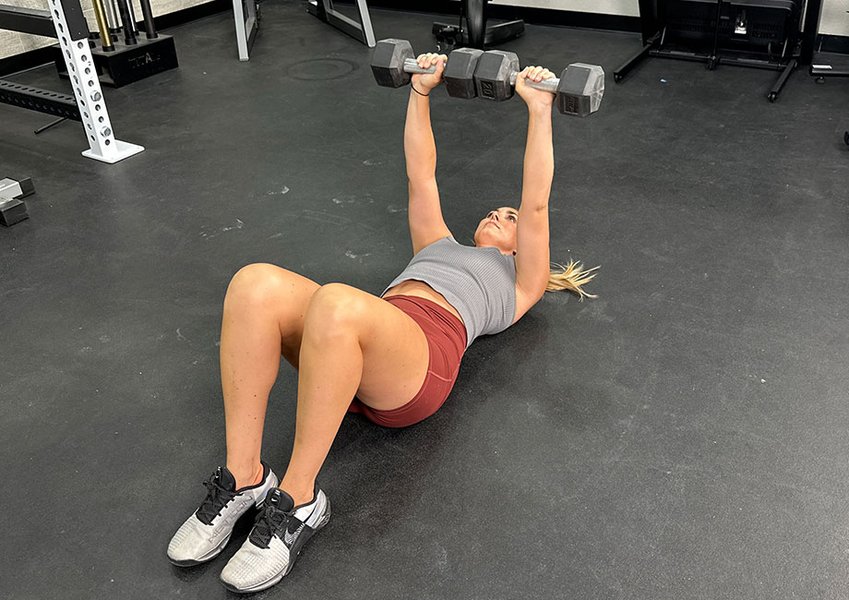
The Dumbbell Floor Press limits depth, protecting the shoulder joint.
How to Perform
Lie on your back on the floor with knees bent and feet flat. Hold dumbbells above your shoulders. You can use a neutral grip (palms facing each other) or a standard pronated grip (palms facing forward) if comfortable. Lower the dumbbells slowly until your upper arms (triceps) lightly touch the floor. Pause briefly, ensuring your shoulders stay packed, then press the dumbbells back up powerfully. Focus on squeezing your chest at the top.
Tips
Start with lighter weights than you'd use on a bench press. Focus on control, especially during the lowering phase. If one shoulder is more problematic, consider single-arm dumbbell floor presses to address imbalances.
2. Push-Up Variations
Why They Work
Push-ups are a versatile bodyweight exercise that allows for natural scapular movement, which is beneficial for shoulder health. They can be easily modified to suit your current pain levels and strength.
- Incline Push-Ups: Performing push-ups with your hands elevated on a bench, box, or wall reduces the percentage of your bodyweight you're lifting and decreases the angle of shoulder flexion, making it significantly easier on the joints.
- Knee Push-Ups: Performing push-ups on your knees also reduces the load, allowing you to focus on form and chest activation without overwhelming painful shoulders.
- Reverse Grip Push-Ups: While less common, placing hands with fingers pointing backward (reverse grip) can sometimes alleviate pain by changing the rotation at the shoulder joint, though it requires good wrist flexibility.
How to Perform (Incline Example)
Place your hands slightly wider than shoulder-width apart on an elevated surface (higher surface = easier). Step your feet back so your body forms a straight line from head to heels. Lower your chest towards the surface by bending your elbows, keeping them tucked at about a 45-degree angle relative to your body (avoid flaring them out wide). Push back up to the starting position, allowing your shoulder blades to move naturally.
Tips
Maintain core tension throughout. Stop if you feel pinching or sharp pain. Gradually decrease the incline height as you get stronger and pain diminishes.
3. Cable or Machine Chest Press (Neutral Grip)
Why They Work
Machines and cables offer a controlled movement path and often have options for a neutral grip, which can be less stressful on the shoulder joint.
- Guided Motion: Machines provide stability, reducing the demand on smaller stabilizing muscles around the shoulder, which can be beneficial if they are weak or injured.
- Neutral Grip Option: Many chest press machines and cable stations allow for a palms-facing-inward grip, reducing internal rotation stress.
- Adjustable Resistance: Easily modify the weight to find a pain-free level.
How to Perform (Cable Example)
Set the pulleys on a cable crossover machine to chest height. Grab the handles (using a neutral grip attachment if available, or simply holding D-handles with palms facing each other). Step forward slightly into a stable stance. Press the handles forward and slightly inward until your arms are extended, focusing on squeezing your chest. Slowly return to the start position, controlling the resistance.
Tips
Adjust the seat height (on machines) or pulley height (on cables) so that the handles are at mid-chest level during the press. Avoid letting your shoulders round forward.
4. Single-Arm Cable/Dumbbell Press
Why It Works
Working one arm at a time increases the demand on core stability and allows you to focus intently on the movement quality of the working side. It can help identify and correct strength imbalances between sides.
- Enhanced Stability Challenge: Engages core muscles to prevent torso rotation.
- Corrects Imbalances: Allows the weaker or more painful side to work independently without compensation from the stronger side.
- Pain-Free ROM Focus: Easier to find and work within a pain-free range of motion for the affected shoulder.
How to Perform (Standing Single-Arm Cable Press)
Set a cable pulley to chest height. Stand sideways to the machine, grabbing the handle with the hand furthest from the machine. Step away slightly and adopt a stable stance. Press the handle across your body until your arm is extended. Control the return to the starting position. Keep your core braced to resist rotation.
5. Cable Crossovers / Resistance Band Flyes
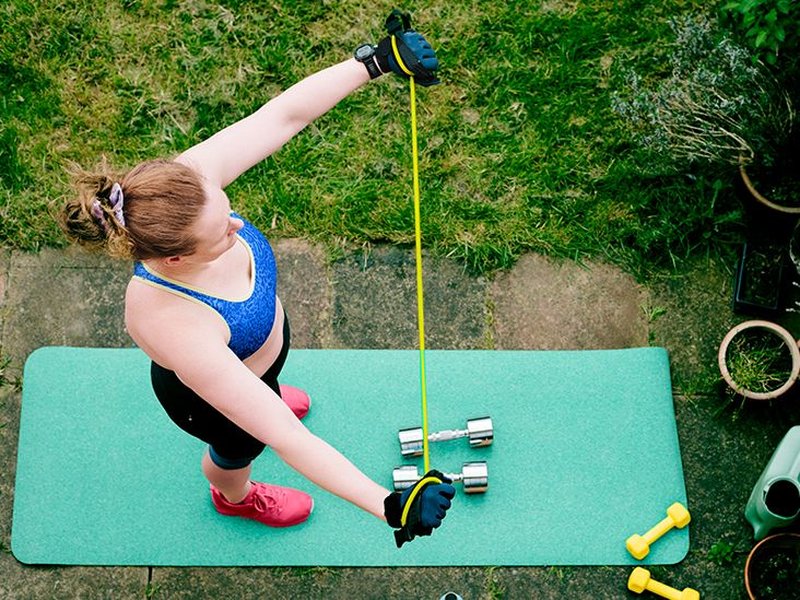
Resistance band flyes offer constant tension with less joint stress.
Why They Work
While technically a fly movement rather than a press, cable crossovers or resistance band flyes/presses can provide excellent chest stimulation with potentially less direct shoulder joint stress compared to heavy pressing, especially when performed carefully.
- Constant Tension: Cables and bands maintain tension throughout the range of motion.
- Isolation: Helps focus on the pectoral muscles.
- Adjustable Angle: You can easily adjust the angle of pull (high-to-low, low-to-high, straight across) to find a comfortable and effective path.
How to Perform (Resistance Band Standing Chest Press)
Anchor a resistance band behind you at chest height (or loop it around your back). Hold the ends of the band or handles. Step forward to create tension. Starting with hands at chest level, press forward until arms are extended. Squeeze your chest. Slowly return to the start position, resisting the pull of the band.
Tips
Use lighter resistance and focus on feeling the chest muscles work. Avoid overstretching the shoulder at the start position.
Optimizing Technique for Pain-Free Pressing
Regardless of the exercise chosen, fine-tuning your technique is paramount:
- Scapular Positioning: Actively pull your shoulder blades back and down ("pack the shoulders") before initiating any press. Maintain this stability throughout the movement, especially during dumbbell and machine presses. For push-ups, allow natural movement but control it.
- Elbow Tucking: Avoid flaring your elbows out to 90 degrees relative to your torso. Aim for roughly a 45-75 degree angle, which puts the shoulder in a safer, stronger position.
- Controlled Eccentric: Lower the weight slowly (e.g., a 3-second count). This builds muscle control and reduces stress on joints and connective tissues.
- Grip Width: Experiment with slightly narrower grips if wider grips cause pain.
- Avoid Locking Out Elbows Forcefully: Extend your arms but avoid aggressively slamming the joints into lockout.
Visualizing Exercise Suitability: A Comparative Look
This radar chart offers a visual comparison of different chest exercises based on key factors relevant to training with shoulder pain. Higher scores generally indicate a more favorable profile for that specific factor (e.g., higher 'Shoulder Safety' is better). Note that 'ROM Limitation' indicates how much the exercise inherently restricts potentially painful ranges (higher score = more limitation, potentially safer).
As the chart illustrates, exercises like the Dumbbell Floor Press score highly on 'Shoulder Safety' and 'ROM Limitation', making them excellent choices when dealing with pain. Traditional Barbell Bench Press scores highest on 'Chest Activation' but lowest on 'Shoulder Safety' and 'Grip Versatility'. Cable and push-up variations offer a good balance. Choose exercises that align with your current pain tolerance and goals.
Connecting the Concepts: A Mindmap Overview
This mindmap visually organizes the key elements involved in training your chest effectively while managing shoulder pain. It connects the common causes of pain with the principles for safer training, recommended exercises, and other vital considerations like warm-ups and knowing when to seek help.
(e.g., elbow flare)"] id2["Excessive Weight/Volume"] id3["Limited Scapular Control"] id4["Fixed Grip/ROM (Barbells)"] id5["Impingement/Underlying Issues"] Principles["Shoulder-Safe Principles"] id6["Limit Range of Motion"] id7["Use Neutral/Reverse Grip"] id8["Control Tempo & Movement"] id9["Focus on Scapular Stability"] id10["Allow Natural Shoulder Movement"] id11["Pain-Free Execution"] Exercises["Recommended Exercises"] sub1["Dumbbell Floor Press"] sub2["Push-Up Variations
(Incline, Knee, Reverse Grip)"] sub3["Cable/Machine Press
(Neutral Grip)"] sub4["Single-Arm Variations"] sub5["Cable Crossovers/Flyes"] sub6["Svend Press (Plate Press)"] Considerations["Important Considerations"] id12["Thorough Warm-up
(Mobility & Activation)"] id13["Perfect Technique Focus"] id14["Listen Intently to Your Body"] id15["Gradual Progression (Load/Volume)"] id16["Address Rotator Cuff/Scapular Weakness"] id17["Seek Professional Help if Needed
(Doctor/PT)"]
Understanding these interconnected factors empowers you to make informed decisions about your training, selecting exercises and strategies that promote both chest development and shoulder health.
The Importance of Warm-Up and Prehab
Never skip your warm-up, especially when dealing with shoulder issues. A dedicated warm-up prepares the muscles and joints for the demands of your workout, improving mobility and activating key stabilizing muscles.
Effective Warm-Up Components:
- General Cardio: 5 minutes of light cardio (e.g., jogging, cycling) to increase blood flow.
- Dynamic Stretching: Arm circles (forward and backward), torso twists, cat-cow stretch.
- Shoulder Mobility: Wall slides, band pull-aparts, shoulder dislocations with a band or stick (focus on controlled movement).
- Scapular Activation: Scapular push-ups (performing push-ups using only shoulder blade movement), prone Y-T-W raises.
Consider incorporating specific rotator cuff strengthening exercises (like external rotations with bands) and scapular stability drills into your routine 2-3 times per week as "prehab" to build resilience against future issues.
Video Guidance: Alternatives for Painful Bench Pressing
Visual aids can be incredibly helpful for understanding exercise form and alternatives. This video discusses common bench press issues leading to shoulder pain and presents practical alternatives you can implement in your training. It reinforces many of the concepts discussed, showing how modifications can allow for continued progress.
Watching expert demonstrations can clarify proper technique for exercises like the floor press or how to adjust grips and angles to minimize shoulder stress, ensuring you perform the movements safely and effectively.
Comparative Analysis: Shoulder Stress vs. Chest Activation
Choosing the right exercise involves balancing chest stimulation with shoulder safety. This table compares common pressing exercises and shoulder-friendly alternatives on key factors:
| Feature | Barbell Bench Press | Dumbbell Floor Press | Incline Push-Up | Neutral Grip Cable Press |
|---|---|---|---|---|
| Primary Muscle | Chest, Shoulders, Triceps | Chest, Triceps | Chest, Shoulders, Triceps | Chest, Triceps |
| Shoulder Stress Level | High | Low | Low-Moderate | Low-Moderate |
| Equipment Needed | Barbell, Bench, Rack | Dumbbells, Floor Space | Bodyweight, Elevated Surface | Cable Machine |
| Key Benefit (for Shoulder Pain) | (Often problematic) | Limited ROM, Floor Stability | Reduced Load, Scalable Difficulty | Controlled Path, Neutral Grip |
| Grip Options | Limited (Pronated) | Versatile (Neutral, Pronated) | Fixed (Pronated) | Versatile (esp. Neutral) |
This comparison highlights why alternatives like the Dumbbell Floor Press are often preferred when shoulder pain is present. They offer substantial chest work with significantly reduced shoulder stress compared to the traditional barbell bench press.
Frequently Asked Questions
▶ Can I still build chest muscle with shoulder pain?
Yes, absolutely. By selecting shoulder-friendly exercises like dumbbell floor presses, incline push-ups, or cable presses, modifying your technique (e.g., using neutral grips, controlling tempo), and focusing on pain-free ranges of motion, you can continue to stimulate your chest muscles effectively for growth while allowing your shoulder to recover or work around limitations.
▶ Why is the dumbbell floor press often recommended?
The dumbbell floor press is highly recommended because the floor limits the range of motion, preventing the deep stretch at the bottom of a traditional bench press that often irritates the shoulder joint. Using dumbbells allows for a more natural and shoulder-friendly neutral grip, and the floor provides stability feedback, helping you maintain proper shoulder blade positioning.
▶ Are push-ups safe for bad shoulders?
Push-ups can be safe, provided you modify them appropriately. Incline push-ups (hands elevated) significantly reduce the load and stress on the shoulders. Knee push-ups are another good modification. Proper form, especially keeping elbows slightly tucked (not flared wide), is crucial. If standard push-ups cause pain, start with easier variations and progress slowly.
▶ Should I avoid all pressing movements if my shoulder hurts?
Not necessarily. You should avoid movements that *cause* pain. Many people find that while traditional barbell bench presses are painful, modified presses like the dumbbell floor press, neutral grip machine press, or incline push-ups can be performed pain-free. The goal is to find pressing variations and ranges of motion that allow you to train the chest without aggravating the shoulder. If all pressing hurts, focus on isolation exercises (like flyes, carefully) and consult a professional.
▶ When should I see a doctor or physical therapist?
You should consult a doctor or physical therapist if your shoulder pain is severe, persists despite rest and modifications, worsens over time, significantly limits your daily activities, or if you suspect a specific injury (like a rotator cuff tear). They can provide an accurate diagnosis and guide your rehabilitation and safe return to exercise.
Recommended Further Exploration
- What are the best shoulder mobility exercises for lifters?
- How does grip width affect shoulder stress during bench press?
- Can rotator cuff strengthening prevent pressing pain?
- Are there other chest isolation exercises that bypass the shoulder joint?
References
Last updated May 4, 2025