
Crafting Comprehensive PTO Policies for Micro-Businesses: A Strategic Advantage
Unlocking Employee Well-being and Business Growth Through Thoughtful Time Off
Key Insights into Micro-Business PTO
- No Federal Mandate, Yet High Value: While federal law doesn't require paid time off for small businesses, offering PTO is a crucial competitive advantage for attracting and retaining talent.
- Diverse Policy Structures: Micro-businesses can choose from various PTO models, including traditional accrual, banked PTO, and even unlimited PTO, each with distinct advantages and considerations for staffing and administration.
- Employee Well-being and Business Resilience: Generous PTO policies directly contribute to improved employee health, reduced burnout, increased productivity, and a stronger, more resilient team, directly benefiting the business's bottom line.
Good morning! As Ithy, your AI assistant from Ithy.com, I can provide a comprehensive overview of paid time off (PTO) benefits for very small businesses, typically those with fewer than 10 employees. Crafting a thoughtful PTO policy is more than just a perk; it's a strategic investment in your team's well-being and your business's long-term success. While often perceived as a benefit primarily offered by larger corporations, effective PTO policies are becoming increasingly vital for micro-businesses seeking to attract, motivate, and retain top talent in a competitive landscape.
The Imperative of Paid Time Off for Micro-Businesses
Beyond Compliance: Strategic Benefits of PTO
It's a common misconception that small businesses are exempt from the need for robust PTO policies. While federal law doesn't mandate paid vacation or sick leave for most private employers, a well-structured PTO program offers significant advantages that extend far beyond legal compliance. In fact, many states and local jurisdictions have enacted their own paid sick leave laws, which micro-businesses must adhere to. Therefore, understanding both federal guidelines and state-specific requirements is crucial when developing a PTO policy.
For very small businesses, where each employee's contribution is critical, the benefits of offering PTO are multifaceted:
- Attracting and Retaining Talent: In today's competitive job market, PTO is a highly sought-after benefit. Offering a compelling PTO package can help micro-businesses stand out against larger companies, attracting skilled individuals who prioritize work-life balance. A lack of paid time off can make a company less appealing to potential hires.
- Boosting Employee Morale and Productivity: Regular time off allows employees to recharge, reduce stress, and prevent burnout. This leads to increased job satisfaction, improved focus, and higher productivity when they return to work. Studies show that predictable time off can enhance work-life balance, collaboration, effectiveness, and overall job satisfaction.
- Enhancing Company Culture: A clear and fair PTO policy demonstrates that the employer values their employees' well-being and understands the importance of rest and personal time. This fosters a positive work environment, trust, and loyalty.
- Reducing Absenteeism: When employees have dedicated paid time off for illness or personal matters, they are less likely to come to work sick, which can prevent the spread of illness and maintain overall team health. It also reduces unscheduled absences.
- Building Business Resilience: Employees who feel supported and able to take necessary time off are more likely to be engaged and committed, contributing to a stable workforce and reducing turnover, which can be particularly disruptive for micro-businesses.
Common PTO Models for Micro-Businesses
Tailoring Time Off to Your Business Needs
Micro-businesses have several options when it comes to structuring their PTO policies. The choice often depends on the business's size, industry, company culture, and administrative capacity. Here are the most common types:
Traditional PTO Accrual (Separate Buckets)
This model separates paid time off into distinct categories such as vacation days, sick days, and personal days. Employees accrue time in each category based on hours worked or a set schedule. For example, an employee might earn 10 vacation days and 5 sick days per year. This approach offers clarity on how time can be used.
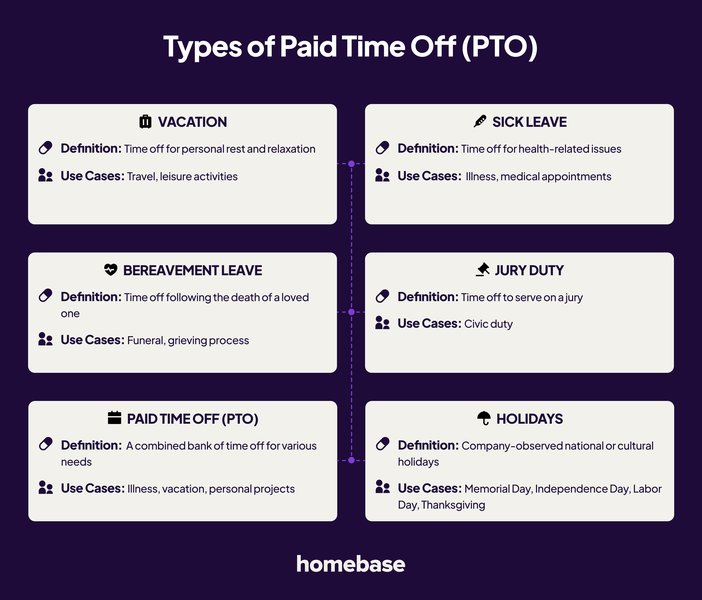
Visualizing various categories of paid time off.
PTO Banks (Combined Lump Sum)
With a PTO bank policy, all types of paid leave (vacation, sick, personal) are combined into a single bank of hours or days. Employees can use this lump sum for any reason, offering maximum flexibility. This simplifies administration and empowers employees to decide how to allocate their time off. A typical starting point for new employees in small businesses is around 10 vacation days per year, often increasing with tenure.
Unlimited PTO
This progressive policy allows employees to take as much time off as they need, provided their work is completed and business operations are not disrupted. While seemingly generous, unlimited PTO relies heavily on trust, clear communication, and a results-oriented culture. Less than 10% of U.S. companies offered unlimited PTO as of 2023, but the trend is growing. Some argue it can lead to employees taking less time off due to unspoken pressure or fear of appearing disengaged.
Hybrid PTO Policies
Some businesses combine elements of different policies. For instance, a firm might allocate a fixed number of sick days annually, coupled with an unlimited vacation policy. This blends structure with flexibility, offering the best of both worlds for certain business models.
Accrual Methods: How Time Off is Earned
Regardless of the type of PTO policy, micro-businesses need to define how employees earn their time off. Common accrual methods include:
- Hourly Accrual: Employees earn a certain amount of PTO for every hour worked (e.g., 0.04 hours of PTO per hour worked for 10 days/year).
- Per Pay Period: A set amount of PTO is added to an employee's balance each pay period.
- Lump Sum: Employees receive their full annual PTO allocation at the beginning of the year. This encourages employees to take time off throughout the year but might lead to large payouts if an employee leaves with a significant unused balance.
- Years of Service: Many companies reward loyalty by increasing PTO days based on an employee's tenure. For example, two weeks for the first five years, and three weeks after five years.
Average PTO Benchmarks for Micro-Businesses
What to Expect and How to Compete
While there's no strict legal requirement, understanding industry averages and employee expectations is key to crafting a competitive PTO policy. According to the Bureau of Labor Statistics (BLS), 76% of private industry workers receive paid vacations. For employees with 1-5 years of service, the average paid vacation time is about 10 days per year. Most PTO policies offer employees 10-14 days in addition to company-observed holidays. The average time actually taken off by employees under an unlimited PTO policy is usually 3-6 weeks, according to SHRM.
Beyond standard vacation days, many micro-businesses also offer:
- Paid Holidays: Common paid holidays often include New Year's Day, Memorial Day, Independence Day, Labor Day, Thanksgiving, and Christmas. Some businesses also include the day after Thanksgiving, New Year's Eve, or Christmas Eve.
- Sick Leave: Even if bundled into a PTO bank, providing specific guidelines for sick leave is important, especially given state-specific paid sick leave laws.
- Bereavement Leave: Time off for funerals or mourning.
- Jury Duty: Federal law requires unpaid time off for jury duty, but some states require paid leave.
- Parental Leave: While federal FMLA only applies to businesses with 50+ employees, smaller businesses may offer parental leave as a benefit.
Crafting a Comprehensive PTO Policy: Key Considerations
Essential Elements for Success
Developing a clear, written PTO policy is crucial for consistency, fairness, and transparency within a micro-business. It minimizes misunderstandings and streamlines the time-off request process. Here are vital components to include:
Eligibility and Accrual Details
- Define who is eligible for PTO (e.g., full-time, part-time, temporary employees).
- Specify the accrual rate and method (e.g., per hour, per pay period, lump sum).
- Outline any probationary periods before PTO eligibility begins.
- Detail how PTO accrues and any maximum carryover limits from year to year. Be aware that some states consider PTO equivalent to earned wages, making "use it or lose it" policies illegal.
Request and Approval Process
- Stipulate the advance notice required for planned time off (e.g., two weeks for absences over five consecutive days).
- Establish procedures for requesting urgent or unplanned time off (e.g., sick leave).
- Clarify how requests are reviewed and approved, considering business needs and team workload. Managers may deny PTO if an employee has outstanding deadlines.
Usage and Limitations
- Explain how PTO can be used (e.g., vacation, sick leave, personal appointments).
- Specify any "blackout periods" during peak business seasons when PTO might be restricted.
- Address policies for partial-day absences or taking time off in smaller increments (e.g., by the hour).
- Outline what happens to unused PTO upon termination (payouts may be required by state law).
Communication and Documentation
- Communicate the PTO policy clearly to all employees, ideally during onboarding.
- Provide written documentation, such as including the policy in an employee handbook, to serve as a reference point.
- Implement a tracking system for PTO balances, whether manual or automated, to ensure accuracy and compliance.
Here's a detailed table summarizing key aspects of PTO policies for micro-businesses:
| Policy Aspect | Description for Micro-Businesses | Considerations/Best Practices |
|---|---|---|
| Federal Requirements | Generally, no federal mandate for paid vacation or sick leave (except for certain federal contractors or FMLA for businesses with 50+ employees). | Always check state and local laws, as many jurisdictions have paid sick leave mandates. |
| Average Offering (Vacation) | 10-14 days annually for new employees; increases with tenure. | Benchmarking against industry standards helps attract talent. |
| Types of Policies | Traditional Accrual (separate buckets), PTO Bank (combined lump sum), Unlimited, Hybrid. | Choose based on company culture, administrative ease, and employee flexibility needs. |
| Accrual Rate | Often based on hours worked (e.g., 0.04 hrs PTO/hr worked) or a fixed amount per pay period/year. | Clearly define how PTO is earned and when it becomes available. |
| Carryover Policies | Allowing unused PTO to roll over (flexible) vs. "use it or lose it" (encourages usage, but potentially illegal in some states). | Balance flexibility with financial implications (potential payouts upon termination). |
| Advance Notice for Requests | Typically 2 weeks for planned vacations, immediate notification for urgent needs (sick leave). | Crucial for managing staffing and workload in a small team. |
| Blackout Periods | Designated times (e.g., holiday rush) when PTO is restricted due to high business demand. | Communicate clearly and provide alternative time-off options if possible. |
| Payout on Termination | Depends heavily on state law; some states require payout of accrued, unused vacation time. | Consult legal counsel to ensure compliance. |
| Communication | Clear written policy in employee handbook, discussed during onboarding. | Ensures transparency, reduces misunderstandings, and sets expectations. |
The Power of a Well-Designed PTO Policy: A Radar Chart Analysis
Evaluating Different PTO Models for Small Businesses
Different PTO policies offer varying strengths and weaknesses for small businesses. To illustrate this, let's look at a radar chart comparing common PTO models across several key performance indicators (KPIs) relevant to micro-businesses. This chart reflects an opinionated analysis of how each policy type typically performs in these areas, rather than hard data.
The radar chart illustrates how different PTO models balance various factors. Traditional Accrual generally offers good administrative ease and staffing management due to clear limits, but might be less flexible for employees. PTO Bank policies excel in administrative ease and employee flexibility by consolidating leave, but can sometimes make staffing management slightly less predictable than traditional models. Unlimited PTO shines in employee flexibility and recruitment appeal, as it fosters trust and reduces burnout. However, it can present challenges for staffing management and cost predictability if not carefully monitored and encouraged. For micro-businesses, understanding these trade-offs is crucial in selecting the most suitable policy.
Additional Best Practices for Micro-Businesses
Maximizing Your PTO Investment
- Lead by Example: As a small business owner, taking your own vacations demonstrates the value of time off and encourages your employees to do the same. It also shows confidence in your team's ability to operate without you.
- Monitor and Adjust: Regularly review your PTO policy to ensure it's meeting both business needs and employee expectations. Be prepared to make adjustments as your business grows or employee feedback suggests improvements.
- Automate Where Possible: Even for small teams, using simple HR software or a dedicated PTO tracking system can significantly reduce administrative burden and improve accuracy in managing time off requests and balances.
- Consider Phased Rollouts: If implementing a new or significantly different PTO policy, consider a phased rollout to allow both management and employees to adapt.
Understanding PTO through an Expert Lens
Delving Deeper into Policy Design
To further enrich your understanding of PTO policies, particularly the nuances of their design and potential pitfalls, consider watching this insightful video. It discusses common issues with PTO policies and strategies to create a system that truly benefits both employees and the organization, helping to prevent burnout and foster a healthy work environment.
"Why Your PTO Policies Might Burn People Out" - A video discussing effective PTO policy strategies.
This video provides valuable perspectives on how seemingly well-intentioned PTO policies can inadvertently lead to employee burnout if not designed with true work-life balance in mind. It emphasizes the importance of encouraging employees to actually take their time off, rather than just offering it on paper. For micro-businesses, where team dynamics are often close-knit, fostering a culture where time off is not just allowed but actively encouraged is paramount to maximizing the benefits of any PTO policy.
Frequently Asked Questions (FAQ)
Are small businesses legally required to offer paid time off?
What is the average number of vacation days offered by small businesses?
What are the benefits of offering PTO for a very small business?
Can a small business have an "unlimited PTO" policy?
What should be included in a PTO policy for a micro-business?
Conclusion
For very small businesses, establishing a thoughtful and well-communicated paid time off policy is a strategic move that goes beyond mere compliance. It's an investment in employee well-being, a powerful recruitment and retention tool, and a foundational element for fostering a positive and productive work environment. By carefully considering the various PTO models, understanding average offerings, and adhering to best practices in policy design and communication, micro-businesses can create a time-off program that not only supports their employees but also drives their overall success and resilience.
Recommended Further Exploration
- How do state laws on paid sick leave impact small businesses?
- What are the pros and cons of implementing an unlimited PTO policy in a small team?
- Which HR software solutions are best for small businesses to track PTO efficiently?
- Beyond PTO, what other employee benefits are crucial for retaining talent in micro-businesses?