
Unveiling Earth's Smartest Animals: Beyond Human Intelligence
Exploring the remarkable cognitive abilities of the planet's most intelligent non-human species.
Highlights of Animal Intelligence
- Primates Lead the Way: Chimpanzees, sharing ~98% DNA with humans, consistently top intelligence charts due to advanced tool use, problem-solving, and social learning.
- Diverse Cognitive Strengths: Intelligence isn't uniform; dolphins excel in social complexity and communication, elephants in memory and empathy, and corvids (crows/ravens) in planning and tool manipulation.
- Beyond Mammals: Remarkable intelligence is found across different animal classes, including invertebrates like octopuses (problem-solving, camouflage) and birds like African Grey Parrots (language comprehension).
Defining and Measuring Animal Intelligence
Measuring intelligence across the vast diversity of the animal kingdom presents a unique challenge. Unlike human IQ tests, there's no single standard. Instead, researchers evaluate cognitive abilities based on observable behaviors relevant to a species' survival and ecological niche. These include:
- Problem-solving capabilities
- Tool use and modification
- Memory and learning capacity
- Complex social structures and interactions
- Communication methods (vocal, gestural, etc.)
- Self-awareness (e.g., mirror recognition)
- Adaptability to new situations
- Planning and foresight
It's crucial to understand that intelligence isn't a linear scale but a spectrum of diverse abilities shaped by evolution. An animal highly intelligent in one area (like navigation) might not excel in another (like tool use). This overview synthesizes findings from various studies up to 2025 to highlight animals consistently recognized for their exceptional cognitive prowess.
The Brainiacs: Earth's Most Intelligent Species
While ranking is complex, several species consistently emerge as top contenders in the animal intelligence arena.
Chimpanzees (Pan troglodytes)
Our Closest Cognitive Relatives
Often cited as the smartest non-human animals, chimpanzees share a remarkable genetic similarity with humans (around 98-99%). This close evolutionary link is reflected in their sophisticated cognitive abilities. They exhibit exceptional problem-solving skills, intricate social hierarchies, and impressive tool use. Chimps have been observed fashioning tools from sticks to "fish" for termites, using stones to crack nuts, and even creating rudimentary spears for hunting smaller primates. They learn through observation and imitation, passing down skills through generations, a form of cultural transmission. Their capacity for self-recognition in mirrors signifies a high level of self-awareness.
 Chimpanzees demonstrate remarkable tool use, learning complex tasks like cracking nuts from others in their group.
Dolphins (Order Cetacea, esp. Bottlenose Dolphins)
Masters of the Marine Mind
Dolphins, particularly bottlenose dolphins, possess large, complex brains relative to their body size, featuring a highly developed neocortex associated with higher-order thinking and emotional processing. They live in complex social groups called pods, exhibiting cooperative hunting strategies, sophisticated vocal communication (including signature whistles acting like names), and transmission of learned behaviors, considered a form of animal culture. Dolphins demonstrate self-awareness, recognizing themselves in mirrors, and possess impressive problem-solving abilities. Their use of echolocation for navigation and hunting is a testament to their specialized sensory intelligence.
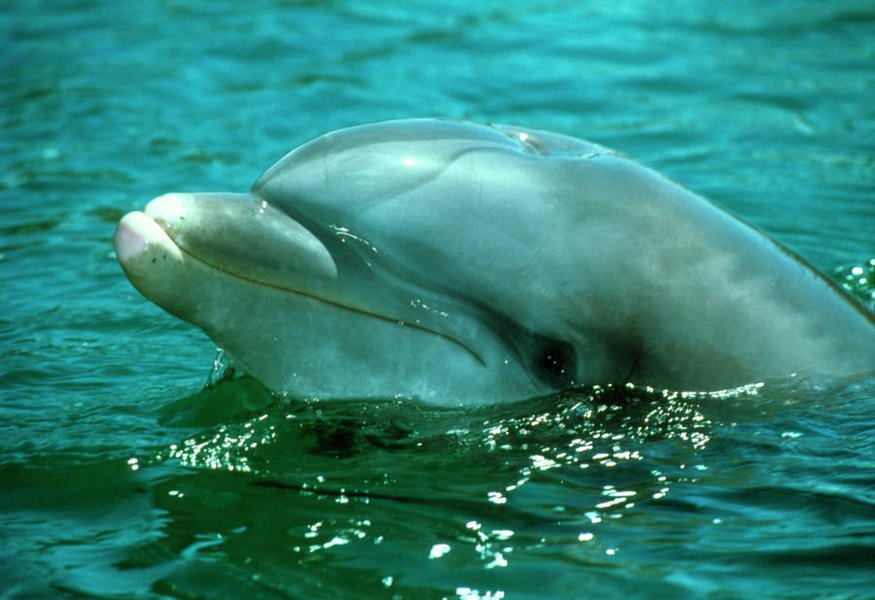 The Bottlenose Dolphin, with its large brain, exhibits complex social behaviors and advanced communication.
Elephants (Family Elephantidae)
Giants of Memory and Empathy
Elephants possess the largest brains of any land animal and are renowned for their extraordinary memory, crucial for remembering water sources and migration routes over vast distances and long periods. They display complex social structures, strong family bonds, and evidence of empathy and mourning, gathering around deceased individuals in apparent rituals. Elephants communicate using a wide range of vocalizations, including infrasound undetectable by humans, allowing contact over long distances. They demonstrate tool use (e.g., using branches as fly swatters), problem-solving skills, and self-awareness (mirror test). Their intricate social lives and emotional depth place them high on intelligence rankings.
Octopuses (Order Octopoda)
Invertebrate Ingenuity
Octopuses are arguably the most intelligent invertebrates, showcasing cognitive abilities that rival some vertebrates. With a large brain-to-body mass ratio (though their nervous system is distributed, with much processing power in their arms), they are masters of camouflage, problem-solving, and escape. Octopuses have been observed opening jars, navigating complex mazes, using tools (like carrying coconut shells for later shelter), and recognizing individual humans. Their ability to learn quickly and adapt to novel situations is remarkable, demonstrating a sophisticated level of intelligence unique outside the vertebrate lineage.
Corvids (Family Corvidae - Crows, Ravens, Magpies, Jays)
Feathered Einsteins
The corvid family boasts some of the most intelligent birds, often compared to primates in cognitive tests. Crows and ravens, in particular, exhibit exceptional problem-solving skills, tool manufacture and use (e.g., bending wire to create hooks), planning for future needs (caching food and remembering locations), and recognizing human faces. Ravens have demonstrated the ability to understand cause and effect and even barter. Their intelligence challenges the notion that brain size alone determines cognitive capacity, showcasing sophisticated thinking in relatively small brains.
Other Notable Intelligences
A Glimpse into Wider Cognitive Abilities
Beyond the top contenders, many other animals display remarkable intelligence:
- Orangutans: These great apes show advanced problem-solving, tool use (like using leaves for shelter or gloves), and planning abilities.
- Pigs: Often underestimated, pigs possess significant cognitive skills, demonstrating good long-term memory, object-discrimination learning, maze navigation, and complex social lives.
- Bonobos: Closely related to chimpanzees, bonobos excel in social intelligence, empathy, cooperation, and communication through gestures and vocalizations.
- African Grey Parrots: Famous for vocal mimicry, they also demonstrate an understanding of concepts like number, shape, and color, indicating deep cognitive processing beyond simple imitation.
- Rats: Highly adaptable and skilled learners, rats excel in navigation, problem-solving (especially in mazes), and exhibit metacognition (awareness of their own knowledge). They are also used in tasks like detecting landmines and tuberculosis.
- Dogs: Bred for cooperation with humans, dogs (especially certain breeds like Border Collies and Poodles) show high levels of social intelligence, trainability, and understanding of human cues and language.
- Bees: Despite tiny brains, bees demonstrate complex navigation, communication (through the "waggle dance"), pattern recognition, and even basic numerical understanding.
Comparing Cognitive Abilities: A Visual Snapshot
Understanding animal intelligence requires appreciating the different facets of cognition where various species excel. This chart provides a comparative visualization of estimated strengths across key cognitive domains for some of the smartest animals discussed. The scores are illustrative, representing relative prowess based on current scientific understanding rather than precise quantitative measures.
As the chart illustrates, chimpanzees show high scores across most areas, particularly tool use and problem-solving. Dolphins excel in social complexity and communication. Elephants stand out for memory and social bonds. Octopuses are remarkable problem solvers and highly adaptable, while ravens show exceptional problem-solving and tool use for birds. This highlights the multifaceted nature of intelligence in the animal kingdom.
Factors Shaping Animal Intelligence
Animal intelligence is not a random occurrence but a product of complex interactions between various biological and environmental factors. This mindmap outlines some key influences shaping the cognitive abilities we observe across different species.
(Size, Complexity, Neuron Density)"] id1b["Genetics
(Shared DNA, Evolutionary Lineage)"] id1c["Sensory Capabilities
(Echolocation, Vision, Olfaction)"] id2["Environmental Pressures"] id2a["Ecological Niche
(Foraging Challenges, Habitat Complexity)"] id2b["Predation Risk
(Need for Vigilance, Evasion Strategies)"] id2c["Resource Availability
(Competition, Need for Planning)"] id3["Social Factors"] id3a["Social Structure
(Group Living, Cooperation, Competition)"] id3b["Communication Needs
(Complex Signaling, Information Transfer)"] id3c["Social Learning
(Cultural Transmission, Imitation)"] id4["Life History Traits"] id4a["Lifespan
(Longer Life Allows More Learning)"] id4b["Developmental Period
(Extended Juvenile Phase for Skill Acquisition)"]
This mindmap illustrates how factors like brain complexity, the challenges posed by an animal's environment (like finding food or avoiding predators), the demands of living in social groups, and even an animal's lifespan all intertwine to drive the evolution of diverse cognitive skills across the animal kingdom.
Intelligence Traits at a Glance
This table summarizes some of the key cognitive traits associated with the highly intelligent animals discussed, offering a quick comparison.
| Animal | Notable Cognitive Traits | Examples |
|---|---|---|
| Chimpanzee | Tool Use, Problem Solving, Social Learning, Self-Awareness, Communication (Gestural/Vocal) | Using sticks for termites, cracking nuts with stones, learning sign language, mirror self-recognition. |
| Dolphin | Complex Social Structure, Advanced Communication, Problem Solving, Self-Awareness, Echolocation | Cooperative hunting, signature whistles, recognizing self in mirror, puzzle-solving. |
| Elephant | Exceptional Memory, Complex Social Bonds, Empathy/Mourning, Tool Use, Communication (Infrasound) | Remembering water sources, grieving dead, using branches as tools, long-distance communication. |
| Octopus | Problem Solving, Adaptability, Camouflage, Tool Use (Shelter), Learning/Memory | Opening jars, navigating mazes, using coconut shells for defense, escaping tanks. |
| Corvids (Crow/Raven) | Tool Manufacture/Use, Planning/Foresight, Problem Solving, Facial Recognition (Crows), Memory (Caching) | Bending wire into hooks, solving multi-step puzzles, remembering food cache locations, recognizing human faces. |
| Orangutan | Tool Use, Problem Solving, Planning, Nest Building, Learning | Using leaves as umbrellas, solving puzzles, planning travel routes. |
| Pig | Problem Solving, Learning, Memory, Social Complexity, Object Discrimination | Navigating mazes, recognizing symbols, understanding mirror reflections (in some studies). |
Watch: Exploring Animal Ingenuity
Visual examples often provide the most compelling evidence of animal intelligence. This video from BBC Earth showcases the creativity and cognitive skills of several species, including pigs, dolphins, and parrots, offering a glimpse into their remarkable mental worlds.
The video highlights diverse examples, such as a pig demonstrating creativity, dolphins using sophisticated echolocation, and parrots engaging in complex communication, reinforcing the idea that intelligence manifests in many fascinating forms adapted to different ecological challenges and evolutionary paths.
Frequently Asked Questions about Animal Intelligence
How is animal intelligence actually measured?
There isn't a single "IQ test" for animals. Scientists measure intelligence by observing behaviors like problem-solving (e.g., puzzles, accessing food), tool use and modification, learning speed and memory retention, navigating environments (like mazes), understanding symbols or language (in some cases), social learning (imitating others), planning, and self-awareness (like recognizing themselves in mirrors). The specific tests are adapted to the species' natural abilities and environment.
Are smarter animals more "conscious" or emotional?
While consciousness is difficult to measure definitively, animals exhibiting higher cognitive functions (like self-awareness, planning, complex social behavior) are often considered to have richer subjective experiences. Many intelligent animals, such as elephants, dolphins, primates, and even rats, show clear signs of complex emotions like joy, grief, empathy, and stress. The correlation between measured intelligence and the depth of emotional experience is an active area of research.
Which animal has the best memory?
Elephants are famously cited for their incredible long-term memory, essential for recalling migration routes, water sources, and recognizing individuals (both elephants and humans) after many years. Dolphins also possess excellent long-term social memory. However, other animals excel in specific types of memory; for instance, Clark's Nutcrackers (a type of corvid) can remember the locations of thousands of cached seeds months later, showcasing exceptional spatial memory.
Can intelligence be compared between vastly different animals like an octopus and a crow?
Direct comparison is challenging because their intelligence evolved under different pressures and manifests differently. An octopus excels at physical problem-solving, camouflage, and learning through exploration with its unique distributed nervous system. A crow excels at tool use, planning, and understanding causal relationships with its centralized avian brain. Both are highly intelligent, but comparing them is like comparing apples and oranges – they demonstrate different types of cognitive strengths suited to their vastly different lifestyles and evolutionary histories.
References
- The 10 Smartest Animals in the World - Updated 2024 Rankings - A-Z Animals
- Top 10 smartest animals in the world - BBC Science Focus Magazine
- 32 of the world's smartest animals | Live Science
- Top 30 Smartest Animals in the World | HowStuffWorks
- The 30 Most Intelligent Animals in the World Might Surprise You - Sentient Media
- Smartest Animals in the World To Know - MyFahlo
Recommended
Last updated April 14, 2025