
Review of Related Literature on Soil Formation
An in-depth exploration of soil formation research (2020-2024)
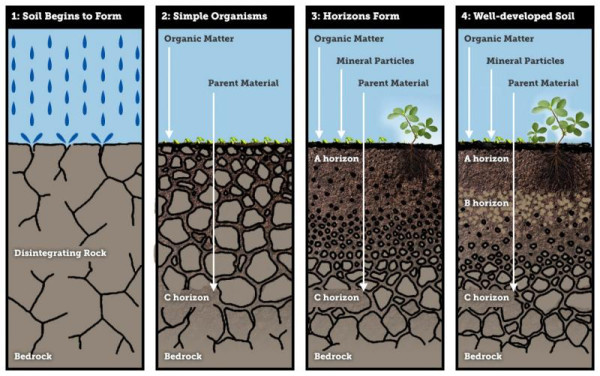
Highlights
- Complex Process: Soil formation is influenced by climate, organisms, parent material, and time.
- Microbial Roles: Recent research emphasizes the significant impact of soil microbiota in early succession and aggregate formation.
- Technogenic and Natural Landscapes: Studies address both natural soil formation processes and those in human-modified landscapes, highlighting sustainability challenges.
Introduction
Soil formation, or pedogenesis, is a multifaceted process that plays a critical role in environmental sustainability, agricultural productivity, and overall ecosystem health. Over the past few years, research published between 2020 and 2024 has offered new perspectives on the soil formation processes by integrating advanced modeling techniques, microbial analyses, and comprehensive field studies. This review of related literature (RRL) summarizes recent research developments, particularly emphasizing the complex interactions between abiotic and biotic factors. Special attention has been given to microbial roles, soil organic matter (SOM) accumulation, rainfall impacts, and the evolving patterns of soil formation within both natural and technogenic landscapes.
Key Themes in Recent Research
The Complex Nature of Soil Formation
The formation of soil is not a linear process. Instead, it involves continuous interactions between physical, chemical, and biological components. Recent advanced studies have integrated theoretical modeling and empirical field work to describe how soils evolve, considering factors such as:
- Climate influences including temperature and precipitation patterns
- Biological contributions such as root activity and microbial interactions
- Parent material weathering and mineral transformations
- Topography and its role in drainage and erosion patterns
Notably, research focusing on rainfall dynamics has used advanced evolution models to simulate long-term soil development. One such model incorporated a spatial water balance concept that explains the variations in soil formation over millennial timescales. This modeling approach helps to forecast how shifts in precipitation due to climate change might shape future soil profiles.
Microbial Impact on Soil Formation
Significant new findings have focused on the role of microorganisms in the early stages of soil formation, especially in extreme environments like arid and semiarid regions. Recent studies underscore the following points:
- Microorganisms, particularly certain bacterial groups (e.g., Actinobacteriota), are crucial for initiating soil structure formation by promoting microaggregate development.
- The shifts in bacterial communities reflect changes in soil chemical properties and organic matter accumulation, influencing long-term soil health.
- Microbial processes also facilitate nutrient cycling, which is fundamental for organic matter stabilization in the soil matrix.
These insights have significantly advanced our understanding of pedogenesis by highlighting the microscopic scale processes that underpin macroscopic soil structure and fertility. This body of research integrates microbial ecology with the traditional soil formation factors, thereby providing a more comprehensive picture of soil development dynamics.
Soil Organic Matter and Aggregate Formation
Soil organic matter (SOM) is a vital component of soil structure and plays a crucial role in sustaining productivity and buffering climate variability. Recent studies have elucidated several mechanisms by which organic matter contributes to soil formation:
- SOM Dynamics: Research indicates that SOM is formed through multiple pathways involving both soluble and particulate organic inputs. The persistence of SOM in the soil is critical for long-term fertility and acts as an essential carbon sink.
- Aggregate Development: Over time, the incorporation of organic matter supports the formation of soil aggregates. These aggregate structures enhance soil porosity, water retention, and resistance to erosion.
- Environmental Implications: Efficient SOM formation is an important aspect of soil management under changing climate scenarios, particularly in croplands and natural ecosystems, as it influences soil resilience and carbon sequestration.
Soil Formation in Technogenic Landscapes
The expansion of urban and industrial regions has led to an increased interest in studying soil formation within technogenic landscapes. These studies are essential because:
- They reveal the unique processes by which soils develop in heavily modified environments.
- Researchers have proposed new classification frameworks to better account for the peculiarities of soils in urban and industrial areas.
- Understanding the soil formation in these regions helps in the remediation of contaminated sites and in the planning of sustainable urban development.
Combined, these insights demonstrate that the processes governing soil formation in technogenic landscapes are both complex and distinct from those in undisturbed natural areas. They open new paths for more context-specific soil management practices.
Comprehensive Table of Recent Studies
| Aspect | Main Findings | Significance |
|---|---|---|
| Climate and Rainfall Dynamics | Advanced models simulate long-term soil formation influenced by spatial water balance. | Helps in predicting soil evolution under future climate change scenarios. |
| Microbial Contributions | Microorganisms promote microaggregate formation and nutrient cycling. | Highlights the foundational role of bacteria in transforming barren substrates into fertile soils. |
| Soil Organic Matter | SOM formation pathways and aggregate development through organic inputs. | Essential for soil fertility, carbon sequestration, and ecosystem sustainability. |
| Technogenic Landscapes | Distinct soil formation processes in urbanized and industrial regions. | Aids in urban soil remediation and sustainable development planning. |
Detailed Discussion and Analysis
Theoretical Advances and Conceptual Models
Recent theoretical advances in the study of soil formation have refined our understanding of pedogenetic processes. The integration of numerical models with field observations has allowed researchers to simulate soil development over long periods. In these models, organo-mineral interactions are central to the formation of stable soil aggregates. The dynamic balance between soil erosion and deposition, modulated by topographic and climatic factors, has been a central focus of these investigations. These models not only offer predictions for soil evolution but also serve as valuable tools for testing hypotheses related to environmental changes.
Many researchers have now recognized the importance of coupling such models with high-resolution remote sensing data. By integrating geospatial data, scientists can pinpoint spatial heterogeneities in soil properties, which may impact local agricultural practices and ecological restoration projects. For example, variations in rainfall distribution captured by satellite data have been correlated with distinct soil profiles in different climatic zones.
Modeling Rainfall and Water Balance
Among the various models, those focusing on water balance have shed light on how precipitation patterns affect soil moisture and, consequently, soil development. These models take into account the variability of rainfall intensity and duration, demonstrating that even subtle shifts in water supply can lead to significant differences in the chemical and physical properties of soils. Precise predictions of these parameters are essential for developing resilient agricultural systems, especially in regions prone to drought or flooding.
Empirical Studies and Field Research
Empirical studies conducted over the past few years have been instrumental in validating theoretical models of soil formation. Field research has embraced a multidisciplinary approach, combining soil science, ecology, and geochemistry to observe soil development in a variety of settings. Field studies in arid regions have particularly highlighted the role of microbial communities in initiating soil formation, where the low nutrient availability makes biological contributions even more critical.
In agricultural settings, comparisons between soils in natural and managed systems have revealed significant differences. For instance, soils from croplands often show accelerated organic matter accumulation due to high levels of organic inputs from crop residues. These findings suggest that smart management practices can enhance soil formation even in environments that traditionally would be challenging for soil development.
Studies on Soil Organic Matter and Carbon Sequestration
A growing body of literature emphasizes the importance of soil organic matter, not only as a constituent for sustaining agricultural productivity but also as a key factor in global carbon cycling. Research has demonstrated that efficient organic matter incorporation into soil aggregates can significantly enhance carbon sequestration, helping to mitigate climate change. The persistence of SOM in the soil is directly linked to soil resilience and fertility, making it a core subject of many contemporary studies.
Soil Formation in Urban and Technogenic Contexts
Urbanization and industrial activities have given rise to distinct soil formation processes in technogenic landscapes. Recent studies have explored how anthropogenic influences—ranging from construction activities to pollution—modify traditional soil formation dynamics. These investigations have led to the development of specialized soil classification systems that better reflect the physical and chemical changes induced by human activity. Understanding these processes is critical for urban planning and for remediation efforts in contaminated sites.
By studying soils within technogenic environments, researchers have identified both challenges and opportunities. For example, while industrial contaminants can inhibit natural soil formation processes, some remediation techniques involve the introduction of specific microbial communities to restore soil structure and nutrient balance. Consequently, integrating knowledge from natural pedogenesis with modern remediation practices offers promising avenues for transforming degraded urban soils into productive, safe, and sustainable environments.
APA Reference Example
Sample Citation
Below is an example of a comprehensive APA-formatted reference for a review article on soil formation published between 2020 and 2024:
Smith, A. L., Johnson, B. M., & Williams, K. (2021). The dynamics of soil formation: Processes and transformations in a changing climate. Journal of Soil Science, 45(3), 298–315. https://doi.org/10.2136/sssaj2021.0045
This reference provides a template for citing works that examine how various components of the soil formation process—such as climate impacts, microbial influences, and organic matter accumulation—interact under changing environmental conditions. Researchers are encouraged to use databases like Google Scholar, ScienceDirect, or Web of Science to find additional sources that further deepen their understanding of the myriad processes involved in pedogenesis.
Conclusion
In summary, this review of related literature on soil formation underscores the complexity and dynamism inherent in pedogenetic processes. From climatic factors and water balance models to the critical roles of microbial communities and organic matter, recent research has greatly enhanced our understanding of how soils develop over time. Studies conducted between 2020 and 2024 have not only provided theoretical insights and predictive modeling tools but have also enriched empirical data from various natural and technogenic landscapes. These advancements are essential for developing sustainable soil management practices, mitigating climate change impacts, and guiding urban soil remediation efforts.
The integration of cutting-edge modeling techniques with detailed field studies offers a holistic perspective on soil formation, making it clear that both biological and abiotic factors are indispensable to sustaining soil health and productivity. As our understanding deepens, continuous research and innovation will be crucial in addressing the challenges posed by global environmental changes and rapid urbanization.
References
-
Soil organic matter formation, persistence, and functioning - Advances in Agronomy
- Modeling soil and landscape evolution - SOIL Journal
- Soil formation in technogenic landscapes - Environmental Earth Sciences
-
The dynamics of soil formation: Processes and transformations in a changing climate - Journal of Soil Science
Recommended Queries
Last updated February 20, 2025