
Unlocking Peak Performance: How Mirrors and PCM Revolutionize Solar Still Efficiency
A deep dive into enhancing freshwater production using reflectors and thermal storage in solar desalination.
Solar stills offer a sustainable solution for producing freshwater from saline or contaminated sources using the power of the sun. However, conventional designs often face limitations in efficiency and productivity, particularly due to intermittent sunlight. Research has intensely focused on optimization strategies, with two prominent techniques emerging: the use of mirrors as reflectors to boost solar energy capture and the integration of Phase Change Materials (PCMs) for thermal energy storage to extend operation. This review synthesizes recent findings on these methods, including the concept of using PCM within containers like spray bottles.
Key Optimization Highlights
- Mirrors Amplify Solar Gain: Strategically placed mirrors can significantly increase the solar radiation reaching the still's basin, boosting water temperatures and evaporation rates, leading to productivity increases ranging from 20% to over 300% in some configurations.
- PCM Extends Operation: Phase Change Materials store excess solar heat during the day and release it during cooler periods (evenings, cloudy weather), maintaining evaporation and potentially increasing daily freshwater yield by 50% to 120%.
- Synergistic Combination: Combining mirrors (for enhanced input) and PCM (for thermal storage) offers a powerful synergistic effect, leading to even greater improvements in overall efficiency and prolonged water production compared to using either technique alone (reports suggest gains up to 180-480% in advanced systems).
The Challenge: Improving Traditional Solar Stills
Why Optimization is Crucial
Traditional solar stills, while simple and effective in principle, suffer from relatively low thermal efficiency. Much of the absorbed solar energy can be lost to the surroundings, and their productivity ceases shortly after sunset or during overcast conditions. This limits their daily freshwater output, making optimization essential for practical, large-scale deployment, especially in regions with high water stress but abundant sunlight.
Boosting Solar Input: The Power of Reflection
Using Mirrors to Maximize Solar Energy Capture
One direct way to enhance solar still performance is to increase the amount of solar energy entering the system. Mirrors, acting as reflectors, are employed to redirect additional sunlight onto the still's absorber surface (typically the basin liner or water surface). This concentrated solar flux leads to higher basin water temperatures, accelerating the rate of evaporation and subsequent condensation, thus increasing freshwater yield.

Mirrors can be designed to concentrate solar energy, significantly boosting the thermal input to devices like solar stills.
Types and Effectiveness
Reflectors can be integrated in various ways:
- Internal Reflectors: Mirrors or reflective foils placed on the inner walls of the still reduce internal optical losses and redirect sunlight towards the basin. Studies show these can increase productivity by 20% to 75%.
- External Reflectors: Mirrors positioned outside the still capture additional sunlight and direct it onto the basin or through the cover glass. These can be flat plates, parabolic troughs, or more complex geometries. When combined with sun-tracking mechanisms, external reflectors have achieved productivity gains reported as high as 380% in specific stepped solar still designs.
- Geometric Design: The shape (flat, concave, parabolic) and angle of the reflectors are crucial for maximizing effectiveness, often requiring optimization based on the still's design and geographic location (latitude and seasonal sun path). Conical solar stills with external mirrors have shown yield increases exceeding 33%.
Research consistently demonstrates that incorporating reflectors significantly enhances the thermal performance and water output of solar stills by maximizing the utilization of available solar irradiance.
Extending Operation: Thermal Energy Storage with PCM
Harnessing Latent Heat for Continuous Distillation
Phase Change Materials (PCMs) are substances that absorb and release large amounts of thermal energy (latent heat) when they change phase (typically melting and solidifying) at a near-constant temperature. In solar stills, PCMs are used to store excess heat collected during peak sunshine hours. This stored energy is then released back into the system as ambient temperatures drop (e.g., during the evening or cloudy periods), maintaining a higher basin water temperature and prolonging the evaporation and condensation processes beyond direct sunlight hours.
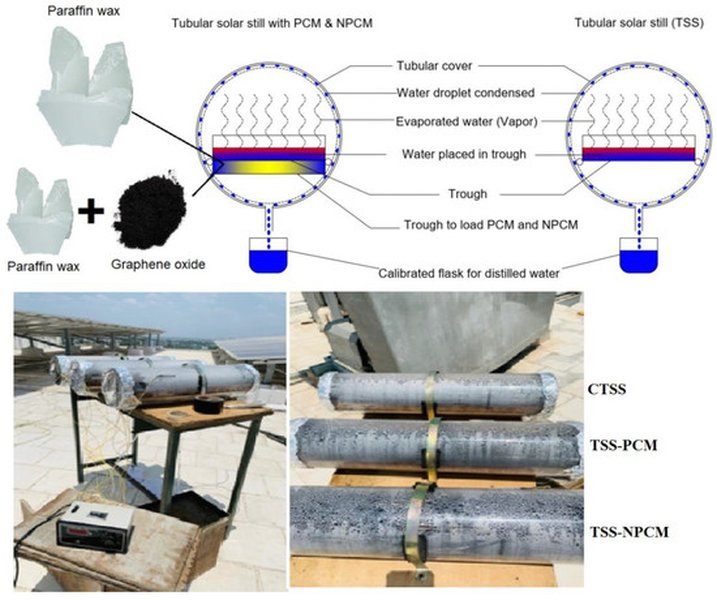
Conceptual diagram illustrating the integration of Phase Change Material within a solar still design for thermal energy storage.
PCM Integration and Performance
PCMs are typically integrated into the solar still in several ways:
- Placed underneath the basin liner.
- Mixed with other materials in the basin.
- Contained within tubes, spheres, or other enclosures placed inside the basin.
The key benefits include:
- Extended Productivity: By releasing stored heat, PCMs enable distillation to continue during nighttime or low-insolation periods, significantly boosting the total daily freshwater yield. Reported increases range from 51% to as high as 120% compared to conventional stills without PCM.
- Temperature Stabilization: PCMs help moderate temperature fluctuations within the still, potentially improving overall thermal efficiency.
Commonly used PCMs include paraffin waxes and fatty acids (like stearic acid), chosen for their appropriate melting temperatures (typically 50-80°C for solar still applications), high latent heat capacity, stability, and low cost. Recent research also explores nano-enhanced PCMs (NPCMs) for improved thermal conductivity and heat transfer rates.
The Concept of PCM in Spray Bottles
Your query specifically mentioned using "spray bottles filled with PCM". While the fundamental principle of using contained PCM aligns with established research, the reviewed literature (based on provided answers up to April 2025) does not specifically detail experiments or widespread use of standard *spray bottles* for this purpose. PCM is typically integrated using containers designed for optimal heat transfer and durability within the still's environment (e.g., metal tubes, encapsulated pouches, or directly integrated layers).
Using a container like a spray bottle conceptually represents a method of containing the PCM. Potential advantages, theoretically, could include ease of placement or replacement. However, challenges might involve the thermal resistance of the bottle material (often plastic), ensuring good thermal contact with the basin water, the durability of the container under thermal cycling, and the efficiency of heat exchange compared to purpose-built integration methods. While novel containment approaches are always possible areas for research, the current body of evidence primarily supports PCM integration through methods like basin liners, tubes, or embedded layers.
Synergistic Power: Combining Mirrors and PCM
Achieving Optimal Performance Through Integration
The true potential for maximizing solar still performance lies in combining multiple optimization strategies. Integrating mirrors (to increase energy input) with PCM (to store excess energy and extend operation) creates a powerful synergy.
- Mirrors enhance the daytime solar gain, providing more thermal energy not only for immediate evaporation but also for charging the PCM heat store more effectively.
- The PCM then utilizes this stored energy to continue the distillation process when direct solar input diminishes, leveraging the enhanced energy captured by the mirrors.
Studies investigating combined systems have reported substantial performance gains. For example, a modified stepped solar still incorporating both internal reflectors and PCM demonstrated productivity increases of up to 180%. Advanced designs combining multiple enhancement techniques (reflectors, PCM, improved insulation, wick materials, etc.) have reported theoretical or experimental efficiency gains reaching as high as 480% compared to basic designs, along with economic benefits like reduced payback periods.
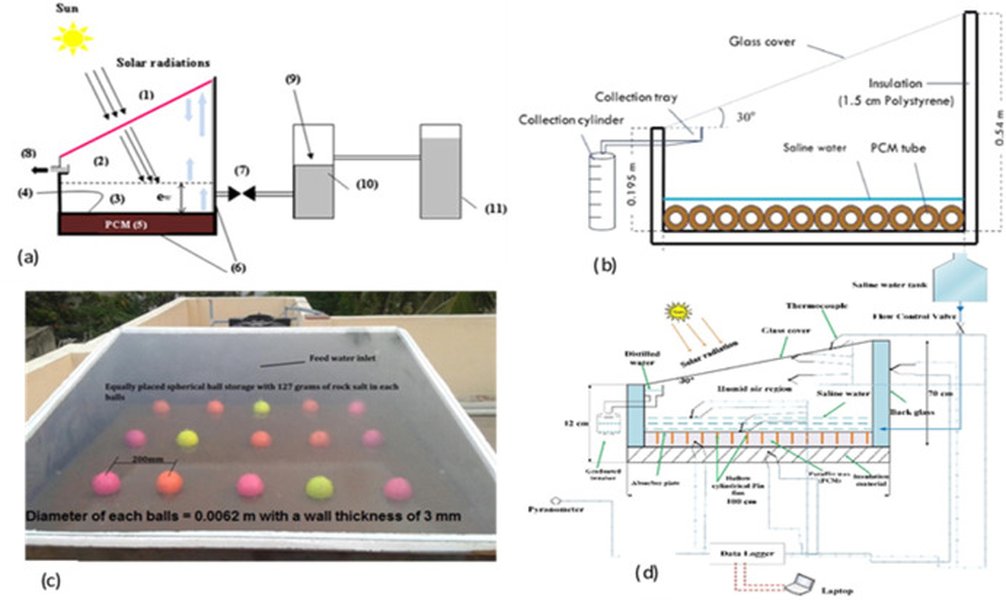
Schematic illustrating a solar desalination system incorporating PCM for enhanced thermal management.
Visualizing Performance Enhancement Factors
Relative Comparison of Solar Still Configurations
This radar chart provides a conceptual comparison of different solar still configurations based on key performance and practical factors. The values represent relative performance, illustrating the progressive benefits of adding mirrors and PCM. A 'Combined' system leverages the strengths of both techniques.
Mapping Solar Still Optimization Strategies
A Visual Overview of Enhancement Techniques
This mindmap illustrates the primary approaches discussed for optimizing solar still performance, focusing on reflectors and phase change materials, along with related considerations.
Comparative Overview of Solar Still Enhancements
Features and Performance Summary
The following table summarizes the key characteristics and typical performance impacts of incorporating mirrors and PCM into solar still designs, compared to a basic conventional still.
| Configuration | Key Feature(s) | Primary Advantage(s) | Potential Disadvantage(s) | Typical Productivity Increase (vs. Basic) |
|---|---|---|---|---|
| Basic Solar Still | Simple basin & cover design | Low cost, simple construction | Low efficiency, daytime operation only | Baseline (0%) |
| Still + Mirrors | Internal or external reflectors added | Increased solar radiation capture, higher daytime evaporation | Increased cost & complexity, potential shading/alignment issues | 20% - 380% (highly design dependent) |
| Still + PCM | PCM integrated for heat storage | Extended operation (night/cloudy), stabilized temperature | Increased cost, weight, requires suitable PCM selection & integration | 50% - 120% |
| Still + Mirrors + PCM | Combines reflectors and heat storage | Synergistic effect: Maximized input & extended operation, highest overall yield & efficiency | Highest cost & complexity, requires careful system design & optimization | Potentially > 180% (Reported combined gains can be substantial) |
Exploring Advanced Solar Still Concepts
Insights from Research on High-Efficiency Desalination
Modern research continues to push the boundaries of solar still performance. Techniques like multi-stage evaporation and condensation, vacuum operation, and advanced thermal localization aim to dramatically increase efficiency beyond what single-stage passive stills can achieve. The following video discusses one such approach, highlighting the ongoing innovation in solar desalination technology.
This presentation by Lenan Zhang discusses ultrahigh-efficiency desalination using a thermally-localized multi-stage solar still. While distinct from the mirror/PCM approach, it exemplifies the advanced concepts being explored to overcome traditional limitations and significantly boost freshwater production from solar energy, showcasing the frontier of desalination research.
Frequently Asked Questions (FAQ)
Clarifying Key Concepts in Solar Still Optimization
What exactly are Phase Change Materials (PCMs)? +
How much do mirrors realistically improve solar still output? +
Is combining mirrors and PCM always the best approach? +
What factors are important when choosing a PCM for a solar still? +
Why isn't PCM stored in simple containers like spray bottles commonly documented? +
References
Relevant Research and Review Articles
-
Phase Change Materials (PCMs) in solar stills: review of their use for enhanced freshwater yield - ScienceDirect
-
Experimental study on the effect of external reflecting mirrors on augmenting solar radiation capture and enhancing freshwater yield from conical solar still - ScienceDirect
- Phase change materials (PCMs) for improving solar still productivity—a review - SpringerLink
-
Optimization of double basin solar still performance–Use of reflectors and cooling fan - ScienceDirect
- Performance enhancement analysis of single slope solar still using reflective mirrors and reflective aluminum foil on inner surfaces - SpringerLink
-
A review on phase change materials in different types of solar stills - ScienceDirect
- Improved solar still productivity using PCM and nano-PCM: an experimental investigation and environmental analysis - Nature
Recommended Further Exploration
Related Queries for Deeper Insights
Last updated April 19, 2025