
Solving the Cookie Tin Mystery: Finding the Original Number Using Percentages
Discover how to work backwards from a percentage to uncover the total amount.
Let's tackle this cookie conundrum! Winnie ate 9 cookies, which represents 20% of the total cookies originally in the tin. Your goal is to figure out just how many cookies were in the tin before Winnie started snacking. We'll call the original number of cookies 'H', as you requested, and solve this using methods suitable for Primary 6 level math, focusing on the relationship between the percentage, the part, and the whole.
Key Insights at a Glance
- Understanding the Relationship: The problem tells us that 9 cookies are equivalent to 20% of the total number of cookies (H).
- Percentage as a Fraction or Decimal: To solve, we can convert the percentage (20%) into a simpler form, either a fraction (1/5) or a decimal (0.20).
- Finding the Whole: If we know what a fraction or percentage of a number is, we can find the whole number by using multiplication or division.
What are Reverse Percentages?
This problem is a classic example of working with "reverse percentages". Normally, you might calculate a percentage of a number (like finding 20% of 50). Reverse percentages involve working backward: you know the result of a percentage calculation (like the 9 cookies Winnie ate) and the percentage it represents (20%), and you need to find the original amount (the total cookies in the tin).
Working with reverse percentages is a fundamental skill in mathematics, especially as you progress through levels like Primary 6 and beyond. It's used in real-life situations such as calculating original prices before a discount or finding the starting value before an increase.
In Primary 6, students learn to handle percentages of amounts and percentage increase or decrease problems. Reverse percentages build upon this by requiring you to understand the relationship between the part and the whole in a new way – using the part to deduce the whole.
Solving the Cookie Problem in Primary 6 Terms
Let H be the original number of cookies in the tin.
We are told that Winnie ate 9 cookies, and this amount is 20% of the original number of cookies (H).
We can write this relationship as an equation:
20% of H = 9
In Primary 6, it's helpful to think about what 20% means in simpler terms, like a fraction. 20% means 20 out of 100, which can be written as the fraction 20/100. This fraction can be simplified:
\[ \text{20%} = \frac{\text{20}}{\text{100}} = \frac{\text{1}}{\text{5}} \]So, the problem can be restated as:
1/5 of H = 9
If 1/5 of the total number of cookies (H) is equal to 9 cookies, then to find the total number (H), we need to figure out what the whole (5/5) would be. Since 1/5 of H is 9, the full amount (5/5 of H) must be 5 times the amount of 1/5.
Therefore, to find H, we multiply the number of cookies Winnie ate (9) by 5:
\[ \text{H} = 9 \times 5 \] \[ \text{H} = 45 \]So, there were originally 45 cookies in the tin.
Alternatively, using decimals, 20% is equivalent to 0.20 or 0.2. The equation becomes:
\[ 0.2 \times \text{H} = 9 \]To find H, we divide both sides of the equation by 0.2:
\[ \text{H} = \frac{9}{0.2} \]Dividing by a decimal can be done by making the divisor a whole number. Multiply both the numerator and the denominator by 10:
\[ \text{H} = \frac{9 \times 10}{0.2 \times 10} = \frac{90}{2} \] \[ \text{H} = 45 \]Both methods confirm that the original number of cookies in the tin was 45.
Visualizing Percentage Problems
For Primary 6 students, visual aids like bar models can be very helpful in understanding percentage problems, including reverse percentages. A bar model represents the total amount (H) as a whole bar, divided into sections representing percentages.
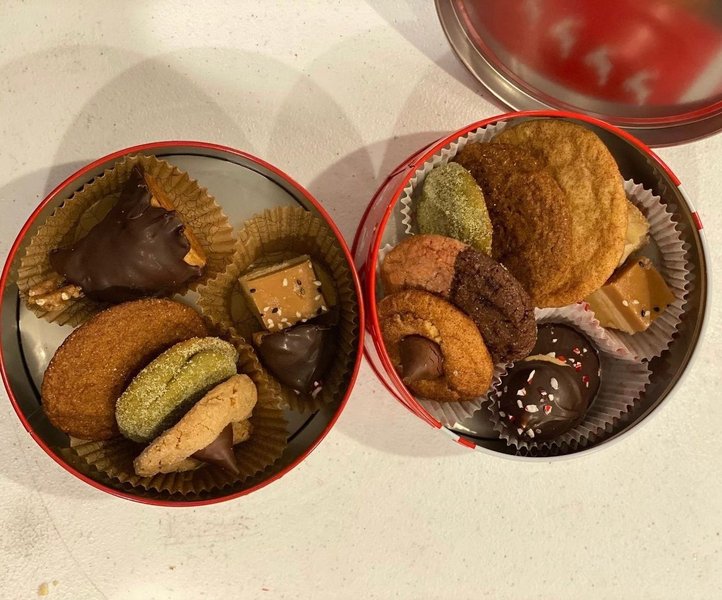
Image: Visualizing the concept of a tin holding a total quantity of cookies.
In this case, the whole bar represents 100% (which is H). We know that 20% of this bar corresponds to 9 cookies. If you divide the bar into 5 equal sections (since 20% is 1/5 of 100%), each section represents 20%. Since one 20% section is equal to 9 cookies, all five sections combined (100%) would be 5 times 9 cookies.
Here is a simple representation of the bar model concept for this problem:
-
Total (H) = 100%
-
20% of Total = 9 cookies
-
Break 100% into units of 20%: 100% / 20% = 5 units
-
Each 20% unit = 9 cookies
-
Total (H) = 5 units * 9 cookies/unit = 45 cookies
This visual approach reinforces the fraction method and helps make the relationship between the part (9 cookies) and the whole (H) clearer.
Checking Your Answer
A good way to be sure your answer is correct is to check it. If the original number of cookies was 45, does 20% of 45 equal 9? Let's calculate 20% of 45.
Using the decimal form:
\[ \text{20% of 45} = 0.20 \times 45 \] \[ 0.2 \times 45 = 9 \]Using the fraction form:
\[ \text{20% of 45} = \frac{1}{5} \times 45 \] \[ \frac{1}{5} \times 45 = \frac{45}{5} = 9 \]Since 20% of 45 is indeed 9, our answer is correct.
Understanding Different Percentage Problems in Primary 6
Percentage word problems in Primary 6 often involve different scenarios. Here are a few types students might encounter:
Finding a Percentage of a Number
This is the most straightforward type, where you calculate a percentage of a given quantity. For example, "What is 25% of 80?" (Answer: 0.25 * 80 = 20).
Finding What Percentage One Number is of Another
This involves comparing two numbers and expressing one as a percentage of the other. For example, "If you have 15 out of 20 questions correct on a test, what percentage did you get?" (Answer: (15/20) * 100% = 75%).
Percentage Increase or Decrease
These problems involve calculating the new amount after a percentage change or finding the percentage change between two amounts. For example, "A shirt costing $20 is discounted by 10%. What is the new price?" (Answer: 20 - (0.10 * 20) = $18). Or, "If a price increases from $20 to $25, what is the percentage increase?" (Answer: (($25-$20)/$20) * 100% = 25%).
Reverse Percentage Problems (Finding the Original Amount)
This is the type we solved, where you are given the result after a percentage change (or a part that represents a percentage) and need to find the original amount. For example, "A jacket is on sale for $72 after a 20% discount. What was the original price?" In this case, $72 represents 100% - 20% = 80% of the original price. So, 80% of Original Price = $72. Original Price = $72 / 0.80 = $90.
Understanding the context of the problem is key to identifying which type of percentage calculation is needed. Our cookie problem falls into the reverse percentage category because we know the part (9 cookies) and the percentage it represents (20%), and we need the whole (the original number of cookies, H).
Common Percentage Conversions
It is useful to be familiar with common percentage, decimal, and fraction equivalents. This can make solving percentage problems quicker, especially at the Primary 6 level.
| Percentage | Decimal | Fraction |
|---|---|---|
| 10% | 0.10 | 1/10 |
| 20% | 0.20 | 1/5 |
| 25% | 0.25 | 1/4 |
| 50% | 0.50 | 1/2 |
| 75% | 0.75 | 3/4 |
| 100% | 1.00 | 1 |
Table: Common percentage, decimal, and fraction equivalents. Knowing these helps quickly convert between forms when solving problems.
As seen in the table, 20% is equivalent to 1/5. This conversion was very helpful in solving the cookie problem using the fraction method, which is often intuitive for students learning percentages for the first time.
Additional Reverse Percentage Examples
Example 1: Finding Original Price After Discount
A toy car costs $15 after a 25% discount. What was the original price?
The discounted price ($15) represents 100% - 25% = 75% of the original price.
Let P be the original price.
75% of P = $15
0.75 * P = 15
P = 15 / 0.75
P = 15 / (3/4) = 15 * (4/3) = 60/3 = $20
The original price was $20.
Example 2: Finding Original Amount After Increase
The price of a bus ticket increased by 10% to $2.20. What was the original price?
The new price ($2.20) represents 100% + 10% = 110% of the original price.
Let B be the original price.
110% of B = $2.20
1.10 * B = 2.20
B = 2.20 / 1.10
B = 2
The original price was $2.00.
These examples demonstrate the general approach to reverse percentage problems: identify the new amount, determine what percentage of the original amount it represents (100% ± percentage change), set up the equation, and solve for the original amount.
Educational Resources for Percentage Problems
Many resources are available to help students practice percentage word problems, including those involving reverse percentages. Websites offer calculators, worksheets, and explanations tailored for different grade levels.
Image: Practice problems often use everyday objects like cookies and tins to make math relatable.
Videos can also be a great way to see problems being solved step-by-step. Here is a video that demonstrates solving percentage word problems, which can be helpful for understanding the concepts discussed:
Video: This video demonstrates solving percentage word problems using fraction and bar models, which are common techniques in Primary 6 mathematics. It helps visualize the relationship between percentages and the whole amount.
This type of visual and step-by-step explanation is particularly effective for solidifying understanding of how to approach various percentage problems, including finding the original amount.
Frequently Asked Questions (FAQ)
What does "20% of H" mean?
It means a portion of the total amount H. Specifically, if you were to divide H into 100 equal parts, 20% would be equivalent to 20 of those parts. As a fraction, 20% is equal to 1/5, meaning it's one out of five equal parts of H.
Why do we divide by the percentage (as a decimal) or multiply by the reciprocal of the fraction?
When you have an equation like 0.20 * H = 9, you want to isolate H. To do this, you perform the opposite operation of multiplication, which is division. So, you divide both sides by 0.20: H = 9 / 0.20. When using the fraction form, (1/5) * H = 9, the opposite of multiplying by 1/5 is dividing by 1/5, which is the same as multiplying by its reciprocal, 5/1 (or simply 5). So, H = 9 * 5.
Can I always use the fraction method for percentage problems?
Yes, any percentage can be converted to a fraction (e.g., 30% = 30/100 = 3/10). Using fractions can be very helpful, especially for simple percentages like 20% (1/5), 25% (1/4), or 50% (1/2), as it can sometimes make the calculation simpler without a calculator. For more complex percentages, the decimal method is often more practical.
What are other real-world examples of reverse percentages?
Besides discounts and increases, reverse percentages are used to calculate tax before the tax was added, find the original population size before a percentage change, or determine the cost of an item before sales tax was applied.
References
 amazon.com
 math-salamanders.s3.us-west-1.amazonaws.com
Last updated April 18, 2025