
Unlocking the Infinite: Can We Truly Solve Pi?
Delving into the history, calculation, and profound nature of the mathematical constant π.
The concept of "solving pi (π)" isn't about finding a simple, finite answer. Pi is a fundamental mathematical constant, representing the ratio of a circle's circumference to its diameter. Crucially, it's an irrational and transcendental number. This means its decimal representation goes on forever without repeating, and it cannot be expressed as a simple fraction or as the root of a non-zero polynomial equation with rational coefficients. Therefore, we can't "solve" pi in the traditional sense, but we can calculate its value to astonishing levels of precision and understand its deep significance.
Highlights: Understanding Pi (π)
- Universal Constant: Pi (π) represents the unchanging ratio (Circumference / Diameter ≈ 3.14159...) for all circles, regardless of size.
- Infinite & Irrational: As an irrational number, π's decimal digits extend infinitely without any repeating pattern, making an exact finite representation impossible.
- Approximation is Key: "Solving" pi involves using various mathematical methods—from ancient geometric techniques to modern supercomputer algorithms—to calculate its approximate value with increasing accuracy.
The Enduring Quest for Pi: A Historical Journey
From Ancient Approximations to Modern Marvels
The fascination with pi stretches back nearly 4,000 years. Early civilizations recognized the need to understand the relationship between a circle's dimensions for practical purposes like construction and astronomy.
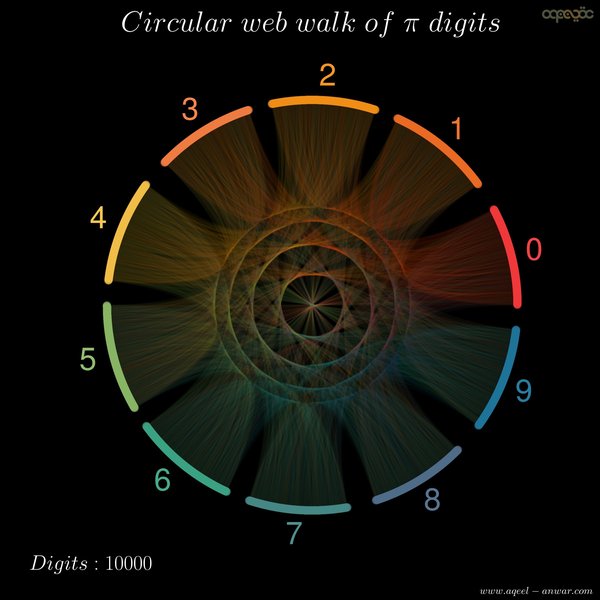
A visual representation illustrating the infinite nature of Pi's digits.
Ancient Roots
Ancient Babylonians (around 1900–1600 BCE) used a rough approximation of 3. Egyptian mathematicians, evidenced by the Rhind Papyrus (circa 1650 BCE), employed a value closer to 3.1605. These early estimates were sufficient for their architectural and land-measurement needs.
Archimedes' Rigorous Approach
The first truly mathematical attempt to calculate pi is credited to the Greek mathematician Archimedes of Syracuse (circa 250 BCE). He devised a brilliant method using polygons. By inscribing and circumscribing polygons with increasing numbers of sides (starting with hexagons and progressing up to 96-sided polygons) inside and outside a circle, he effectively "trapped" the value of pi between two bounds. Archimedes determined that pi lay between \( \frac{223}{71} \) (approximately 3.1408) and \( \frac{22}{7} \) (approximately 3.1429), a remarkably accurate estimate for his time.
Eastern Advancements and Infinite Series
Significant progress continued in the East. The Chinese mathematician Zu Chongzhi (429–500 CE) calculated pi to an accuracy of 3.1415926, a record that stood for nearly a millennium. Later, Indian mathematicians made groundbreaking discoveries involving infinite series. European mathematicians, building on earlier work and developing calculus, further refined these methods. John Machin, in 1706, developed a rapidly converging series (a Machin-like formula) that allowed him to calculate pi to 100 decimal places.
The Computational Era
The advent of computers revolutionized the calculation of pi. Leveraging sophisticated algorithms derived from infinite series (like those developed by Srinivasa Ramanujan and the Chudnovsky brothers) and immense processing power, mathematicians and computer scientists have pushed the boundaries of computation. As of July 2024, pi has been calculated to over 202 trillion decimal places. While such precision far exceeds any practical requirement, these massive computations serve as benchmarks for supercomputer performance, stress tests for hardware, and fuel the ongoing human quest to explore the infinite.
Methods for Calculating Pi
Techniques Old and New
Calculating pi relies on mathematical methods rather than physical measurement, which is inherently limited in precision. Even measuring a perfect circle the size of the observable universe would only yield about 40 digits of pi.

The fundamental geometry of a circle, illustrating the relationship Pi describes.
1. Geometric Methods
- Direct Measurement: The simplest conceptual approach is to measure a circle's circumference (C) and diameter (d) and calculate the ratio \( \pi = C/d \). However, physical imperfections and measurement limitations make this highly inaccurate for more than a few decimal places.
- Archimedes' Polygon Method: This historical method involves approximating the circle's circumference with the perimeters of inscribed and circumscribed polygons. As the number of sides (\(n\)) increases, the polygon perimeters converge towards the circle's circumference. For a unit circle, the perimeter of an inscribed \(n\)-sided polygon is \( n \cdot \sin(180^\circ/n) \). While foundational, this method is computationally inefficient compared to modern techniques.
2. Infinite Series
Most high-precision calculations rely on infinite series, where pi is expressed as the sum or product of an infinite sequence of terms. More terms yield better accuracy.
- Gregory-Leibniz Series: One of the earliest discovered series: \[ \pi = 4 \left(1 - \frac{1}{3} + \frac{1}{5} - \frac{1}{7} + \frac{1}{9} - \cdots \right) = 4 \sum_{k=0}^\infty \frac{(-1)^k}{2k+1} \] This series is elegant but converges very slowly. Hundreds of terms are needed for just two decimal places of accuracy.
- Nilakantha Series: A faster converging series from 15th-century India: \[ \pi = 3 + \frac{4}{2 \times 3 \times 4} - \frac{4}{4 \times 5 \times 6} + \frac{4}{6 \times 7 \times 8} - \cdots \]
- Machin-like Formulas: Developed by John Machin and others, these formulas based on the arctangent function converge much faster than the basic Gregory-Leibniz series and were used for record calculations for centuries.
- Ramanujan-Sato Series: Extremely rapid convergence formulas discovered by Srinivasa Ramanujan and later generalized. Some can add multiple digits of pi per term.
- Chudnovsky Algorithm: A modern, fast-converging series based on Ramanujan's work, used for many recent record-breaking computations: \[ \frac{1}{\pi} = 12 \sum_{k=0}^\infty \frac{(-1)^k (6k)! (13591409 + 545140134k)}{(3k)! (k!)^3 640320^{3k + 3/2}} \]
3. Monte Carlo Methods
These probabilistic methods use random sampling to estimate pi. A common example:
- Imagine a square with side length 2, centered at the origin, enclosing a circle of radius 1. The area of the square is 4, and the area of the circle is \( \pi r^2 = \pi(1)^2 = \pi \).
- Generate a large number of random points (\(N_{total}\)) within the square.
- Count the number of points (\(N_{inside}\)) that fall inside the circle.
- The ratio \( N_{inside} / N_{total} \) approximates the ratio of the areas: \( \pi / 4 \).
- Therefore, \( \pi \approx 4 \times (N_{inside} / N_{total}) \).
While conceptually simple and useful for demonstrations, Monte Carlo methods require vast numbers of samples for high precision and are less efficient than series algorithms.
4. Other Approaches
- Arithmetic-Geometric Mean (AGM): Algorithms like the Brent-Salamin (or Gauss-Legendre) algorithm use AGM iterations to converge quadratically to pi, meaning the number of correct digits roughly doubles with each step.
- Buffon's Needle Problem: Another probabilistic method involving dropping needles onto parallel lines and calculating the probability of intersection to estimate pi.
Comparing Pi Calculation Methods
Efficiency, Accuracy, and Application
Different methods for calculating pi vary significantly in their speed of convergence, computational requirements, and historical relevance. The following table summarizes some key approaches:
| Method | Approach | Convergence Speed | Typical Use Case |
|---|---|---|---|
| Geometric Measurement | Physical measurement (C/d) | Very Low / Impractical | Conceptual understanding, basic demonstration |
| Archimedes' Polygons | Geometric approximation | Slow | Historical significance, conceptual understanding |
| Gregory-Leibniz Series | Infinite series (arctan) | Very Slow | Historical significance, simple programming exercise |
| Nilakantha Series | Infinite series | Moderate | Educational, faster convergence than Leibniz |
| Monte Carlo Methods | Probabilistic simulation | Slow (requires many trials) | Educational demonstration, computational statistics |
| Machin-like Formulas | Infinite series (arctan variants) | Fast | Historical record calculations (pre-computer/early computer) |
| AGM Algorithms (Brent-Salamin) | Iterative algorithm | Very Fast (Quadratic) | Modern high-precision computation |
| Chudnovsky Algorithm | Infinite series (hypergeometric) | Extremely Fast | Modern record-breaking computations |
This table highlights the evolution from slow, geometric methods to extremely rapid algorithms used in modern supercomputing.
Visualizing Method Characteristics
A Radar Chart Comparison
To better visualize the trade-offs between different approaches to calculating Pi, consider the following radar chart. It compares several methods based on criteria like convergence speed, historical importance, conceptual simplicity, and computational cost for high precision. Note that these are qualitative assessments.
This chart illustrates that methods like the Chudnovsky algorithm excel in speed and efficiency for high precision but are conceptually complex and harder to implement. Conversely, simpler methods like Monte Carlo or Gregory-Leibniz are easier to grasp but far less efficient for serious computation. Archimedes' method holds immense historical value but is impractical today.
The Essence of Pi: A Mindmap
Connecting the Concepts
This mindmap summarizes the key aspects surrounding the mathematical constant Pi (π), from its definition and properties to its calculation and significance.
(Non-terminating,
Non-repeating decimal)"] id2b["Transcendental Number
(Not a root of
polynomial with rational coeffs)"] id3["History"] id3a["Ancient Approximations
(Babylonians, Egyptians ~3)"] id3b["Archimedes (~250 BCE)
(Polygon Method,
Bounds: 223/71 to 22/7)"] id3c["Zu Chongzhi (5th Century CE)
(High precision: 3.1415926)"] id3d["Infinite Series Era
(India, Europe - Leibniz, Machin)"] id3e["Computational Era
(Computers, Algorithms,
Trillions of digits)"] id4["Calculation Methods"] id4a["Geometric Measurement
(Practical but imprecise)"] id4b["Polygon Approximation
(Archimedes' legacy)"] id4c["Infinite Series
(Leibniz, Nilakantha,
Machin, Ramanujan,
Chudnovsky)"] id4d["Monte Carlo Methods
(Probabilistic, Random Sampling)"] id4e["Iterative Algorithms
(AGM, Brent-Salamin)"] id5["Significance & Applications"] id5a["Mathematics
(Geometry, Trigonometry,
Calculus, Number Theory)"] id5b["Physics & Engineering
(Waves, Oscillations,
Fluid Dynamics, Structures)"] id5c["Computer Science
(Algorithm testing,
Random number generation)"] id5d["Astronomy
(Orbital calculations)"]
Why Does Pi Matter?
Beyond the Circle
While defined by the circle, pi appears ubiquitously across mathematics, science, and engineering. It's essential in formulas for:
- Area of a circle: \( A = \pi r^2 \)
- Volume of a sphere: \( V = \frac{4}{3} \pi r^3 \)
- Surface area of a sphere: \( A = 4 \pi r^2 \)
- Formulas involving ellipses, cylinders, cones.
- Trigonometry and wave functions (like sine and cosine).
- Probability and statistics (e.g., the normal distribution).
- Physics principles involving oscillations, rotations, and waves.
Its fundamental nature makes it indispensable in fields ranging from architecture and electronics to cosmology and fluid dynamics.
This video from Math Antics provides a clear visual explanation of what Pi is and its relationship to circles, perfect for understanding the fundamental definition.
Frequently Asked Questions (FAQ)
Quick Answers to Common Questions about Pi
Can pi be fully calculated or "solved"?
Who discovered pi?
Why do we calculate pi to so many digits?
How many digits of pi do we need?
Recommended Reading
- Explore the practical applications of Pi in various engineering fields.
- Learn more about Archimedes and his groundbreaking contributions beyond calculating Pi.
- Discover the algorithms and computational power behind modern Pi calculations.
- Understand the mathematical concepts of irrational and transcendental numbers in more detail.
References
Last updated May 2, 2025