

Key Insights into Sonnet 16
- Procreation as the Ultimate Immortality: Sonnet 16 vehemently argues that having children is a "mightier way" to defy the ravages of time and preserve beauty than any artistic endeavor, including the poet's own "barren rhyme."
- The Limitations of Art: The sonnet presents a humble admission of poetry's inability to fully capture and sustain the "inward worth nor outward fair" of the beloved youth, positioning biological legacy as superior.
- Time as a "Bloody Tyrant": Through vivid personification and war imagery, time is depicted as an aggressive, destructive force that relentlessly erodes beauty and life, making the youth's active resistance through procreation essential.
William Shakespeare's Sonnet 16 stands as a compelling continuation within the "Fair Youth" sequence, specifically building upon the thematic foundations laid in Sonnet 15. This sonnet doesn't merely praise beauty; it issues a fervent plea for its preservation, not through the ephemeral means of art, but through the enduring act of procreation. The speaker, keenly aware of time's relentless march, urges the young man to engage in a "mightier way" to fortify himself against decay, emphasizing that biological offspring offer a more potent and lasting form of immortality than the poet's own verses.
This sonnet, like its predecessors in the procreation sequence, is structured meticulously as a Shakespearean sonnet. It comprises three quatrains, each presenting a distinct yet interconnected argument, culminating in a powerful, summarizing couplet. The rhythmic flow of iambic pentameter combined with the classic ABAB CDCD EFEF GG rhyme scheme provides a musicality that belies the weighty themes explored within. At its core, Sonnet 16 delves into humanity's perennial struggle against mortality, proposing an ancient yet profound solution: the perpetuation of one's line.
The Call to Action Against Time's Tyranny
Sonnet 16 opens with a rhetorical question, directly challenging the "Fair Youth" to adopt a more effective strategy against the "bloody tyrant, Time." The speaker questions why the youth does not "make war upon" this destructive force in a "mightier way" than merely relying on the poet's verse. This immediate call to action sets the urgent tone of the poem, positioning time as an active, hostile entity that threatens to erase the youth's beauty and existence.
The core argument revolves around the inadequacy of artistic immortality compared to biological reproduction. While poetry can preserve memory or an image, it cannot replicate the living essence, the "inward worth nor outward fair" of the individual. Children, conversely, are presented as "living flowers" that can emerge from "maiden gardens," actively repairing the "lines of life" that time's "pencil" — or even the poet's "pupil pen" — cannot adequately capture or mend.
The Contrast: Barren Rhyme vs. Living Flowers
A central tenet of the sonnet is the stark contrast between the poet's "barren rhyme" and the potential for the youth to cultivate "living flowers" through procreation. The speaker, with surprising humility, concedes that his poetic endeavors are insufficient to genuinely immortalize the youth's beauty. Poetry, in this context, is seen as a "painted counterfeit," an imitation that lacks the vibrant, self-renewing power of actual offspring. This self-critique of art is pivotal, as it elevates the act of biological continuation above artistic creation as the true path to lasting legacy.
The closing couplet reinforces this idea, suggesting that by "giving away yourself" — interpreted as committing to marriage and fatherhood — the youth paradoxically "keeps yourself still." This implies that self-replication through children is the ultimate form of self-preservation, ensuring that his beauty and essence continue to "live, drawn by your own sweet skill."
Literary Devices: Crafting the Argument
Shakespeare employs a rich tapestry of literary devices in Sonnet 16 to amplify its themes and persuasiveness. These tools not only enhance the poem's aesthetic quality but also deepen its meaning and emotional impact.
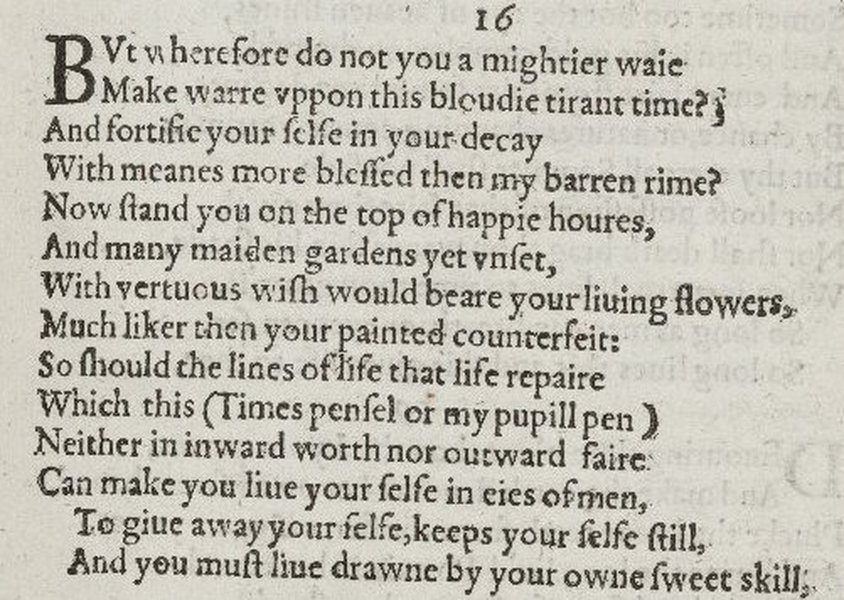
A digitized image of the original publication of Sonnet 16 from Shakespeare's 1609 quarto.
Vivid Metaphors and Personification
The most striking literary device is the pervasive use of metaphor and personification. Time is personified as a "bloody tyrant" engaged in war, suggesting an active, malevolent force that wages an unrelenting battle against human life and beauty. The imagery of "fortify yourself in your decay" extends this war metaphor, positioning procreation as a strategic defense against inevitable aging. Children are beautifully envisioned as "living flowers" blooming from "maiden gardens," a metaphor that conveys fertility, renewal, and natural beauty. The poet's verse is described as "barren rhyme," contrasting sharply with the generative power of offspring.
Further artistic metaphors include Time's "pencil" and the poet's "pupil pen." Time's pencil is depicted as an erasing or defacing tool, slowly wiping away the youth's features, while the poet's "pupil pen" suggests a subservient or less effective instrument, unable to truly counter Time's destructive artistry. This sophisticated interplay of metaphors underscores the sonnet's central tension between artistic and biological immortality.
Alliteration, Enjambment, and Wordplay
Alliteration is used to create emphasis and rhythm, as seen in phrases like "bloody tyrant, Time," "mightier way," and "happy hours." These repeated consonant sounds draw attention to key concepts and contribute to the sonnet's musicality.
Enjambment, where lines flow seamlessly without punctuation, mimics the relentless, continuous passage of time. This poetic technique enhances the sense of urgency and the unstoppable nature of decay that the youth is urged to combat. For example, the flow from "But wherefore do not you a mightier way / Make war upon this bloody tyrant, Time?" demonstrates this continuous motion.
Wordplay, particularly with the word "lines," adds layers of meaning. "Lines" can refer to poetic verses, the wrinkles that appear with age, and the lineage or descendants of the youth. This clever use of homonyms enriches the poem's argument, connecting the poet's craft with the biological legacy of the youth.
This mindmap illustrates the intricate web of themes and literary devices employed in Shakespeare's Sonnet 16, showcasing how they collectively reinforce the poem's central message.
Overarching Themes in Sonnet 16
The thematic landscape of Sonnet 16 is rich, revolving primarily around the concepts of time, mortality, legacy, and the efficacy of different means to achieve immortality.
Time and the Inevitability of Decay
A dominant theme is the destructive power of Time. Throughout the sonnet, Time is presented as an antagonist, an irresistible force that erodes beauty and leads to decay. The speaker acknowledges this inevitability, setting the stage for the proposed solution. This theme is not merely a lament but a foundational premise for the urgency of the youth's procreative actions.
Procreation as the Path to Immortality
The most prominent theme is the idea that procreation offers a superior and more enduring form of immortality than art. Children are seen as living legacies, physical embodiments of the parent's beauty and essence that can withstand the onslaught of time. This biological continuity ensures that the youth's "inward worth" and "outward fair" are passed down, creating a living chain of remembrance that far outlasts any poetic tribute.
The Limitations of Art and the Poet's Humility
Sonnet 16 also explores the limitations of art. The poet, despite his skill, humbly admits that his verses are "barren" and cannot achieve the same level of immortality as biological reproduction. This self-awareness underscores the theme that while art can memorialize, it cannot truly recreate or perpetuate life in the way that offspring can. This theme adds a layer of depth, moving beyond simple praise to a more philosophical contemplation of different forms of legacy.
An artistic rendition of a Shakespearean sonnet collection, symbolizing the enduring nature of his works.
Legacy and Renewal
The sonnet underscores the importance of leaving a legacy, not just in memory but in tangible, living form. Children are presented as a source of renewal, capable of repairing the effects of aging and decay. This concept of renewal is vital, as it offers hope and a constructive response to the otherwise bleak prospect of time's destructive force.
Understanding Sonnet 16 in Context
Sonnet 16 is part of the "Fair Youth" sequence (Sonnets 1-126), a collection of poems largely addressed to a young, aristocratic man. Within this sequence, Sonnets 1-17 are known as the "procreation sonnets," directly urging the youth to marry and have children. Sonnet 16 directly follows Sonnet 15, which also addresses the struggle against time, making them a thematic pair.
The sonnet reflects Renaissance anxieties about mortality and the desire for lasting fame. In a society where lineage and heritage were paramount, the idea of preserving one's line was deeply significant. Shakespeare masterfully weaves these societal values into a personal plea, elevating the act of procreation to a heroic defiance against the universal enemy: time.
This video provides an explanation of Sonnet 16, detailing the poet's advice to his friend about marriage and children as a means to defy time. It contextualizes the sonnet's themes effectively for a deeper understanding.
Comparative Efficacy of Immortality: Art vs. Procreation
To further illustrate the sonnet's argument, let's consider the perceived effectiveness of different forms of immortality as presented or implied within Sonnet 16.
| Method of Immortality | Description in Sonnet 16 | Perceived Efficacy Against Time | Nature of Legacy |
|---|---|---|---|
| Procreation (Children) | "Living flowers," "lines of life that life repair," "mightier way." | Highest (active, self-renewing, enduring). | Biological, living, dynamic, direct continuation of self. |
| Poetry (Bard's Rhyme) | "Barren rhyme," "pupil pen," "painted counterfeit." | Limited (static, vulnerable to decay, indirect). | Artistic, memorial, intellectual, a representation of self. |
| Painting/Portraiture | "Painted counterfeit." | Limited (static, susceptible to physical damage, indirect). | Visual, artistic, a representation of self. |
| Personal Skill/Action | "Drawn by your own sweet skill" (in the context of self-preservation through procreation). | High (when applied to procreation, otherwise transient). | Active, but only permanently impactful through offspring. |
This table outlines the various methods of achieving immortality mentioned or alluded to in Sonnet 16, highlighting the poem's strong preference for procreation over other forms of legacy.
FAQ: Sonnet 16 Unpacked
What is the central message of Shakespeare's Sonnet 16?
How does Sonnet 16 relate to other "procreation sonnets"?
What does the phrase "barren rhyme" signify in Sonnet 16?
How is "Time" personified in Sonnet 16?
What is the significance of the closing couplet in Sonnet 16?
Conclusion
Shakespeare's Sonnet 16 offers a profound contemplation on mortality, legacy, and the most effective means of defying time's inexorable grasp. By positioning procreation as a "mightier way" than art, the sonnet not only underscores the Renaissance emphasis on lineage but also highlights the poet's remarkable humility regarding the limits of his craft. The vivid imagery, compelling metaphors, and the very structure of the sonnet work in concert to deliver a powerful message: while poetry can preserve memory, only living descendants can truly perpetuate one's "inward worth nor outward fair" against the relentless "bloody tyrant, Time." Sonnet 16 remains a testament to Shakespeare's enduring exploration of humanity's deepest desires for immortality and continuity.
Recommended Further Reading
- Shakespeare's Sonnet 15 analysis and comparison with Sonnet 16
- Thematic connections in Shakespeare's Fair Youth sonnets
- Renaissance views on immortality and procreation
- Literary devices in Shakespearean sonnets and their impact