
Market Turbulence: Why the S&P 500 Faces an Uphill Battle Today
Analyzing the confluence of tariff shocks, technical indicators, and market sentiment affecting April 3rd's trading session
Key Insights
- Significant morning selloff: The S&P 500 dropped 3.3% in early trading following President Trump's major tariff announcements, creating substantial downward pressure
- Negative technical setup: The index has failed to break its bearish trend line with key support levels now acting as resistance points
- Contrasting recent performance: Despite closing higher on both Monday (0.55%) and Tuesday (0.38%), today's market faces overwhelming bearish sentiment
Current Market Status and Morning Trading
The probability of the S&P 500 closing higher today (April 3, 2025) appears significantly low based on current market conditions and early trading data. The index experienced a substantial 3.3% decline in early trading hours, primarily triggered by market reaction to President Trump's sweeping tariff announcements.
Before the market opened today, futures tied to major indices showed alarming declines, with Dow Jones futures dropping approximately 1,064 points (around 2.5%) and Nasdaq-100 futures falling approximately 3.4%. These pre-market indicators suggested a challenging trading environment ahead.
Recent Historical Context
To properly assess today's prospects, it's worth noting the S&P 500's recent performance:
- Monday, March 31, 2025: The index added 0.55% to close at 5,611.85
- Tuesday, April 1, 2025: The index added 0.38% to close at 5,633.07
- Wednesday, April 2, 2025: The index showed a modest rally of 0.7%, closing at 5,670.97
This positive momentum has been abruptly challenged by today's market reaction to the tariff announcements, creating what some analysts are calling a "tariff shock" that has significantly altered market sentiment.
Technical Analysis Perspective
From a technical standpoint, the S&P 500 is displaying several bearish signals that diminish the probability of a positive close today:
- The index has failed to break above its bearish trend line
- Crucial support levels have transformed into resistance points
- Prior to today's decline, the index was already approximately 10% below its all-time high
- A close below certain technical thresholds would further confirm the bearish outlook
Factors Influencing Today's Trading Session
Tariff Announcement Impact
The most significant factor weighing on the market today is President Trump's tariff announcement. This policy shift has created immediate uncertainty among investors, particularly regarding its potential impact on corporate profits, supply chains, and international trade relationships.
Historical Tariff Impact Parallels
Similar tariff announcements in previous years have typically led to market volatility, with some analysts drawing parallels to the 2018 market reaction. During that period, tariff announcements initially triggered market declines before eventual stabilization as investors assessed the actual economic impact.
Broader Economic Indicators
Several economic factors are contributing to today's market sentiment:
- The 10-year Treasury note yield edged up slightly to 3.74%
- The two-year Treasury yield also showed a minimal increase
- Recession concerns are emerging among some market participants
- Inflation expectations continue to influence trading decisions
Market Sentiment Indicators
Volatility measures have spiked, with significant movement in the VIX (market volatility index), further suggesting bearish sentiment dominates today's trading environment. This heightened volatility makes a positive close increasingly challenging.
Probability Assessment Through Data Visualization
Comparative Factors Influencing Today's Market Direction
This radar chart visualizes the relative strength of factors influencing today's market. The dominance of bearish factors (red) over bullish factors (blue) across most categories illustrates why the probability of a positive close today is low. The previous day's positive momentum (bullish) is being overwhelmed by the significant bearish factors triggered by the tariff announcements and poor technical setup.
Market Decision-Making Framework
Understanding the Market Structure and Decision Points
This mindmap illustrates the decision framework affecting the S&P 500's closing direction today. While there are some bullish factors present, the bearish case presents stronger and more immediate influences on today's trading session, further supporting the low probability assessment for a positive close.
Visual Evidence of Market Conditions
The following images provide visual context for understanding today's market conditions:
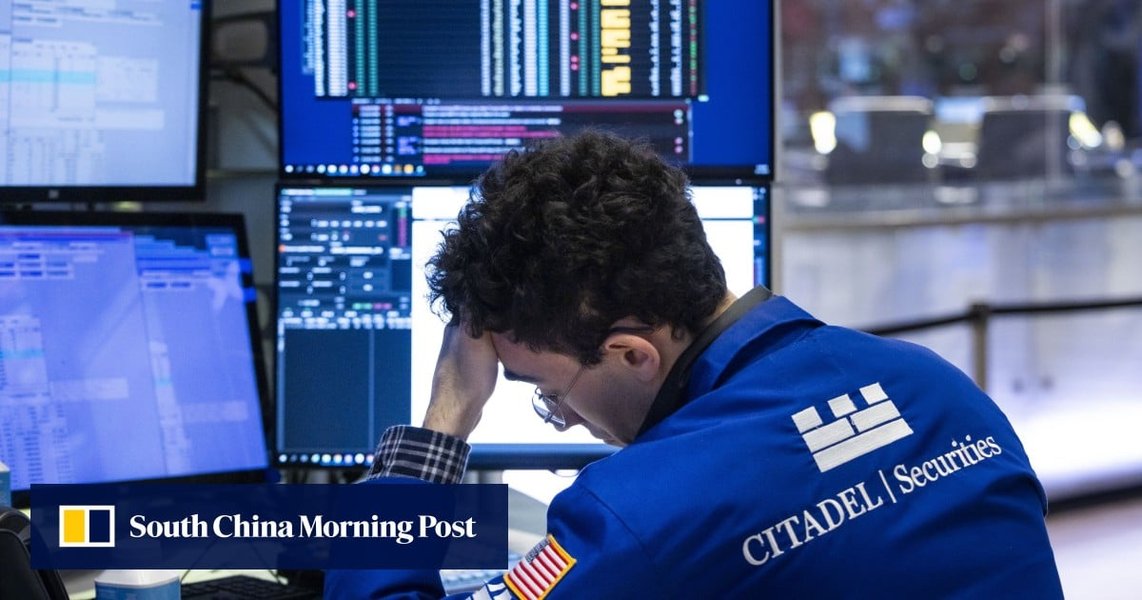
This image shows the market reaction to trade war concerns, similar to the sentiment affecting today's trading session. The visual representation of market participants reacting to tariff news provides context for today's selling pressure.

A recent Goldman Sachs trading desk analysis showing S&P 500 projections. While longer-term forecasts may remain positive, the immediate market reaction to tariff news has significantly altered short-term prospects for today's session.
Market Expert Video Analysis
This video provides expert analysis on the potential impact of President Trump's tariff announcements on the market, particularly relevant to today's trading session:
The video specifically addresses the potential market crash concerns stemming from the recently announced tariffs, examining how they might affect major indices including the S&P 500. This analysis aligns with today's market action and provides context for the low probability of a positive close.
Quantitative Probability Assessment
| Factor | Impact Direction | Strength (1-10) | Contribution to Probability |
|---|---|---|---|
| Tariff Announcement | Negative | 9 | Strongly reduces probability |
| Early Trading Performance (-3.3%) | Negative | 8 | Significantly reduces probability |
| Technical Setup | Negative | 7 | Reduces probability |
| Pre-Market Futures | Negative | 8 | Significantly reduces probability |
| Recent Positive Momentum (Mon-Wed) | Positive | 6 | Slightly increases probability |
| Market Sentiment | Negative | 8 | Significantly reduces probability |
| Treasury Yield Movement | Mixed | 4 | Neutral impact on probability |
| Overall Assessment | Negative | 8 | Low probability (10-20%) |
Based on the comprehensive assessment of all factors, the probability of the S&P 500 closing higher today is estimated to be between 10-20%. The significant early selling pressure, negative technical setup, and market reaction to tariff announcements create substantial headwinds that would require extraordinary positive developments later in the trading session to overcome.
Frequently Asked Questions
References
- S&P 500 adds 0.55% on Monday, touches six-month low - CNBC
- S&P 500 closes higher on Tuesday amid volatile trading - CNBC
- Stock Market News For Apr 3, 2025 - Yahoo Finance
- 5 Things to Know Before the Stock Market Opens - Investopedia
- Dow plunges and dollar weakens as recession fears grip Wall Street - CNN
- Stock Rout Deepens on Tariff Shock as Bonds Rally: Markets Wrap - Bloomberg
- Why S&P 500 rising to 6000 is hardly a stretch as stocks clinch new record - MSN
Related Queries
Last updated April 3, 2025