
Filament Dryer Showdown: Creality Space Pi Plus vs Sovol SH02
A comprehensive comparison of two leading filament dryers for optimal 3D printing performance
Key Highlights
- Temperature Performance: Space Pi Plus reaches slightly higher temperatures (up to 75°C) compared to the SH02 (up to 70°C), but the SH02 heats up faster with its 150W PTC heater
- User Interface: Both feature touch screens with preset filament options, with Space Pi Plus offering presets for 12 filament types versus SH02's 9 filament types
- Design and Build: Both support dual-spool capacity, but the SH02 features a triple-seal system for superior moisture protection
Design and Build Comparison
The Creality Space Pi Plus and Sovol SH02 are both designed to solve a common 3D printing problem: moisture absorption in filaments. Their design philosophies, however, show subtle but important differences that might affect your decision.
Creality Space Pi Plus Design
The Space Pi Plus features a sleek, modern design with dimensions of approximately 343 x 226 x 300 mm, providing a good balance between capacity and desktop footprint. It's engineered to hold two filament spools simultaneously, making it ideal for users who frequently switch between materials or need continuous printing with different filaments. The device includes compartments specifically designed for silica gel packets to enhance moisture absorption during the drying process.
Sovol SH02 Design
The Sovol SH02 similarly supports dual 1kg spools but places greater emphasis on its sealing system. It features a triple-seal design that effectively prevents environmental moisture from entering the drying chamber. The unit is built around a 150W PTC heating element that provides 360° surround heating for even temperature distribution. This design ensures consistent drying results regardless of where the filament is positioned within the chamber.
Build Quality Comparison
Both devices demonstrate solid construction, but user reviews suggest the Sovol SH02 particularly excels in its heating stability and consistent performance. The Space Pi Plus, while robustly built, focuses more on versatility with its comprehensive filament preset options.
Technical Specifications Face-Off
Understanding the technical differences between these two filament dryers helps identify which one might better suit your specific 3D printing needs.
| Feature | Creality Space Pi Plus | Sovol SH02 |
|---|---|---|
| Maximum Temperature | ~75°C (based on standard Space Pi) | 70°C |
| Heating Time | Not specifically documented | 50°C in 7 minutes, 70°C in 25 minutes |
| Heating Technology | PTC heating with uniform distribution | 150W PTC with 360° surround heating |
| Display | 4-inch touchscreen | 3.9-inch LCD touchscreen |
| Filament Presets | 12 types (PLA, TPU, ABS, ASA, PETG, PC, PA, PET, PLA-CF, PETG-CF, PA-CF, and more) | 9 types (PLA, TPU, PETG, ABS, ASA, PVA, PC, PA, PP) |
| Spool Capacity | Two spools | Two 1kg spools |
| Filament Diameter Support | 1.75mm and 2.85mm | 1.75mm and 2.85mm |
| Moisture Protection | Standard sealing with silica gel compartments | Triple-seal system |
| Approximate Price | $69.50-$75 | $69-$99 (often on sale from $99.99) |
Performance Analysis
While both dryers effectively remove moisture from filaments, their performance characteristics differ slightly. The Space Pi Plus has been reported to reduce moisture content significantly—one user noted a decrease from 58% to 15% moisture in six hours for a new spool of PETG. Meanwhile, the Sovol SH02's faster heating time means you can start printing with properly dried filament sooner, which is beneficial for urgent projects.
Energy Efficiency
Both units employ PTC (Positive Temperature Coefficient) heating technology, which provides self-regulating temperature control and is generally energy-efficient. The Sovol SH02's 150W heater might consume slightly more power during the initial heating phase but efficiently maintains temperature once reached.
User Interface and Ease of Use
The interface design significantly impacts the user experience, especially for those new to filament drying.
Creality Space Pi Plus Interface
The Space Pi Plus features a responsive 4-inch touchscreen that provides access to all drying settings. Its interface includes one-key temperature presets for 12 different filament types, making it exceptionally user-friendly for beginners and experienced users alike. The screen also displays current temperature and drying status.
Sovol SH02 Interface
With its 3.9-inch LCD touchscreen, the SH02 offers real-time monitoring of both temperature and humidity levels inside the chamber. This additional humidity reading provides valuable insight into the drying process that the Space Pi Plus doesn't offer. The interface includes presets for nine common filament types, slightly fewer than the Space Pi Plus but covering all the most commonly used materials.
Noise Levels
User experiences regarding noise levels vary for both devices. Some users report that the Sovol SH02 produces noticeable fan noise during operation, while others find it acceptably quiet. The Space Pi Plus is generally described as not being particularly loud, making it potentially better suited for home offices or spaces where noise might be a concern.
Performance Comparison Visualization
To help visualize the strengths and weaknesses of each filament dryer across multiple dimensions, the following radar chart compares their key performance attributes based on compiled user reviews and specifications. This should help you identify which device better aligns with your specific needs.
The radar chart illustrates that while both dryers perform admirably across all metrics, they each have distinct advantages. The Space Pi Plus excels in maximum temperature capabilities and filament preset options, while the SH02 stands out for its heating speed and moisture protection system.
Filament Compatibility and Material Handling
One of the most critical aspects of any filament dryer is how well it handles different materials, as various filaments require specific drying temperatures and times.
Creality Space Pi Plus Filament Compatibility
The Space Pi Plus is engineered to accommodate a wide range of filaments with its 12 preset options. Its slightly higher maximum temperature (around 75°C) makes it particularly suitable for engineering filaments like nylon that benefit from higher drying temperatures. The preset options include specialized settings for carbon fiber-reinforced materials (PLA-CF, PETG-CF, PA-CF), which are increasingly popular for functional prints.
Sovol SH02 Filament Compatibility
While offering fewer presets (9 types), the Sovol SH02 covers all commonly used filament types including hygroscopic materials like TPU, PETG, and nylon. Its maximum temperature of 70°C is sufficient for most filaments, though it falls slightly short of the Space Pi Plus for certain high-temperature materials. However, its triple-seal system provides excellent protection against ambient moisture, which is particularly beneficial for highly hygroscopic filaments like nylon and TPU.
Ideal Usage Scenarios
The Space Pi Plus might be the better choice for users who frequently work with specialty engineering filaments and require precise temperature control across a wider range of materials. The Sovol SH02, with its superior sealing and faster heating, would excel for users in humid environments who need quick preparation of standard filaments and prioritize long-term storage protection.
Visual Comparison
Let's take a look at both filament dryers to better understand their physical design and user interface differences.
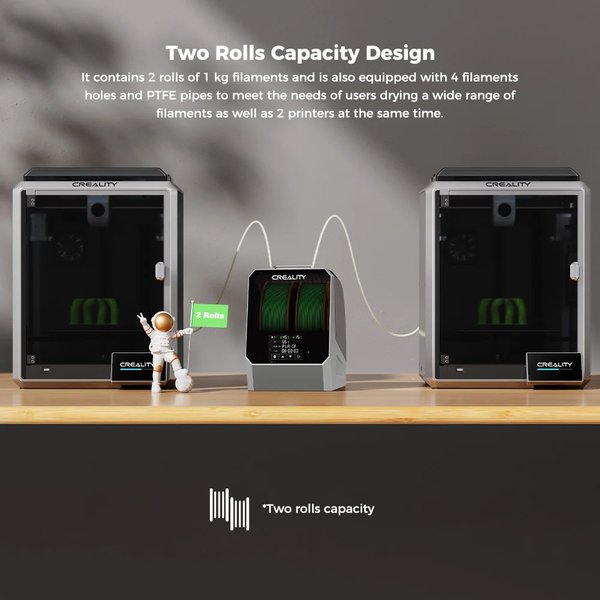
Creality Space Pi Plus with its dual-spool capacity and touchscreen interface
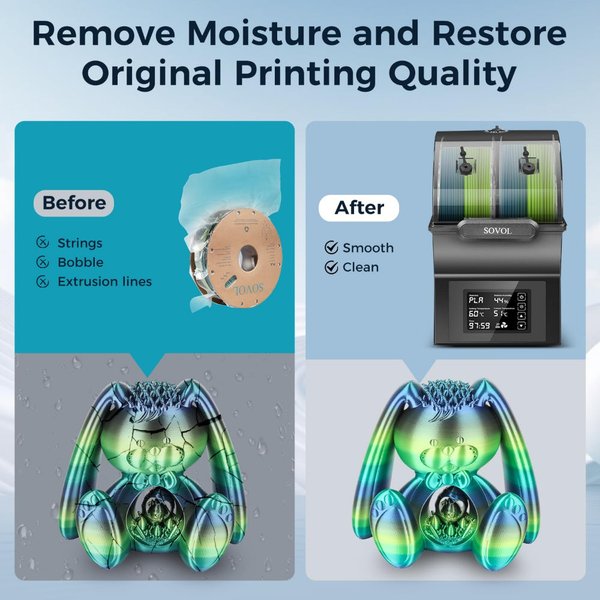
Sovol SH02 showing its LCD touchscreen and dual-spool configuration
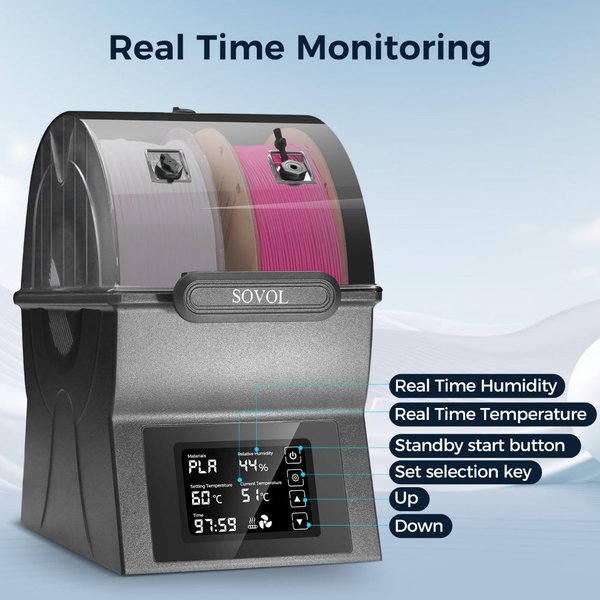
Sovol SH02's touchscreen interface displaying temperature controls and filament presets
Filament Dryer Decision Framework
To help visualize the decision-making process when choosing between these two filament dryers, here's a comprehensive mindmap outlining the key considerations and how each model addresses them:
Better for engineering filaments"] SH02["SH02: Up to 70°C
Sufficient for most common materials"] Heating Performance Heating Speed["SH02: Faster heating
50°C in 7 min, 70°C in 25 min"] Heat Distribution["Both offer PTC heating
SH02 features 360° surround heating"] User Interface Space Pi Display["Space Pi Plus: 4-inch touchscreen"] SH02 Display["SH02: 3.9-inch LCD with humidity display"] Filament Compatibility Space Pi Presets["Space Pi Plus: 12 filament presets
Including CF-reinforced materials"] SH02 Presets["SH02: 9 filament presets
Covering most common materials"] Moisture Protection Standard Protection["Space Pi Plus: Standard sealing
Silica gel compartments"] Advanced Protection["SH02: Triple-seal system
Superior moisture barrier"] Price and Value Space Pi Price["Space Pi Plus: $69.50-$75"] SH02 Price["SH02: $69-$99
Often on sale from $99.99"] Use Cases Engineering["Space Pi Plus: Better for specialized materials"] Standard["SH02: Excellent for common filaments"] Humid Environments["SH02: Superior with triple-seal system"]
Expert Video Review
For a more detailed visual walkthrough of the Sovol SH02 filament dryer's capabilities, check out this comprehensive review that tests its actual performance and demonstrates its features:
This video provides an in-depth analysis of the Sovol SH02, including real-world testing of its moisture removal capabilities. The reviewer demonstrates how the dryer affects print quality and examines its build quality, making it a valuable resource for understanding this device's actual performance beyond specifications.
Frequently Asked Questions
Which filament dryer is better for highly hygroscopic filaments like nylon and TPU?
For highly hygroscopic filaments like nylon and TPU, both dryers offer strong performance but with different advantages. The Space Pi Plus has a slightly higher maximum temperature (75°C vs 70°C), which can be beneficial for nylon filaments that dry better at higher temperatures. However, the Sovol SH02's triple-seal system provides superior protection against environmental moisture reabsorption, which is particularly important for these sensitive materials.
If you primarily work in a humid environment, the Sovol SH02's better sealing system might be more valuable. If you need to dry nylon at optimal temperatures or work with specialty engineering filaments, the Space Pi Plus's higher temperature capability could be the deciding factor.
How do these dryers compare in terms of energy consumption?
Both dryers use PTC (Positive Temperature Coefficient) heating technology, which is inherently energy-efficient as it self-regulates temperature. The Sovol SH02 has a specified 150W PTC heater, while the Space Pi Plus doesn't explicitly state its wattage but likely falls in a similar range.
The SH02 might consume slightly more power during its initial heating phase since it heats up faster, but this is balanced by shorter heating times. For long-term operation, both units should have comparable energy consumption. Neither manufacturer provides specific energy usage metrics, but users generally report that both dryers are reasonably economical to operate.
Can these dryers be used during printing, and how do they connect to 3D printers?
Yes, both the Creality Space Pi Plus and Sovol SH02 are designed to be used both for storage and during active printing. They feature filament outlets that allow the filament to be fed directly to the printer while remaining in the controlled environment of the dryer.
The Sovol SH02 includes PTFE tubes to guide the filament from the dryer to the printer, minimizing exposure to ambient air. The Space Pi Plus has similar features for feeding filament during printing. Neither requires a direct electronic connection to your 3D printer; they operate independently and physically feed the filament to your machine.
What maintenance is required for these filament dryers?
Both filament dryers require minimal maintenance. Regular cleaning of the interior to remove any filament debris or dust is recommended. For the Space Pi Plus, you'll want to periodically replace the silica gel packets when they become saturated. The SH02's triple-seal system should be inspected occasionally to ensure the seals remain intact and effective.
Neither device has user-serviceable filters that require regular replacement. The heating elements and fans in both units are designed for long-term operation without maintenance. As with any electronic device, keeping vents clear of obstruction and ensuring the exterior remains clean will help maintain optimal performance.
How long does it typically take to properly dry different types of filament?
Drying times vary significantly depending on the filament type, initial moisture content, and how thoroughly you want to dry the material. Here are some general guidelines that apply to both dryers:
- PLA: 4-6 hours at 45-50°C
- PETG: 4-6 hours at 65°C
- TPU/TPE: 4-6 hours at 50-55°C
- Nylon: 8-12 hours at 70-75°C (Space Pi Plus has an advantage here with its higher max temperature)
- ABS/ASA: 4-6 hours at 60-65°C
- PVA: 5-7 hours at 45-50°C
The Sovol SH02's faster heating time means it reaches optimal drying temperatures quicker, potentially reducing total drying time by 20-30 minutes compared to slower-heating units. However, the bulk of the drying time is spent maintaining the temperature to gradually remove moisture from the filament.
References
- Creality Space Pi Filament Dryer Plus - Creality Official Store
- Creality Space Pi Plus Filament Dryer Review - Gaming Trend
- Sovol SH02 3D Printing Filament Dryer Box - Sovol Official
- Sovol SH02 Dryer Review - Bambu Lab Community Forum
- Creality Space Pi Plus Filament Dryer Discussion - Creality Forum
- Sovol Filament Dryer Storage Box Dehydrator - Amazon UK
-
Creality Ender 3 V3 Speedy Bundle with Space PI Plus - Amazon
Recommended Searches


 amazon.com
Last updated April 8, 2025