

Key Insights into Coordinate System Conversion
- Fundamental Relationships: Converting between spherical \((\rho, \theta, \varphi)\) and cylindrical \((r, \theta, z)\) coordinates hinges on trigonometric relationships derived from their definitions relative to the Cartesian system.
- Angle Theta Remains Constant: A crucial simplification in this conversion is that the azimuthal angle, \(\theta\), remains the same in both cylindrical and spherical coordinate systems.
- Practical Applications: These conversions are indispensable in fields like physics, engineering, and computer graphics, especially when modeling objects with mixed spherical and cylindrical symmetries.
Understanding and converting between different three-dimensional coordinate systems is a fundamental skill in various scientific and engineering disciplines. While Cartesian coordinates \((x, y, z)\) provide a straightforward orthogonal framework, cylindrical \((r, \theta, z)\) and spherical \((ρ, \theta, \varphi)\) coordinates offer more intuitive ways to describe objects and phenomena with specific symmetries. This guide focuses on the precise methods for converting points and equations from spherical coordinates to cylindrical coordinates, illuminating the underlying mathematical principles and their practical utility.
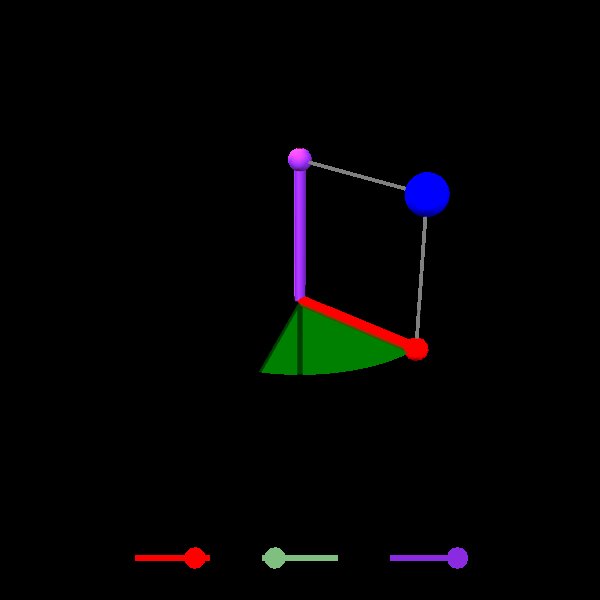
Illustration of a point in the cylindrical coordinate system, highlighting r, θ, and z.
Cylindrical coordinates are particularly advantageous for problems involving cylindrical shapes or rotational symmetry around an axis, such as calculating the flow through a pipe or the volume of a water tank. They extend the two-dimensional polar coordinate system into three dimensions by adding a \(z\)-component identical to the Cartesian \(z\)-coordinate. A point in cylindrical coordinates is defined by:
- \(r\) (radial distance): The distance from the \(z\)-axis to the point in the \(xy\)-plane. It is always non-negative.
- \(\theta\) (azimuthal angle): The angle in the \(xy\)-plane, measured counterclockwise from the positive \(x\)-axis to the projection of the point onto the \(xy\)-plane.
- \(z\) (height): The same vertical distance as in Cartesian coordinates.
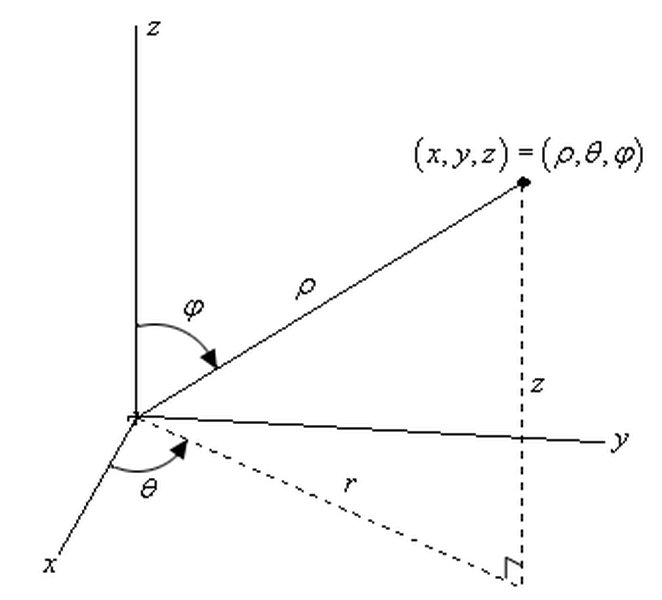
A visual representation of spherical coordinates, showing ρ, θ, and φ.
Spherical coordinates, on the other hand, are ideal for scenarios involving spheres or spherical symmetry, such as analyzing gravitational fields, planetary orbits, or the volume of domed structures. They describe a point using:
- \(\rho\) (radial distance): The distance from the origin to the point. It is always non-negative.
- \(\theta\) (azimuthal angle): Identical to the \(\theta\) in cylindrical coordinates, measured counterclockwise from the positive \(x\)-axis.
- \(\varphi\) (polar angle or colatitude): The angle measured from the positive \(z\)-axis down to the line segment connecting the origin to the point. It typically ranges from \(0\) to \(\pi\) radians (or \(0^\circ\) to \(180^\circ\)).
The shared azimuthal angle \(\theta\) between cylindrical and spherical systems simplifies the conversion process significantly, as this component remains unchanged.
The Core Conversion Formulas: Spherical to Cylindrical
The conversion from spherical coordinates \((\rho, \theta, \varphi)\) to cylindrical coordinates \((r, \theta, z)\) is derived by considering the geometric relationships between the components in three-dimensional space. These formulas are:
\[ \begin{align*} r &= \rho \sin \varphi \ \theta &= \theta \ z &= \rho \cos \varphi \end{align*} \]Let's break down each component:
Understanding the Radial Component (r)
In spherical coordinates, \(\rho\) is the distance from the origin to the point, and \(\varphi\) is the angle with the positive \(z\)-axis. When projecting the point onto the \(xy\)-plane, the radial distance \(r\) in cylindrical coordinates forms the side opposite to \(\varphi\) in a right-angled triangle where \(\rho\) is the hypotenuse. Thus, \(r = \rho \sin \varphi\).
The Unchanged Azimuthal Angle (θ)
Both cylindrical and spherical coordinate systems define \(\theta\) as the angle of rotation around the \(z\)-axis, measured from the positive \(x\)-axis in the \(xy\)-plane. Consequently, the value of \(\theta\) remains the same during the conversion.
Deriving the Vertical Component (z)
The \(z\)-component in cylindrical coordinates is the height of the point along the \(z\)-axis. In the same right-angled triangle mentioned above, \(z\) is the side adjacent to \(\varphi\). Therefore, \(z = \rho \cos \varphi\).
These formulas allow for direct conversion without needing to first transform into Cartesian coordinates. This direct approach streamlines calculations and helps maintain a clearer understanding of the spatial relationships.
Illustrative Example: Converting a Point
Let's consider a point in spherical coordinates \((\rho, \theta, \varphi) = (4, \pi/4, \pi/3)\). We want to convert this to cylindrical coordinates \((r, \theta, z)\).
Using the conversion formulas:
- For \(r\): \(r = \rho \sin \varphi = 4 \sin(\pi/3) = 4 \cdot (\sqrt{3}/2) = 2\sqrt{3}\)
- For \(\theta\): \(\theta = \pi/4\) (remains unchanged)
- For \(z\): \(z = \rho \cos \varphi = 4 \cos(\pi/3) = 4 \cdot (1/2) = 2\)
So, the cylindrical coordinates for the point are \((2\sqrt{3}, \pi/4, 2)\).
Transforming Equations
Converting entire equations between coordinate systems follows the same principle of substitution. For instance, consider the equation of a sphere in Cartesian coordinates: \(x^2 + y^2 + z^2 = R^2\).
To convert this to cylindrical coordinates, we use the relations: \(x = r \cos \theta\), \(y = r \sin \theta\), and \(z = z\). Substituting these into the sphere equation:
\[ (r \cos \theta)^2 + (r \sin \theta)^2 + z^2 = R^2 \ r^2 \cos^2 \theta + r^2 \sin^2 \theta + z^2 = R^2 \ r^2 (\cos^2 \theta + \sin^2 \theta) + z^2 = R^2 \ r^2 + z^2 = R^2 \]This is the equation of a sphere in cylindrical coordinates. This process can be applied to more complex equations, using the appropriate substitution rules.
The Utility of Coordinate Transformations
Coordinate transformations are not merely mathematical exercises; they are powerful tools that simplify problem-solving in various real-world scenarios. Choosing the right coordinate system can significantly reduce the complexity of calculations, especially in integral calculus, physics, and engineering. For example, problems involving volumes of revolution or fluid dynamics through pipes often become much more manageable in cylindrical coordinates. Similarly, gravitational problems or antenna radiation patterns are more naturally described and solved using spherical coordinates.
Below is a mindmap illustrating the various applications and benefits of understanding coordinate transformations.
This mindmap encapsulates how these transformations are woven into the fabric of advanced mathematics and its practical applications. The ability to fluidly move between coordinate systems empowers professionals to select the most efficient and elegant solution for a given problem.
Conversion Table for Key Coordinate Systems
Here's a comprehensive table summarizing the conversion formulas between Cartesian, cylindrical, and spherical coordinates. This table serves as a quick reference for navigating through various 3D coordinate transformations.
| From | To | Formulas |
|---|---|---|
| Spherical \((\rho, \theta, \varphi)\) | Cylindrical \((r, \theta, z)\) |
\(r = \rho \sin \varphi\) \(\theta = \theta\) \(z = \rho \cos \varphi\) |
| Cylindrical \((r, \theta, z)\) | Spherical \((\rho, \theta, \varphi)\) |
\(\rho = \sqrt{r^2 + z^2}\) \(\theta = \theta\) \(\varphi = \operatorname{arctan2}(r, z)\) or \(\varphi = \arccos\left(\frac{z}{\sqrt{r^2 + z^2}}\right)\) |
| Cartesian \((x, y, z)\) | Cylindrical \((r, \theta, z)\) |
\(r = \sqrt{x^2 + y^2}\) \(\theta = \operatorname{arctan2}(y, x)\) \(z = z\) |
| Cylindrical \((r, \theta, z)\) | Cartesian \((x, y, z)\) |
\(x = r \cos \theta\) \(y = r \sin \theta\) \(z = z\) |
| Cartesian \((x, y, z)\) | Spherical \((\rho, \theta, \varphi)\) |
\(\rho = \sqrt{x^2 + y^2 + z^2}\) \(\theta = \operatorname{arctan2}(y, x)\) \(\varphi = \arccos\left(\frac{z}{\sqrt{x^2 + y^2 + z^2}}\right)\) |
| Spherical \((\rho, \theta, \varphi)\) | Cartesian \((x, y, z)\) |
\(x = \rho \sin \varphi \cos \theta\) \(y = \rho \sin \varphi \sin \theta\) \(z = \rho \cos \varphi\) |
Note: \(\operatorname{arctan2}(y,x)\) is the two-argument arctangent function, which correctly determines the quadrant of \(\theta\).
Exploring the Visuals of Coordinate Conversions
To further solidify the understanding of these conversions, it is helpful to see them in action. The following video provides a visual explanation of how these coordinate systems relate to each other and demonstrates conversions.
A comprehensive tutorial on converting between spherical and cylindrical coordinate systems.
This video from YouTube, titled "Converting Between Spherical and Cylindrical Coordinate Systems," directly addresses the process of transformation between these two systems. It elucidates the techniques for straightforward conversion, offering a practical demonstration that complements the theoretical formulas discussed. Understanding the visual interplay of these coordinate systems enhances the ability to apply the conversion formulas correctly in problem-solving scenarios.
FAQ
What are the primary components of spherical and cylindrical coordinates?
Why is the azimuthal angle \(\theta\) the same in both cylindrical and spherical systems?
When should I use spherical coordinates versus cylindrical coordinates?
Can I convert directly from spherical to cylindrical coordinates without going through Cartesian?
Are there any restrictions on the values of \(\rho\), \(r\), \(\theta\), and \(\varphi\)?
Conclusion
The conversion from spherical to cylindrical coordinates is a fundamental concept in multivariable calculus and its applications. By leveraging the trigonometric relationships inherent in their definitions, one can efficiently transform points and equations between these systems using the formulas: \(r = \rho \sin \varphi\), \(\theta = \theta\), and \(z = \rho \cos \varphi\). This ability to switch between coordinate systems not only simplifies complex geometric problems but also provides deeper insights into the nature of three-dimensional space, proving invaluable across a wide spectrum of scientific and engineering fields.
Recommended Further Exploration
- How to convert equations from Cartesian to spherical coordinates?
- Applications of cylindrical coordinates in engineering.
- Understanding the Jacobian for coordinate transformations.
- Vector calculus in curvilinear coordinate systems.