
Unlocking an Edge: A Filtered Open Range Breakout Strategy for SPX500 CFDs
Combining specific timing, trend analysis, and tactical leverage for a structured approach to trading the S&P 500 index via CFDs.
Highlights
- Strategy Core: Utilizes the Open Range Breakout (ORB) during the high-liquidity U.S. market open, focusing on breakouts confirmed by momentum indicators.
- Proprietary Filters: Integrates a long-term trend filter (200-day MA) and volatility context to refine entry signals, aiming for higher probability trades compared to basic ORB.
- Tactical Leverage & Risk: Employs moderate CFD leverage strategically on confirmed setups while emphasizing strict risk management protocols, including stop-losses and awareness of trading costs.
Introducing the "Filtered Open Range Breakout" Strategy
Trading Contracts for Difference (CFDs) on major indices like the SPX500 (which tracks the S&P 500) requires a disciplined approach. While no strategy guarantees profits, developing an edge involves combining known techniques in a structured, refined manner under specific conditions. This "Filtered Open Range Breakout" strategy aims to provide such an edge by layering confirmation signals and risk controls onto a classic intraday pattern.
This strategy is designed specifically for the SPX500 index CFD, leveraging its liquidity and typical behavior during the U.S. market open. It integrates specific timing, trend analysis, momentum confirmation, and tactical leverage application, aiming to provide a more robust framework than a simple breakout approach.
The Core Mechanism: Open Range Breakout (ORB) Explained
The foundation of this strategy is the Open Range Breakout. The "Open Range" refers to the high and low price established within a specific period shortly after a market opens. Traders watch for the price to break decisively above the range high (for a long entry) or below the range low (for a short entry), anticipating continued momentum in that direction.
Defining the Range and Timing
- Open Range Period: The high and low is typically defined between 9:30 AM and 10:15 AM Eastern Time (ET), which corresponds to 3:30 PM and 4:15 PM Central European Time (CET). This 45-minute window captures the initial flurry of activity as the U.S. market digests overnight news and order flow.
- Trade Execution Timing: Breakout trades are considered *after* 10:15 AM ET (4:15 PM CET). The goal is to execute trades relatively early in the U.S. session and ideally exit before the market close at 4:00 PM ET (10:00 PM CET) to avoid overnight risks and financing fees associated with holding CFD positions overnight.
Layering the Filters for an Edge
A simple ORB can lead to false signals ("fakeouts"). This strategy adds specific filters to improve the quality of trade entries, creating a more refined approach.
Filter 1: Aligning with the Long-Term Trend (200-Day Moving Average)
Trading *with* the dominant trend can significantly increase the probability of success for momentum strategies like the ORB. Before considering any intraday breakout, assess the position of the SPX500 index relative to its 200-day simple moving average (SMA) on a daily chart.
- Long Bias: If the SPX500 price is currently trading above its 200-day SMA, the strategy prioritizes only *long* breakout signals (breaking above the open range high).
- Short Bias: If the SPX500 price is currently trading below its 200-day SMA, the strategy prioritizes only *short* breakout signals (breaking below the open range low).
- Conflicting Signals: If a breakout occurs against the direction indicated by the 200-day SMA (e.g., a break below the range low when the price is above the 200-day SMA), the signal is typically ignored.
This filter helps avoid taking positions against the prevailing market tide, a common pitfall for purely intraday strategies.
Filter 2: Volatility and News Catalysts
Breakout strategies tend to perform better when there's sufficient market volatility and a reason for price to move decisively. While not a strict mechanical filter, consider the context:
- Favorable Conditions: Prioritize trading the ORB strategy on days when significant economic data is released near the market open (e.g., employment figures, inflation data) or during periods of heightened market activity (e.g., earnings season, major geopolitical events).
- Less Favorable Conditions: Be more cautious on days with very low expected volatility or during tight, range-bound market conditions where breakouts are less likely to follow through. Analyzing the pre-market activity and the Volatility Index (VIX), if available, can provide clues.
Filter 3: Intraday Momentum Confirmation (15-Minute EMA 10)
Once a breakout from the open range occurs *in the direction* favored by the 200-day SMA, an additional layer of confirmation is sought using a short-term momentum indicator.
- Confirmation Signal: Use the 15-minute Exponential Moving Average (EMA) with a period of 10.
- For a *long* breakout (above the range high, with price > 200DMA), wait for the price on the 15-minute chart to also be trading *above* the 10-period EMA.
- For a *short* breakout (below the range low, with price < 200DMA), wait for the price on the 15-minute chart to also be trading *below* the 10-period EMA.
This EMA filter helps confirm that short-term momentum aligns with the breakout direction, reducing the chance of entering on a brief spike that quickly reverses.
Strategic Leverage Application
CFDs are leveraged products, meaning you can control a larger position size with a smaller amount of capital (margin). While this amplifies potential profits, it equally magnifies potential losses. Using leverage requires careful consideration.
Understanding CFD Leverage
Brokers offer varying leverage ratios (e.g., 10:1, 20:1, or higher depending on regulations and the asset). A 20:1 leverage means for every $1 of margin, you can control $20 worth of the underlying asset. It's crucial to understand that your profit or loss is calculated on the full position size, not just your margin.
Tactical Leverage Deployment
Within this strategy, leverage should be applied tactically and moderately, only *after* all filter conditions are met:
- Moderate Use: Avoid using the maximum available leverage. A lower level, such as 5:1 or 10:1, might be more prudent, especially when starting. The exact amount depends on your risk tolerance and account size.
- Timing: Apply leverage only when entering a confirmed trade based on the filtered ORB signal. Do not maintain high leverage speculatively.
- Position Sizing: Your leverage choice directly impacts position sizing. Ensure your total position size aligns with your risk management rules (e.g., risking no more than 1-2% of your capital per trade).
Cost Awareness
Trading CFDs involves costs that impact profitability:
- Spreads: The difference between the buy (ask) and sell (bid) price. This is an immediate cost upon entering a trade.
- Overnight Financing: If you hold a CFD position overnight, you'll typically incur financing charges (or credits). This strategy aims for intraday trades to avoid these costs.
- Commissions: Some brokers might charge a commission per trade in addition to the spread.
Factor these costs into your profit calculations and strategy viability.
Visualizing Strategy Components
Strategy Radar Chart Analysis
The radar chart below provides a visual comparison of the "Filtered Open Range Breakout" strategy against a hypothetical "Basic ORB" (without the trend/EMA filters) and a "Long-Term Trend Following" strategy across several key dimensions. This helps illustrate the trade-offs involved. The Filtered ORB aims for a balance, potentially offering higher probability than basic ORB while being more active than pure trend following, but demanding disciplined execution and monitoring.
Strategy Mindmap
This mindmap illustrates the interconnected components of the Filtered Open Range Breakout strategy, from the core concept to the essential filters, leverage considerations, and risk management protocols.
Advanced Tactics and Risk Management
Advanced Tactics: Scaling and Profit Taking
Beyond the core entry signal, refining exit and position management can further enhance a strategy.
Scaling into Positions
Instead of entering the full position size at the initial breakout signal, consider scaling in. This involves entering a partial position initially (e.g., 50% of the intended size) and adding the remainder if the price moves favorably by a certain amount or successfully retests the breakout level. This can improve the average entry price and reduce risk if the initial move fails quickly.
Setting Profit Objectives
Define clear profit targets before entering a trade. Options include:
- Fixed Risk/Reward Ratio: Aiming for a profit that is a multiple (e.g., 1.5x or 2x) of the initial risk (distance to stop-loss).
- Pivot Points or Support/Resistance: Targeting previous significant highs/lows or calculated pivot levels.
- Fibonacci Extensions: Using Fibonacci tools projected from the open range or recent price swings to identify potential exhaustion points.
- Trailing Stop-Loss: Letting profits run while protecting gains by moving the stop-loss up (for longs) or down (for shorts) as the price moves favorably.
Essential Risk Management Protocols
No trading strategy is complete without rigorous risk management. This is especially true when using leverage.
- Stop-Loss Orders: ALWAYS use a stop-loss order. For this strategy, a logical placement is just outside the opposite end of the defined open range (e.g., slightly below the range low for a long trade, slightly above the range high for a short trade). Adjust based on volatility, but ensure it defines your maximum acceptable loss.
- Position Sizing: Calculate your position size based on your stop-loss distance and a pre-defined risk percentage per trade (e.g., 1% of your total trading capital). This ensures that even if a trade hits the stop-loss, the loss is controlled and survivable.
- Discipline: Stick to the strategy rules. Avoid impulsive trades or overriding filters based on emotion. If conditions aren't met, don't trade.
Strategy Parameters Comparison
The table below contrasts the key parameters of the "Filtered Open Range Breakout" strategy with a more basic ORB approach to highlight the added layers of analysis and control.
| Parameter | Basic ORB Strategy | Filtered ORB Strategy |
|---|---|---|
| Timeframe | Typically first 30-60 mins of market open | Specific 9:30-10:15 AM ET range, trade after 10:15 AM ET |
| Entry Signal | Breakout above range high or below range low | Breakout + Trend Alignment (200DMA) + Momentum Confirmation (15m EMA10) |
| Trend Filter | Often ignored or discretionary | Mandatory (200-day MA on Daily Chart) |
| Momentum Filter | Optional / Variable | Mandatory (15-min EMA 10 relative to price) |
| Leverage Use | Variable / Discretionary | Tactical and Moderate (e.g., 5:1-10:1) on confirmed signals |
| Risk Management | Stop-loss recommended | Mandatory stop-loss (outside range), strict position sizing (1-2% risk) |
| Context Consideration | Less emphasis | Prioritizes higher volatility / news-driven days |
Insights from Trading Strategies
Understanding different approaches can refine your own strategy. The video below discusses a specific strategy for trading the SPX500, offering perspectives that might complement the Filtered ORB approach by showcasing real-world application or alternative techniques. Observing how other traders structure their strategies, manage risk, and interpret price action can provide valuable learning opportunities, even if their exact methods differ.
This particular video claims to reveal an exact SPX500 trading strategy. While it's essential to critically evaluate any presented strategy and adapt it to your own risk tolerance and analysis (rather than blindly copying), observing the presenter's logic, entry/exit criteria, and rationale can spark ideas or highlight aspects to consider within the Filtered ORB framework, such as specific price action patterns or indicator combinations used for confirmation.
The Trading Environment
A successful trading approach isn't just about the strategy; it's also about the environment and mindset. Discipline, focus, and a professional setup contribute significantly. Whether it's a multi-monitor desk analyzing charts or a simple laptop focusing on key data points, the ability to execute the strategy without emotional interference is paramount. The images below reflect common trading setups, emphasizing the tools used for market analysis and execution.
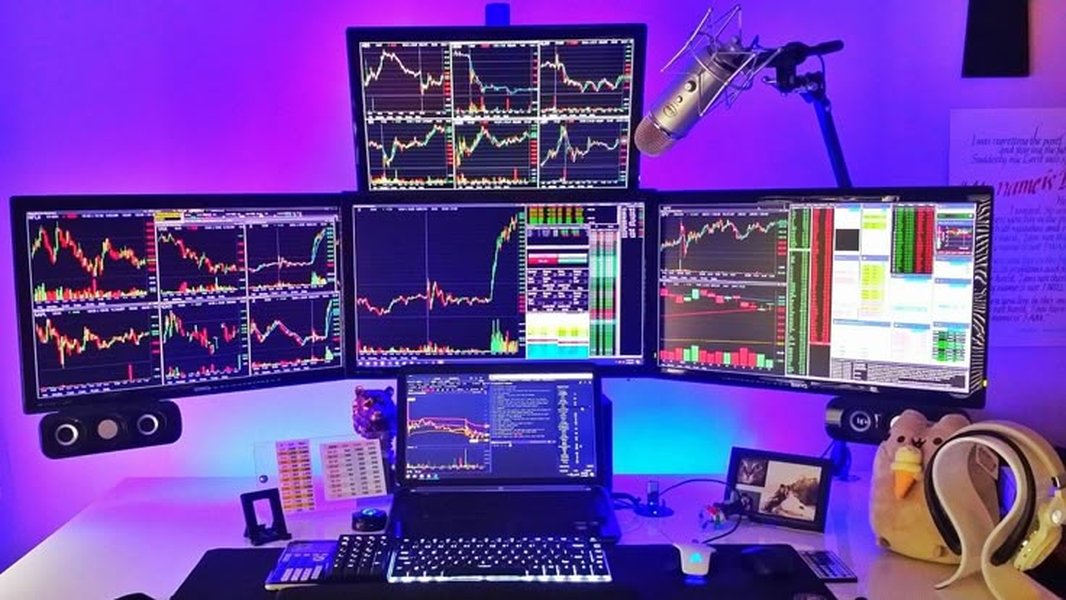

These setups highlight the need for clear visualization of price action, indicators (like Moving Averages and EMAs used in our strategy), and potentially economic calendars or news feeds. Regardless of the complexity, the goal is to facilitate efficient decision-making based on the strategy's rules.
Frequently Asked Questions (FAQ)
Why focus on the 9:30-10:15 AM ET open range specifically?
This period captures the initial reaction of the U.S. market to overnight developments and the influx of opening orders. It often establishes an initial balance area, and breakouts from this range can signify the early directional bias for the session. Extending it to 45 minutes allows the initial extreme volatility to settle slightly, potentially providing a more reliable range definition than a shorter period.
What if the 200-day MA filter conflicts with a strong intraday breakout signal?
According to the strategy rules, if the breakout direction opposes the trend indicated by the 200-day MA, the trade signal is ignored. The purpose of this filter is to prioritize higher-probability setups that align with the broader market direction. Taking trades against the dominant trend, even if they look strong intraday, generally carries higher risk. Discipline in adhering to all filters is key to the strategy's design.
How much CFD leverage is considered "moderate" vs. "too much"?
"Moderate" leverage (e.g., 5:1 to 10:1 suggested here) is subjective but generally implies using significantly less than the maximum offered by the broker. "Too much" leverage is any amount that results in a position size where a potential stop-loss hit would cause an unacceptably large loss relative to your account size (e.g., exceeding your 1-2% risk rule per trade). Always prioritize risk management and position sizing over maximizing leverage.
Can this Filtered ORB strategy be automated?
Yes, the core components of this strategy (defining the range, checking MA/EMA conditions, executing trades on breakouts) are rule-based and could potentially be automated using trading platforms that support algorithmic trading (like MetaTrader, TradingView with broker integration, or custom APIs). However, incorporating the discretionary aspect of assessing volatility context and news catalysts might be more challenging to automate effectively and may still require manual oversight.
References
- Trading the SPX500 CFD with the Open Range Breakout Strategy - InvestMacro
- S&P500 CFD trading - S&P 500 index futures | AvaTrade - AvaTrade
- SPX500 CFD - TradingBrokers.com
- SPX (S&P) Trading Strategies: Insider Tips For Success - Vestinda
- Trade S&P 500 index with CFDs | Capital.com - Capital.com
- S&P500 Trading Strategies: (Backtested) - Quantified Strategies
- S&P 500 1.25x Leverage Carry-Free Daily | S&P Dow Jones Indices - S&P Global
Recommended
Last updated April 11, 2025