
Empowering the Squad: A Profile for the Value Stream Contributor
Unpacking the Vital Role of a Squad Member within Modern Value Streams
- Strategic Alignment: Squad members are the fundamental executors, directly translating the vision of the Value Stream Owner and Product Owner into tangible value for the customer.
- Cross-Functional Collaboration: This role thrives on continuous interaction with various leads (Delivery, Tech, Product, Scrum Master, Chapter, Practice) and fellow squad members, ensuring cohesive and efficient delivery.
- Continuous Improvement: Beyond task execution, squad members are crucial in identifying and contributing to the optimization of the value stream, enhancing flow and quality.
In today's dynamic organizational landscapes, particularly within agile and scaled agile frameworks, the concept of a "squad" has become a cornerstone of effective product development and service delivery. A squad is a small, autonomous, cross-functional team designed to work towards a common goal or objective, often with a maximum of twelve members. These teams are empowered with decision-making authority and ownership, fostering a strong sense of responsibility and boosting efficiency. This document outlines the role profile for a "Squad Member," a critical contributor operating directly within a larger "Value Stream."
Value Stream Management (VSM) is a set of practices focused on improving the way teams deliver high-quality customer experiences. A value stream itself represents the entire set of actions that occur to add value for customers, from the initial idea or request through to the realization of that value. Within this framework, the squad member plays a pivotal role in the actual execution and delivery of this value, acting as a direct conduit for transforming concepts into customer-centric solutions. Their work is integral to accelerating product delivery, exceeding customer expectations, and enhancing overall business agility.
Role Purpose: Driving Value Delivery
The primary purpose of a Squad Member is to actively contribute to the design, development, and delivery of products and services that fulfill the objectives of their assigned value stream. They are the hands-on contributors, applying their specific expertise to execute tasks, solve problems, and collaborate with peers to ensure the continuous flow of value from idea to customer. This role requires a blend of technical proficiency, problem-solving acumen, and a strong collaborative spirit to work effectively within a self-organizing and cross-functional team.
Ultimately, a squad member is responsible for the diligent execution of tasks and responsibilities assigned to them within the squad's sprint or iteration, contributing directly to the incremental delivery of value. Their focus is not just on completing individual tasks but understanding how their work contributes to the broader value stream and its impact on the end-user or customer. This deep understanding enables them to proactively identify impediments and suggest improvements, thereby fostering a culture of continuous enhancement within the value stream.
Capabilities: Essential Skills for Success
To thrive as a Squad Member within a value stream, individuals must possess a diverse set of capabilities that extend beyond their core technical skills. These capabilities ensure effective collaboration, adaptability, and a proactive approach to problem-solving and value delivery. The ideal squad member is a T-shaped individual, possessing deep expertise in one area while also having a broad understanding of related domains.
Technical Proficiency
A squad member must demonstrate strong technical skills relevant to their specific discipline (e.g., software development, quality assurance, UI/UX design, data analysis). This includes proficiency in relevant programming languages, tools, frameworks, and methodologies. They should be able to write clean, efficient, and maintainable code, conduct thorough testing, or create user-centric designs, depending on their specialization.
Problem-Solving and Critical Thinking
The ability to analyze complex problems, break them down into manageable components, and propose effective solutions is crucial. Squad members are expected to contribute to troubleshooting, identify root causes of issues, and think critically about the implications of their work on the broader system and customer experience.
Collaboration and Teamwork
Given the cross-functional nature of squads, strong collaboration skills are paramount. This involves effective communication, active listening, willingness to share knowledge, provide constructive feedback, and work harmoniously with diverse team members, including other squad members, product owners, and technical leads. They must be adept at working in an environment where collective ownership and shared goals are prioritized.
Adaptability and Learning Agility
The agile environment is characterized by continuous change and evolving requirements. Squad members must be adaptable, open to new ideas, and willing to learn new technologies, tools, and methodologies. This includes embracing a growth mindset and continuously seeking opportunities for personal and professional development.
Customer Focus and Value Orientation
An understanding of the end-user and the business value their work delivers is essential. Squad members should strive to understand customer needs, contribute to solutions that truly address those needs, and maintain a focus on delivering high-quality, impactful results that align with the value stream's objectives.
Key Responsibilities: Driving Daily Progress
The responsibilities of a squad member are diverse, reflecting the multidisciplinary nature of agile squads. These responsibilities contribute directly to the squad's ability to deliver increments of value consistently.
- Task Execution: Performing assigned tasks and activities within the sprint or iteration, ensuring high-quality output and adherence to established standards and deadlines. This includes coding, testing, designing, documenting, and other discipline-specific duties.
- Active Participation in Agile Ceremonies: Engaging fully in daily stand-ups, sprint planning, sprint reviews, and retrospectives, providing updates, contributing to planning, demonstrating work, and participating in continuous improvement discussions.
- Code Quality and Testing: For developers, this involves writing well-tested, robust code, participating in code reviews, and ensuring the quality and maintainability of the codebase. For QA specialists, it involves designing and executing comprehensive test plans.
- Problem Identification and Resolution: Proactively identifying impediments, technical debt, and potential risks, and collaborating with the team to resolve them effectively.
- Knowledge Sharing and Mentorship: Sharing expertise, mentoring less experienced team members, and contributing to the collective knowledge base of the squad and broader organization.
- Continuous Improvement Contributions: Actively participating in retrospectives to identify areas for improvement in processes, tools, and team dynamics, and implementing agreed-upon actions.
- Adherence to Standards: Following established architectural guidelines, coding standards, security protocols, and other organizational best practices to ensure consistency and quality across the value stream.
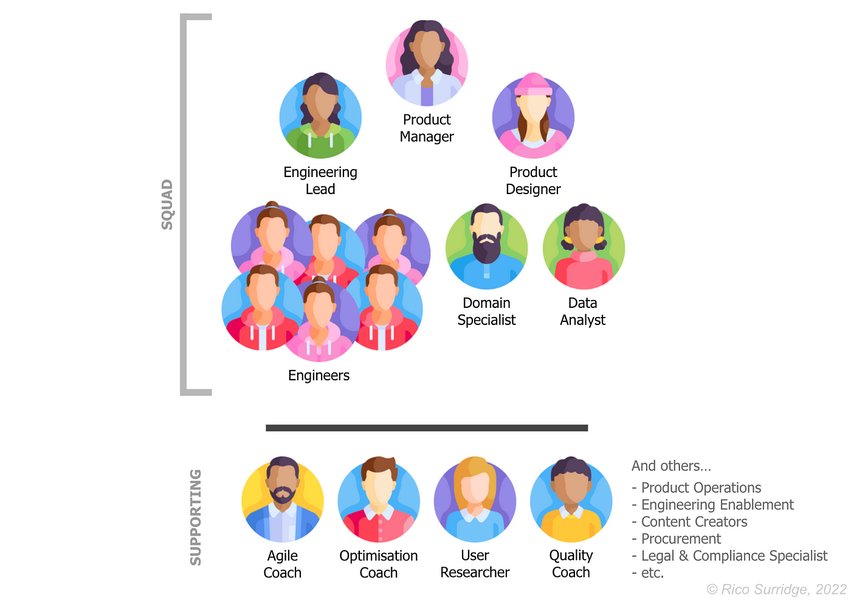
An illustration highlighting the interconnected roles within a typical product engineering squad.
Key Interactions: Navigating the Collaborative Ecosystem
A squad member operates within a rich ecosystem of interactions, both within their immediate squad and across the broader value stream and organizational structure. Effective communication and collaboration with these stakeholders are vital for smooth operations and successful value delivery.
| Interaction Role | Purpose of Interaction | Frequency / Context |
|---|---|---|
| Value Stream Owner | To understand the 'What' and 'Why' of the value stream, strategic direction, and overall business objectives. | As needed for clarity on strategic direction, larger initiatives, and feedback on value delivered. |
| Delivery Lead (VS Level) | To understand the overall delivery roadmap, dependencies, and process optimizations across the value stream. | Regular updates, dependency discussions, process improvement workshops. |
| Tech Lead (VS Level) | To align on architectural guidelines, technical standards, shared services, and technical impediments affecting the value stream. | Regular technical discussions, architectural reviews, problem-solving sessions. |
| Product Owner (Squad Level) | To gain detailed understanding of user stories, prioritize backlog items, clarify requirements, and provide feedback on delivered features. | Daily stand-ups, sprint planning, backlog refinement, sprint reviews. |
| Scrum Master (Squad Level) | To address impediments, optimize team processes, facilitate agile ceremonies, and foster a healthy team environment. | Daily stand-ups, retrospectives, one-on-one coaching, impediment resolution. |
| Other Squad Members | To collaborate on tasks, conduct code reviews, share knowledge, pair program, and collectively solve problems to achieve sprint goals. | Daily, during development work, pair programming sessions, informal discussions. |
| Chapter Leads | To discuss professional development, share best practices within a specific discipline (e.g., all developers across squads), and foster skill growth. | Regular chapter meetings, mentorship, skill development sessions. |
| Practice Leads | To align on cross-cutting concerns, shared tools, and organizational practices (e.g., DevOps, security, quality assurance) that span multiple chapters and squads. | Regular practice meetings, workshops, adoption of new tools/practices. |
| Stakeholders/Customers | To understand feedback on delivered features, gather requirements, and validate solutions (often facilitated by Product Owner). | Sprint reviews, user acceptance testing (UAT), feedback sessions. |
The intricate web of interactions ensures that while squads operate autonomously, they remain aligned with the broader organizational goals and benefit from shared knowledge and standardized practices. This multi-layered collaboration is a hallmark of successful agile at scale implementations, preventing silos and promoting a holistic approach to value delivery.
Understanding Team Dynamics: A Radar Chart Perspective
Effective squad performance is heavily reliant on the interplay of individual capabilities and how they contribute to the overall team dynamic. While specific roles define responsibilities, the behavioral strengths and preferences of squad members significantly impact collaboration, problem-solving, and efficiency. The radar chart below illustrates hypothetical strengths across various attributes essential for a high-performing squad member, acknowledging that individual profiles will vary but collective balance is key.
This radar chart visually represents how an average squad member's capabilities might compare to an ideal profile. While individuals may excel in certain areas, the collective strength of a squad arises from a balanced distribution of these capabilities across its members. The "Average Squad Member Profile" shows solid performance, while the "Ideal Squad Member Profile" demonstrates aspirational levels of competence across all critical attributes. This visualization helps in identifying areas for individual growth and in building well-rounded, high-performing squads.
Contextualizing the Squad Member Role
The concept of a "squad" originated from the Spotify model, emphasizing autonomous, cross-functional teams. While the "Squad Member" might not always be an official hierarchical title, it denotes a crucial functional role within these agile structures. They are the bedrock of value delivery, bringing the vision of the value stream owner to life. Their daily actions directly impact the efficiency, quality, and speed of the value flow.
In a military context, a squad member's role is highly specialized, focusing on specific tasks like medic, grenadier, or rifleman, contributing to the squad's overall mission. Similarly, in an organizational value stream, a squad member's specialization (e.g., backend developer, UX designer, QA engineer) contributes to the squad's collective ability to deliver a specific part of the product or service. The key is that each member understands their contribution to the larger objective and collaborates seamlessly with others. This video further elaborates on the critical roles within value stream management, providing context for the squad member's place:
Insights into the Value Stream Manager role, providing context for the collaborative environment of a squad member.
This video focuses on the Value Stream Manager, but it highlights the larger context of value stream management, which directly impacts the work of every squad member. Understanding the manager's role in optimizing flow emphasizes the importance of every individual contributor's efficiency and communication within the value stream.
Frequently Asked Questions (FAQ)
What is the difference between a "role" and a "title" for a squad member?
How does a Squad Member contribute to Value Stream Management?
Is the Squad Member role always cross-functional?
What is the relationship between a Squad Member and Chapter/Practice Leads?
Conclusion
The Squad Member role is undeniably fundamental to the success of organizations adopting agile and value stream management principles. Far from being a mere executor of tasks, a squad member is a proactive, collaborative, and adaptable individual who directly contributes to the flow of value from concept to customer. Their technical prowess, combined with strong problem-solving skills, customer focus, and commitment to continuous improvement, empowers squads to deliver high-quality solutions efficiently. By fostering an environment where squad members are empowered, continually learning, and seamlessly integrated into the broader value stream ecosystem, organizations can unlock significant business agility and deliver superior customer experiences.
Recommended Further Queries
- Deep dive into Value Stream Management best practices
- Understanding the Spotify Agile Model for team organization
- Key metrics for measuring squad performance in agile
- How to build and nurture high-performing cross-functional teams
References
Last updated May 22, 2025