
Unveiling the Powerhouses: Sunoco SR18 vs. VP C25 Racing Fuels – Which Reigns Supreme for Your Engine?
A detailed look into the specifications, performance, and applications of two leading high-octane racing fuels.
Choosing the right racing fuel is paramount for achieving peak performance and engine longevity in competitive motorsports. Among the top contenders are Sunoco SR18 and VP Racing Fuels C25, both leaded, high-octane fuels designed for demanding racing applications. While they share some similarities, crucial differences in their chemical composition, physical properties, and intended uses set them apart. Understanding these distinctions can help racers make an informed decision tailored to their specific engine setup and racing discipline.
Key Insights at a Glance
- Octane and Composition: Both SR18 and C25 are high-octane, leaded, non-oxygenated fuels, but SR18 boasts an (R+M)/2 of 118 (MON 116, RON 120), while C25 has a MON of 113 and RON of 120+, resulting in an (R+M)/2 of approximately 118.
- Primary Applications: Sunoco SR18 is often favored for its fast-burning characteristics in very high-compression, large displacement engines, particularly in drag racing (NHRA Comp Eliminator mandated) and truck pulling. VP C25 is highly recommended for naturally aspirated engines with compression ratios up to 17:1 and is a popular choice for Pro Mod EFI nitrous engines.
- Physical Properties: SR18 has a specific gravity of 0.703 and an RVP of 5.6 psi, making it Sunoco's lightest fuel. C25 has a specific gravity of 0.698 and a higher RVP of 7.15 psi, which can affect vaporization.
Deep Dive into Sunoco SR18
Sunoco SR18 is engineered as an "ultimate high-octane racing fuel," specifically formulated for engines operating under extreme conditions. Its characteristics make it a preferred choice in certain demanding motorsport categories.
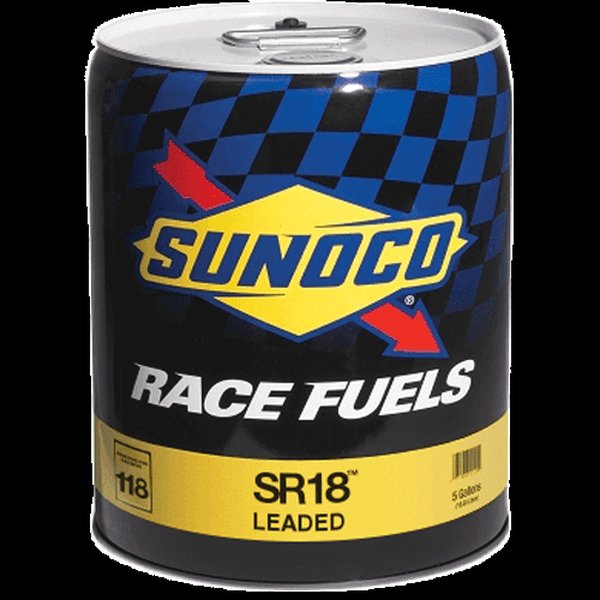
A container of Sunoco SR18 racing fuel.
Key Specifications of Sunoco SR18
Octane Ratings
Sunoco SR18 features a robust octane profile designed to prevent detonation in high-compression engines:
- (R+M)/2 Octane: 118
- Research Octane Number (RON): 120
- Motor Octane Number (MON): 116
Physical Properties
- Specific Gravity: 0.703 at 60°F (Sunoco's lightest fuel at 5.85 lbs/gallon)
- Reid Vapor Pressure (RVP): 5.6 psi
- Color: Light Blue (Note: some sources mention yellow, but official Sunoco data indicates Light Blue for SR18)
- Lead Content: Yes, it is a leaded fuel.
- Oxygenated: No
- Additives: Contains additives to enhance stability and increase storage life (up to 2 years or more under proper conditions).
Performance and Engine Compatibility
SR18 is characterized by its fast-burning nature, making it particularly effective in engines that demand rapid combustion. It excels in applications with:
- Very high compression ratios (no specific limit mentioned, often used where there are no compression ratio restrictions).
- High RPM race engines.
- Large displacement applications.
Its formulation helps to offset slower-burning characteristics of some two-stroke oils, making it suitable for certain high-performance two-stroke engines as well.
Recommended Applications for SR18
Sunoco SR18 is highly recommended and often mandated in specific racing domains:
- Drag Racing: Especially for large displacement engines. It is the required fuel for NHRA Competition Eliminator engines.
- Truck Pulling: Its high octane and fast burn suit the demands of powerful truck pulling engines.
- Oval Course and Road Racing: Suitable where high cylinder pressures are present and compression ratio limitations are absent.
Due to its lead content, SR18 is not compatible with catalytic converters or oxygen sensors and is strictly for off-road racing use.
Exploring VP Racing Fuels C25
VP Racing Fuels C25 is another formidable high-performance racing fuel, known for its strong track record in various NHRA classes and its suitability for high-compression engines, including those utilizing nitrous oxide.

A pail of VP Racing Fuels C25.
Key Specifications of VP C25
Octane Ratings
VP C25 provides excellent anti-knock properties, particularly valued in nitrous applications:
- (R+M)/2 Octane: Approx. 118 (calculated from RON 120+ and MON 113)
- Research Octane Number (RON): 120+
- Motor Octane Number (MON): 113
Physical Properties
- Specific Gravity: 0.698 at 60°F
- Reid Vapor Pressure (RVP): 7.15 psi
- Color: Yellow
- Lead Content: Yes, it is a leaded fuel.
- Oxygenated: No
- Additives: Formulated for stability and performance in high-demand racing conditions, including nitrous use.
Performance and Engine Compatibility
C25 is engineered for consistency and power in demanding racing environments. It is particularly suited for:
- Naturally aspirated engines with compression ratios up to 17:1.
- Pro Mod EFI nitrous engines.
- Applications requiring robust performance with "power adders" like nitrous oxide.
Its higher RVP compared to SR18 may influence vaporization characteristics, potentially offering benefits in certain atmospheric conditions or engine setups.
Recommended Applications for C25
VP C25 has a strong history and is widely used across several NHRA and other racing categories:
- NHRA Pro Stock Car & Bike
- NHRA Competition Eliminator (though SR18 is mandated for some Comp Eliminator engines)
- NHRA Pro Mod
- Engines utilizing nitrous oxide systems.
Like SR18, C25 is leaded and intended for off-road racing use only, being incompatible with catalytic converters and oxygen sensors.
SR18 vs. C25: Head-to-Head Comparison
While both fuels are designed for the upper echelons of motorsport, their nuanced differences can significantly impact engine tuning and performance outcome. The following table provides a direct comparison of their key attributes:
| Attribute | Sunoco SR18 | VP Racing Fuels C25 |
|---|---|---|
| (R+M)/2 Octane | 118 | Approx. 118 |
| RON | 120 | 120+ |
| MON | 116 | 113 |
| Specific Gravity @ 60°F | 0.703 | 0.698 |
| Reid Vapor Pressure (RVP) | 5.6 psi | 7.15 psi |
| Color | Light Blue | Yellow |
| Leaded | Yes | Yes |
| Oxygenated | No | No |
| Primary Engine Suitability | Very high compression, high RPM, large displacement, fast-burning applications | Naturally aspirated up to 17:1 CR, Pro Mod EFI nitrous engines |
| Key Applications | Drag racing (NHRA Comp Eliminator mandated), truck pulling | NHRA Pro Stock (Car & Bike), Pro Mod, Comp Eliminator |
| Special Features | Fast-burning, Sunoco's lightest fuel, excellent stability | Excellent for nitrous applications, consistent performance |
This table summarizes the core technical differences, highlighting how each fuel is tailored for specific high-performance scenarios.
Visualizing Fuel Characteristics: A Comparative Radar Chart
To further illustrate the distinctions, the radar chart below compares Sunoco SR18 and VP C25 across several performance-related attributes. The scores are relative and for illustrative purposes, emphasizing their strengths. A higher score indicates a stronger emphasis or suitability for that particular characteristic (Note: for Specific Gravity, a "higher" score here means lighter, which is often desirable, so 0.698 gets a higher score than 0.703).
This chart visually represents SR18's edge in MON and suitability for unlimited compression scenarios where fast burning is key, versus C25's strengths in RON, nitrous applications, and slightly higher volatility/lighter weight.
Key Differentiators Explained
Octane Ratings: MON, RON, and (R+M)/2
Understanding octane ratings is crucial:
- Research Octane Number (RON): Reflects fuel performance under low-speed, mild operating conditions. VP C25's "120+" RON suggests excellent anti-knock under these conditions.
- Motor Octane Number (MON): Indicates fuel performance under more severe, high-speed, high-load conditions. Sunoco SR18's higher MON of 116 (vs. C25's 113) suggests it may offer better protection against detonation under sustained heavy loads and high temperatures.
- (R+M)/2: The average of RON and MON, commonly used in North America to represent overall octane quality. Both fuels have a similar (R+M)/2 around 118. The difference in MON and RON (sensitivity) can influence which fuel performs better in a specific engine and conditions.
Specific Gravity and Its Impact
Specific gravity relates to the fuel's density. SR18 (0.703) is slightly denser than C25 (0.698). A lighter fuel (lower specific gravity) means more fuel by volume for the same weight. This can be a factor in weight-sensitive racing classes. It can also affect air/fuel ratio calculations, potentially requiring slight jetting adjustments when switching between fuels with different specific gravities.
Reid Vapor Pressure (RVP) and Volatility
RVP measures fuel volatility. C25 has a higher RVP (7.15 psi) than SR18 (5.6 psi), meaning C25 will vaporize more readily. Higher RVP can aid in cold starting and engine response but may also increase the risk of vapor lock in hot conditions or with certain fuel system designs. The optimal RVP can depend on ambient temperature, altitude, and engine setup.
NHRA Sanctioning and Usage
A significant practical difference is NHRA sanctioning. Sunoco SR18 is the mandated fuel for NHRA Competition Eliminator engines. This means that in this specific class, C25 (or other fuels) cannot be used. Both fuels are widely accepted in other NHRA classes where rules are more open, but this specific mandate for SR18 in Comp Eliminator is a key differentiator for racers in that category.
Racing Fuel Landscape: A Mindmap Overview
The mindmap below provides a conceptual overview of Sunoco SR18 and VP C25, highlighting their core characteristics and target applications within the broader context of high-performance racing fuels.
This visual helps to quickly grasp the positioning and primary strengths of each fuel.
Practical Considerations for Racers
When choosing between Sunoco SR18 and VP C25, racers should consider:
- Engine Specifications: Compression ratio, displacement, RPM range, and use of power adders (like nitrous) are primary factors. SR18 is tailored for extreme, naturally aspirated or mechanically supercharged large engines without CR limits, while C25 excels with high CR naturally aspirated engines and specifically Pro Mod EFI nitrous setups.
- Racing Regulations: Sanctioning body rules, like the NHRA mandate for SR18 in Competition Eliminator, can dictate fuel choice. Always verify class-specific fuel regulations.
- Tuning: Switching between these fuels may require adjustments to ignition timing and fuel delivery (jetting or EFI mapping) due to differences in specific gravity, RVP, and burning characteristics to optimize performance and prevent engine damage. VP suggests that moving between C12 and C25 might require minimal jet changes, but direct SR18 to C25 changes should be approached with careful tuning.
- Ambient Conditions: Temperature and altitude can affect how a fuel vaporizes and performs. C25's higher RVP might be advantageous in cooler conditions, while SR18's lower RVP could be more stable in extreme heat.
- Storage and Handling: Both are leaded fuels requiring careful handling. SR18 is noted for a shelf life of 2+ years with proper storage (stable temperature, opaque, sealed containers). Similar precautions apply to C25.
Frequently Asked Questions (FAQ)
Q: Which fuel is definitively "better," SR18 or C25?
Neither fuel is universally "better." The best choice depends entirely on your specific engine build, the type of racing you do, sanctioning body rules, and tuning preferences. SR18 excels in very high compression, large displacement, fast-burn applications and is mandated in some NHRA classes. C25 is excellent for high-compression naturally aspirated engines (up to 17:1 CR) and particularly for Pro Mod EFI nitrous applications.
Q: Can I switch between SR18 and C25 without re-tuning my engine?
It is highly unlikely that you can switch between these fuels without re-tuning. Differences in specific gravity, RVP, and burning characteristics mean that ignition timing and fuel mixture (jetting for carburetors or mapping for EFI) will likely need adjustments to optimize performance and ensure engine safety. Always consult with your engine builder or a tuning expert.
Q: Are Sunoco SR18 and VP C25 street legal?
No, both Sunoco SR18 and VP C25 are leaded racing fuels. Leaded fuels are not legal for use in street vehicles equipped with catalytic converters or oxygen sensors, and their use on public roads is prohibited in most regions. They are designed exclusively for off-road competition use.
Q: How should I store these racing fuels?
Both fuels should be stored in approved, tightly sealed, opaque containers to prevent degradation from light and air exposure. Store them in a cool, dry, well-ventilated area away from direct sunlight and sources of ignition. Sunoco states SR18 can have a shelf life of 2 years or more under these stable temperature conditions. Similar care should be taken with C25 to maintain its quality.
Recommended Further Exploration
To deepen your understanding of high-performance fuels and their application, consider exploring these related queries:
- How does MON and RON affect engine performance in racing applications?
- What are the tuning considerations when switching between different high-octane racing fuels?
- Impact of specific gravity and RVP on fuel system design and performance in motorsports.
- Are there oxygenated alternatives to SR18 and C25 for similar racing applications?
References
Last updated May 11, 2025